Buying Guide
Best Hunting Boots of 2026: Our Top 4 Picks
The right boot is the one matched to how you hunt and how cold you sit. Here is how to read insulation, waterproofing, height and fit - then four picks that earn their place in the field, plus one dealer-direct boot worth knowing about.
There is no single best hunting boot — there is only the best boot for the terrain you cover, the temperatures you sit in, and how much you move once you get there. A spot-and-stalk elk hunter grinding out ten miles of shale needs almost the opposite boot from a whitetail hunter who walks 300 yards to a ladder stand and then sits dead still for four cold hours. Buy for the wrong one and you will be miserable no matter how good the boot is.
So this guide starts with the four decisions that actually matter — insulation, waterproofing, height, and fit — and only then gets to specific models. Get the criteria right first, and the pick almost makes itself. Every price below is approximate and time-sensitive; always verify current pricing before you buy.
The best hunting boots of 2026 at a glance
Four boots that cover the main jobs, from a do-everything leather boot to a dedicated wet-ground rubber. Every spec below is the manufacturer's own published figure.
| Boot | Price & buy | Height | Insulation | Waterproofing | Best for |
|---|---|---|---|---|---|
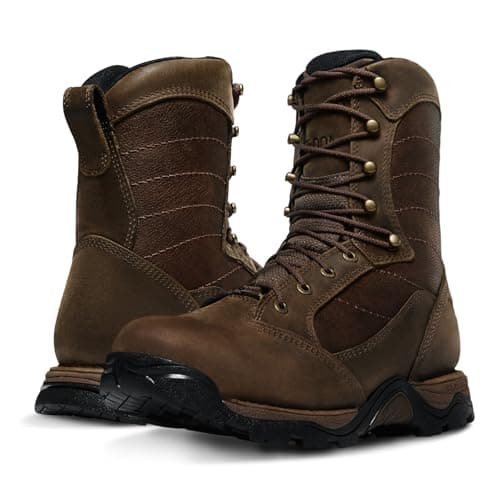
| Danner Pronghorn 8-inch 400G | $319.95Buy | 8 in | 400g PrimaLoft | GORE-TEX | Best overall |
| Irish Setter Elk Tracker | $239.95Buy | 12 in | 1,000g Thinsulate Ultra | GORE-TEX | Cold, low-activity sits |
| LaCrosse Alphaburly Pro | $104.95Buy | 18 in | 0g to 1,600g options | Rubber over neoprene | Wet ground, whitetail |
| Kenetrek Mountain Extreme 400 | $532.39Buy | 10 in | 400g Thinsulate | Windtex | Premium mountain |
Prices shown are from Amazon as of October 10, 2026 and change often — the button always goes to the current listing. Some links may earn us a commission at no extra cost to you.
If you only read one more thing, read the insulation section: gram ratings assume an activity level, and choosing them off a temperature forecast instead of off how much you move is the single most common way hunters buy the wrong boot.
How we picked
Boots are the one piece of gear where the right answer is genuinely personal, so this page is built to narrow the field rather than to crown a winner:
- One boot per job, not four versions of the same boot.The four picks cover all-around leather, sedentary cold, wet ground and steep country — the four hunts that demand genuinely different footwear.
- Published specs only.Every height, insulation weight, membrane, outsole and boot weight here comes from the manufacturer's current product page, all listed in Sources. Where a maker does not publish a figure — Irish Setter does not publish a weight for the Elk Tracker — we say so rather than estimate one.
- No temperature ratings.We describe insulation by conditions and activity level, because a "comfortable to X degrees" number cannot account for your circulation, your socks, or whether your feet are wet.
- Marketing claims are labelled as claims. The scent-control case for rubber boots is a long-standing tradition we have not found a cited study to support, and we say that plainly rather than repeat it as fact.
- One boot we cannot sell you is included anyway— the dealer-direct Crispi Nevada GTX — because leaving out the best option in a price bracket to protect a commission is not a buying guide.
Which boot for your hunt
Start from how you hunt, not from the boot. Find your row:
| If this is your hunt | Buy | Why |
|---|---|---|
| One pair for everything, whitetail to Western | Danner Pronghorn 8-inch 400G | 8 in is the do-everything height, 400g suits a hunter who keeps moving, and the Pronghorn line goes up to 1,200g if you need more. 58 oz the pair, and friendlier to wide feet than most mountain lasts. |
| Treestand or blind, barely moving, genuinely cold | Irish Setter Elk Tracker | 12 in of coverage and 1,000g of Thinsulate Ultra under a GORE-TEX lining - the sedentary-cold spec. Heavy and tall, which is the price of sitting still comfortably. |
| Mud, flooded timber, marsh edges, swampy ground | LaCrosse Alphaburly Pro | An 18 in rubber boot has no membrane to fail, hoses clean, and comes in everything from uninsulated to 1,600g. It is a specialist, not a hiking boot. |
| Steep, rocky, high country under a loaded pack | Kenetrek Mountain Extreme 400 | 2.8mm leather, a 7mm nylon midsole and a seamless tongue vamp built to edge and haul weight. The stiffest, most expensive and most demanding boot here. |
| Early season, dry, mild, lots of walking | An uninsulated or 200g boot you already own | None of the four picks is the right early-season boot. Insulation you do not need becomes a sweat box, and wet feet from the inside get cold just as fast as wet feet from the outside. |
| You can reach a dealer and want the shortest break-in | Crispi Nevada GTX | GearJunkie's best-overall pick, singled out for an unusually short break-in. Sold dealer-direct, so we have no buy link for it - it is here on merit, not margin. |
Insulation: match it to activity, not just temperature
Hunting-boot insulation is measured in grams of Thinsulate (or a similar synthetic), typically running from 0 up to about 1,600g. The instinct is to read grams as a thermometer — more grams, more warmth — and that is roughly true, but it hides the single most important variable: how much you move.
Gram ratings assume a certain activity level. Sit still and your feet make no heat, so even a heavily insulated boot eventually loses. Hike hard and your feet generate plenty of heat, so a lightly insulated boot stays warm — and a heavy one turns into a sweat box, which ironically leaves you colder once you stop. The practical rule: match insulation to how active you will be, then to temperature.
| 0-400g | Active, mobile hunts - spot-and-stalk, elk, early season, or anyone covering ground |
|---|---|
| 600g | Snow on the ground with moderate movement |
| 800-1000g+ | Sedentary cold sits - treestand or blind where you barely move for hours |
As a temperature reference, SCHEELS describes the common grades this way: 200g suits "cool to cold" conditions, 400g "cold to above-freezing," 600g when there is "snow on the ground," 800g for "multiple inches of snow" at low activity, and 1,000g for "freezing, snowy, or wet" conditions when you are inactive. Notice how the higher grades all assume you are sitting still — that is the activity caveat baked right into the chart.
Waterproofing
Wet feet get cold fast and blister faster, so waterproofing is not optional for most hunting. There are three broad approaches, and the right one depends on your ground:
- Gore-Tex. The standard waterproof-breathable membrane in premium leather boots. It keeps rain and puddle splash out while letting some sweat vapor escape, which matters on high-output hikes. Most quality mountain and Western boots use it.
- Proprietary membranes.Several makers use their own waterproof-breathable systems — Danner Dry and Kenetrek's Windtex are two examples. They aim at the same job as Gore-Tex; performance is broadly comparable and comes down to the specific boot.
- Rubber.A full rubber boot is inherently, completely waterproof — there is no membrane to fail because the whole lower boot is a barrier. That is why rubber rules mud, flooded timber, marsh edges, and swampy whitetail ground. The trade-off is breathability: rubber does not vent sweat, so it is a poor choice for long, hard hikes.
Boot height
Height buys you ankle support, coverage against brush and water, and warmth — at the cost of weight and flexibility. Roughly:
| 6 in | Early-season, dry, mild terrain and lots of walking |
|---|---|
| 8 in | Mountain and Western hunting - the do-everything height for support on uneven ground |
| 9-12 in | Cold weather and rougher country - more coverage and warmth |
| 17-18 in | Rubber boots for mud, flooded timber, and wetlands |
If you only own one pair for varied hunting, an 8-inch leather boot is the most defensible height — enough support and coverage for mountains without the weight penalty of a taller boot. Add a tall rubber boot when your ground gets genuinely wet.
Fit and break-in
The best boot on this page will ruin a hunt if it does not fit your foot or if you have not broken it in. Two rules matter more than any spec:
- Never debut new boots on a hunt.Leather boots in particular need to be broken in on varied terrain — hills, sidehills, rock — over multiple outings before you trust them for a hard day. A boot that feels fine on the driveway can shred your heels three miles into the backcountry.
- Try boots on at the end of the day.Feet swell as the day goes on, so an evening fitting reflects how the boot feels when you have been on your feet for hours — which is exactly when fit problems show up. Fit them over the merino hunting socks you will actually wear.
Wool or merino socks manage moisture and cushion far better than cotton, and they pair with the layering logic in our cold-weather hunting clothes guide. Warm feet start with dry feet, and dry feet start with the right sock.
Best overall: Danner Pronghorn 8-inch 400G
The Danner Pronghorn is our best-overall pick because it is the boot that fits the most hunts: durable, comfortable, and versatile enough to be the only boot a lot of hunters ever buy. The 8-inch, 400g version lists at $320.00on Danner's own site and is built on a full-grain leather upper with a GORE-TEX lining, 400g PrimaLoft insulation and a fifth-generation Vibram Pronghornoutsole — 58 oz the pair. (Danner also uses its own Danner Dry membrane across much of its range; this particular boot is a GORE-TEX one.) The 400g insulation puts it squarely in "cold to above-freezing" territory for a hunter who keeps moving, and the Pronghorn line offers grades up to 1,200g if you want more warmth for colder, more sedentary hunts. It is also a good bet if you have wide feet, where it fits better than many narrower mountain lasts. The 8-inch height is the do-everything choice from the height section above — enough ankle support for broken Western ground without a tall boot's weight.
| Height | 8 in |
|---|---|
| Insulation | 400g PrimaLoft (line runs up to 1,200g) |
| Waterproofing | GORE-TEX lining |
| Upper | Full-grain leather |
| Outsole / last | Vibram Pronghorn (5th generation) / Danner 851 last |
| Weight | 58 oz per pair |
| List price | $320.00 at Danner |
Who it's for: the all-around whitetail-to-Western hunter who wants a proven, comfortable boot at a fair price and does not need the specialized stiffness of a dedicated mountain boot. It is the pick we would hand most hunters first.
Best for cold: Irish Setter Elk Tracker
When the job is sitting still in the cold, you want warmth and coverage, and the Irish Setter Elk Tracker delivers both. It is a tall 12-inch boot with 1,000g of 3M Thinsulate Ultra and a GORE-TEXlining over a full-grain waterproof leather upper, on Irish Setter's aggressive Bulls-Eye Air Bob outsole, listed at $309.99in regular (D) and wide (EE) widths. That combination is built for late-season stands and blinds where you barely move for hours — exactly the sedentary-cold scenario where high insulation earns its keep. The trade-off is honest: at that height and insulation it is a tall, supportive, and heavy boot, so it is not what you want for long, fast miles.
| Height | 12 in |
|---|---|
| Insulation | 1,000g 3M Thinsulate Ultra |
| Waterproofing | GORE-TEX lining, full-grain waterproof leather upper |
| Outsole | Bulls-Eye Air Bob Aggressive |
| Widths | Regular (D) and wide (EE) |
| Weight | Not published by Irish Setter |
| List price | $309.99 at Irish Setter |
Who it's for: the cold-weather stand and blind hunter who prioritizes warmth over mobility. Pair it with the layering system in our cold-weather clothing guide and you can sit comfortably long past when your buddies have quit.
Best rubber boot: LaCrosse Alphaburly Pro
For wet ground, the LaCrosse Alphaburly Pro is the benchmark. It is an 18-inch boot of premium rubber built over 3.5mm neoprene, and the important thing to understand before you order is that insulation is a choice, not a model: the Alphaburly Pro runs from uninsulated through 800g and 1,000g to a 1,600g Thinsulate Ultraversion, and the price moves with it — LaCrosse lists the uninsulated 18-inch at $209.95 and the 1,600g at $240.00. Pick your level on the listing; it is the most affordable boot on this page either way. Rubber makes it fully waterproof for mud, flooded timber, marsh, and swampy whitetail country, and it wipes clean when you are done. As covered above, LaCrosse markets it for scent protection too — its own copy says there is no better scent-suppressing material than rubber — and we treat that as a traditional claim rather than a proven one, but the guaranteed waterproofing alone justifies a pair for anyone hunting wet ground.
| Height | 18 in |
|---|---|
| Insulation | Uninsulated, 800g, 1,000g or 1,600g Thinsulate Ultra |
| Waterproofing | Premium rubber over 3.5mm neoprene - no membrane to fail |
| Outsole / liner | Burly Pro outsole; quick-drying jersey knit liner; EVA midsole |
| Weight | 5.5 lbs per pair (1,600g version) |
| List price | $209.95 uninsulated to $240.00 at 1,600g, at LaCrosse |
Who it's for:the whitetail hunter walking to a stand through wet ground, the waterfowl-adjacent timber hunter, and anyone who deals with mud and standing water. It is a specialist — not a hiking boot — but for its job nothing is more sensible.
Premium mountain: Kenetrek Mountain Extreme 400
When the country is genuinely extreme — steep, rocky, high, and unforgiving — the Kenetrek Mountain Extreme is a favorite of serious mountain hunters. It is a 10-inch premium leather boot with 400g Thinsulate and a Windtex waterproof-breathable membrane, built stiff and supportive for hauling weight across bad ground. The construction is where the money goes: 2.8mm leather in a one-piece vamp with no seams down the tongue, a 7mm nylon midsolefor edging, and a K-Talon outsole, in narrow, medium and wide widths. That performance costs the most in this roundup by a wide margin — Kenetrek lists it at $540 to $580— and at 4.2 lbs it is heavy and asks for a committed break-in period. This is a specialist tool, and it is priced like one.
| Height | 10 in |
|---|---|
| Insulation | 400g Thinsulate |
| Waterproofing | Windtex waterproof-breathable membrane |
| Upper | 2.8mm premium leather, one-piece vamp with no tongue seams |
| Midsole / outsole | 7mm nylon midsole / K-Talon |
| Weight | 4.2 lbs |
| Widths | Narrow, medium, wide |
| List price | $540.00 - $580.00 at Kenetrek |
Who it's for: the backcountry and mountain hunter who lives in steep country and needs maximum support and durability, and who is willing to pay for it and break it in properly. For most people the Danner Pronghorn covers all-around duty for roughly $220 less; step up to the Kenetrek when your terrain truly demands it.
Worth knowing: the dealer-direct Crispi Nevada GTX
One more boot deserves an honest mention even though we cannot give you a buy link for it. The Crispi Nevada GTX is an 8-inch Gore-Tex leather boot that GearJunkie named its best overall hunting boot, praised in particular for an unusually short break-in— a real advantage when a stiff mountain boot can otherwise take weeks to become trustworthy. It runs roughly $410-450, and Crispi sells it dealer-direct — through its own site and its authorized dealer network rather than mainstream retailers like Amazon — so we have left it out of the picks table and price links above. If you are near a Crispi dealer and can try a pair on, it is a genuinely excellent mountain boot; if you are buying online at this price bracket, the Kenetrek above is the comparable pick you can actually order today.
The bottom line
Start with how you hunt. For an all-around leather boot at a fair price, the Danner Pronghorn is the best overall pick and hard to beat. If you cover ground in steep mountains, the Kenetrek Mountain Extremeis the no-compromise upgrade for extreme terrain — with the dealer-direct Crispi Nevada GTX worth a look if you can reach a dealer. When you sit still in the cold, reach for the warmth and coverage of the Irish Setter Elk Tracker; when the ground is wet, the LaCrosse Alphaburly Prois the sensible, affordable answer. Match insulation to your activity, waterproofing to your ground, and height to your terrain — then break them in before opening day.
Once your feet are sorted, the next step is knowing where to point them. Our guide to the best cellular trail cameras helps you scout without spooking your ground, and when deer move tells you when to be in the boots in the first place.
Frequently asked questions
What are the best hunting boots in 2026?
There is no single best hunting boot - there is a best boot per job, which is why this page has four. For one pair that covers whitetail-to-Western hunting, the Danner Pronghorn 8-inch 400G is our top pick: full-grain leather, a GORE-TEX lining, 400g PrimaLoft and a Vibram Pronghorn outsole at 58 oz the pair. For sitting still in genuine cold, the 12-inch, 1,000g Irish Setter Elk Tracker. For mud and flooded timber, the 18-inch LaCrosse Alphaburly Pro. For steep, rocky country under a loaded pack, the Kenetrek Mountain Extreme 400.
How much should you spend on hunting boots in 2026?
The four picks here bracket the real market using the makers' own published prices: LaCrosse lists the 18-inch Alphaburly Pro from $209.95 uninsulated to $240.00 at 1,600g, Irish Setter lists the Elk Tracker at $309.99, Danner lists the Pronghorn 8-inch 400G at $320.00, and Kenetrek lists the Mountain Extreme 400 at $540.00 to $580.00. Roughly $200 to $320 buys a genuinely good boot for most hunting; the jump to $500-plus buys mountain-specific stiffness, thicker leather and resolable construction, which is worth it only if your terrain demands it.
How much do hunting boots weigh, and does it matter?
It matters most when you cover ground, because weight on your feet costs more energy than weight on your back. The published figures on this page show the spread: the Danner Pronghorn 8-inch 400G is 58 oz per pair (about 3.6 lbs), the Kenetrek Mountain Extreme 400 is 4.2 lbs, and the 1,600g LaCrosse Alphaburly Pro is 5.5 lbs per pair. Irish Setter does not publish a weight for the Elk Tracker, but a 12-inch boot with 1,000g of insulation sits at the heavy end by construction. For long, fast miles buy the lightest boot that still has the support and insulation you need; for a short walk to a cold sit, weight barely registers.
Is Gore-Tex better than a proprietary waterproof membrane?
Not inherently - it is the most common and most recognised waterproof-breathable membrane, and both the Danner Pronghorn 400G and the Irish Setter Elk Tracker use it, but proprietary systems aim at the same job and performance comes down to the specific boot. Kenetrek uses its own Windtex membrane in the Mountain Extreme 400 and Danner uses Danner Dry across much of its own range. The one genuinely different answer is rubber: a rubber boot like the LaCrosse Alphaburly Pro has no membrane at all, so there is nothing to fail - at the cost of breathability, which makes it a poor choice for hard hiking.
How many grams of insulation do I need in a hunting boot?
Match insulation to how much you move, not just the temperature. For active, mobile hunts like spot-and-stalk or elk hunting, 0-400g is plenty because your feet generate heat. For snow with moderate movement, 600g is a good target. For sitting still in the cold - a treestand or blind - step up to 800-1000g or more, because sedentary feet make almost no heat. A boot that is too warm for a hard hike makes you sweat and then leaves you colder.
Are rubber hunting boots really scent-free?
Rubber boots are marketed as a scent-control tool, and it is a long-standing hunting tradition, but we have not found a cited scientific study proving rubber meaningfully reduces the scent a deer detects. Treat any scent advantage as an unproven bonus. Their real, guaranteed benefit is complete waterproofing for mud and wet ground. What actually keeps deer from winding you is hunting the wind and your thermals.
What boot height should I choose for hunting?
A 6-inch boot suits dry, mild, early-season terrain with lots of walking; an 8-inch boot is the do-everything height for mountain and Western hunts because it adds ankle support on uneven ground; 9-12 inches adds coverage and warmth for cold weather; and 17-18-inch rubber boots are for mud, flooded timber, and wetlands. If you own one leather boot for varied hunting, 8 inches is the most versatile choice.
Do I need to break in hunting boots?
Yes - especially leather boots. Never wear brand-new boots on a hunt. Break them in on varied terrain over several outings, wearing the merino socks you will actually hunt in, and try boots on at the end of the day when your feet have swollen. A boot that feels fine on the driveway can blister you badly miles into the backcountry.
Sources
- SCHEELS - hunting boot insulation guide
- Wide Open Spaces - hunting boot insulation & activity
- GearJunkie - best hunting boots for men (Crispi Nevada GTX)
- Danner - Pronghorn 8-inch 400G specifications
- Irish Setter - Elk Tracker A0860 specifications
- GearJunkie - LaCrosse Alphaburly Pro review
- Kenetrek - Mountain Extreme 400 specifications
- LaCrosse - Alphaburly Pro 18-inch 1600G specifications and price
- GearJunkie - Crispi Nevada GTX review
- Outdoor Life - best elk hunting boots
Keep reading
Gearing up before your next hunt?
See how we evaluate gear, then dig into the reviews and buying guides — written without inventory to sell.