Buying Guide
Best Hunting Rangefinders (2026)
Guessed yardage is the most fixable miss in hunting. Here is how to read rangefinder specs honestly - deer-range vs reflective ratings, angle compensation, displays - and five picks for rifle, bow, and crossbow hunters.
Of all the ways to miss an animal, misjudging distance is the most common and the most completely solvable. An arrow drops enough between 30 and 40 yards to turn a heart shot into a wound, and a rifle bullet at 350 does the same if you held for 250 — and human eyes are provably bad at estimating either. A laser rangefinder removes that entire failure mode for a couple hundred dollars, which is why it has gone from luxury to standard equipment in a generation.
The catch is that rangefinder spec sheets are written to flatter, and the headline number — that big yardage on the box — is the single most misleading spec in the optics aisle. This guide explains how to read the claims honestly, which features earn their price, and then names five picks: a best-overall, a budget unit, a ballistics powerhouse, a bow-specific model, and a crossbow specialist. Claims below come from manufacturer specifications and independent published reviews; prices are approximate as of 2026, so verify before buying.
Ranging distance: the spec-sheet trick
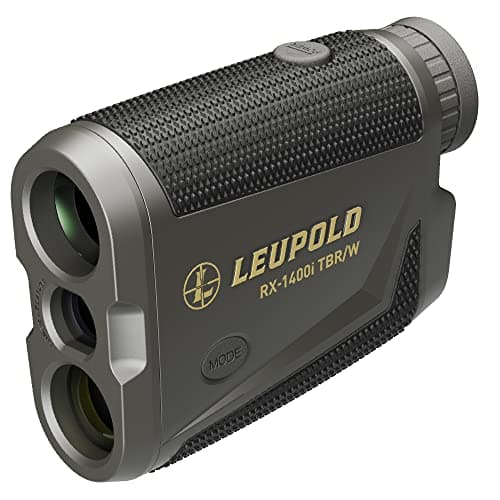
A rangefinder sold as a "1,400-yard" unit will not range a deer at 1,400 yards. That number is measured against a reflective target— think a road sign in good conditions. Soft, dull, deer-shaped things reflect far less laser energy, so the honest spec is the deer/game rating, typically 55-65 percent of the headline number. Leupold, to its credit, publishes all three tiers for the RX-1400i: 1,400 yards reflective, 1,200 on trees, 900 on deer.
| Reflective rating | Marketing-best case (signs, rock faces). The number on the box |
|---|---|
| Tree rating | Realistic mid-case for terrain features |
| Deer/game rating | The number that matters - usually 55-65% of the reflective figure |
| Rule of thumb | Buy at least 2x your maximum shot distance in deer rating - lasers lose reach in rain, snow, haze, and low light |
Why buy double your shot distance? Because rated maximums assume good conditions and a steady hand, and because ranging is not only for shooting — you will constantly range terrain, trails, and feeding animals well beyond your effective range to plan stalks. A hunter who shoots to 400 yards is well served by a deer rating around 800-900, which is exactly the class the best-overall pick below occupies.
Angle compensation: not optional for treestands and mountains
Gravity only acts on the horizontalcomponent of a shot. Range a deer at 40 yards from a steep treestand and the distance your arrow actually drops over is closer to 35 — hold for 40 and you hit high. The steeper the angle and the longer the shot, the worse the error, which makes uncompensated line-of-sight ranging genuinely misleading in exactly the places hunters shoot from.
Every maker brands the fix differently — Leupold calls it TBR/W (True Ballistic Range), Vortex calls it HCD (Horizontal Component Distance), Sig calls it AMR(Angle Modified Range) — but the function is the same: the unit measures the angle and displays the shoot-to distance. Treat angle compensation as a hard requirement; every pick in this guide has it. It is a solved problem you should not pay extra for or hunt without.
Displays and low light: red vs black
Rangefinder displays come in two kinds, and the difference shows up exactly when deer move. Black LCD displays are crisp against a bright midday field but smear into invisibility against dark timber at dawn and dusk. Red OLED/TOLED displays stay readable in any light, with adjustable intensity so they do not bloom at night. The red display is a meaningful part of what separates the Leupold and Sig picks from bargain units.
Two more usability specs worth checking: scan mode, which updates the range continuously as you track a moving animal or sweep a field edge (Sig's HyperScan runs four updates per second), and magnification — 5x to 7x is the sweet spot, enough to pick out an animal without making the unit impossible to hold steady offhand.
Rifle, bow, or crossbow: matching features to the weapon
Past the shared fundamentals, the category splits by weapon:
- Rifle huntersshooting past about 300 yards benefit from ballistic solutions — the unit pairs your load data with measured range, angle, and (on the Sig below) live environmental sensors to display a holdover or dial-to value. Inside 300, simple angle compensation is honestly enough.
- Bowhuntersneed excellent close-range precision and angle handling, and benefit from arrow-specific tools — Leupold's FullDraw line models your actual arrow's flight and even flags overhead branches the arc will clip, a genuinely archery-first feature.
- Crossbow hunterssit in between: crossbow bolts fly flatter than arrows but drop far more than bullets, so precise ranging with angle compensation matters on every shot past 20 yards. Purpose-built units like Ravin's pair cleanly with crossbow scope reticles — more in our crossbow sight-in guide.
The picks at a glance
Five rangefinders covering every weapon and budget. Prices are approximate as of 2026 — verify current pricing before buying.
| Rangefinder | Deer/real-world range | Angle comp | Best for | Approx. price |
|---|---|---|---|---|
| Leupold RX-1400i TBR/W Gen 2 | ~900 yd (deer) | TBR/W | Best overall | ~$200-250 |
| Vortex Sonora HD 1800 | ~700 yd (deer) | HCD | Best budget | ~$185-220 |
| Sig Sauer KILO3K | Long-range + ballistics | AMR + BDX | Rifle ballistics | ~$350 |
| Leupold RX-FullDraw 5 | ~1,100 yd (trees) | TBR + Flightpath | Bowhunters | ~$400-500 |
| Ravin 1200 | 1,200 yd (reflective) | Yes | Crossbow hunters | ~$400 |
Best overall: Leupold RX-1400i TBR/W Gen 2
The RX-1400i TBR/W Gen 2 is the rangefinder we would hand most hunters, because it puts the three specs that matter at a price that embarrasses the premium tier: an honest 900-yard deer rating (1,400 reflective), Leupold's proven TBR/W angle compensation with wind holds, and a bright red TOLED display that stays readable against dawn timber. It weighs about 5 ounces, runs a common CR2 battery, and even includes a basic Flightpath archery mode borrowed from the FullDraw line. Street pricing typically lands around the $200-250 mark — verify current pricing — which is remarkable for the feature set, and reviewers from Petersen's Hunting on down have said as much.
Honest cons: the 5x optic is serviceable rather than beautiful, and glass quality overall is where the premium units justify their price. It also will not run a full ballistic solver — if you dial turrets past 500 yards, look at the Sig below.
Who it's for: the deer, elk, and all-around hunter who wants honest long-range capability, angle compensation, and a low-light display without spending optics- safe money. The default pick.
Best budget: Vortex Sonora HD 1800
A housekeeping note first: Vortex's long-serving budget unit, the Impact 1000, has been discontinued — it no longer appears in Vortex's main rangefinder lineup and shows only limited remaining distribution — and the Sonora HD 1800, introduced in 2025, is the model that now holds down the brand's budget slot. It is a clear upgrade on its predecessor. The 6x21 HD optic ranges 1,800 yards on reflective targets, 1,000 on trees, and an honestly published 700 yards on deer — Vortex, like Leupold, prints all three tiers instead of hiding behind the box number. HCD angle compensationis standard with no extra input needed, accuracy is rated at plus-or-minus 1 yard, it runs a common CR2 battery at 6.1 ounces, and behind it stands Vortex's unconditional VIP lifetime warranty— unusual insurance at any price, remarkable with street prices typically in the $185-220 range (verify current pricing).
Honest cons: the compact 6x21 optic gives up low-light brightness to bigger glass, there is no ballistic solver or app connectivity, and dialed long-range rifle shooters will outgrow it — that is what the Sig below is for.
Who it's for: bowhunters, whitetail rifle hunters inside 300 yards, and anyone buying their first rangefinder on a real budget.
Best ballistics: Sig Sauer KILO3K
Sig's KILO line brought ballistic computing down from four-figure units, and the KILO3K is its current sweet spot at around $350. Onboard you get Applied Ballistics Ultralight running your actual bullet profile against live temperature, pressure, and humidity sensors, so the red OLED display shows a real elevation and windage solution, not just a distance. HyperScan updates ranges four times per second in scan mode, Bluetooth syncs profiles from the BDX app, and archery and AMR modes cover the close work. It is, feature for feature, the most rangefinder per dollar in the lineup.
Honest cons: all that capability lives in menus — expect an evening with the app and manual before it feels natural — and inside 300 yards none of it buys you anything the Leupold does not. The 6x22 optic is compact rather than luxurious.
Who it's for: rifle hunters who genuinely shoot past 400 yards, dial turrets, and want a measured solution instead of a memorized drop chart.
Best for bowhunters: Leupold RX-FullDraw 5
The FullDraw 5 is what happens when a rangefinder is designed around an arrow instead of a bullet. Feed it your arrow weight, velocity, and peep height and its ballistic engine ranges with your actual arc; its signature Flightpath feature then displays the highest point of that arc, telling you instantly whether the shot clears the branch between you and the buck — the classic unseen deal-breaker of treestand archery. The red TOLED display, TBR angle compensation, and 1,200-yard reflective reach carry over from Leupold's rifle line. MSRP is $499.99, with street prices typically lower — verify current pricing.
Honest cons: it is a lot of money for archery distances, and rifle-first hunters get more from the KILO3K at less. The Flightpath value also depends on entering honest arrow data — garbage in, garbage out.
Who it's for:the serious bowhunter — especially the treestand and timber hunter — for whom one clipped branch has already cost one buck too many.
Crossbow pick: Ravin 1200
Crossbow hunters are underserved by rangefinder marketing, and Ravin — the brand behind the R18 and R500we have reviewed — builds a purpose-made answer. The Ravin 1200 Laser Rangefinder ranges to 1,200 yards on reflective targets with angle compensationand a backlit display, in a compact housing designed to live in a crossbow hunter's kit; at $399.99 direct from Ravin it is priced with the premium hunting units. Paired with a speed-calibrated crossbow scope, precise compensated yardage is what makes the reticle's drop marks honest — the entire system depends on the number you feed it.
Honest cons: nothing about the 1200 is crossbow-exclusive under the hood — a Leupold or Vortex above ranges a crossbow lane just as well, usually for less — so this pick is for the hunter who values the matched-kit integration and Ravin build quality rather than a spec advantage. Note it is also not the same thing as Ravin's scope-integrated Garmin Xero systems, which build ranging into the optic itself.
Who it's for:crossbow hunters — especially Ravin owners — who want a clean, purpose-positioned unit from the same maker as the bow.
The bottom line
Read the deer rating, not the box number; treat angle compensation as mandatory; and prefer a red display if you hunt the edges of the day. For most hunters the Leupold RX-1400i TBR/W Gen 2 is the obvious buy, with the Vortex Sonora HD 1800 covering the budget seat behind a lifetime warranty. Long-range rifle shooters should step up to the Sig KILO3K and its live ballistics; dedicated bowhunters get real value from the Leupold RX-FullDraw 5 and its branch-clearance Flightpath; and crossbow hunters building a matched kit have the Ravin 1200. Then burn the savings on practice at ranged, known distances — the rangefinder only removes the guesswork; the shot is still yours.
Ranging is half the accuracy equation. You still have to find the animal first — see our best hunting binocularsguide for the glass that does it — then our guide to sighting in a crossbow to make the yardage count, and our best crossbows roundup if the launcher itself is due for an upgrade.
Frequently asked questions
How far will a hunting rangefinder actually range a deer?
Roughly 55-65 percent of the number on the box. Advertised maximums are measured on reflective targets like signs; soft, dull targets like deer reflect far less laser energy. A '1,400-yard' unit like the Leupold RX-1400i is rated 900 yards on deer - which Leupold publishes honestly. Buy a deer rating of at least twice your maximum shot distance, since rain, haze, and low light all shorten real-world reach.
Do I need angle compensation in a rangefinder?
Yes - treat it as mandatory. Gravity acts on the horizontal component of the shot, so from a steep treestand or across a canyon, the line-of-sight distance overstates the shoot-to distance and makes you hit high. Every maker offers it under a different name (Leupold TBR/W, Vortex HCD, Sig AMR) and it appears on units under $200, so there is no reason to hunt without it.
Is a red or black rangefinder display better?
Red OLED displays are better for hunting. Black LCD displays read fine against bright midday backgrounds but disappear against dark timber at dawn and dusk - exactly when game moves. Red displays stay readable in any light and adjust intensity for night use. The display type is one of the main real-world differences between budget and mid-tier rangefinders.
Are ballistic rangefinders worth it for hunting?
Only past about 300-400 yards. Units like the Sig KILO3K pair your bullet profile with live environmental sensors to display an actual holdover solution, which genuinely helps dialed long-range shots. Inside typical deer distances, simple angle-compensated ranging gives up nothing - a $200 unit plus the savings spent on practice ammunition will do more for your hit rate than a ballistics engine.
What rangefinder should a crossbow hunter use?
Any quality angle-compensating unit works - crossbow bolts drop far more than bullets, so compensated yardage matters on every shot past about 20 yards, especially from elevated stands. Ravin's 1200 Laser Rangefinder ($399.99) is a purpose-positioned option for matched-kit Ravin owners, ranging 1,200 yards with angle compensation, though a Leupold RX-1400i ranges a crossbow lane just as accurately for less.
Sources
Keep reading
Gearing up before your next hunt?
See how we evaluate gear, then dig into the reviews and buying guides — written without inventory to sell.