Air Rifle Review
Benjamin Marauder .22 Review: The PCP Benchmark That Refuses to Age
Fifteen-plus years after it rewrote PCP pricing, the Marauder is still the default first serious air rifle. We look at what the .22 actually delivers with real pellets, what the regulated version changes, and who should buy something else.
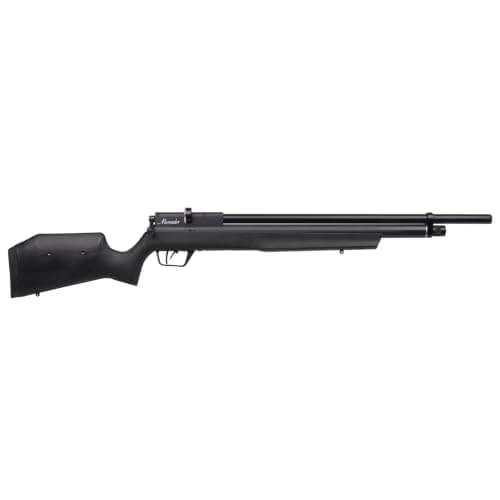
Still the default first serious PCP: quiet, accurate, hunt-capable, and endlessly supported. Buy the regulated version if your budget stretches; budget for fill gear either way.
- Best for
- Small-game hunters, pest controllers, and backyard precision shooters who want one quiet, accurate .22 PCP to grow into - and who are willing to own fill gear.
- Price context
- Mid-tier PCP - synthetic-stock Marauder lists from $549.90 and the factory-regulated walnut version at $695.90 per benjaminairguns.com (as of 2026). Add fill gear. Verify current pricing before buying.
Some products define a category and then get passed by it. The Benjamin Marauder — "M-Rod" to the airgun crowd — did the first part in 2009, bringing features that had been reserved for European guns costing twice as much: a shrouded barrel, a genuinely adjustable match-style trigger, and a multi-shot magazine, all near $500. The surprising part is the second half: a decade and a half of rivals later, it is still the rifle most experienced shooters name when a newcomer asks what serious PCP to buy first.
We don't sell air rifles, so we have no stake in whether you buy the Marauder, a cheaper Crosman 362 to learn on, or nothing at all. Here is what the .22 Marauder actually delivers, spec by spec.
What the Marauder is
The Marauder is a bolt-action, pre-charged pneumatic (PCP) air rifle: an onboard reservoir is filled to 3,000 PSIand meters air to each shot, so there is no spring slam and no pumping between shots — just a light bolt cycle that indexes the next pellet from a 10-round rotary magazine. In .22 it is rated up to 1,000 FPS, wears a full-length shrouded barrel, and comes in synthetic-stock (from $549.90 list) and hardwood versions, plus the factory-regulated model we cover below. Current-generation guns include the refinements owners used to pay tuners for: a reversible bolt handle for lefties, an adjustable raised-comb cheek-piece, and a two-stage trigger that is adjustable for pull weight and travel.
That trigger deserves its own sentence: independent testing measured roughly a 3-pound break from the factory, which is match-adjacent territory in a category where budget guns ship with vague 5-pound lawyer triggers. A good trigger is half of practical accuracy, and it is the single most underrated reason Marauders shoot as well as they do.
The shrouded-barrel quiet
The Marauder's signature feature is its full-length barrel shroud — the barrel lives inside a larger tube that gives muzzle air room to expand and slow before it exits, working like an integrated moderator. The practical result, echoed across independent tests and thousands of owner reports, is a rifle quiet enough that the loudest sound at the bench is often the pellet striking the target. Hard Air Magazine's review called it exceptionally quiet and made backyard-friendliness a headline finding.
Why that matters more than it sounds: a quiet rifle gets shot more, in more places, without drama — and for pest control it means the second pigeon does not leave when you take the first. If suburban discretion is a top requirement, the shroud alone justifies the Marauder over louder, cheaper break-barrels. (Check your local discharge ordinances either way — quiet is not the same as permitted.) If noise is the whole reason you are shopping, our guide to the quietest air rifles compares the Marauder against cheaper shrouded options and explains why pellet weight matters more than the shroud.
Real-world power and accuracy
Benjamin's "up to 1,000 FPS" rating is an alloy-pellet best case. The numbers that matter are what real lead hunting pellets do, and here the instrumented testing is refreshingly concrete:
| Alloy pellets (light) | ~1,040 FPS tested - fast, but not what you hunt with |
|---|---|
| JSB Jumbo Exact 14.35 gr lead | ~940 FPS tested |
| H&N Baracuda Match 21.14 gr lead | ~844 FPS tested, ~33 ft-lbs muzzle energy |
Call it 28-33 FPE with hunting-weight lead— roughly two and a half times the common 12 FPE field standard for squirrels and rabbits, and enough for raccoon- class pests at sensible ranges with good shot placement. Accuracy-wise, the platform's reputation is dime-sized groups at 25-30 yards from a rested gun with pellets it likes; the shrouded barrel, recoilless firing cycle, and that trigger all pull in the same direction. As with every airgun, pellet selection is the final variable — buy a few weights of quality lead and let the barrel vote.
Regulated vs unregulated: the generation that matters
Here is the one genuinely confusing choice in the lineup. A standard (unregulated) Marauder meters air straight off the reservoir, so velocity rides a curve as pressure falls: independent testing found only about 30 shotsinside a tight velocity band before the drop-off becomes meaningful. You can shoot more; they just land progressively lower. Owners historically answered with tuning — the Marauder's adjustable hammer spring and transfer port are famously tinker-friendly — or aftermarket regulators.
Benjamin now sells the fix from the factory: the Marauder Regulated (.22, walnut stock, $695.90 list) adds an integrated regulator that holds each shot to the same working pressure, stretching the consistent string to up to 80 shots per fill— with the same shroud, 10-round magazine, adjustable comb, and reversible bolt. It is frequently backordered, which tells you how the market voted.
Living with a PCP
The Marauder's real cost of ownership includes air. The 3,000 PSI fill is actually a point in its favor — it is reachable with a manual high-pressure hand pump (a genuine workout, but cheap and dependable), where many newer 4,500 PSI guns all but require a compressor or tank. Budget either a PCP hand pump or a compressor setup when you price the rifle.
The other honest tax is heft: 7.1 pounds before glassand 42.8 inches long. Scoped — and being a recoilless PCP it will happily wear any of the best air rifle scopes— you are carrying a centerfire-weight rifle to shoot squirrels. On a bench or a fence line that is stability; on a long walk it is a con, and lighter modern rivals undercut it here. Nothing about the Marauder is compact — it is a full-size rifle that shoots like one.
Who it's for - and who should skip it
Buy the Marauder ifyou want one quiet, accurate, hunt-capable .22 PCP with a great trigger and a 15-year deep well of parts, tunes, and community knowledge behind it — the rifle you keep after the hobby gets serious. It is the best-overall pick in our best air rifles guide for exactly that reason.
Skip it ifthe all-in PCP cost (rifle plus fill gear) breaks the budget — a multi-pump like the Crosman 362 delivers real .22 utility for a fifth of the money — or if you want maximum adjustability per dollar, where the regulated Air Venturi Avenger undercuts even the standard Marauder while matching its headline features (with cruder fit and finish). Weight-sensitive hikers should also look at lighter modern PCPs before committing.
The verdict
Benchmarks usually get dethroned; the Marauder just got refined. The shrouded quiet, the honest 28-33 FPE with lead, the adjustable 3-pound trigger, and the 10-shot magazine are still a combination nothing at the price fully beats — and the factory-regulated version quietly fixed the platform's one structural weakness. It is heavy, and PCP ownership has a buy-in cost the box does not mention. But if you want the serious air rifle you will not outgrow, the M-Rod remains the safe money in 2026 — which, after fifteen years, is its own kind of remarkable.
What we liked
- Full-length shrouded barrel makes it one of the quietest hunting-power air rifles in production
- Adjustable two-stage trigger breaks around 3 lbs from the factory - rare at this price
- 10-shot auto-indexing magazine, reversible bolt, and adjustable comb on current guns
- Huge aftermarket and tuning knowledge base built up over 15+ years
- Factory-regulated version delivers up to ~80 consistent shots per fill
What gave us pause
- Unregulated guns give only ~30 consistent shots before velocity falls off the plateau
- 7.1 lbs bare - a full pound or more heavier than newer rivals once scoped
- PCP ownership tax: hand pump, tank, or compressor is a real added cost
- Regulated version costs ~$150 more and is frequently backordered
Frequently asked questions
How fast does the Benjamin Marauder .22 really shoot?
Benjamin rates it up to 1,000 FPS, which reflects light alloy pellets. Independent chronograph testing measured about 940 FPS with 14.35-grain JSB lead pellets and about 844 FPS with 21.14-grain H&N Baracuda Match - roughly 28-33 ft-lbs of muzzle energy with the lead hunting pellets you would actually use.
Is the Benjamin Marauder .22 powerful enough for hunting?
Yes, comfortably - for the right game. At roughly 28-33 FPE with lead pellets it more than doubles the common 12 FPE field standard for squirrel- and rabbit-sized game, and handles raccoon-class pests at sensible ranges with precise shot placement. It is not an ethical tool for anything larger; big-game airgunning is big-bore PCP territory.
Should I buy the regulated or unregulated Marauder?
Hunters who fire a handful of shots per outing can save about $150 with the standard gun - its ~30-shot consistent string is plenty. High-volume target shooters and anyone who values shot-to-shot consistency should buy the factory-regulated version ($695.90 list), which stretches the consistent string to as many as 80 shots per fill.
Do I need a compressor to fill a Benjamin Marauder?
No - and that is one of its quiet advantages. The Marauder's 3,000 PSI maximum fill is realistic to reach with a manual high-pressure hand pump, unlike many newer 4,500 PSI PCPs that effectively require a compressor or dive tank. A compressor is more convenient, but the hand-pump path keeps entry cost down.
How quiet is the Benjamin Marauder?
One of the quietest hunting-power air rifles made. Its full-length barrel shroud acts as an integrated moderator, and independent reviewers consistently describe backyard-friendly noise levels where the pellet impact is often louder than the muzzle. Quiet is not the same as legal, though - check your local discharge ordinances.
Sources
Keep reading
Gearing up before your next hunt?
See how we evaluate gear, then dig into the reviews and buying guides — written without inventory to sell.