Buying Guide
Best Camping Stoves: How to Choose (2026)
Camp stoves come in two families that barely compete: propane two-burners for the tailgate and palm-sized canister stoves for the trail. Here is how to pick within each - and six stoves that earn their fuel.
"Best camping stove" is really two questions wearing one search term. If you cook where you park, you want a propane two-burner— a briefcase-sized camp kitchen that runs on green 1-pound cylinders and cooks like a range. If you carry your kitchen in a backpack, you want a canister stove— a palm-sized burner that threads onto an isobutane canister and weighs about as much as a candy bar. The two families barely compete, so this guide handles both: how to choose within each, then three honest picks per side.
As with everything on this site, this is research, not theater: published manufacturer specs, comparative testing from OutdoorGearLab, GearJunkie and Switchback Travel, and owner-feedback patterns. Prices move constantly — treat every bracket below as approximate and verify before you buy.
Two families of stove (buy for how you camp)
| Propane two-burner | 10-20 lbs, cooks for groups, real pots and pans, runs on 1-lb propane cylinders or a bulk tank with an adapter. Lives in the truck |
|---|---|
| Canister backpacking stove | 3-14 oz, boils water fast for 1-2 people, runs on isobutane-propane canisters. Lives in a pack pocket |
Deciding is usually easy: family campground trips and hunting-camp cook duty want the two-burner; trail miles want the canister stove; a lot of households justifiably own one of each. If your camping involves a backpacking tent, you are in canister territory. If it involves the family hauler and a six-person tent, think two-burner.
BTUs and simmer control (the spec everyone misreads)
Burner output is measured in BTUs per hour, and shoppers fixate on it. Here is the honest hierarchy: simmer control beats peak BTUs.Almost any stove will eventually boil water; far fewer can hold a low flame that cooks eggs and pancakes without scorching. Testers consistently rank stoves like the Camp Chef Everest 2X highly not just for its 20,000-BTU burners but because its valves modulate down to a genuine simmer — OutdoorGearLab went as far as comparing its control to a home gas range.
What BTUs do buy you: recovery speed with big, full pots, faster boils in wind and cold, and headroom when both burners run at once — many budget two-burners sag noticeably on the second burner. In the 10,000-11,000-BTU-per-burner class (Coleman Cascade, Coleman Triton+), expect adequate power for two-pot family cooking and slower recovery with large volumes.
On the backpacking side the equivalent trap is boil-time worship. In calm air the top stoves are separated by seconds; the real separators are the regulator (pressure-regulated stoves like the WindMaster and PocketRocket Deluxe hold output as canisters drain and chill) and wind behavior, next.
Wind, fuel and cold weather
- Wind is the biggest real-world variable.A breeze that barely registers on your skin can double boil times on an unshielded burner. On two-burners, look for tall three-sided windscreens; on canister stoves, look for recessed or concave burner heads — the design reason the Soto WindMaster wins windy-condition tests.
- Propane vs isobutane.Green 1-pound propane cylinders are cheap and sold everywhere; a bulk-tank adapter hose cuts long-term cost further. Isobutane canisters cost more per ounce of fuel but weigh little enough to carry. Neither is "better" — they belong to different stoves.
- Cold notes. Canister pressure drops as temperature falls; a pressure regulator compensates meaningfully into the low-20s F range, which is why regulated stoves are the right canister choice for shoulder-season trips and early-season hunting spike camps. Propane itself vaporizes fine well below zero.
- Safety, briefly:every stove here is outdoor-only — carbon monoxide makes tents and vestibules a no-cook zone — and piezo push-button igniters are a convenience, not a lifeline. Pack a lighter regardless.
The picks at a glance
Three two-burners, three canister stoves. Weights and outputs are manufacturer-published; prices are approximate mid-2026 brackets — verify before buying.
| Stove | Type | Output | Weight | Best for | Approx. price |
|---|---|---|---|---|---|
| Camp Chef Everest 2X | Propane 2-burner | 2 x 20,000 BTU | ~15 lb | Best camp kitchen | ~$180-200 range |
| Coleman Cascade Classic | Propane 2-burner | 2 x 10,000 BTU | ~10 lb | Best budget | ~$100 range |
| Coleman Triton+ | Propane 2-burner | 2 x 11,000 BTU | ~12 lb | InstaStart budget alternative | ~$100 range |
| Soto WindMaster | Canister | ~11,000 BTU class | 3.1 oz | Best backpacking stove | ~$70-80 range |
| MSR PocketRocket Deluxe | Canister | 11,000 BTU | 2.9 oz | Ultralight all-rounder | ~$70-85 range |
| Jetboil Flash | Integrated canister | 9,000 BTU class | 13.1 oz | Fast boils, freeze-dried meals | ~$130 range |
Best two-burner: Camp Chef Everest 2X
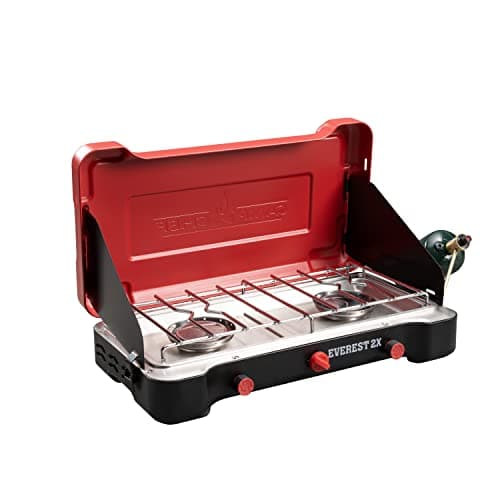
The Everest 2X is the two-burner the others get measured against. Each burner puts out 20,000 BTU— roughly double the budget class — behind a tall, effective windscreen, and the valves modulate low enough that testers rate its simmer control better than some home ranges. That combination — violence when you want it, finesse when you need it — is why it keeps winning group tests, and it is exactly what a deer-camp cook feeding six hungry hunters before shooting light appreciates: both burners loaded, no sag, coffee that does not taste scorched.
Honest cons: it is big— around 15 pounds and notably deeper than rivals, so it claims real cargo space; the piezo igniter is convenient but, like all of them, mortal; and it typically street-prices in the $180-200 range (verify current pricing), nearly double the Cascade below.
Who it’s for:families and camps that genuinely cook — multi-pot dinners, griddle breakfasts, groups — and have the vehicle space to carry the kitchen that does it.
Best budget two-burner: Coleman Cascade Classic
The Cascade Classic is Coleman’s modernized take on the green camp stove your family probably owned, and it remains the value default: two 10,000-BTU burners, push-button ignition, sizable wind panels, good fuel efficiency, and a street price that hovers around $100 (verify current pricing). For burgers, chili, and morning eggs for a small family, it simply does the job.
Honest cons, and they are documented in owner feedback: the push-button igniter has a pattern of arriving faulty or dying early — annoying rather than disqualifying, since a lighter fixes it — and simmer control is a clear step down from the Everest, with a flame that jumps from low to medium where premium valves glide. Run both burners with big pots and you will feel the power ceiling.
Who it’s for: occasional campers and anyone outfitting a first camp kitchen who would rather bank the $100 difference toward a better tent or bag.
Budget alternative: Coleman Triton+
The Triton+ is Coleman’s other budget two-burner, and it earns its slot on details rather than tier: it sits at the same roughly $100 street price as the Cascade Classic (verify current pricing), so choose between them on features, not budget. The Triton+ answers with slightly stronger 11,000-BTU burners, push-button InstaStartignition that OutdoorGearLab’s testers found sound and reliable, PerfectFlow pressure regulation to steady the flame as the cylinder drains, and room for a 10-inch and a 12-inch pan side by side. The same testing found it simmers quite wellonce you learn the low end of the valves — boiling a quart in 4:45 in calm air.
Honest cons, straight from the same test: wind is its weakness— that 4:45 boil stretched to 9:15 in a breeze, one of the slower windy-condition results in its class — and the flame gets hard to see at the lowest settings. Like the Cascade, it runs a full class below the Everest in burner power, and at about 12 pounds it is no more packable. It is a second seat at the budget table, not a step up from it.
Who it’s for: the budget camper who wants matchless push-button lighting and a touch more burner headroom than the Cascade, and who cooks somewhere with a bit of wind shelter.
Best backpacking: Soto WindMaster
The WindMaster earns its name and its perennial top ranking the same way: a concave, recessed burner head that keeps a grip on its flame when exposed canister stoves surrender. In comparative testing it is consistently the stove whose boil times degrade least in wind, while weighing 3.1 ounces with a pressure regulator for cold canisters and a micro-regulated valve that simmers far better than the pocket-stove stereotype. The clip-on four-arm pot support steadies wide pots and detaches for packing.
Honest cons: the detachable pot support is a small part you can genuinely lose, the piezo igniter is (as always) mortal, and at a typical $70-80 street price (verify current pricing) it costs a bit more than basic 3-ounce burners. As an all-conditions pick, none of that changes the verdict.
Who it’s for:backpackers and spike-camp hunters who cook above treeline, in shoulder seasons, and in real weather — the people wind actually punishes.
Backpacking runner-up: MSR PocketRocket Deluxe
The PocketRocket Deluxe is the WindMaster’s only serious rival, and in calm air it is arguably the faster boiler: 11,000 BTU from a 2.9-ounce stove with a pressure regulator, piezo ignition, and a broad burner head that spreads heat more evenly than the pencil-flame budget stoves. Its fixed, fold-out pot supports mean no loose parts, and the whole thing disappears inside a small pot with a canister.
Honest cons: its burner is less recessed than the Soto’s, so hard wind hurts it more — the one test where it reliably loses — and pricing in the $70-85 range (verify current pricing) buys the WindMaster instead if wind is your reality. Between the two, pick by climate; neither choice is wrong.
Who it’s for: the ultralight generalist who wants the simplest, lightest full-featured burner and mostly camps below the wind line.
Best boil system: Jetboil Flash
The Flash is a different tool: an integrated system where burner, windscreen, and a heat-exchanger pot lock together into one 13.1-ounceunit that does one thing spectacularly — boil water, fast, with Jetboil claiming roughly 100 seconds for half a liter. The insulated sleeve, push-button start, and color-changing heat indicator make it nearly idiot-proof, and the locked-together design shrugs off breeze that slows open burners. If your menu is coffee, oatmeal, and freeze-dried pouches — which honestly describes most backpackers and most hunters at a spike camp — it is the most convenient cooking system made.
Honest cons: it is a boiler, not a stove — simmer control is poor and real cooking in the narrow tall cup is misery; it weighs three to four times what a WindMaster-plus-pot setup does; and it typically street-prices around $130 (verify current pricing). Buy it for the workflow, not versatility.
Who it’s for: boil-water-only campers, coffee-dependent hunters, and anyone who values two-minute hot water over culinary ambition.
The bottom line
Buy by how you camp. Cooking from the truck for a group, the Camp Chef Everest 2X is the kitchen; the Coleman Cascade Classic and Coleman Triton+split the budget seat at the same table — pick by igniter and deal. Carrying your kitchen, the Soto WindMaster is the all-weather pick, the MSR PocketRocket Deluxe the calm-climate twin, and the Jetboil Flash the boil-only convenience play. Round out the camp with our camping tents guide and sleeping bag guide— a hot dinner, a dry tent, and a warm bag cover about 90 percent of what makes camping good.
Frequently asked questions
How many BTUs do I actually need in a camping stove?
For two-burner propane stoves, 10,000 BTU per burner handles routine family cooking; 20,000-BTU burners like the Camp Chef Everest 2X earn their keep with big pots, wind, and running both burners hard. Simmer control matters more than peak output for most meals. Backpacking canister stoves cluster around 9,000-11,000 BTU, where regulators and wind design separate them more than the number does.
Should I get a propane two-burner or a canister backpacking stove?
It depends where the stove rides. If it travels in a vehicle and feeds a group, a propane two-burner cooks like a range. If it travels in a backpack, a 3-ounce canister stove is the only sensible answer. They are different tools, and many campers eventually own one of each.
Do canister stoves work in cold weather?
Standard isobutane canisters lose pressure as they chill, and unregulated stoves fade with them. A pressure-regulated stove - the Soto WindMaster and MSR PocketRocket Deluxe both have regulators - keeps output usable roughly into the low 20s F. Below that, keep the canister warm in a jacket or sleeping bag, or move to a propane or liquid-fuel setup.
Can I use a camping stove inside a tent or vestibule?
No. Burning fuel produces carbon monoxide, which is odorless and can be lethal in enclosed spaces, and tent fabrics ignite fast. Cook outside with ventilation, full stop. In genuinely bad weather, cook under an open-sided tarp with generous airflow rather than in the tent.
Is the Jetboil Flash worth it over a regular canister stove?
If your menu is boiling water - coffee, oatmeal, freeze-dried meals - yes: it is faster, more wind-tolerant, and more convenient than an open burner with a separate pot. If you actually cook (simmering, frying, real pots), a WindMaster or PocketRocket Deluxe with a normal pot is lighter and far more versatile. Choose by menu, not by marketing.
Sources
Keep reading
Gearing up before your next hunt?
See how we evaluate gear, then dig into the reviews and buying guides — written without inventory to sell.