Buying Guide
Best Camping Tents: How to Choose (2026)
A car-camping tent lives or dies on real capacity, weather protection, and how fast it goes up in a fading evening. Here is how to read the specs that matter - then five tents that earn a spot in the truck.
A car-camping tent has one enormous advantage over every other shelter you will ever buy: you do not have to carry it. That single fact changes what you should shop for. Weight barely matters, so the winning tent is the one with real space for your actual group, walls that shrug off a surprise thunderstorm, and a pitch simple enough that you can get it standing in the last twenty minutes of daylight with kids underfoot. If you are shopping for a tent you will carry on your back, this is the wrong guide — our backpacking tents guide covers the weight-driven end of the market.
This guide is research-based: we compared published manufacturer specs, independent testing from outlets like OutdoorGearLab, GearJunkie and Switchback Travel, and consistent patterns in owner feedback. We start with the four decisions that actually matter — capacity, weather protection, setup, and livability — then get to five picks with honest trade-offs. Prices shift constantly, so treat every bracket below as approximate and verify current pricing before you buy.
Capacity: the person rating lies
Every tent maker rates capacity the same optimistic way: the number of adult sleeping pads that can physically touch the floor at once, shoulder to shoulder, with zero room for gear, dogs, or moving around. Nobody camps like that. The rule seasoned campers use is simple: subtract two from the rating. A 6-person tent is a comfortable home for four, or for two adults, two kids, and the duffel pile. An 8-person tent suits a family of five or six.
Floor area tells you more than the person rating. Somewhere around 15 square feet per sleeper is genuinely comfortable for family camping; the 83 to 115 square feet offered by the six- and eight-person tents below is realistic space for three to six people once air mattresses enter the picture. Check the floor dimensions against your actual sleep setup — a queen air mattress alone claims roughly 60 by 80 inches.
Weather protection
Most family tents are fine in fair weather. The separation shows up in the first real storm, and three specs predict it:
- Rainfly coverage.A full-coverage fly that extends down near the ground protects the walls and seams from wind-driven rain. Many budget tents use a partial "cap" fly that covers only the mesh roof — adequate in a drizzle, leaky in a sideways storm. If you camp in the Rockies, the Midwest storm belt, or anywhere weather arrives fast, prioritize full coverage.
- Hydrostatic head.Waterproofness is rated in millimeters of water pressure a fabric withstands. Roughly 1,200mm handles rain; 1,800 to 3,000mm on the fly and floor — what a tent like the Marmot Limestone carries — is storm-worthy. Sealed seams matter as much as the number.
- Pole structure.Aluminum poles (DAC is the benchmark name) flex and recover in wind; cheap fiberglass can splinter under the same load. More pole crossings and more guy-out points mean a stiffer tent. Tall, boxy cabin tents trade wind resistance for headroom — a fair trade at a sheltered campground, a bad one on an exposed ridge.
Setup speed
Setup time is a comfort feature you use every single trip. Traditional pole-and-clip domes take an experienced camper 10 to 20 minutes; big multi-room basecamp tents can eat 30 or more. Two designs shortcut this:
| Pre-bent pole domes | Coleman's Skydome line snaps onto pre-attached poles - up in around 5 minutes with more vertical walls than an old-school dome |
|---|---|
| Hub tents | Gazelle's T4 pops open like a hunting blind - walls and roof deploy in about 90 seconds, staking adds a minute |
| Classic pole tents | 10-20 minutes, lighter to pack and usually cheaper for the space - fine if you camp without time pressure |
Be honest about how you camp. If you roll into camp after work on Friday night, a five-minute pitch is worth real money. If setup is part of the ritual, save the cash and buy space or weather protection instead.
Headroom and livability
The difference between a tent you tolerate and a tent you love is mostly what happens when you are awake inside it. Peak height around 72 to 78 incheslets most adults stand and dress upright — and near-vertical walls matter as much as the peak number, because a steep-walled 76-inch tent has far more usable standing room than a dome that only hits its height at dead center. Look for large doors (two is better with kids), mesh for airflow on warm nights, interior pockets, and a power-cord port if you camp with sites that have hookups.
One more livability item that is really a sleep item: the tent only keeps you dry. Warmth comes from what is under and around you — see our sleeping bag guide for how temperature ratings actually work.
The picks at a glance
Five tents that cover the main jobs, from a budget dome to a 90-second hub tent. Approximate street prices as of mid-2026 — always verify current pricing.
| Tent | Sleeps (rated) | Floor area | Peak height | Best for | Approx. price |
|---|---|---|---|---|---|
| The North Face Wawona 6 | 6 | ~86 sq ft + huge vestibule | 76 in | Best overall family tent | ~$500 range |
| Coleman Skydome 6 | 6 | ~85 sq ft | 72 in | Best budget | ~$150-200 range |
| Marmot Limestone 6P | 6 | 83 sq ft | 76 in | Storm-prone campgrounds | ~$600 range |
| Gazelle T4 Hub Tent | 4 | 61 sq ft | 78 in | Fastest setup | ~$400 range |
| Coleman Skydome XL 8 | 8 | 114.5 sq ft | 76 in | Big families and groups | ~$250-300 range |
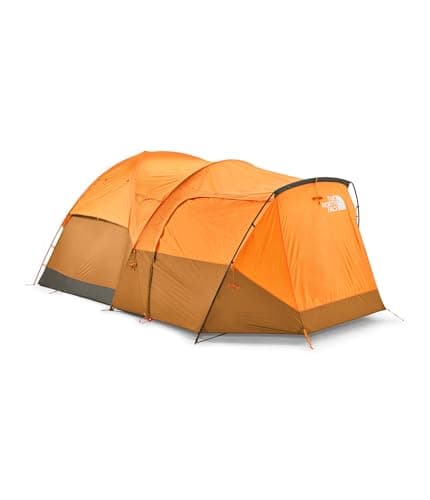
Best overall: The North Face Wawona 6
The Wawona 6 keeps landing at or near the top of independent family-tent rankings — GearJunkie calls it the best tent for most families — and the reasons are structural. A 76-inch peak height and steep single-wall-plus-fly design create real stand-up living space, and the signature feature is the enormous front vestibule of roughly 44 square feet— effectively a covered gear garage for bikes, coolers, and wet boots that most competitors simply do not have. Build quality and pole structure are a clear step above big-box tents.
The honest cons: it typically street-prices in the $500 neighborhood (verify current pricing), the hybrid double-wall design means less mesh than some rivals on hot, humid nights, and the long footprint plus vestibule needs a large, flat pad. None of that changes the verdict — for a family that camps several times a year, this is the space-per-dollar benchmark.
Who it’s for: the family of three to five that wants one tent to live in comfortably for long weekends, with covered storage for the gear pile.
Best budget: Coleman Skydome 6
Coleman’s Skydome line is the rare budget tent that reviewers consistently describe as feeling modern. Pre-bent, pre-attached polespull the walls near vertical — opening up interior space an old-school dome of the same footprint wastes — and setup runs around five minutes. You get roughly 85 square feet of floor, a 72-inch peak, and a price that regularly sits in the $150 to $200 range (verify current pricing), leaving budget for the sleeping pads that will do more for your comfort than any tent upgrade.
The trade-offs are exactly what the price predicts: a partial-coverage fly rather than a full one, so it is a fair-weather-to-moderate-rain tent rather than a storm shelter, and materials that reward gentle handling. For two to four campers at drive-in campgrounds in decent conditions, it is the sensible default first tent.
Who it’s for: new campers and families who camp a handful of fair-weather weekends a year and want maximum space per dollar.
Best in weather: Marmot Limestone 6P
The Limestone 6P is what happens when a mountaineering brand builds a family tent. The numbers behind its weather reputation: a full-coverage 68-denier ripstop polyester fly rated to 1,800mm, a burly 150-denier floor rated to 3,000mm, and a DAC aluminum pole set with color-coded clips. OutdoorGearLab’s testing praises exactly this combination — genuinely impressive weather protection with a livable 83-square-foot interior and a 76-inch peak that feels bigger than the spec sheet suggests.
Cons, honestly: at around 17 pounds it is heavy even by car-camping standards, the top pole sleeve is known to run tight during pitching, and it typically street-prices around the $600 mark (verify current pricing) — serious money for a six-person tent. You are paying for the nights the cheap tent fails.
Who it’s for:campers in storm-prone country — mountain campgrounds, the plains, shoulder-season trips — who want a family tent they never have to babysit in weather.
Fastest setup: Gazelle T4 Hub Tent
The Gazelle T4 borrows its hub-and-pop-out frame directly from the hunting-blind world, and the result is a tent that goes from bag to standing in about 90 seconds— pop the four walls and roof, stake it down, done. The rigid hub frame gives you 61 square feet of floor, a cavernous 78-inch ceiling, near-vertical walls, and a removable floor that makes sweeping out sand and pine needles absurdly easy. Owner satisfaction runs remarkably high for exactly these reasons.
The trade-offs are real: at roughly 30 poundsin a long duffel it is strictly a car or truck tent, it is rated for four (read: two adults plus gear, or a small family), and it typically street-prices around the $400 range (verify current pricing) — a premium for the convenience. In sustained high wind you will want every stake and guy line deployed.
Who it’s for:overlanders, tailgaters, and anyone who moves camp often enough that a 90-second pitch changes the trip. Its blind-style frame and quick pitch have also made it a favorite double-duty shelter for hunters running a truck-based deer camp — if your camping gear pulls hunting duty too, this and the Kings Camo XKG Summit in our backpacking guide are the two crossover picks in these guides.
Best for big groups: Coleman Skydome XL 8
When the crew is five or six people, floor area becomes the whole game, and the Skydome XL 8 delivers a gargantuan 114.5 square feet— enough for three queen-size air mattresses — with the same pre-bent-pole, near-vertical-wall design and fast pitch as its smaller sibling, plus a 76-inch peak. For a genuine eight-rated tent it remains remarkably affordable, typically in the $250 to $300 range (verify current pricing).
Same honest caveats as any budget Coleman: the partial fly means you pick your weather or pitch it with rain in mind, and a single giant room means zero privacy — some families prefer two cheaper tents for exactly that reason. But as a maximum-space, minimum-dollar basecamp for a big family or a group of friends, it is the value play.
Who it’s for: big families and multi-couple groups at drive-in campgrounds who want one huge, affordable room and are willing to respect the weather forecast.
The bottom line
Subtract two from the person rating, then match the tent to your weather and your patience. For most families, The North Face Wawona 6 is the best blend of space, build quality, and that giant vestibule. On a budget, the Coleman Skydome 6gets you a modern, fast-pitching dome for a fraction of the price — and the Skydome XL 8 scales the same value up for big groups. If your campgrounds see real storms, the Marmot Limestone 6P is the one built for them, and if setup speed rules everything, nothing touches the Gazelle T4.
Tent sorted? What goes inside it matters just as much on a cold night — start with our sleeping bag guide, then sort out camp cooking with the best camping stoves.
Frequently asked questions
How many people actually fit in a 6-person tent?
Comfortably, about four - or two adults and two kids plus gear. Manufacturer capacity ratings count adult sleeping pads packed edge to edge with no room for duffels, dogs, or moving around. The reliable rule is to subtract two from the rating, and to check the floor dimensions against your actual sleep setup - a queen air mattress alone takes roughly 60 by 80 inches.
What makes a camping tent actually waterproof?
Three things: a rainfly that covers the whole tent rather than just the mesh roof, sealed seams, and adequate hydrostatic-head ratings - roughly 1,200mm handles rain, while 1,800-3,000mm fly and floor ratings like the Marmot Limestone's are storm-worthy. Budget tents with partial 'cap' flies are fine in drizzle but leak in wind-driven rain.
Are instant and hub tents worth the extra money?
If you move camp often or arrive late, yes - a hub tent like the Gazelle T4 stands in about 90 seconds versus 10-20 minutes for a classic pole tent, and pre-bent-pole designs like Coleman's Skydome split the difference at around five minutes. If setup time doesn't bother you, put the money toward weather protection or floor space instead.
What peak height do I need to stand up in a tent?
Around 72 inches works for most adults, and 76-78 inches feels genuinely roomy. Wall steepness matters as much as the peak number: a tent with near-vertical walls offers usable standing room across much of the floor, while a classic dome only reaches its rated height at dead center.
Should I buy a bigger tent or two smaller tents for a big family?
One big tent like the Coleman Skydome XL 8 is cheaper and keeps everyone together, but it's a single room with no privacy. Two smaller tents cost a bit more, add privacy for teens or couples, spread the load between vehicles, and give you a backup shelter if something breaks. For groups of six or more, two tents is often the more livable answer.
Sources
Keep reading
Gearing up before your next hunt?
See how we evaluate gear, then dig into the reviews and buying guides — written without inventory to sell.