Buying Guide
The Best Hand Warmers for Hunting
Air-activated warmers need oxygen to work, which is why the one you stuff into a tight glove goes lukewarm and dies. Understanding that single fact fixes most of the complaints hunters have about the entire category - and changes where you should put them.
Air-activated hand warmers work by oxidizing iron powder. The reaction consumes oxygen, and the rate of the reaction is limited by how much oxygen can reach the powder through the pouch.
That is the whole explanation for the single most common complaint about the category. Stuff a warmer into a tight glove, press it flat between your palm and a bow grip, and you have choked its air supply. It goes lukewarm, then cold, and you conclude the product is junk. The same warmer in a loose coat pocket runs hot for hours.
This guide covers what to buy, but more usefully, where to put it - and when a battery warmer or a muff is the better answer than either.
Why your warmer went cold in your glove
Disposable warmers contain iron powder, water, salt, activated carbon and vermiculite. When the outer wrapper is opened, oxygen reaches the iron and it rusts - an exothermic reaction. Everything about how the warmer behaves follows from that:
- Restrict the air and it cools down. Crushed inside a tight glove or under a boot laced snug, it runs cool. Give it air and it recovers, which is why shaking a fading warmer and putting it in a looser pocket often brings it back.
- They cannot be turned off, only slowed. Sealing an active warmer in a zip bag starves it and pauses the reaction, which is the standard trick for saving a half-used warmer for the afternoon sit.
- They keep going after you stop needing them. Once opened, the runtime clock starts. Do not open a pair on the drive to the woods.
The four types and what each is for
| Type | How it works | Best for | Watch out for |
|---|---|---|---|
| Disposable hand warmer | Iron oxidation, single use, several hours of heat | Pockets, muffs, general use; the default | Dies if compressed or airtight |
| Disposable toe warmer | Same chemistry, thinner, with adhesive backing | Inside boots, stuck to the top of a sock | Formulated for the lower oxygen inside a boot - do not substitute hand warmers |
| Rechargeable electric warmer | Lithium battery with a heating element, on demand | Repeat use, doubles as a phone power bank | Heavier; capacity drops in cold weather |
| Hand muff (heated or not) | An insulated pouch that traps warm air around both hands | Stand hunting, bowhunting, anyone needing bare hands fast | One more thing on your belt |
Disposable versus rechargeable: the actual math
Buy disposables in bulk and the cost per sit is small change. A 40-pair box covers a full season of cold hunts for one person, or most of a season for two.
A rechargeable pair costs roughly what a bulk box costs and lasts several seasons, so on pure economics it wins over time. The reasons to still keep a box of disposables anyway:
- They need no charging, so a forgotten charge is not a cold hunt.
- They are lighter and can be distributed - toes, pockets, chest, muff, all at once.
- They keep working when a battery has given up in the cold.
- They cost almost nothing to hand to a hunting partner who did not bring any.
The honest recommendation is both: a bulk box of disposables in the truck, and one rechargeable pair in the pack for the days you want heat you can switch on and off.
The cold-weather battery problem
Lithium-ion capacity falls as temperature falls. A rechargeable warmer that runs six hours in a 50-degree garage will not run six hours at 15 degrees in a stand, and the advertised figure is almost always the lowest heat setting.
Two practical fixes. Keep the warmer inside your jacket next to your body rather than in an outside pocket, so its own heat and yours keep it in a better operating range. And start the day with it off - most hunters need heat in bursts, not continuously.
The same limitation applies across all battery-heated gear. See our heated hunting gear guide.
The picks at a glance
| Product | Type | Best for |
|---|---|---|
| HotHands 40-pair box | Disposable | The default buy for any cold-weather hunter |
| HotHands toe warmers | Disposable, adhesive | Cold feet - the correct product for inside a boot |
| HotHands Super Warmers | Disposable, large | All-day sits; larger surface, longer duration |
| OCOOPA UT3 Pro | Rechargeable | Repeat use plus a phone power bank |
| Heated hand muff | System | The best hand solution for stand and bow hunters |
Best overall: HotHands bulk pack
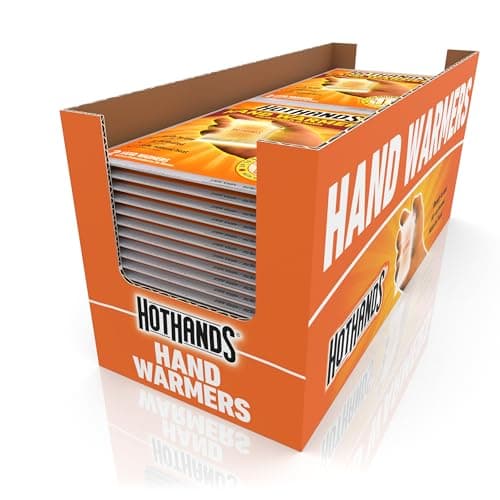
There is no clever pick here. HotHands is the category standard, it is available everywhere, and buying it by the 40-pair box drops the cost per sit to a rounding error.
Buy the box rather than a two-pack. The reason hunters run out is that they buy warmers in singles at a gas station at 4am for several times the bulk price. A box in the truck ends that permanently. Smaller 20-pair and 10-pair packs exist for a stocking or a first try.
HotHands Super Warmers and body warmers
Super Warmers are physically larger with a longer stated duration - the right choice for an all-day sit in genuinely cold weather, or for a coat pocket where you want one warmer rather than two.
Body warmers are larger still and adhesive-backed, designed to stick to a base layer over the kidneys or chest. That is the core-warming approach: warm the trunk and your body stops restricting blood flow to your fingers in the first place.
Toe warmers are a different product
This is the mistake worth avoiding: toe warmers are not just smaller hand warmers. They are formulated to work in the lower-oxygen environment inside a boot, and they have an adhesive back so they stay on top of the sock rather than migrating under the arch.
Put a regular hand warmer in a boot and it will underperform, because the boot is exactly the airtight compression environment the chemistry hates. Buy the toe version.
Placement: on top of the sock, over the toes, not underneath the foot. Under the foot you are standing on it, which compresses it and puts the heat where your weight is rather than where the cold is.
If cold feet are a recurring problem, the sock and boot system underneath matters more than the warmer. See our hunting sock guide and boot insulation guide.
Best rechargeable: OCOOPA UT3 Pro
The UT3 Pro is the widely available rechargeable standard: a two-pack of double-sided magnetic warmers with several heat levels that clip together into one larger unit or separate into two.
The features that matter in the field are the on/off switch - a disposable cannot be turned off - and the fact that these double as a phone power bank, which is genuinely useful during a long sit in the cold when phone batteries also die faster.
Other rechargeable options
Higher-capacity 14,000mAh pairs exist at similar money, and some ship with a charging case so both units recharge from one input. If you want a specific safety marker, look for a UL certification claim on the listing - this is a category with a lot of unbranded lithium products in it, and a certification is a meaningful differentiator.
The muff: the answer most hunters end up at
A hand muff is not a warmer, it is a container for one - an insulated pouch worn at the waist that traps warm air around both hands at once. It is the most thermally efficient hand solution available, because it heats a small enclosed volume rather than fighting moving air through a glove.
For a bowhunter or a rifle hunter waiting on a shot, it has a second advantage that matters more than warmth: your hands come out bare or lightly gloved, warm and fully sensitive, in a single motion. Heated gloves cannot do that.
Two routes. A heated muff has its own battery element. An unheated muff with a couple of disposable warmers inside performs nearly as well for a fraction of the price, and it is the setup most experienced cold-weather hunters actually run.
Where to actually put warmers
- In a muff. The single most effective placement, by a wide margin.
- Loose in a coat pocket. Plenty of air, and your hands go in and out freely.
- Over the toes on top of the sock - toe warmers only, adhesive side down.
- On a base layer over the kidneys or chest - body warmers only. This is the core-warming trick that improves circulation to your hands without touching your hands at all.
- Not crushed inside a tight glove. Not under your foot. Not sealed in a pocket you never open.
The burn risk nobody reads about
Air-activated warmers reach temperatures that will cause low-temperature burns on skin over time, which is why every package says not to apply them directly to bare skin. The risk is not a sudden burn - it is hours of moderate heat on one spot, particularly on a foot you cannot feel well because it is cold.
- Always keep a layer of fabric between the warmer and skin.
- Do not sleep with one, and do not use them on skin with reduced sensation - which includes a foot that has already gone numb from cold.
- Do not put a warmer inside a boot that is already tight. The compression starves the reaction and the pressure concentrates whatever heat there is.
- Follow the manufacturer's printed instructions - they differ slightly by brand.
The bottom line
Buy a 40-pair box of HotHands and keep it in the truck. It is the cheapest comfort per dollar in hunting.
Buy toe warmers separately if your feet are the problem - they are a different product and the substitution does not work.
Add a muff if you sit still, and especially if you bowhunt. Unheated with disposables inside is the value answer; heated is the convenience answer.
Add one rechargeable pair for the on/off control and the power bank, but do not throw the disposables out.
Related: heated hunting gear, honestly assessed, best hunting gloves, and how to stay warm on a long sit.
Frequently asked questions
Why do hand warmers stop working in gloves?
Because they need oxygen. Disposable warmers generate heat by oxidizing iron powder, and the reaction rate depends on how much air reaches the pouch. Crushed inside a tight glove, the warmer is starved of oxygen and compressed, so it runs lukewarm and then cold. The same warmer in a loose coat pocket or a hand muff runs hot for hours. Shaking a fading warmer and moving it to a roomier pocket usually revives it.
Can you reuse a disposable hand warmer?
You cannot recharge one, but you can pause it. Sealing an active warmer in an airtight bag starves the reaction of oxygen and effectively stops it, so a warmer opened for a morning sit can be saved for the evening. Expect some loss of total runtime, and expect it to take a few minutes to come back up to temperature once you reopen it.
Are toe warmers the same as hand warmers?
No, and substituting one for the other is a common mistake. Toe warmers are formulated to work in the lower-oxygen environment inside a boot and have an adhesive back so they stay positioned on top of the sock. A standard hand warmer placed in a boot is compressed and starved of air, which is exactly the condition that makes the chemistry underperform.
Are rechargeable hand warmers better than disposable ones for hunting?
They are better in some ways and worse in others. Rechargeables can be switched off, double as a phone power bank, and cost less over several seasons. Disposables are lighter, need no charging, can be distributed to toes, pockets and a muff simultaneously, and keep working when a lithium battery has lost capacity in the cold. Most experienced cold-weather hunters carry both.
Are hand warmers safe to put against skin?
No. Manufacturers specify keeping a layer of fabric between the warmer and skin, because sustained moderate heat on one spot can cause a low-temperature burn over the course of hours. The risk is highest on a foot that has already gone numb from cold, since you will not feel the warning discomfort. Never sleep with one, and never place one inside a boot that is already tight.
Sources
- CDC / NIOSH - cold stress overview and prevention (layered loose clothing, waterproof insulated boots and headwear as the base of cold-weather protection, with hats reducing heat escaping from the head)
- Amazon product catalog - live availability, current pricing, pack sizes and product images verified for every item listed on this page (checked 2026-09-06)
Keep reading
Gearing up before your next hunt?
See how we evaluate gear, then dig into the reviews and buying guides — written without inventory to sell.