Buying Guide
Best Hunting Rain Gear: Quiet First, Waterproof Second
A rain shell that keeps you dry and sounds like a chip bag has failed at hunting. Here is how to read the specs that matter, why the fabric's noise is the real differentiator, and five sets that work.
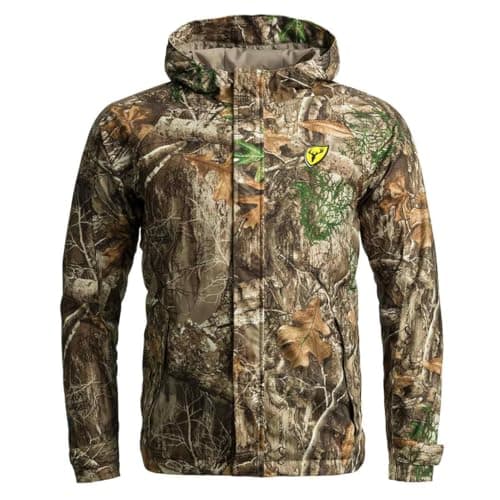
Every rain shell on the shelf will keep water off you for a few hours. That is not the hard part. The hard part is doing it without announcing your position to every deer inside 150 yards, and without turning into a sauna on the walk in. Hunting rain gear is a three-way compromise between waterproofness, breathability and noise — and the third one is the axis general-outdoor rain jackets ignore entirely.
This guide explains how to read the specs, which features actually change a wet sit, and five specific pieces we would buy at different budgets. Prices are approximate mid-2026 street figures; the live price boxes are the number to trust.
Why quiet beats waterproof
A crisp nylon shell — the standard construction for hiking rain jackets — makes a sharp rustle every time your arm moves against your torso. In an open hardwood on a still, wet morning, that sound carries far further than most hunters believe, and it is exactly the kind of unnatural, high-frequency noise a whitetail responds to. Rain masks some of it. Drizzle and post-rain stillness mask none of it.
Hunting-specific rain gear solves this with a brushed, tricot or micro-fleece face fabric laminated over the waterproof membrane. That soft outer surface muffles contact noise dramatically. It also costs you something real: brushed faces hold water in the nap, so the garment gets heavier and wets out sooner than a slick shell.
The practical consequence is that hunters usually want two different shells, not one: a slick, packable, ultralight one that lives in the bottom of the pack for the walk out in a downpour, and a quiet, brushed one that gets worn on stand in steady rain. Buying one shell to do both jobs is where most disappointment comes from.
Reading the specs: mm, breathability and DWR
| Hydrostatic head (mm) | How much water pressure the fabric resists before leaking. Roughly 5,000mm is adequate for light rain, 10,000mm+ handles sustained rain and sitting on wet surfaces, 20,000mm is expedition territory. Sitting down puts far more pressure on the seat of a pant than rain does on a shoulder - which is why pants need the higher number, not jackets |
|---|---|
| Breathability (g/m2/24h or MVTR) | How much water vapor escapes. Under ~5,000 is effectively a rain suit you sweat in; 10,000-20,000 is usable while moving. Note the two numbers trade against each other - very waterproof usually means less breathable at the same price |
| DWR (durable water repellent) | The surface treatment that makes water bead. It is not what makes the garment waterproof, but when it wears off the face fabric 'wets out,' breathability collapses, and you feel clammy and assume the membrane failed. It has not - it needs re-treating |
| Taped seams | Non-negotiable. Every needle hole is a leak until it is taped. 'Critically taped' means only some seams are done - fine on a budget piece, worth knowing |
| Waterproof vs water-resistant | Water-resistant means treated fabric with no membrane. It handles drizzle and nothing else. If the listing does not say waterproof and taped, assume it is not |
One honest caveat about numbers in this category: hunting brands publish them far less consistently than backpacking brands do, and many popular hunting shells list no rating at all. That is not automatically a red flag — it reflects a different market — but it does mean owner reports and return policies matter more here than spec comparison.
The features that matter in a stand
- Pit zips. The single most useful feature on hunting rain gear, because they let you dump heat on the approach without taking the shell off in the rain. Their absence on a jacket you will walk in is a bigger deal than 5,000mm of rating.
- Full-zip or three-quarter-zip pants. Pulling rain pants over boots in the dark, in the rain, standing on one leg, is how hunts start badly. Side zips let you put them on without removing boots.
- A hood that turns with your head. Look for a stiffened brim and a rear volume adjuster. A hood that blocks your peripheral vision when you turn is a hood you will take down, which defeats the purpose.
- Packability. A shell that stuffs to the size of a water bottle gets carried. One that does not gets left in the truck on the morning it rains.
- Cuffs and hem you can seal. Water runs down a raised arm at full draw and enters at the cuff. Velcro tabs matter.
- Pocket placement above a harness or pack belt. Standard hip pockets are unusable under a safety harness waist strap. Chest pockets are the hunting answer.
- Length. A jacket that rides up when seated exposes your lower back to the rail of a stand. Hunting cuts run longer than hiking cuts for this reason.
The picks at a glance
| Piece | Type | Noise | Best for | Approx. price |
|---|---|---|---|---|
| Blocker Outdoors Drencher Jacket | Lightweight breathable shell | Low-moderate | Best value all-rounder | ~$60 |
| Frogg Toggs Pilot II Guide Jacket | Waterproof breathable shell | Moderate | All-day hard rain | ~$130-190 |
| Gamehide Trails End Jacket | Brushed waterproof hunting shell | Very low | Quietest for the money | ~$90 |
| Huntworth Winsted Tricot Jacket | Tricot-faced waterproof jacket | Very low | Cold-and-wet season sits | ~$85 |
| Badlands Exo Rain Pant | Packable rain pant | Low | Carrying rain protection all season | ~$190 |
Prices are approximate mid-2026 brackets and vary widely by size and pattern; verify before buying.
Best value: Blocker Outdoors (ScentBlocker) Drencher Jacket
The Drencher is the piece we would point most hunters to first, because it solves the actual problem — carrying rain protection you will actually have with you — for around $60 (verify current pricing). It is a lightweight, breathable, waterproof hunting shell that packs small enough to live in a pack pocket from October through January without you resenting the weight.
Blocker Outdoors builds it as hunting gear rather than adapted outdoor gear, which shows up in the details that matter: hunting-appropriate patterns, a cut long enough to stay put seated, and a face fabric noticeably quieter than a comparably priced hiking shell.
Honest cons: at this weight and price it is a shell, not a fortress. In sustained, wind-driven, all-day rain it will eventually wet out, and it has neither the fabric weight nor the feature set of the $200 pieces. Treat it as the shell that is always with you rather than the one you plan a wet-weather week around.
Who it’s for: almost everyone, as a first purchase — and as the permanent pack shell even after you buy something heavier.
Best all-day protection: Frogg Toggs Pilot II Guide Jacket
Frogg Toggs made its name on disposable-cheap rain suits; the Pilot II Guide is the serious end of the line. It is a genuinely waterproof, breathable jacket built for people who are outside in weather for a living — guides, waterfowlers, anyone whose day does not end when it starts raining — and it typically street-prices from about $130 to $190 depending on size and colorway (verify current pricing).
What you get for the step up from the Drencher is durability and sustained performance: heavier fabric, better hardware, a hood built to stay up in wind, and the kind of construction that survives a season in a boat or a marsh rather than a handful of wet sits.
Honest cons: it is a fishing-and-guide lineage jacket, so the face fabric is slicker and noisier than a purpose-built brushed hunting shell — better for a duck blind or a boat than for a still-hunt through hardwoods. It is also heavier and less packable than the Drencher, and the colorways skew toward marine rather than timber. If you hunt waterfowl, see our duck hunting waders guide for the rest of that system.
Who it’s for: waterfowlers, boat hunters, and anyone who is out in weather often enough that a cheap shell becomes an annual purchase. If your time on the water is really the occasional day — you book a fishing charter once or twice a season rather than running your own boat — the cheaper Drencher above is the honest answer, and the difference is better spent on the rest of your kit.
Quietest for the money: Gamehide Trails End Waterproof Jacket
Gamehide is a smaller name that has quietly built its reputation on exactly the thing this category needs: soft, silent face fabrics on waterproof shells at working-hunter prices. The Trails End is a waterproof hunting jacket at around $90 (verify current pricing) whose main argument is that a deer at 40 yards will not hear your arm move.
For a whitetail hunter sitting a stand in steady drizzle — which is most of what "rain gear" means in the East — that is the single most valuable property a shell can have, and it is one the big-box $60 shells and the $200 marine shells both miss.
Honest cons: brushed face fabrics absorb water in the nap, so it gets heavier and wets out sooner than a slick shell in sustained downpour, and it does not pack down small. Gamehide’s sizing and pattern availability are also less consistent than the major brands — check the size chart rather than assuming your usual.
Who it’s for: stand and blind hunters whose rain is usually drizzle, and anyone who has spooked deer with a noisy shell and does not intend to do it again.
Best budget cold-and-wet shell: Huntworth Winsted Tricot Jacket
Huntworth has built a business on delivering hunting-specific construction at prices that undercut the name brands, and the Winsted is the clearest example: a tricot-faced waterproof hunting jacket for roughly $85 (verify current pricing). Tricot is a knit face that is both quiet and a little warmer than a plain shell, which makes this the right pick for the specific late-season problem of cold rain rather than warm rain.
It sits in an awkward and useful gap: not as packable as the Drencher, not as bombproof as the Pilot II, but quieter than either and warm enough to be the outer layer rather than an extra one.
Honest cons: the added warmth is a liability on a mild wet day, breathability is modest, and Huntworth’s finish quality — zipper pulls, cuff adjusters, hood hardware — is visibly a tier below the premium brands. It is honest value, not a hidden $200 jacket.
Who it’s for: late-season stand hunters in cold rain and sleet who want one quiet outer layer instead of a shell over a jacket.
Best packable pant: Badlands Exo Rain Pant
Rain pants are the half of the system hunters skip, and it is the wrong half to skip — sitting on a wet stand seat or kneeling in wet grass puts far more water pressure against fabric than rain falling on your shoulders ever does. The Badlands Exo is a genuinely packable rain pant, around $190 (verify current pricing), which is the property that determines whether it is with you when the weather turns.
Badlands backs its gear with an unconditional lifetime warranty, which changes the value math on a piece like this: a $190 pant you keep for fifteen years is cheaper than four $60 pants.
Honest cons: the price is real and hard to justify if you hunt six days a year in dry country, the ultralight fabric is less abrasion-resistant than a heavier pant in briars, and packable shells are the noisier end of the spectrum — this is the pant you pull on when it starts raining, not the one you still-hunt in all morning.
Who it’s for: western and backcountry hunters carrying everything, and anyone who has decided to stop leaving rain pants in the truck.
The Kings XKG rain option
Kings Camo’s XKG line includes rain shells positioned as the value alternative to the premium technical brands, and if you are already running an XKG layering system, buying the shell from the same line keeps sizing and layering thickness consistent. We cover exactly where Kings closes the gap on the premium brands — and where it does not — in our Kings Camo vs Sitka comparison.
Making rain gear last
| Wash it - really | Body oils and dirt are what kill DWR and clog membranes. A dirty shell breathes worse than a clean one. Use a technical wash, never detergent with softeners or brighteners |
|---|---|
| Re-treat the DWR each season | Wash-in or spray-on. When water stops beading and the face fabric goes dark in the rain, the DWR is gone - not the membrane |
| Tumble dry low or iron on low through a cloth | Heat reactivates most DWR treatments. Check the care label first |
| Hang it, do not stuff it | Long-term storage compressed in a stuff sack creases laminates and eventually cracks them |
| Dry it before it goes in the truck | A shell packed wet for a week delaminates and smells - and human scent is the last thing you want on your outer layer |
The bottom line
Buy for the rain you actually get. In the East, that is drizzle and steady light rain on a stand, and the answer is a quiet brushed shell — the Gamehide Trails End or the Huntworth Winsted. If you need one shell that lives in the pack and covers everything, the Blocker Outdoors Drencher is the value answer. For genuinely hard, all-day weather — marshes, boats, guide work — the Frogg Toggs Pilot II Guide is built for it. And whatever jacket you pick, buy the pant too.
Rain gear is the outer shell of a system. What goes under it matters just as much — see hunting base layers and cold weather hunting clothes.
Frequently asked questions
What makes hunting rain gear different from regular rain jackets?
Noise. Standard hiking and marine rain shells use slick nylon face fabrics that crackle audibly every time your arm brushes your torso - a sound that carries in wet, still woods and that deer react to. Hunting rain gear laminates a brushed, tricot or micro-fleece face over the waterproof membrane to muffle that contact noise, accepting slightly worse wet-out performance in exchange.
What waterproof rating do I need for hunting rain gear?
Around 5,000mm handles light rain, 10,000mm and up handles sustained rain and sitting on wet surfaces, and 20,000mm is more than most hunters need. Pants need the higher number more than jackets do, because sitting down puts far more pressure against the fabric than falling rain does. Note that many hunting brands do not publish ratings at all.
Why does my waterproof jacket feel wet inside?
Usually the DWR surface treatment has worn off rather than the membrane failing. When the face fabric soaks through - 'wetting out' - vapor can no longer escape, so your own sweat condenses inside and you feel clammy. Wash the shell with a technical cleaner and re-treat the DWR, and it will usually breathe like new again.
Do I really need rain pants, or is a jacket enough?
Pants matter more than most hunters think. Sitting on a wet stand seat, kneeling in soaked grass, or pushing through wet brush puts sustained pressure and contact against the fabric, which is a harder test than rain falling on your shoulders. Cold, wet legs also end sits as reliably as a cold torso.
Can I use a regular hiking rain jacket for deer hunting?
It will keep you dry, and in a downpour the rain masks its noise. In drizzle and in the still period after rain stops - which is often the best movement of the day - the crackle of a slick shell is a real liability. If it is what you own, hunt in it, but make a quiet shell the next upgrade.
How do I wash hunting rain gear without ruining it?
Use a technical wash made for waterproof-breathable garments, never regular detergent, and skip fabric softener entirely - both leave residues that block breathability, and household detergents add optical brighteners that fluoresce under the UV light deer see well. Tumble dry on low afterward if the label allows, since heat reactivates most DWR finishes.
Sources
- WindRider - best hunting rain gear 2026: jackets and suits by season (mm ratings, quiet-fabric notes)
- Hunting Magazine - best camo rain gear for bowhunting
- Hunters Loadout - best hunting rain gear: waterproof jacket reviews and guide
- Guns Corner - best rain pants for hunting: waterproof, quiet, packable
- The Old Deer Hunters - best rain gear for hunting
- Product specs, availability and pricing verified via the Amazon Creators API, 2026-08-13
- Kings Camo - XKG series
Keep reading
Gearing up before your next hunt?
See how we evaluate gear, then dig into the reviews and buying guides — written without inventory to sell.