Buying Guide
Best Air Rifle Scopes (2026)
An ordinary rifle scope cannot focus at 20 yards, and a spring-piston airgun can destroy one outright. Those two facts decide this entire category - so here is how to read them off a spec sheet, then five scopes that pass.
Most people buy an air rifle scope the way they buy a firearm scope: pick a magnification, pick a brand they recognize, spend what the budget allows. It is the wrong method, and it is why so many airgunners end up with a perfectly good scope that will not group. Airguns break two assumptions that every ordinary rifle scope is built on — that you are shooting past 100 yards, and that recoil only travels backwards. Get those two specs right and a modest scope will shoot brilliantly. Get them wrong and an expensive one will disappoint you, or simply die.
So this guide does the criteria first: what parallax actually is and why the number on your scope's box is probably 100 yards, what a spring-piston powerplant does to glass that was never designed for it, and why the rings matter as much as the scope on a springer. Then five picks that clear those bars — each with its honest cons, because every one of them has some. Prices move constantly in this category, so we show the live price rather than printing a number that goes stale; think of the picks in brackets, from a budget springer scope to a premium airgun-specific option.
The parallax problem: why firearm scopes cannot focus
Parallax sounds like an optics-nerd word and is really a very physical problem. Inside a scope, the image of your target and the reticle sit on two different focal planes unless the scope is focused for the distance you are actually shooting. When they do not line up, the crosshair visibly crawls across the target as you shift your head behind the scope — which means the rifle is no longer pointing where the reticle says it is. You can hold a perfect sight picture and still miss.
Here is the catch that catches airgunners. A scope has to be focused for some distance, and if it has no adjustment, the factory picks one. As Hard Air Magazine puts it, a scope without adjustable parallax "is likely to be designed for use with firearms and so be focused at 100 Yards." Vortex prints it right on the spec sheet for the Diamondback 4-12x40: parallax setting, fixed at 100 yards. Even a rimfire-specific scope is only set to about 50 yards.
Now consider where you actually shoot an air rifle: a squirrel at 25 yards, a starling at 15, a paper card at 10 meters. Parallax error grows the further your target sits from the scope's fixed focus distance — so a 100-yard scope is at its worst precisely across the airgun band, and the targets are small enough that the error is a clean miss rather than a harmless wobble.
There is a bonus you get for free. Because the parallax ring is calibrated in yards, it doubles as a rangefinder: dial until the target snaps into focus, read the distance off the ring. Pellets fly a rainbow trajectory compared to a bullet, so knowing whether that squirrel is at 20 or 35 yards is the difference between a hit and a story — and your scope will tell you if you let it.
The springer problem: recoil that runs both ways
The second failure mode only affects some airguns, and it destroys scopes rather than merely frustrating them. A spring-piston or gas-ram rifle does not recoil once. Umarex describes the mechanism plainly: "the first impulse comes from the release of the spring and piston assembly. The second impulse occurs when the piston assembly comes to a stop at the end of the cylinder" — and critically, "the second impulse is going in the opposite direction of the first recoil impulse. It is this impulse that can cause damage to your optic."
Ordinary rifle scopes are braced against rearward recoil, because that is the only direction a firearm pushes. A springer adds a sharp forwardjolt that the lens elements and erector tube were never designed to survive. That is why the failure is so counterintuitive: as Hard Air Magazine warns, "even the most expensive, $1,000+, scopes can be ruined by shooting with a cheap, $100, breakbarrel if they are not specifically designed for airgun use." Price is no protection. Design is.
One honest caveat that shapes every pick below: this is a category where marketing outruns documentation. Very few makers publish an explicit spring-piston durability rating. Plenty of scopes are sold as "airgun" scopes on the strength of a close-focus AO ring and an airgun-friendly reticle, which is not the same claim. Below, we say exactly what each manufacturer does and does not commit to in writing — and where the only evidence is a forum report or a retailer's own marketing copy, we say that too.
Rails, rings and the stop pin
On a springer, the rings are not an accessory — they are part of the recoil system, and they are where most first builds go wrong.
| Dovetail (11mm / 3/8 in) | The traditional airgun rail. Rings clamp onto a smooth trapezoidal groove - nothing but friction stops the scope walking backwards under repeated recoil |
|---|---|
| Weaver / Picatinny | Increasingly common on airguns. Ring lugs drop into transverse slots, so it resists creep mechanically rather than by clamping force |
| Scope stop pin | A small vertical peg on the mount that seats into a hole in the receiver, restoring a mechanical lock on a dovetail. Essential on a magnum springer, rarely needed on a PCP or low-power gun |
Two traps worth knowing about before you order. First, "11mm" is a nominal label, not a standard — real dovetail widths run anywhere from about 9.5mm to 14mm depending on who made the rifle, which is why rings that fit your friend's gun may not close on yours. Second, several excellent airgun-market scopes ship with Picatinny/Weaver rings in the box, including two of the picks below. If your rifle has a dovetail, those rings are the wrong shape and you will need a dovetail-to-Weaver adapter — an easy fix, but only if you know before the scope arrives.
As Airgun Depot puts it, if your gun is a lower-recoiling type — a mild springer, or any PCP or CO2 gun — "a scope stop is rarely called for as the recoil isn't enough to cause your scope to creep." On a magnum break-barrel it is the difference between a zero that holds and a scope that has quietly slid a quarter-inch back in its rings by lunchtime.
Good scopes that are wrong for this job
It is worth naming the trap directly, because these are genuinely good scopes and we are not sending you to buy them. The Vortex Diamondback 4-12x40 and the Bushnell Banner 3-9x40are two of the most-recommended budget hunting scopes on the internet, they are well made, and both carry excellent warranties — Vortex's VIP warranty is famously unconditional. Both are also fixed at 100-yard parallax with no adjustable objective at all, confirmed on Vortex's own spec sheet. On a deer rifle, that is exactly right. On an air rifle at 25 yards, it is the one thing you cannot fix later, at any price, with any amount of practice.
The same logic rules out the great mass of $30 "air rifle scopes" on Amazon. Some of them do have an AO ring. Almost none of them will hold zero on a magnum springer, and the ones that fail do it quietly — a group that walks over a tin of pellets, which you will blame on yourself, your hold, and your pellets for a month before you blame the scope.
The picks at a glance
Five scopes, five different jobs. Every one focuses close enough for real airgun ranges — that was the entry requirement — and the column that matters most is the last one, which is the honest answer to "will this survive a magnum break-barrel?"
| Scope | Min. parallax | Rings included | Price bracket | Spring-piston durability claim |
|---|---|---|---|---|
| Hawke Vantage 4-12x40 AO | 10 yd (AO ring) | No | Mid-range | None published; users report Hawke support caps it at 12 fpe |
| Hammers 4-12x40AO | 5 yd (AO ring) | Yes - 11mm dovetail, with stop pin | Budget | Yes - explicitly reinforced for piston airguns |
| UTG BugBuster 3-9x32 AO | 3 yd (AO ring) | Yes - Picatinny QD | Mid-range | None published by Leapers |
| UTG 4-16x44 30mm | 10 yd (side wheel) | Yes - Picatinny QD | Mid-range | "Fully tested on both air rifles and firearms" - no springer rating |
| Hawke Airmax 4-12x40 AO | 10 yd (AO ring) | No | Premium | Airgun-designed, but no explicit springer rating |
Best overall: Hawke Vantage 4-12x40 AO
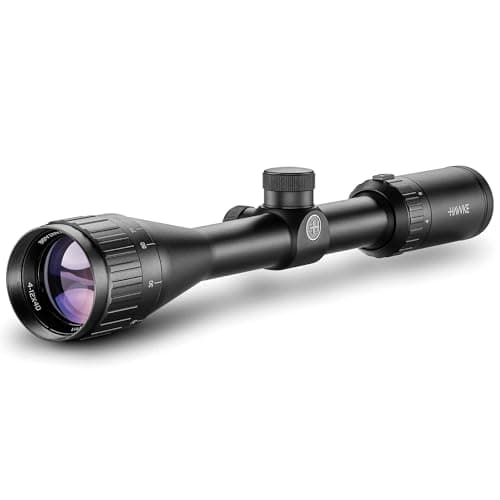
Hawke has spent two decades selling into the airgun market, and the Vantage is the scope that shows up on more air rifles than any other in its price class — because the spec sheet fits the job almost perfectly. The adjustable objective focuses from 10 yards to infinity, the 4-12x range covers everything from a garden pest at 15 yards to a bench group at 50, and it is a one-inch mono-tube with capped, resettable 1/4 MOA turrets and 3.5 inches of eye relief in a 13.6-inch, 17.1-ounce package. The 30/30 duplex reticle is uncluttered and quick. Behind it sits Hawke's No-Fault Lifetime Warranty, which is genuinely no-fault for the original purchaser.
Honest cons, and one is important. Hawke does notpublish a spring-piston durability rating for the Vantage — their page says only "all caliber rated," which is a firearm-caliber statement, not a double-recoil one. Airgunners on AirgunNation report that Hawke support told them the Vantage line is rated for springers under 12 foot-pounds, which would exclude most magnum break-barrels; users in the same thread report running them on 13-18 fpe guns without failures so far. Treat it as a warranty risk, not a certainty. Beyond that: the objective-mounted parallax ring is stiff and awkward to reach compared to a side wheel, the fine reticle disappears against dark targets in low light, and rings are not included.
Who it's for: the PCP shooter or mild-springer owner who wants the best all-round airgun scope for the money and a warranty that will actually answer the phone. If you shoot a hard-kicking magnum break-barrel, buy the Hammers below instead.
Best for magnum springers: Hammers 4-12x40AO
This is the only scope here that answers the springer question in writing. Hammers builds it specifically for "high power magnum spring" air rifles and states that it is "internally reinforced to stand the unique shocking from piston type high power air rifle", in a one-inch mono-tube chosen for shock resistance. It is also the only pick that ships a springer-correct mounting solution in the box: a solid one-piece mount with four clamping screws and a built-in stop pin, sized for 3/8-inch and 11mm dovetails — exactly the mechanical lock a dovetail springer needs to stop the scope creeping. Its AO ring focuses closer than the Hawkes, down to about 5 yards, and the mil-dot reticle gives you holdover points for a pellet trajectory. It is also the cheapest scope here by a wide margin.
Honest cons, and there are real ones. The most common complaint is running out of elevation travelbefore reaching zero on some break-barrels — one AirgunNation user could not get there and found similar reports in the Amazon reviews. A later commenter in that same thread found the cause on his own copy: "almost every securement screw was very loose. After tightening them I was able to zero it perfectly" — so check and torque every screw before you conclude the scope is faulty, and be prepared to add an adjustable or shimmed mount if it still will not come down. The eye box is unforgiving (the image grays out if your head is off-center), the turret clicks are mushy, and at 23 ounces and 13.75 inches it is the biggest, heaviest scope in this lineup.
Who it's for: the magnum break-barrel owner — a Gamo Swarm Magnumor Hatsan Mod 95 class rifle — who wants glass that is built for two-way recoil and a mount that will not walk, without spending more on the scope than the rifle cost.
Best compact and close-range: UTG BugBuster 3-9x32 AO
The BugBuster has been the cult airgun scope for years, and the reason is on the spec sheet: it focuses down to 3 yards— closer than anything else here, and close enough for rats in a barn, backyard pest work at arm's length, and 10-meter target practice where every other scope is a blur. It is tiny (8.1 inches, 13.2 ounces), which suits a short PCP carbine or a youth rifle where a full-length scope looks absurd, and it packs in an illuminated red/green mil-dot, 1/4 MOA turrets, generous 3.2-4.2 inches of eye relief and Leapers' lifetime defects warranty. QD rings are in the box.
Honest cons. Leapers does notpublish a spring-piston rating — their page claims the "True Strength" platform and shockproof construction, and while Hard Air Magazine judges that platform to protect against "the violent reverse recoil which can be generated by high-powered spring/piston and gas ram-powered air rifles," that is HAM's assessment, not a Leapers guarantee. The most common owner complaint is exactly the one that matters — that it will not hold zero, with broken turrets and short service lives reported on Pyramyd AIR. The included QD rings are Picatinny, not dovetail, so most springer owners need an adapter. And the very short body that makes it so handy also makes eye relief hard to set: there is little fore-and-aft room to slide it into position.
Who it's for:close-range pest control, barn work and 10-meter plinking on a recoilless gun — a multi-pump like the Crosman 362or a compact PCP — where nothing else will focus that near.
Best high magnification for PCPs: UTG 4-16x44 30mm
Once you are shooting a regulated PCP off a bag at 50 yards, 12x runs out of resolution and you want to see the pellet holes. This UTG gives you 4-16x on a 30mm tube with a 44mm objective for light, and it adjusts parallax with a side wheel rather than a front ring— a real ergonomic upgrade, because you can refocus without coming off the gun, and it accepts an optional big wheel for finer distance calls. Parallax runs from 10 yards to infinity, the target turrets are zero-locking and zero-resetting, and it is remarkably short for the magnification at 10.6 inches. The illuminated mil-dot gives you holdover marks, Picatinny QD rings are included, and Leapers backs it with a lifetime repair-or-replace warranty.
Note the naming trap: "AO" is in the model name, but the adjustment is a side wheel, not an adjustable objective. Same result, different hand.
Honest cons. Leapers claims it is "fully tested on both air rifles and firearms" but stops short of a spring-piston rating — and the failure reports on Pyramyd AIR are exactly the springer ones: owners losing zero after a few hundred shots on recoiling gas-piston rifles, one running out of elevation entirely. Another reported the scope creeping backwards in its mounts on a Gamo Swarm Magnum. It is heavy at 20.6 ounces, the side wheel is stiff at the close end of its travel, and those Picatinny rings again need an adapter on a dovetail gun.
Who it's for: the PCP target shooter or long-range pest shooter who wants magnification and a side wheel, on a gun that does not recoil. We would not put it on a magnum springer.
Best airgun-specific premium: Hawke Airmax 4-12x40 AO
The Airmax is Hawke's dedicated airgun line — marketed, in their words, as "specialist scopes designed by airgunners for airgunners" — and the substance behind the slogan is the reticle. The AMX is glass-etched (more durable than a wire reticle) and laid out for the steep, curved trajectory of a pellet, so the holdover marks correspond to something useful instead of being generic mil-dots you have to reverse-engineer. The rest is a step up from the Vantage: 16-layer fully multi-coated H2 optics, 3.5 inches of eye relief, 80 MOA of adjustment, AO from 10 yards, and the same Hawke No-Fault Lifetime Warranty.
Honest cons, and the first one is awkward for a scope in this bracket. "Designed for airgunners" is a market claim, not a durability rating — Hawke publishes no explicit spring-piston ratingfor the Airmax either, and an Airgun Depot customer review states flatly that it is "not spring rated and will not hold up to a heavy or medium powered spring gun," with another reporting lost zero after roughly 100 shots on a medium-powered springer. Meanwhile it costs several times what the Hammers does, still ships without rings, and reviewers report a stiff parallax ring that can shift the sight picture as you turn it, plus a fine reticle that fades in low light.
Who it's for: the serious PCP shooter who wants the best glass and the best airgun reticle here and is not asking it to survive two-way recoil. If your rifle is a springer, the honest answer is that this is not the safer buy just because it is the dearer one.
The bottom line
Once the scope is mounted, the zeroing procedure is its own job — parallax, the artillery hold and a pellet’s rainbow trajectory all change how you do it. See how to sight in an air rifle.
Start with the powerplant, not the price. If your rifle is a magnum spring-piston or gas-ram break-barrel, the field narrows fast: buy the Hammers, because it is the only scope here whose maker commits in writing to surviving piston recoil, and because the one-piece dovetail mount with a stop pin solves the creep problem in the same purchase. Torque every screw before you zero it.
If your rifle is a PCP, CO2 or multi-pump, two-way recoil is not your problem and the whole market opens up. The Hawke Vantage is the best all-round buy and the one we would put on most guns; the UTG 4-16x44 adds magnification and a side wheel for bench and long-range pest work; the BugBuster is unbeatable up close and on short carbines; and the Hawke Airmax is the upgrade if you want a purpose-built airgun reticle and better glass.
Whatever you choose, budget for the mounts rather than treating them as an afterthought, check whether your rifle wears a dovetail or a Picatinny rail before the scope arrives, and remember the spec that started all this: if it will not focus at 10 yards, it is not an air rifle scope, however good it is at being something else. Pair it with the right rifle from our guide to the best air rifles, and the glass will finally be the part you stop thinking about.
Frequently asked questions
Do I really need a special scope for an air rifle?
You need close-focus parallax on every airgun, and recoil-hardened glass only on some. Ordinary rifle scopes without an adjustable objective are focused at a fixed 100 yards (about 50 on rimfire scopes), which produces the most parallax error precisely at the 10-35 yard distances airgunners shoot. Separately, spring-piston and gas-ram rifles recoil in two directions and can destroy a scope built only for rearward recoil - Hard Air Magazine notes even a $1,000 scope can be ruined by a cheap breakbarrel. PCP, CO2 and multi-pump airguns are recoilless, so they only need the close focus.
What does AO mean on an air rifle scope?
AO stands for adjustable objective - a focus ring on the front bell of the scope that lets you set parallax for the distance you are actually shooting, instead of the fixed 100 yards a firearm scope is locked to. Some scopes do the same job with a side-focus wheel near the turrets, which is easier to reach without coming off the gun. Either is fine; what matters is the minimum distance it will focus to. Aim for 10 yards or closer. As a bonus, the ring is marked in yards, so it doubles as a rangefinder for judging pellet holdover.
Will a spring-piston air rifle break a normal rifle scope?
It can. Umarex explains that a springer produces two recoil impulses - one when the piston launches, and a second, opposite one when the piston slams to a stop - and that the second, forward impulse is what damages optics. Conventional scopes brace their lens elements against rearward recoil only, so the forward jolt hits them in the one direction nothing is holding. Scopes built for airgun use brace the glass on both sides. If you shoot a magnum break-barrel, buy a scope whose maker states it is reinforced for piston airguns.
Do air rifle scopes come with mounts, and will they fit my gun?
Some do, and the rail type is the thing to check before you order. Airguns traditionally use an 11mm (3/8-inch) dovetail, but Weaver/Picatinny rails are increasingly common - and several airgun-market scopes, including the UTG BugBuster and the UTG 4-16x44, ship with Picatinny rings that will not fit a dovetail without an adapter. The Hammers is the exception here: it includes a one-piece dovetail mount with a built-in stop pin. Note also that '11mm' is a nominal label - actual dovetail widths vary from about 9.5mm to 14mm between manufacturers.
What is a scope stop pin and do I need one?
It is a small peg on the scope mount that drops into a hole in the rifle's receiver, mechanically locking the mount so recoil cannot push it backwards. Dovetail rings otherwise rely on clamping friction alone, and the repeated two-way jolt of a magnum springer can walk the whole scope back in its rings, ruining your zero. Airgun Depot notes that on lower-recoiling guns - a mild springer, or any PCP or CO2 gun - a scope stop is rarely needed because the recoil is not enough to cause creep. On a magnum break-barrel, use one.
Sources
- Hawke Optics — Vantage 4-12x40 AO 30/30 specifications
- Hawke Optics — Airmax 4-12x40 AMX specifications
- Hawke Optics — No-Fault Lifetime Warranty terms
- Leapers/UTG — BugBuster 3-9x32 AO (SCP-M392AOLWQ) specifications
- Leapers/UTG — 4-16x44 30mm Compact (SCP3-UM416AOIEW) specifications
- Umarex USA — What kind of scope can I put on my spring or gas piston air rifle?
- Hard Air Magazine — What's the best airgun scope for me?
- Hard Air Magazine — Leapers UTG scopes: value and quality for airguns
- Airgun Depot — Air rifle scope mounting (rails and scope stops)
- Vortex Optics — Diamondback 4-12x40 specifications (parallax fixed at 100 yards)
- AirgunNation — Hawke Vantage on a springer (Hawke support's 12 fpe guidance, user-reported)
- AirgunNation — Hammers 4-12x40AO zeroing and loose-screw reports
- Pyramyd AIR — UTG BugBuster 3-9x32 AO customer reviews
- Pyramyd AIR — UTG 4-16x44 AO SWAT customer reviews
- Airgun Depot — Hawke Airmax 4-12x40 AO customer reviews
Keep reading
Gearing up before your next hunt?
See how we evaluate gear, then dig into the reviews and buying guides — written without inventory to sell.