Buying Guide
Best PCP Air Compressors, Hand Pumps and Tanks
A precharged rifle is only as good as the air you put in it. Here is what each way of filling one actually costs you - in money, in labor, and in the moisture that quietly destroys regulators.
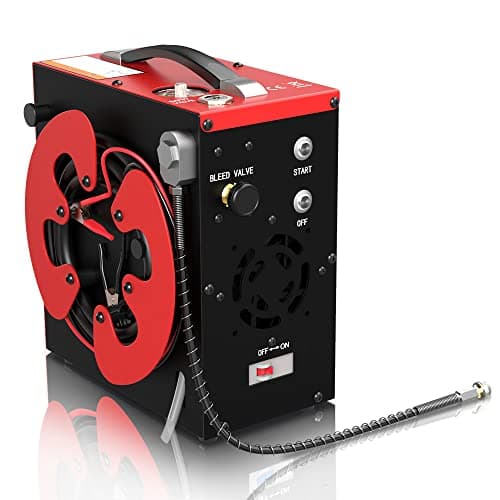
Nobody buys a precharged rifle because they want to think about air. But the day the gun arrives, the air supply stops being an accessory and becomes the thing that decides whether you shoot on a Tuesday evening or wait until the weekend to drive somewhere.
Our PCP buying guidecovers why these rifles shoot better than springers, and it puts the true cost of entry plainly: the rifle is only part of the purchase. This guide is the other part — what to actually buy to fill it, and the two mistakes (moisture, and tank certification) that turn a cheap solution into an expensive one.
The three ways to fill a PCP
There are only three sources of high-pressure air, and they are not really competing products. They are three different trades between money, effort and how far you have to travel.
- A hand pump compresses atmospheric air in stages, much like a bicycle pump built to survive pressures a hundred times higher. It is the cheapest way in and the only one that works with no power at all.
- A carbon fiber tankis a storage bottle you get filled somewhere else — a dive shop, a fire equipment supplier, a paintball store — and then decant from at home. There is no machine to maintain, but you are dependent on a place that will fill it.
- An electric compressor makes its own air on demand. It is the only option that never runs out and never requires a trip, which is why most people who stay in the sport end up owning one.
Fill pressure narrows the field before preference does. Pyramyd AIR’s buying guidance is blunt about it: below roughly 3,500 psi a hand pump or a small compressor will serve, and at 4,500 psi and above a compressor is effectively required. Reservoir size matters the same way — small compressors handle rifles with reservoirs under 300cc comfortably, start needing cooling pauses in the 300–500cc range, and are out of their depth above 500cc.
What actually matters
| Maximum pressure | Has to exceed your rifle's fill pressure, not match it. A compressor rated to exactly 4,500 psi is working at its ceiling every single fill, which is where heat and wear come from |
|---|---|
| Duty cycle and cooling | The most misunderstood spec. Fan-cooled portables are built for short runs with cooldown pauses; water-cooled units run longer but require you to manage a water supply. Neither is a mistake - but running a portable like a shop compressor is |
| Moisture management | Compressed air carries the water that was in the atmosphere, and it condenses out as the air cools inside your gun. Look for a built-in water-oil separator, and plan on an inline filter beyond it |
| Auto shut-off | Set the pressure and walk away. Without it you are watching a gauge for the entire fill and a moment of inattention overfills a reservoir |
| What it can actually fill | Small portables fill onboard gun reservoirs. They are not designed to charge a carbon fiber bottle and will take a very long time trying. Confirm this before you buy one expecting to do both |
| Power source | 12V DC lets you fill at the range off a vehicle battery; 110V AC is the home option. The good portables do both, usually through an included converter |
| Consumables and maintenance | Oil-free units need filter media changed. Oil-lubricated units need oil changes and cooling water on top of that. This is an ongoing cost, not a one-time purchase |
Moisture: the failure nobody budgets for
If this guide changes one decision, let it be this one. Every method of compressing air concentrates whatever water vapor was in the atmosphere when you started. That water stays suspended while the air is hot and condenses into liquid as it cools — which happens after it is already inside your rifle’s reservoir.
The result is corrosion in the tube and, far sooner, contamination of the regulator and valve seals. Regulated PCPs are the most vulnerable, because a regulator is a precision assembly of small seats and springs that does not tolerate rust particles or standing water.
None of this means you should not buy a pump. It means an inline filter is part of the purchase rather than an upgrade, and that you should drain the water trap on whatever you own every time you use it.
The three routes at a glance
| Hand pump | Carbon fiber tank | Portable compressor | |
|---|---|---|---|
| Up-front cost | Lowest | Middle | Highest of the three |
| Ongoing cost | None | Every refill at a shop | Filter media, power |
| Effort per fill | Genuine physical work | Seconds - open a valve | Minutes, unattended |
| Needs power | No | No | 12V DC or 110V AC |
| Needs a trip | No | Yes, to refill the bottle | No |
| Air dryness | Worst | Best - shop air is filtered | Middling |
| Best suited to | Backup, low fill pressures, small reservoirs | Shooters near a shop that fills DOT bottles | Anyone who shoots weekly |
A useful way to read that table: the tank has the best air and the worst logistics, the pump has the worst air and the best independence, and the compressor is the one that removes the reason you would stop shooting.
Best for most owners: GX PUMP GX-E-CS3
The CS3 is the portable that most PCP owners should buy first. It is oil-free and fan-cooled, carries a built-in water-oil separator filter, shuts off automatically at your set pressure, and runs from either a car’s 12V outlet or a household 110V outlet through the included converter. It sits in the mid three-figure bracket — more than a hand pump, less than a serious shop machine.
The published fill figures give you an honest sense of scale: a 190cc reservoir from 1,800 to 3,300 psi in about two and a half minutes, and a 480cc reservoir from 1,800 to 3,500 psi in around seven and a half minutes. It is rated to 4,500 psi, draws 250W, and runs at roughly 75 dB — loud enough that you will not run it next to someone on the phone.
Honest cons: it is an onboard-reservoir machine, not a tank charger — the manufacturer targets vessels under a liter, and asking it to fill a carbon fiber bottle is asking for a very long run and a hot compressor. Fan cooling means cooldown pauses if you are filling several guns back to back, the water trap needs draining after every session, and the filter media is a consumable you will replace.
There is also a CS3-I variant with the converter built into the unit rather than sitting on the cord. If you can find it at a similar price, the tidier package is worth having.
For higher fill pressures: GX PUMP GX-E-CS4
The CS4 is the same idea with more headroom: a 350W motor and a maximum of 5,800 psi / 40 MPaagainst the CS3’s 4,500. That matters for two reasons. Some current rifles fill to 4,500 psi, and a compressor whose ceiling is also 4,500 psi is working flat out on every fill. And if you ever intend to top off a bottle rather than only a gun, the extra pressure and motor are the difference between slow and hopeless.
Buy it if your rifle fills above 3,600 psi, if you own more than one PCP, or if you would rather buy the machine once. The unit linked below is the CS4-I, which builds the power converter into the compressor instead of leaving it on the cord — one less loose box to lose.
Honest cons: it costs meaningfully more than the CS3 and it is still a portable-class machine, so the duty-cycle discipline does not go away — you are buying more ceiling, not a shop compressor. For a single rifle that fills to 3,000 psi it is more machine than the job needs.
Cheapest real compressor: Yong Heng 4500
The Yong Heng is the compressor that made home filling affordable, and it is still the cheapest way to own one. This version adds an LCD display, an auto-stop that holds your set pressure, and a built-in water-oil separator. It is rated to 4,500 psi / 30 MPa. On capability per dollar nothing else here is close.
What you are accepting in exchange is a machine that asks something of you. It is water-cooled, not fan-cooled: the cooling coil sits in a bucket of water with the supplied pump circulating it, and the manufacturer’s instruction is that running it without water is forbidden. It is oil-lubricated, using ISO VG46 or AW46 oil on a splash system, so checking the oil level is a pre-flight step rather than an annual chore. And the filter cotton is specified for replacement after roughly 50 minutes of cumulative running.
Honest cons: all of the above. If you are the kind of owner who will not check an oil level or change water, this is the wrong machine and a fan-cooled portable is worth the extra money purely for the maintenance you will not do. It is also the heaviest and least portable option here — a garage appliance, not a range one.
Best hand pump: Air Venturi MK5 by Hill
If you are going to pump, buy the good one. The MK5 is a three-stage pump manufactured by Hill in England, rated to 4,500 psi / 310 bar, nickel plated, weighing 6.8 lbs, supplied with a 17.5-inch hose terminating in a 1/8″ BSPP female thread, and covered by a five-year limited warranty. Every unit is tested before it ships.
The reason to spend here rather than at the bottom of the market is that a hand pump is a pressure vessel you operate with your body weight several hundred times per fill. Sealing quality and stage design are what determine whether that is hard work or genuinely punishing work, and the MK5’s redesigned interior is aimed squarely at the last thousand psi where cheaper pumps become miserable.
Hill also sell a Dry-Packit version with color-changing desiccant media that removes a claimed 90% of intake moisture. Given everything above about water, that version is the one to want — but check what you are ordering, because the base pump listing is the pump alone.
Honest cons: no fitting in the box, no moisture filtration unless you buy the kit, and the physics do not care how good the pump is. Reaching 3,000 psi is manageable for most people; going beyond it rewards body mass over strength, which is why pumping is a poor primary plan for a 4,500 psi rifle with a large reservoir.
Cheapest pump: TUXING 4-Stage
A four-stage pump rated to 4,500 psi at a fraction of the MK5’s price. The extra stage is doing real work — more stages means each one compresses through a smaller ratio, which is what keeps the handle effort tolerable near the top of the range.
Its honest role is as a first air supply or a backup. If you have just bought a PCP and want to shoot this weekend without deciding your long-term plan, this is the least money that will get air into the gun. Keep it after you buy a compressor, too: a pump is the only thing that works during a power cut or on a hunt far from a vehicle.
Honest cons: it is built to a price, so expect shorter seal life than the Hill and more effort in the last stretch. It offers essentially no moisture management on its own, which makes an inline filter more important here than anywhere else in this guide.
The tank route, and the DOT trap
A carbon fiber bottle is the most pleasant way to fill a rifle. You open a valve, the gun fills in seconds from air that a commercial compressor already dried and filtered, and there is no machine in your garage to maintain. The catch is entirely about where you get the bottle refilled.
The Orcair 98ci / 1.6L is the pick for that reason: it is DOT marked, runs to 4,500 psi, and ships as a complete charging system with a dual-gauge valve, so a US dive shop or fire equipment supplier can fill it and you can decant from it without buying anything else.
The TUXING 183ci / 3Lis nearly twice the volume for less money, also to 4,500 psi and also supplied with a dual-gauge valve — but it is CE marked. If you own a compressor and simply want a buffer bottle you charge yourself, that is fine and the volume is excellent value. If your entire plan depends on a shop filling it, it is the wrong buy at any price.
Two things to budget for regardless of which you choose. A tank does not empty into your gun — it equalizes with it, so the usable fills you get shrink as bottle pressure falls, and the last portion of the bottle will only take a rifle to a partial charge. And cylinders are regulated equipment: under the DOT requalification rules in 49 CFR 180.205, fully wrapped carbon fiber cylinders are tested every five years and carry a fifteen-year service life. After that the bottle is done, whatever it looks like.
The filter that protects the gun
Whatever you buy, put a filter between it and your rifle. An inline high-pressure filter holds a water separator and desiccant media in the line, catching condensed water and particulate before it reaches a regulator that costs more to rebuild than the filter costs to buy.
GX’s own high-pressure filter is the straightforward choice alongside their compressors, and it is equally useful downstream of a hand pump. Cheaper inline separators exist for very little money and are still much better than nothing.
Honest cons: it is another fitting, another possible leak point, and its media is a consumable. That is a small price against the alternative.
Which should you buy?
| If you... | Buy | Why |
|---|---|---|
| Just bought your first PCP and fill to 3,000 psi | A four-stage hand pump plus an inline filter | Least money that gets you shooting, and it stays useful as a backup forever |
| Shoot weekly, one rifle, reservoir under 300cc | GX PUMP GX-E-CS3 | Portable, oil-free, auto-stop, fills the gun in minutes with no trip and no labor |
| Own a 4,500 psi rifle or more than one PCP | GX PUMP GX-E-CS4 | The 5,800 psi ceiling means it is not working flat out on every fill |
| Want a compressor for the least money and will maintain it | Yong Heng 4500 | Cheapest real compressor, provided you manage cooling water and oil |
| Live near a shop that fills DOT bottles | Orcair DOT 98ci tank | Driest air of any option and seconds per fill, with nothing to maintain |
| Already own a compressor and want faster fills | A carbon fiber bottle as a buffer | Charge the bottle at leisure, then fill the gun instantly from it |
The bottom line
For most people the honest sequence is a hand pump now and a compressor later, and there is no shame in it — the pump keeps its value as the thing that works when nothing else does. If you already know you will shoot every week, skip the intermediate step and buy the GX-E-CS3, or the CS4 if your rifle fills above 3,600 psi.
Buy an inline filter with whichever you choose, drain the water trap every session, and if you go the tank route, check for DOT marking before you check the price. Those three habits are the difference between a PCP that shoots the same in year five and one that needs a regulator rebuild in year two.
Check the GX-E-CS3 price on Amazon. If you are still choosing the rifle itself, start with our PCP air rifle roundup— shot count per fill is the spec that decides how much any of this matters — or with PCP vs break barrel if you have not committed to the platform yet. The rifles with the most to gain from a compressor are the big bores— a 4,500 psi reservoir is where hand-pumping stops being realistic.
Frequently asked questions
Do I need a compressor for a PCP air rifle?
Not necessarily, but it depends on your fill pressure. Below roughly 3,500 psi a hand pump or a small compressor will serve. At 4,500 psi and above a compressor is effectively required - hand pumping to that pressure is punishing work and a tank large enough to make it painless is its own logistical problem.
Can a portable PCP compressor fill a carbon fiber tank?
Generally no. Small portable compressors are designed for onboard gun reservoirs, typically under one liter, and manufacturers say so directly. They can technically move air into a bottle but it takes a very long time and runs the compressor far past a sensible duty cycle. Filling bottles is a job for a larger light-duty or commercial machine.
Why does moisture matter so much in a PCP?
Compressed air concentrates atmospheric water vapor, and that water condenses into liquid as the air cools inside your rifle's reservoir. The results are corrosion in the tube and contamination of regulator and valve seals. Regulated PCPs are the most vulnerable because a regulator is a precision assembly that does not tolerate rust particles or standing water. An inline filter and draining the water trap every session are the fixes.
Will a dive shop fill any carbon fiber tank?
No. US filling stations work to Department of Transportation certification, and shops routinely refuse CE-marked or otherwise non-DOT cylinders on legal and liability grounds. Plenty of tanks sold online are not DOT marked. Check the markings before buying if a shop refill is your plan.
How long do carbon fiber air tanks last?
Under the DOT requalification rules in 49 CFR 180.205, fully wrapped carbon fiber cylinders are hydrostatically tested every five years and carry a fifteen-year service life. At the end of that life the cylinder is out of service regardless of its condition, so a used bargain tank is worth exactly as many years as it has left.
Is the Yong Heng compressor worth it?
It is the cheapest way to own a compressor, and the capability per dollar is genuinely good. But it is water-cooled and oil-lubricated: the cooling coil sits in a bucket with a circulating pump and must never run dry, it uses ISO VG46 or AW46 oil on a splash system, and the filter cotton is specified for replacement after about 50 minutes of cumulative running. If you will not do that maintenance, an oil-free fan-cooled portable is worth the extra money.
How many pumps does it take to fill a PCP by hand?
It varies with reservoir size and how far down you have let it go, but a full fill from low pressure is commonly several hundred strokes. Reaching 3,000 psi is manageable for most adults; beyond that the effort climbs sharply and rewards body weight over arm strength, which is why hand pumping suits smaller reservoirs and lower fill pressures.
Sources
- Pyramyd AIR - Guide to Buying a PCP Compressor for Airguns (fill pressure and reservoir size thresholds, filtration, tank limitation)
- Airgun Depot - PCP Filling Options: Pros & Cons (hand pump moisture limitations, portable compressor filtration)
- Pyramyd AIR - Air Venturi MK5 Pump by Hill product specifications (3-stage, 4,500 psi/310 bar, 6.8 lbs, 17.5in hose, 5-year warranty, no Foster fitting included)
- GX Pump - CS3 product specifications (250W, 75dB, 12V DC / 110V AC, published fill times, sub-1L vessel guidance)
- Yong Heng YH-QB01 user manual (water cooling requirement, ISO VG46/AW46 splash lubrication, filter cotton service interval)
- US DOT / PHMSA 49 CFR 180.205 requalification requirements - fully wrapped carbon fiber cylinders, 5-year test interval and 15-year service life
- Product titles, specifications, availability and pricing verified via the Amazon Creators API, 2026-08-23
Keep reading
Gearing up before your next hunt?
See how we evaluate gear, then dig into the reviews and buying guides — written without inventory to sell.