Comparison
Cellular vs Non-Cellular Trail Cameras: You Are Buying Fewer Trips, Not Better Photos
The subscription is the obvious cost and the wrong thing to argue about. What a cellular camera actually sells you is not walking to the camera - and what a non-cellular camera actually costs you is a human visit for every photo, in the exact spot you want deer to feel safe. Here is how the two compare once you price that.
Buy cellular if the camera is more than a short walk from where you park, or if it sits anywhere you do not want to be walking during the season. Buy non-cellular if the camera is on ground you are already crossing anyway, or if you want to run four or five cameras without a recurring bill. That is the whole decision, and almost none of it is about photo quality.
The argument you will see everywhere is about the subscription, and the subscription is real — we have the brand-by-brand numbers in our trail camera plan comparison. But framing it as “free camera versus camera plus bill” gets the economics backwards, because a non-cellular camera is not free to operate. It is paid for in trips.
The verdict
A trail camera is not an entertainment device. It exists to tell you what is using a spot and when, so you can hunt that spot at the right time without having burned it first. Every design decision about a camera should be judged against that one job.
Measured that way, cellular and non-cellular are not better and worse versions of the same product. They make opposite trades:
A non-cellular camera is cheap, simple, has no bill, no signal requirement and a battery life measured in months. It requires a human being to walk to it and pull a card every time you want to know anything.
A cellular camera costs more up front, costs money every month, needs enough signal to transmit, and eats batteries faster. It tells you what walked past at six this morning while you are drinking coffee at home.
If your hunting ground is a back forty you walk daily anyway, the non-cellular camera wins on every axis that matters. If your camera is a mile in on a ridge you can only reach by crossing the bedding area, the cellular camera is not a luxury — it is the only version of this tool that does the job without wrecking the spot.
The decision in one table
| Cellular | Non-cellular | |
|---|---|---|
| Up-front cost | Higher for the camera, though the gap has narrowed sharply - the cheapest cellular cameras now overlap the mid-tier non-cellular ones | Lower, and the cheapest usable cameras are genuinely cheap |
| Recurring cost | A per-camera data plan, usually tiered by image count - see our plan comparison for brand-by-brand pricing | None, ever. SD cards and batteries are the only consumables |
| Trips to the camera | Battery and card maintenance only - a few per season | Every single time you want to see a photo |
| Battery life | Shorter. Every transmission costs power, and a busy camera on a frequent upload schedule drains fastest | Longer. The radio is the power hog and there isn't one |
| Signal requirement | Yes. No usable carrier signal at the tree means no photos off the camera | None |
| Theft awareness | You find out the same day, and some models offer GPS location features | You find out on your next card pull, which could be two weeks later |
| Legal risk | Several states restrict or ban cellular or transmitting cameras for hunting, and the rules are changing - see the legal section | Lower, but not zero - some bans cover conventional cameras too |
| Scales to many cameras | Poorly. The bill multiplies per camera, though several brands discount additional cameras | Well. The tenth camera costs the same as the first |
The cost nobody prices: trips to the camera
Here is the arithmetic that should decide this purchase, and we have never seen it on a product page.
Say you run a non-cellular camera and pull the card every two weeks, which is a normal interval if you want the information to still be useful. A fourteen-week season is seven visits per camera. Each visit means walking to the spot, standing next to the tree, touching the camera, and walking out — leaving scent on the ground and on the camera housing, making noise, and doing it at whatever time of day suits you rather than whatever time of day is least disruptive.
Run three cameras and that is twenty-one intrusions into your hunting area over a season, in the exact locations you have identified as the places deer want to be. Our deer patterning guide is largely about not doing that, and our scent control explainer is about how little you can do to undo it once you have.
The practical version of this: if you can reach the camera without crossing anything you care about, intrusion is close to free and a non-cellular camera is the better buy. If reaching the camera means walking through bedding cover or along the travel route you intend to hunt, the subscription is cheap.
What the subscription actually costs
We are not going to re-table every plan here, because we already did that work — our cellular trail camera plan comparison carries the current tiers for Spypoint, Tactacam, Moultrie, Stealth Cam, Reconyx, Bushnell, Browning and Spartan, including which brands discount additional cameras and which price every camera the same.
Three structural points from that page are worth repeating in a buying decision:
| Pattern | What it means for the decision |
|---|---|
| Plans are priced per camera | This is the single biggest factor in whether cellular scales for you. Two cameras is an annoyance; six cameras is a real line item. Some brands do discount the second and subsequent cameras, which is worth checking before you commit to a brand rather than after. |
| Tiers are sold by image count, not by data | So the variable that drives your bill is how busy the camera is, which you do not control. A camera on a field edge in October will burn through an entry tier that was perfectly adequate in July. |
| Annual billing and pausing both exist | Annual billing is meaningfully cheaper than monthly on several brands, and you can stop paying for the months you are not scouting. Nobody needs live photos from a soybean field in April. |
The upshot: cellular is cheap for one or two cameras on a short season and expensive for five cameras year-round. Price your actual plan before you buy the camera, not after.
Two failure modes cellular adds
A non-cellular camera has one way to fail you: the batteries die or the card fills, and you lose everything since the last pull. A cellular camera adds two more.
Signal.A cellular camera is a phone bolted to a camera, and it has the same problem a phone has at the bottom of a hollow. No usable carrier signal at the tree means no photos leave the camera, and you will not know until you check the app and see nothing. Several brands now ship dual-SIM or multi-carrier cameras specifically to attack this — the Spypoint Flex-M2 publishes dual-SIM LTE and the Tactacam Reveal X 3.0 publishes auto-connect multi-carrier behavior. If you hunt broken terrain, buy a multi-carrier camera and test it at the actual tree before the season, not at the truck.
Battery.Transmitting costs power. A cellular camera on an aggressive upload schedule in a busy spot will go through batteries much faster than the same camera set to upload once a day, and much faster than a non-cellular camera in the same place. This is the cost that surprises people, because it partly cancels the benefit: you went cellular to avoid walking in, and now you are walking in for batteries. The fix is lithium cells or an external power source rather than alkalines — our trail camera battery and solar panel guide covers the options, and on a cellular camera a solar panel is closer to mandatory than optional.
The photo you get is not always the photo on the card
This is the detail most likely to disappoint a first-time cellular buyer, and it is worth checking on the spec sheet of whatever camera you are considering rather than assuming.
Cellular cameras advertise their sensor — 32MP, 40MP, 64MP, 4K photo. What they transmit to your phone is a compressed image sized to go over a cellular network cheaply, and on many models the full-resolution file stays on the SD card in the camera. In practice that means the photo you use to identify a buck on your phone may be noticeably softer than the file sitting in the woods, and getting the good one still requires a card pull.
Practical consequences worth planning around:
| Implication | What to do about it |
|---|---|
| Transmitted images are for decisions, not for identification at distance | Judge 'something is using this trail at 6am' off the app. Judge 'is that the eight-point from last year' off the card, or set the camera to a closer, better-lit position. |
| Video is usually worse than photos over cellular | Most plans meter video separately and charge more for it, and transmitted clips are short and compressed. If you want video, you want it off the card. |
| A cellular camera still has a card in it | So the card still fills, and the card is still the thing holding your best images. A cellular camera is not a camera you never visit - it is a camera you visit on your schedule instead of its schedule. |
None of this is an argument against cellular. It is an argument against expecting cellular to be a non-cellular camera that mails you its card.
What happens when the plan lapses
This is the reassuring part, and it is a genuine point in cellular's favor that rarely gets made: a cellular camera with no active plan is a non-cellular camera. It still triggers, still records to the SD card, and still works perfectly as a card-pull camera. You lose the transmission, not the camera.
That changes the risk calculus of trying cellular. The downside of buying a cellular camera and deciding the subscription is not worth it is that you paid a premium for a radio you are not using — not that you own a brick. The downside of buying non-cellular and later wanting transmission is that you buy a second camera.
It also means the sensible way to run cellular is seasonally: pay for the months you are scouting and hunting, let it lapse over the summer, and pull cards in the off-season when intrusion costs nothing.
Where cellular cameras are restricted or banned
This belongs in a buying decision because in some states the answer to “cellular or non-cellular” is decided for you by law, and the law has been moving fast. Reported restrictions include:
| State | Reported restriction |
|---|---|
| Arizona | Reported as the first state to ban trail cameras for the purpose of taking or locating wildlife, with sources describing it as covering both public and private land |
| Utah | Reported to have banned the use of trail cameras for hunting, following Arizona and Nevada |
| Nevada | Reported to prohibit trail cameras during hunting season on public land and to ban cellular cameras from July 1 through December 31 annually |
| Kansas | Reported year-round ban on public and walk-in lands covering both cellular and conventional cameras; private land not affected |
| Idaho | House Bill 939 reported as placing a seasonal ban on cellular trail cameras and other advanced electronics on public land, with an effective date reported as July 1, 2026 and a restricted window reported from late August through December, with exceptions described for predator control and wounded-game recovery |
| Montana | Reported to prohibit cellular cameras during hunting season |
| Iowa | Reported rule banning both traditional and cellular trail cameras on state-managed public game management areas, with a reported start date of February 1, 2027 |
If you are buying cellular
Three cameras we would actually buy, all verified in stock, spanning the useful range of this category. Full detail on each is in our cellular trail camera roundup.
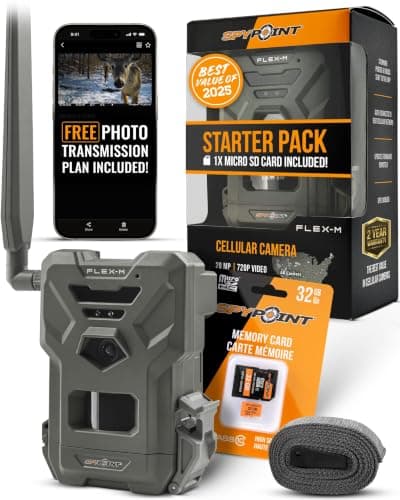
Spypoint Flex-M— the lowest-risk entry point, and our pick for finding out whether cellular works at your spot. Spypoint is the one brand with a genuinely free plan tier, which means you can hang the camera, confirm it has signal at the actual tree, and see real photos before any money goes to a subscription. The SD card pack version is the one to get, because you want a card in it regardless.
Honest cons: the free tier is deliberately small, and a busy camera will outgrow it inside a week in October. Spypoint prices plans per camera, so this is the brand to start with rather than the brand to run six cameras on.
Moultrie Edge 3, two-pack— the sensible buy if you already know you want cellular on more than one spot. Moultrie publishes 40MP photos and a 0.5-second trigger, and buying the pair together is cheaper than two singles.
Honest cons:a 0.5-second trigger is slower than the best non-cellular cameras here, which matters on a trail where deer are moving rather than feeding. And two cameras means two plans — check Moultrie's per-camera pricing in our plan comparison before you commit to the pair.
Tactacam Reveal X 3.0— the pick if signal is your worry. Tactacam publishes auto-connect multi-carrier behavior, 4K photo and 1080p video, and Tactacam is the brand our plan comparison found cheapest across several cameras.
Honest cons:multi-carrier helps and does not create signal where there is none — if your spot is genuinely dead, no cellular camera solves it and you should buy non-cellular. The 4K photo figure is the sensor, not what arrives on your phone.
If you are buying non-cellular
Two cameras, at opposite ends of the reasonable range. Both are covered in more depth in our trail camera roundup and under-$100 guide.
GardePro A3S— the non-cellular default, and the camera that makes the strongest case against paying a subscription at all. GardePro publishes 64MP photos, 1296P video with sound, a 0.1-second trigger and 100-foot no-glow night vision. That trigger speed is faster than either cellular camera above, which is the point worth dwelling on: the money you are not spending on a radio buys you a better camera.
Honest cons:GardePro is a value brand rather than a hunting institution, and the published megapixel figure on cameras in this class is usually interpolated rather than native — treat 64MP as a marketing number and the 0.1-second trigger and no-glow range as the specs that matter. You will be pulling the card, with everything that implies.
Browning Command Ops Elite 40MP, two-pack— the buy for someone who wants a non-cellular camera from a brand that has been making them for serious hunters for a long time, and wants two. The bundle includes two 32GB cards and a USB card reader, which is exactly the kit a card-pull workflow needs and exactly what people forget to order.
Honest cons: it is several times the price of the GardePro for a lower published megapixel count, and the case for it is build reputation and the bundled accessories rather than a spec-sheet win. If you only need one camera, buying a two-pack is the wrong shape of purchase.
The answer most people should actually buy
The framing as an either-or is mostly a product of how these cameras are marketed. Most hunters with more than one camera should run both, and allocate them by how expensive each location is to visit.
| Location | Camera to put there | Why |
|---|---|---|
| The far spot you are saving for the rut | Cellular | This is where intrusion is most expensive and information is most valuable. Pay the subscription on this one camera and never walk in until you hunt it. |
| Field edges and food plots you drive past | Non-cellular | You are already there. A card pull costs you nothing you were not already spending, and the saved subscription buys a faster camera. |
| Mineral sites and summer inventory | Non-cellular | Nothing about a July velvet photo is time-sensitive. Pull the card in August and look at all of it at once. |
| Access routes and gates | Either, and cellular if theft is a concern | Same-day notification is the real anti-theft feature. A stolen non-cellular camera is discovered on your next trip, which is also when you discover the thief had two weeks' head start. |
If you are buying your first camera and you genuinely do not know which side you are on, buy the cheap cellular camera with the free plan tier. It is the only purchase here that answers the question for you — hang it, see whether the photos actually change how you hunt, and remember that if you decide the subscription is not worth it, you still own a working card-pull camera.
For the rest of the trail camera decision — trigger speeds, detection range, no-glow versus low-glow flash and mounting — start with our trail camera roundup and the setup guide, which covers height, angle and the sun-facing mistake that ruins more camera sites than any spec ever will.
Frequently asked questions
Are cellular trail cameras worth the subscription?
It depends on one thing: how expensive it is to walk to the camera. If the camera sits somewhere you already cross - a field edge, a gate you drive past - the subscription buys you very little, and the same money spent on a non-cellular camera buys a faster trigger and better night range. If the camera is deep in, or sits on the travel route you intend to hunt, then every card pull costs you scent and noise in the one place you cannot afford it, and the subscription is cheap by comparison. Price your actual plan before buying, since plans are billed per camera.
Do cellular trail cameras work without a subscription?
Yes, as non-cellular cameras. With no active plan the camera still triggers, still records images and video to its SD card, and still works perfectly for card pulls - you lose the transmission, not the camera. That makes trying cellular low-risk: the worst case is that you paid a premium for a radio you are not using. It also means the sensible way to run cellular is seasonally, paying for the scouting and hunting months and letting it lapse over the summer.
Do cellular trail cameras use more batteries?
Yes, noticeably. Transmitting is the power-hungry part of a cellular camera, so a busy camera on a frequent upload schedule drains far faster than the same camera uploading once a day, and much faster than a non-cellular camera in the same spot. This partly cancels the benefit you bought - you went cellular to avoid walking in, and batteries bring you back. Run lithium cells or an external power source rather than alkalines; on a cellular camera a solar panel is closer to mandatory than optional.
Is the photo quality worse on a cellular trail camera?
The photo that reaches your phone usually is, and the one on the card usually is not. Cellular cameras advertise their sensor - 32MP, 40MP, 4K photo - but what they transmit is a compressed image sized to travel over a cellular network cheaply, with the full-resolution file often staying on the SD card. Use the transmitted image to make decisions about timing and movement, and the card for identifying a specific animal. Check the spec sheet of the specific camera rather than assuming, since brands differ.
Which states ban cellular trail cameras?
Restrictions have been reported in Arizona, Utah, Nevada, Kansas, Idaho, Montana and Iowa, and they vary enormously - some cover all trail cameras, some only cellular or transmitting ones, some only public land, and some only during hunting season. Reported dates and scope conflict between sources, and the rules change most legislative sessions. Most states in the Midwest, South and East currently have few or no restrictions. Check your own state wildlife agency's current regulations before you buy, because the penalty for getting it wrong falls on you.
What happens if there is no cell signal where my camera is?
Nothing leaves the camera, and you will not know until you check the app and find it empty. A cellular camera is a phone bolted to a camera and has the same dead-zone problem. Multi-carrier and dual-SIM models - the Spypoint Flex-M2 publishes dual-SIM LTE, the Tactacam Reveal X 3.0 publishes auto-connect multi-carrier - meaningfully improve the odds but cannot create coverage. Test at the actual tree before the season, not at the truck. If the spot is genuinely dead, buy non-cellular.
Can I run both cellular and non-cellular trail cameras?
That is what most hunters with several cameras should do. Allocate by how expensive each location is to visit: cellular on the far spot you are saving for the rut, where intrusion costs the most and information is worth the most; non-cellular on field edges you already drive past and on summer inventory sites where nothing is time-sensitive. Cellular also makes sense on access routes if theft is a concern, since same-day notification is the real anti-theft feature.
Sources
- Published specifications taken from the current retailer listings for each pick: SPYPOINT Flex-M with SD card pack; SPYPOINT Flex-M2 twin pack (32MP, GPS, dual-SIM LTE, 1080p video); Moultrie Edge 3 cellular 2-pack (40MP, 0.5s trigger); Tactacam REVEAL X 3.0 (4K photo, 1080p video, auto-connect multi-carrier, night vision, waterproof); GardePro A3S non-cellular (64MP photo, 1296P video with sound, 0.1s trigger, 100 ft no-glow night vision); Browning Command Ops Elite 40MP 2-pack bundle with two 32GB SD cards and a USB card reader
- Brand-by-brand cellular data plan pricing is maintained on our own plan comparison page rather than restated here - Spypoint, Tactacam, Moultrie, Stealth Cam, Reconyx, Bushnell, Browning and Spartan tiers, including which brands discount additional cameras
- Idaho Department of Fish and Game - summary of western states' transmitting trail camera regulations (the primary-source document for the western state rules summarized on this page)
- State restriction reporting used for the legal table, all labeled as reported because sources conflict on scope and dates: Arizona described as the first total ban for taking or locating wildlife; Utah reported as following Arizona and Nevada; Nevada reported as prohibiting cameras during hunting season on public land and cellular cameras July 1 to December 31; Kansas reported year-round on public and walk-in lands; Idaho House Bill 939 reported effective July 1, 2026; Montana reported to prohibit cellular cameras during hunting season; Iowa Natural Resource Commission rule reported effective February 1, 2027 on state-managed public game management areas
- Iowa public-land trail camera rule reporting (both traditional and cellular cameras on state-managed game management areas)
- Product availability, titles and stock status verified via the Amazon Creators API, 2026-11-04
- Prices, product images and stock status via the Amazon price layer, refreshed daily
Keep reading
Gearing up before your next hunt?
See how we evaluate gear, then dig into the reviews and buying guides — written without inventory to sell.