Buying Guide
Best Trail Camera Batteries and Solar Panels
The camera is the one-time cost. Batteries are the bill that arrives every season, and a solar panel is the purchase that ends it - if you buy one that actually fits your camera. Here is how power works, and twelve picks that are in stock.
Every trail camera guide on the internet, including ours, tells you to run lithium AAs and think about a solar panel. Almost none of them tell you which ones, and none of them warn you that the wrong panel will not fit your camera, or that a set of perfectly good rechargeable batteries can make a working camera report itself as empty.
Power is where trail cameras actually cost money. The camera is a one-time purchase; the batteries are a bill that turns up every season, multiplied by however many cameras you run. And on a cellular camera the stakes are higher than money, because a dead battery in November is a card you cannot pull remotely and a week of the rut you did not see.
This guide covers the two halves of that problem together, because they are the same problem. If you are still choosing the camera itself, start with our best trail cameras roundup or the cellular picks. This page is about keeping whichever one you own alive.
Fitment first: a solar panel is a part, not an accessory
A trail camera solar panel is not a generic gadget you clip on. It is a powered part that has to match your camera on three separate counts, and if it misses on any one of them, the best panel on the market is the wrong answer for you:
- The connector.Most cellular cameras take a barrel jack; the common size in this category is a 5.5 mm outer, 2.1 mm inner plug with the outer contact as ground. Some brands use their own proprietary port instead, which is why brand panels exist at all.
- The voltage. External power in this category is usually 6V or 12V, and the two are not interchangeable. More on that below, because it is the mistake that costs people cameras.
- The camera generation.Even within one brand, panels are keyed to specific model families. Tactacam sells one panel for the current Reveal cameras and a different one for the X 2.0 and earlier lineup. Moultrie’s Solar Panel Power Pack is sold specifically for its Edge series.
So the buying order is: find the panels that physically attach to your camera, then choose among those on capacity and price. Buying the biggest panel and hoping is how you end up with a return label.
The voltage trap that empties a full battery
This is the section that will save somebody a camera, and it comes in two parts.
Part one: rechargeables that read as flat.A standard NiMH rechargeable AA is a 1.2-volt cell. Alkaline and lithium AAs are 1.5 volts. Most trail cameras are designed around the 1.5-volt assumption — a four-cell camera is a 6-volt system, and many of those monitor voltage and shut down when the pack sags toward roughly 5 volts. Four fully charged NiMH cells deliver about 4.8 volts. The batteries are fine. The camera reports low battery, or refuses to run at all, and the owner concludes the rechargeables are junk.
That does not make NiMH useless — plenty of cameras run eight or twelve cells and have enough headroom — but it does mean you have to check your camera before you commit to a charger and sixteen cells. If your camera is fussy, the modern fix is a 1.5-volt rechargeable lithium-ion AA, which holds a flat 1.5 volts through its whole discharge instead of sagging.
Part two: external power that fries things.If your camera’s external port is rated for 6V and you feed it 12V, and the camera has no regulation on that input, you can damage it. Some manufacturers put a dropping circuit on the port; many do not, and the manual is the only place that tells you. Check the rated input printed by the port or in the manual before you connect anything, every time.
Chemistry: what each battery is actually good at
There is no universally best AA for a trail camera, which is why our camera roundups keep saying “lithium” without much nuance. Here is the nuance.
- Alkalinestarts at 1.5 volts and slides from there. Its two real weaknesses in this application are cold, where trail camera testers at TrailCamPro report alkalines losing up to half their capacity below freezing, and current surge — a no-glow infrared array can pull on the order of an amp when it fires, and a sagging alkaline is what produces the black night photos that top the complaint list. It is also the chemistry that leaks and ruins battery trays.
- Single-use lithiumis the default answer for a reason. It runs slightly hot, which is what keeps the flash bright late in a battery’s life; it is the least affected by temperature swings; and it is noticeably lighter, which matters when you are carrying a season of batteries for six cameras. Energizer rates its Ultimate Lithium cells to operate from −40 °F to 140 °F, guarantees them leak-proof in standard use, and claims up to 25 years in storage. The honest downside is price, which has risen sharply.
- NiMH rechargeableis the value play, subject to the voltage caveat above. Good high-capacity cells beat alkaline meaningfully, but they self-discharge while sitting, they want a smart charger, and TrailCamPro reports their performance falling off above roughly 90 °F — which is exactly summer scouting weather in much of the country.
- 1.5V rechargeable lithium-ionis the newest option and it solves the voltage-sag problem by design, at the cost of giving you almost no warning before it stops — it holds 1.5 volts and then quits, so a battery meter cannot really predict it.
For a cold-country hunter running no-glow cellular cameras all winter, this is not a close call: buy lithium. For a summer scouting set in a mild climate, rechargeables with a decent charger are genuinely cheaper over three seasons.
Does a solar panel pay for itself?
Sometimes, and the arithmetic is worth doing rather than assuming. A panel earns its cost when three things are true: the camera stays out year-round, it transmits (so it draws meaningfully more than an SD-card camera), and it hangs somewhere with real sun. Miss any of those and you have bought a heavy accessory.
The way to run the numbers is simple. Take the cost of one full set of lithium AAs for your camera, multiply by how many times a year you actually change them, and compare that against the panel price shown on this page. On a cellular camera that eats a set every couple of months, a mid-priced panel typically clears its cost inside two seasons — and the thing you actually bought is not the money, it is not walking into the stand site in February to swap batteries.
One caveat that is easy to miss: most brand panels contain their own internal battery, and that battery is what carries the camera through nights and gray weeks. A bare panel with no storage is a much weaker product in a hardwood bottom in December. Every panel below states its internal capacity where the maker publishes one.
What we looked for
- Published fitment.A panel had to state which cameras it works with, from the maker rather than from a retailer’s guess. Where a panel is generation-specific, the write-up says so.
- A stated internal capacity or wattage.Nothing made the list on “solar powered” alone.
- A real voltage figure. For external packs, the rated output has to be published, because that is the number that decides whether it is safe on your camera.
- Currently purchasable. Every pick was checked for stock and price on the date this guide was published.
What you will not find is a claim that we ran twelve power products through a winter side by side. We have not, and inventing that testing is the thing this site exists not to do. This guide sorts the category by fitment and published specification, and every price on the page is a live figure rather than a number typed in months ago.
The picks at a glance
| Product | Type | Key spec | Fits |
|---|---|---|---|
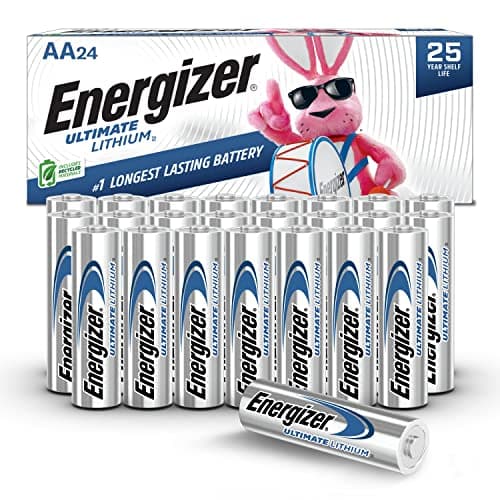
| Energizer Ultimate Lithium, 24-pack | Single-use lithium AA | 1.5V, rated -40 to 140 F, 25-year storage | Any AA camera |
| Energizer Ultimate Lithium, 8-pack | Single-use lithium AA | One fill for an 8-cell camera | Any AA camera |
| Energizer Recharge Universal, 16-pack | NiMH rechargeable AA | 1.2V per cell - check camera tolerance | Cameras with voltage headroom |
| SPYPOINT SPLB-22 | Solar panel + battery | 10W panel, 15,000 mAh internal | All SPYPOINT trail cameras |
| SPYPOINT SPLB-10 | Solar panel + battery | 5W panel, 7,500 mAh internal | All SPYPOINT trail cameras |
| Tactacam Reveal Solar Panel R5 | Solar panel + battery | 5,000 mAh internal, barrel jack | Reveal cameras with a barrel jack |
| Tactacam Reveal Solar Panel (X 2.0 era) | Solar panel + battery | Built-in battery, adjustable mount | X 2.0, X, Gen 1, SK, XB |
| Moultrie Solar Panel Power Pack Gen 2 | Solar panel + battery | 3.4W | Moultrie Edge series |
| Browning Solar Power Pack | Solar panel + 6 rechargeable batteries | Brand pack, ~$60 | All Browning trail cameras |
| Stealth Cam Sol-Pak | Solar panel + battery | 12V output | Stealth Cam and other 12V cameras |
| HME 12V / Solar Auxiliary Power Pack | Auxiliary power housing | 12V, weather-resistant housing | Any camera with a 12V input |
| BareHill 12V External Battery Box Cable Kit | Cable and fuse kit | 8 ft lead, 2A fuse, spade terminals | SPYPOINT, Stealth Cam, Moultrie, Muddy |
Best batteries overall: Energizer Ultimate Lithium, 24-pack
If you take one thing from this page, take this: put lithium AAs in your trail cameras and stop thinking about it. The Ultimate Lithium is the cell every camera manufacturer’s own battery-life rating is quoted against, and the reasons are the ones that matter in the woods. Energizer rates them to run from −40 °F to 140 °F, they are guaranteed leak-proof in standard use so they will not destroy a battery tray on a camera you forgot about, and they hold voltage well enough to keep a no-glow flash bright instead of handing you a month of black frames.
The 24-pack is the right size for anybody running two or three cameras, because that is two to three fills and you will use them.
Honest cons:lithium is the expensive chemistry and its price has climbed hard in recent years, which is the entire argument for the rechargeable and solar options below. Buying 24 at a time also means storing them, though a 25-year shelf life makes that a non-issue. And single-use cells are single-use — if that bothers you, the solar route rather than the rechargeable route is the better environmental answer for a camera that lives outside.
One camera, one fill: Energizer Ultimate Lithium 8-pack
The same cell in the size that matches a single camera. Most trail cameras take 8 to 12 AAs, so an 8-pack is one fill for the common configuration and the sensible way to try lithium before committing to bulk. It is also the pack to keep in the truck as a spare, since it will still be good years from now.
Honest cons: the per-cell price is worse than the 24-pack, which is the usual arithmetic of small packs. If your camera takes 12 cells, one 8-pack is not a fill, and buying two 8-packs costs more than buying the larger pack once.
The rechargeable route: Energizer Recharge Universal
If your cameras hang in a moderate climate, come down between seasons, and you are tired of buying lithium, rechargeables are the honest cheaper answer. Sixteen cells is enough to keep one camera running and one set on the charger, and good NiMH cells outperform alkaline by a wide margin. Over three seasons the math beats single-use lithium comfortably.
Read the voltage section above before you buy, though. These are 1.2-volt cells. On a camera with only four AA slots that monitors for a 5-volt floor, a fully charged set can read as empty. On an eight- or twelve-cell camera there is usually enough headroom. Check your manual first — this is the single most common cause of “my rechargeables do not work in this camera.”
Honest cons:the 1.2-volt issue is real and camera-specific, not something a battery brand can fix. NiMH self-discharges while sitting, so a set charged in August is not a full set in November. TrailCamPro reports NiMH performance dropping off above roughly 90 °F, which is summer scouting weather in much of the country. And you need a decent charger, which is a separate purchase.
Most capable panel: SPYPOINT SPLB-22
SPYPOINT publishes real numbers on this one, which is why it anchors the panel section: a 10-watt panel with a 15,000 mAh internal lithium battery, four universal output cords in the box, four LED charge indicators, and roughly a 24-hour charge from the sun or about five hours from a DC adapter if you want to send it out already full. SPYPOINT states it works with all its trail cameras.
That internal capacity is the actual product. A panel with 15,000 mAh behind it is what carries a transmitting camera through a week of overcast December, which is exactly when a smaller panel quietly falls behind and the camera goes dark.
Honest cons: it is the most expensive item on this page by a wide margin, and at roughly 10.7 by 10.2 inches it is a large object to hang in a tree and to keep aimed at the sun without advertising your camera. For a camera that comes down after the season, or one hanging in closed canopy, the smaller SPLB-10 below is the better buy.
Best value brand panel: SPYPOINT SPLB-10
The SPLB-10 is the same idea at half the panel and half the storage: a 5-watt panel with a 7,500 mAh internal battery, again stated by SPYPOINT as compatible across its camera line. For most people this is the one to buy. A 7,500 mAh buffer is plenty for a camera in reasonable light, and it costs roughly what a couple of sets of lithium AAs cost — which is the whole payback argument in one sentence.
Honest cons:half the wattage means it recovers more slowly after a dark stretch, so if your camera hangs in heavy canopy or you are running a high-volume setup that transmits constantly, the larger panel is the honest recommendation instead. And like every brand panel here, it is a SPYPOINT answer — it is not the pick if you run a mixed fleet.
Current Reveal cameras: Tactacam Reveal Solar Panel R5
The R5 is Tactacam’s current panel: a 5,000 mAh internal battery, charging that Tactacam rates about 30 percent faster than the previous Solar Panel V2, and compatibility with any Reveal camera that has a barrel jack — which covers the Pro 4.0 and X 4.0 through the Pro 3.0, X 3.0, X-Pro, X-Gen 2.0, XB/SK, X and Gen 1.
Worth knowing before you buy: the panel’s Advanced Insights reporting is a 4.0-camera feature. Pair it with an older Reveal and you still get the faster charging and the internal battery, but not the extra data. That is a fair trade rather than a catch, and it is stated plainly by Tactacam.
Honest cons:5,000 mAh is a smaller buffer than either SPYPOINT panel carries, so it is more dependent on getting real sun. The headline software feature is reserved for the newest cameras. And Tactacam owners have to pay attention to which panel they are ordering, because the older one below is still on the shelf.
Older Reveal cameras: the X-series panel
This is the panel Tactacam lists for the X 2.0 and the generation around it — X 2.0, X, Gen 1, SK and XB — with a built-in battery and an adjustable mount so you can aim it independently of the camera. If you are running an older Reveal and want the simplest correct answer rather than a compatibility puzzle, this is it.
The adjustable mount is more useful than it sounds. A camera has to point at the trail; a panel has to point at the sky. Being able to separate those two decisions is often what makes a marginal tree work.
Honest cons:it is the previous-generation product, and it costs about the same as the newer R5 while charging more slowly, so if your camera takes a barrel jack the R5 is usually the better buy. Buy this one because your specific camera calls for it, not because it is cheaper — it mostly is not.
Moultrie Edge owners: Solar Panel Power Pack Gen 2
Moultrie sells this as a 3.4-watt panel with an integrated power pack for its Edge series cameras, and that model-family targeting is the point — it is designed to mate with the Edge rather than to be a universal add-on. Moultrie also offers a 10-watt version of the same product for people who want more headroom, and sells the Gen 2 in a two-pack, which is the cheaper route if you are converting several cameras at once.
Honest cons:3.4 watts is the smallest panel on this page, so in genuinely poor light it is doing less work than the SPYPOINT or Tactacam options. It is scoped to the Edge series, so check your exact model. And Moultrie does not publish an internal capacity figure the way SPYPOINT and Tactacam do, which makes it harder to compare directly — we would rather say that than borrow a number from a retailer listing.
Browning owners: Solar Power Pack
Browning’s own answer is the Solar Power Pack: a tree-mounted panel that angles to the sun, six rechargeable batteries in the box, and compatibility Browning states across all of its trail camera models, at around $60. Buying the camera maker’s own pack is the low-friction route — no adapter roulette, no voltage guesswork.
Browning also sells a plain external battery pack without the panel, and a two-pack solar bundle if you are powering more than one camera, so the range is there on the same mount.
Honest cons:it is Browning-specific, the panel has to see real sun so it is the wrong pick for a north-facing bottom, and its Amazon rating sits at 4.1 — owners are satisfied rather than delighted. A bigger third-party 12-volt panel collects more per day if you do not mind the extra visibility on the tree.
Stealth Cam owners: the 12V Sol-Pak
The Sol-Pak is Stealth Cam’s solar battery pack and it publishes the number that matters for this style of product: 12 volts. That makes it straightforward to match — if your camera’s external port is rated 12V, this is a candidate, and if it is rated 6V, it is not. Stealth Cam also sells a plain 12V battery without the panel, which is the cheaper option for a camera you can reach easily and recharge at home.
Honest cons:12V output means you must confirm your camera’s rated input rather than assuming, and this is exactly the pairing where guessing has consequences. The pack is bulkier than the brand micro-panels. And Stealth Cam’s larger lithium solar bundles cost several times as much, so the range is wide and the model names are similar enough to order the wrong one.
No brand panel for your camera? The HME 12V auxiliary pack
Plenty of cameras have a 12V external port and no first-party panel — older models, budget models, and anything from a brand that has moved on. The HME auxiliary power pack is the generic answer: a weather-resistant housing that supplies 12V to any camera rated for it, with a solar option, and no requirement that the badge match.
This is also the sensible pick if you run a mixed fleet. Buying four different brand panels for four different cameras is how a simple problem gets expensive; standardizing on 12V auxiliary packs, where your cameras allow it, keeps one spare part on the shelf instead of four.
Honest cons:generic means you are responsible for the compatibility check that a brand panel does for you — confirm the 12V rating on your camera first, without exception. The housing is bulkier and less discreet than a brand micro-panel. And you may need the right cable, which brings us to the last item.
The cheap part everyone forgets: the cable
A surprising number of external-power setups fail on a three-dollar problem: the lead that came with the battery box does not reach, or does not end in the right plug, or has no fuse. A dedicated cable kit with an 8-foot lead, an inline 2-amp fuse and spade terminals solves all three, and the fuse is the part worth caring about — it is what stands between a chafed wire in a tree and a dead camera.
Eight feet also lets you put the battery box on the ground at the base of the tree, which is both easier to service and less visible than a second box hanging beside the camera.
Honest cons:it is a commodity part and there is nothing proprietary about it. It only matters for battery-box setups — if you bought a brand panel, the cord is in the box already. And it does nothing to solve a voltage mismatch; a correct cable to the wrong voltage source is still the wrong voltage.
The mistakes that kill cameras
- Feeding 12V into a 6V port. The one genuinely destructive error on this page. Read the port rating first, every time.
- Mixing old and new cells, or brands, or chemistries. The pack runs to the weakest cell, and mismatched cells are a leak risk.
- Leaving alkalines in a camera over the off-season. This is how battery trays get destroyed. If a camera is coming down, take the batteries out.
- Blaming rechargeables for a voltage design.Check the cell count and the camera’s low-voltage cutoff before you decide NiMH does not work.
- Hanging the panel where the camera looks good. The camera points at the trail; the panel points at the sky. Buy a panel with an adjustable mount and aim them separately.
- Buying a bare panel with no storage. On a transmitting camera in winter, the internal battery is doing most of the work.
The bottom line
For most people the whole answer is two purchases. Put lithium AAs in every camera, because they survive cold, keep the flash bright and will not leak in a tray you forgot about. Then, for any camera that stays out year-round and transmits, add the brand solar panel your camera actually takes — matched on connector, voltage and camera generation, in that order — and stop buying batteries for it.
Rechargeables are the right call in a narrower band than people expect: moderate climates, cameras with enough cells to tolerate 1.2 volts, and a willingness to manage a charger. When those conditions hold they are genuinely cheaper. When they do not, they are the reason a camera missed the rut.
Check the Energizer Ultimate Lithium AA 24-pack price on Amazon. If you are still deciding which camera to hang, our best cellular trail cameras guide flags which models have built-in solar already, and cellular plans compared covers the other recurring bill that comes with a transmitting camera.
Frequently asked questions
What batteries are best for a trail camera?
Single-use lithium AAs for almost every situation. They are the least affected by temperature, they hold voltage well enough to keep a no-glow infrared flash bright late in the battery's life, they weigh less than alkaline, and they do not leak in a tray. Energizer rates its Ultimate Lithium cells to operate from -40 F to 140 F with up to 25 years of storage life. Alkaline is the weakest choice for this job because trail camera testers report it losing up to half its capacity below freezing and sagging under the current surge a no-glow flash draws.
Why does my trail camera say low battery with fully charged rechargeables?
Because standard NiMH rechargeable cells are 1.2 volts rather than the 1.5 volts alkaline and lithium deliver, and most cameras are designed around the 1.5-volt assumption. A four-cell camera is a nominal 6-volt system and many of them shut down or warn when the pack sags toward roughly 5 volts. Four fully charged NiMH cells put out about 4.8 volts, so the camera reads them as flat even though they are full. Cameras with eight or twelve cells usually have enough headroom. A 1.5-volt rechargeable lithium-ion AA avoids the problem entirely.
Are trail camera solar panels universal?
No. A panel has to match three things: the connector (most use a barrel jack, but some brands use a proprietary port), the voltage (6V and 12V are not interchangeable), and often the camera generation. Tactacam sells one panel for current Reveal cameras with a barrel jack and a different one for the X 2.0 and earlier lineup; Moultrie's Solar Panel Power Pack is sold for its Edge series. Check the manufacturer's stated compatibility for your exact model rather than assuming any panel of the same brand will fit.
Can I damage my trail camera with the wrong external battery?
Yes. If the camera's external power port is rated for 6V and you connect a 12V source, and the camera has no regulation on that input, you can damage it. Some manufacturers include a dropping circuit; many do not, and the manual is usually the only place that tells you. Read the rating printed at the port or in the manual before connecting anything, and treat a 12V pack as unsafe on a 6V camera unless the maker says otherwise.
Does a trail camera solar panel pay for itself?
On a cellular camera that stays out year-round in reasonable light, usually yes, and often within two seasons. The way to check is to multiply the cost of one full set of lithium AAs for your camera by the number of times a year you actually replace them, then compare it to the panel price. If the camera comes down after the season, or hangs in closed canopy where it never gets real sun, a panel is harder to justify - and the practical benefit is less about money than about not walking into the site in midwinter.
How many batteries does a trail camera take?
Most take 8 to 12 AA cells, and some cellular models take up to 16. That cell count matters for more than cost: a camera with 8 or more cells generally has enough voltage headroom to tolerate 1.2-volt NiMH rechargeables, while a 4-cell camera often does not. Count the slots before you decide between single-use lithium and rechargeables.
Do I need a solar panel with a built-in battery?
For a camera that transmits, yes. The internal battery is what carries the camera through nights and long overcast stretches, and it is the difference between a panel that keeps a camera alive in December and one that only works on sunny days. SPYPOINT publishes 15,000 mAh for its SPLB-22 and 7,500 mAh for the SPLB-10; Tactacam publishes 5,000 mAh for the Reveal Solar Panel R5. Where a maker does not publish a capacity figure, that is worth weighing rather than guessing at.
Can I leave batteries in a trail camera over the off-season?
Take them out, especially alkalines. A leaking alkaline cell destroys the contacts and the battery tray, and that failure usually happens to the camera nobody checked for six months. Lithium cells are guaranteed leak-proof in standard use and hold their charge for years, so they are the safer chemistry to forget about - but the reliable habit is to pull the batteries from any camera that comes down.
Sources
- TrailCamPro - game camera battery information (alkaline loses up to half its capacity in sub-freezing weather and struggles with the current surge from no-glow infrared arrays, producing black night photos; single-use lithium runs about 1.6V, is least affected by temperature change and weighs less; NiMH stabilizes at 1.2V working voltage and is incompatible with cameras requiring a 5V minimum since four cells produce only 4.8V, with performance degrading above roughly 90 F and self-discharge around 0.5% daily; 1.5V Li-ion rechargeables hold voltage through the cycle then shut off abruptly)
- Energizer - Ultimate Lithium battery product page (performs in extreme temperatures from -40 F to 140 F; up to 25 years in storage; 100% leak proof, guaranteed based on standard use)
- SPYPOINT - Lithium Battery Solar Panel (10W) SPLB-22 product page (10 watts, 15,000 mAh internal lithium battery, compatible with all SPYPOINT trail cameras, four universal output power cords included, 4 LED charge indicator lights, approximately 24 hours to charge via sun or 5 hours via DC adapter, 10.7 x 10.2 x 2 inches, $129.99; in stock on 2026-09-02)
- Tactacam - Fast-Charging Solar Panel R5 product page and Amazon listing copy (built-in 5,000 mAh battery; approximately 30% faster charging than the Solar Panel V2; compatible with any REVEAL camera that has a barrel jack, including Pro 4.0, X 4.0, Pro 3.0, X 3.0, X-Pro, X-Gen 2.0, XB/SK, X and Gen 1; Advanced Insights reporting requires a REVEAL Pro 4.0 or X 4.0 connected by barrel jack)
- Winterberry Wildlife - 'Internal and External Trail Camera Power', Bob Zak (LiFeS2 lithium cells at roughly 1.65V each, eight producing about 13.2V; eight NiMH producing about 9.6V, with a warning that some NiMH cells self-discharge appreciably while stored; external power via a 5.5 mm outer / 2.1 mm inner barrel connector with the outer contact as ground and the inner contact +12V)
- Moultrie Mobile - Solar Panel Power Pack Gen 2 listing (3.4W, for Edge Series cameras; a 10W version and a two-pack of the Gen 2 are also sold)
- Product titles, published wattage / capacity / voltage figures quoted from manufacturer listing copy, current pricing and stock status verified via the Amazon Creators API, 2026-09-02; the Browning Micro-Solar Battery Pack listing has since been removed from Amazon and was replaced here with Browning's Solar Power Pack ($59.99, 6 rechargeable batteries, adjustable panel, compatible with all Browning trail cameras), re-verified 2026-09-25
Keep reading
Gearing up before your next hunt?
See how we evaluate gear, then dig into the reviews and buying guides — written without inventory to sell.