Buying Guide
Fastest Crossbows of 2026: What 500 FPS Actually Buys You
The speed race has reached 515 feet per second. Here is the verified leaderboard, what those numbers do for you in the field, and the honest reasons most hunters should buy something slower.
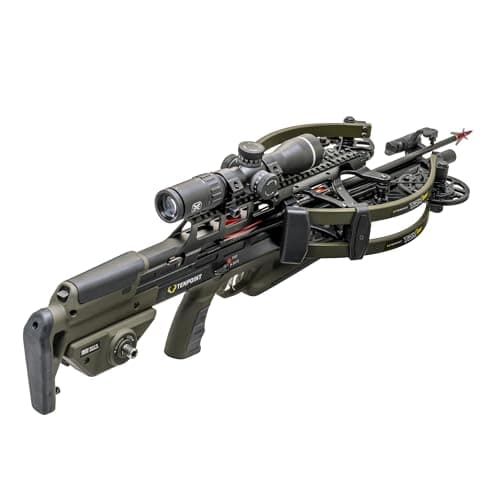
The fastest production crossbow available in 2026 is the TenPoint TRX 515 at a published 515 feet per second, 10 fps ahead of the Nitro 505 it replaced at the top. The Ravin R500 sits just behind at a published 500-plus fps. Independent testing has put real numbers on that race: Outdoor Life clocked the Nitro 505 at 515 fps and the R500 at 502 fps in its head-to-head, and rated the Ravin as the more accurate and consistent of the two when shooting broadheads.
That last clause is the whole story of this category. Speed is easy to measure and easy to advertise; what a fast bow does with a broadhead on the end of the bolt is the thing that decides hunts. Below is the leaderboard, what those numbers actually change, and the costs nobody prints on the box.
The 2026 speed leaderboard
| Crossbow | Published speed | Notes | Approx. price |
|---|---|---|---|
| TenPoint TRX 515 | 515 fps | The fastest production crossbow made | ~$3,400 |
| TenPoint Nitro 505 | 505 fps | Clocked at 515 fps in Outdoor Life's independent test | ~$3,050 |
| Ravin R500 / R500E | 500 fps | Clocked at 502 fps; rated more consistent with broadheads | ~$2,650-2,950 MSRP |
| TenPoint Flatline 460 | 460 fps | Substantially cheaper than the 500-class bows | ~$2,300 |
| Ravin R29X | 450 fps | The balanced choice - 180 ft-lbs at 6.75 lb and 6 in wide | ~$2,350 MSRP |
| CenterPoint Wrath 430 | 430 fps | The most speed per dollar by a wide margin | ~$700-750 |
Speeds are manufacturer-published except where an independent figure is noted; prices are approximate mid-2026 brackets or MSRP. Verify both before buying. Ravin’s full lineup and published specs are in our Ravin brand guide.
What speed actually buys you
- A flatter trajectory, which forgives ranging errors. This is the real benefit and it is worth having. Bolt drop steepens sharply past 40 yards, so a flatter arc means a 5-yard misjudgment costs you fewer inches vertically. If you hunt open country where distances are hard to call, this matters.
- Less flight time, which reduces string jump.A deer that hears the shot has a reaction window; a shorter flight gives it less of one. Real, but smaller than it sounds — going from 400 to 500 fps shaves a fraction of a second at 50 yards.
- More kinetic energy. True, and almost always irrelevant. Every bow on this page produces far more energy than a whitetail pass-through requires. Energy only becomes the binding constraint on genuinely big-bodied game with heavy bone.
What speed costs you
| Broadhead flight gets harder, not easier | At 500 fps, exposed fixed-blade broadheads steer aggressively and mechanical heads face impact forces that test their pivots and collars. This is why Outdoor Life's broadhead-accuracy finding matters more than the raw FPS gap between the top two bows. See our fixed vs mechanical guide |
|---|---|
| Noise | More stored energy released faster means more sound - the same sound that causes string jump. Fast bows need serious dampening to not give back what they gained |
| String and serving wear | The narrow, short axle-to-axle geometry that produces these speeds pinches servings hard. Budget for string service sooner than on a wide, slower bow |
| Cocking effort | Draw weights climb with speed, which makes an integrated cocking device close to mandatory rather than a convenience |
| Weight | Fast flagships run heavy - the Ravin R500 is 8.4 lb and the R500E 9.9 lb. That is a lot to hold offhand, and a lot to carry to a distant stand |
| Price | The gap between a 430-fps bow and a 515-fps bow is roughly $2,500. That buys a lot of bolts, targets, optics and tags |
How FPS is measured (and inflated)
Published speeds are produced under specific, favorable conditions: a light test bolt at the minimum weight the bow is rated for, a fresh string, and a chronograph a few feet from the rail. Change any of those and the number drops.
- Bolt weight is the biggest lever. Heavier bolts fly slower. A hunting bolt with a 100-grain broadhead and real vanes is usually meaningfully heavier than the test bolt behind the marketing number.
- Strings settle. A bow that chronographs at its rated speed new will read slightly lower after a few hundred shots.
- Independent numbers are worth more than published ones,in both directions. Outdoor Life’s test found the Nitro 505 exceeding its published figure and the R500 essentially matching its own.
The practical implication: set your scope’s speed dial or reticle by the speed your bow produces with your hunting bolts, not the number on the box. Getting this wrong is a common cause of misses at 40+ yards on otherwise well-tuned setups.
Fastest made: TenPoint TRX 515
At a published 515 fps, the TRX 515 is the fastest production crossbow you can buy, and it holds that title by 10 fps over TenPoint’s own Nitro 505. It typically street prices around $3,400 (verify current pricing).
TenPoint’s reverse-draw platform is what makes the number possible: moving the limbs rearward lengthens the power stroke without widening the bow, which is the same trick every 500-class crossbow uses. The company’s ACUslide cocking and de-cocking system is included at this tier, and at these draw weights it is not optional equipment.
Honest cons: the price is the story — roughly five times a Wrath 430 for 85 more fps. Fast reverse-draw bows are heavy and demanding to shoot well offhand, broadhead tuning is genuinely harder at this velocity, and string service arrives sooner. This is a bow for someone who wants the outright fastest and has the budget to treat that as a preference rather than a purchase decision.
TenPoint Nitro 505
The Nitro 505 held the speed crown before the TRX and remains extraordinary: published at 505 fps and clocked at 515 fpsin Outdoor Life’s independent testing — a rare case of a manufacturer under-promising. Street pricing runs around $3,050 (verify current pricing).
The honest note from that same testing is the one worth carrying: the Ravin R500 was rated more accurate and consistent when shooting broadheads. Raw velocity and hunting accuracy are not the same measurement, and at this end of the market the second one is what you are actually buying.
Honest cons: as with the TRX, weight, noise, string wear and broadhead tuning all scale with the speed. Now that the TRX has taken the crown, the Nitro is the second-fastest bow at close to the same price, which is an awkward place to sit.
Fastest with broadheads: Ravin R500
The R500 was the first crossbow to reach 500 fps, produces a published 222 ft-lbs of kinetic energy, and does it in a package just 3.6 inches widecocked — the narrowest thing in this class by a significant margin. MSRP runs about $2,649.99, with the electric-cocking R500E at $2,949.99 (verify current pricing).
It also carries the finding that matters most here: in Outdoor Life’s head-to-head against the Nitro, the R500 was the more accurate and consistent bow with broadheads. If you intend to hunt with the bow rather than chronograph it, that is the more valuable number than the 13-fps gap.
Honest cons: it is 8.4 pounds(9.9 for the R500E), which is genuinely heavy to carry and to hold, and Ravin’s ecosystem commits you to its proprietary nocks and accessories. Our full Ravin R500 review covers both in detail.
Best value at the top: TenPoint Flatline 460
The Flatline 460 is TenPoint’s answer to the obvious question — how much speed can you have without paying flagship money. At 460 fps and roughly $2,300 (verify current pricing), it gives up 55 fps to the TRX and saves you more than a thousand dollars.
In practical hunting terms, 460 and 515 fps are indistinguishable inside 50 yards. You get the reverse-draw platform, TenPoint’s build quality and service network, and the same class of cocking hardware. This is the rational purchase for someone who genuinely wants a fast premium crossbow.
Honest cons: still expensive, still heavy, and still fast enough that broadhead tuning takes real work. Package contents vary substantially between the base bow and the ready-to-hunt bundles — read the listing carefully, because the price difference is large.
The sensible fast bow: Ravin R29X
The R29X is the one we actually recommend most often out of everything on this page: 450 fps, 180 ft-lbs, 6 inches wide cocked and 6.75 pounds, at an MSRP around $2,349.99 (verify current pricing).
That weight and width are the argument. A pound and a half lighter than an R500 and narrow enough to swing anywhere, it is the fast crossbow you can actually hold steady offhand at the end of a long sit — and holding steady is what determines where the bolt goes. It appears for the same reason in our best crossbows roundup.
Most FPS per dollar: CenterPoint Wrath 430
And here is the uncomfortable comparison the flagship brands would rather you not run. The Wrath 430 delivers 430 fps for roughly $700-750(verify current pricing) — 85 fps behind the fastest bow made, at about a fifth of the price.
You give up real things: trigger quality, string and cam refinement, scope quality, service network, and any de-cocking function. But if the question is strictly "how much speed can I buy," nothing else is close. See our under $500 guide and CenterPoint brand guide for where the compromises land.
The bottom line
Four of the six bows above come from the two brands that own the top of this market. We compare them directly — width, cocking, arrows and cost of ownership — in Ravin vs TenPoint.
If you want the fastest crossbow made, it is the TenPoint TRX 515, and the number is real. If you want the fastest bow that shoots broadheads well, the independent testing points at the Ravin R500. If you want a fast premium bow without flagship pricing, the Flatline 460 and the R29Xare the sensible ends of that trade — and the R29X’s lighter, narrower package is worth more to most hunters than 50 extra fps.
And if speed is genuinely the only axis you care about, the Wrath 430 gets you within 85 fps of the world record for the price of a tank of feed. Whatever you buy, set your scope to the speed your bow actually produces with your hunting bolts, keep it maintained, and remember that effective range is a property of the shooter, not the bow.
Frequently asked questions
What is the fastest crossbow in 2026?
The TenPoint TRX 515, at a published 515 feet per second - 10 fps faster than the TenPoint Nitro 505 that previously held the title. The Ravin R500 sits just behind at a published 500-plus fps, and in Outdoor Life's independent testing was clocked at 502 fps while the Nitro read 515 fps.
Does a faster crossbow mean a longer ethical range?
No. Speed gives you a flatter trajectory, which forgives ranging errors, and slightly less flight time, which reduces string jump. It does nothing about wind reading, unseen obstructions, or how steady you can hold under adrenaline - and those are what set effective range for nearly everyone. Fifty yards remains the traditional outside ethical limit on a whitetail regardless of bow speed.
Is 400 fps fast enough for a crossbow?
Comfortably. Every bow at 400 fps and up produces far more kinetic energy than a whitetail pass-through needs, and inside 50 yards the trajectory difference between 400 and 500 fps is small. Faster bows also cost more, make more noise, wear strings faster and are harder to tune with broadheads.
Why are fast crossbows harder to tune with broadheads?
Two reasons. Exposed fixed blades act as steering surfaces, and the faster the bolt travels the more aggressively any misalignment gets amplified. Mechanical heads face the opposite problem: at 500 fps, impact forces stress blade pivots and retention collars far beyond what a compound bow ever produced. This is why independent broadhead-accuracy results matter more than raw FPS at the top of the market.
Are advertised crossbow speeds accurate?
They are measured under favorable conditions - the lightest bolt the bow is rated for, a fresh string, and a chronograph close to the rail. Real hunting bolts with broadheads are heavier and therefore slower. Independent testing sometimes finds bows exceeding their published figures and sometimes falling short, so set your scope by the speed your own bow produces with your own hunting bolts.
What is the fastest crossbow for the money?
The CenterPoint Wrath 430, at 430 fps for roughly $700-750, is not close to being matched on speed per dollar - it is within 85 fps of the fastest crossbow made at about a fifth of the price. What you give up is trigger and string refinement, scope quality, service network depth, and any de-cocking function.
Sources
- Outdoor Life - battle of the fastest crossbows: Ravin R500 vs TenPoint Nitro 505 (independent chronograph figures)
- Outdoor Life - the best crossbows of 2026, tested for speed, accuracy and value
- Hunting Giant - TenPoint TRX 515: fastest crossbow
- Deer Hunting Guide - fastest crossbow: TenPoint does it again
- Sharpshaft - fastest crossbows worldwide
- Ravin Crossbows - published model specifications
- Product availability and pricing verified via the Amazon Creators API, 2026-08-13
Keep reading
Gearing up before your next hunt?
See how we evaluate gear, then dig into the reviews and buying guides — written without inventory to sell.