Buying Guide
Best Crossbows for Beginners: What a First Crossbow Actually Needs
Speed is the spec beginners shop on and the one that matters least. Cocking effort, de-cocking, total package cost and manageable weight are what decide whether your first crossbow gets used or sold.
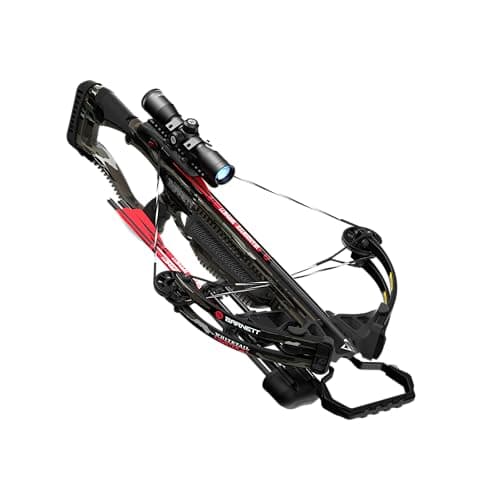
Every crossbow marketed to beginners leads with a speed number, and every beginner shops on it. It is the wrong number. A 350-fps crossbow and a 430-fps crossbow will both kill a whitetail decisively at 30 yards; the specs that actually determine whether you enjoy your first season are how hard the bow is to cock, whether you can safely get the string down at dark, how much the complete package really costs, and whether the thing is light enough to carry and hold steady.
This guide covers those, then five packages that get them right at different budgets. Prices are approximate mid-2026 street figures — the live price boxes are the number to trust.
Why FPS is the wrong spec for a beginner
Kinetic energy scales with speed, and every crossbow in this guide produces far more energy than is needed for a pass-through on a deer at ethical range. The practical differences speed buys are a slightly flatter trajectory (which forgives ranging error) and less flight time (which reduces string jump). Both are real. Neither is worth $400 to someone who has never shot a crossbow.
What faster bows reliably cost you, on the other hand:
- Higher draw weight, which means the cocking device matters more, not less — see our crossbow cocking device picks if yours did not come with one.
- More noise and more vibration— and noise is what causes string jump in the first place.
- Faster string and serving wear, especially on the narrow, short axle-to-axle designs that produce those speeds. See crossbow maintenance.
- More money, taken from a budget that should be going to bolts, a target, a rangefinder and practice.
What actually matters on a first crossbow
| A cocking aid, included | A rope cocker roughly halves the felt draw weight and, more importantly, pulls the string evenly - which is what determines whether the bow shoots straight. A crank drops it to a few pounds of effort. A package without one is not a complete package |
|---|---|
| De-cocking capability | The single most underrated beginner feature. Without it, every sit ends with you needing a discharge target or a special bolt. Crank systems rated for de-cocking solve the problem outright and make the bow safer to own |
| Total package cost | Scope, quiver, bolts, cocking device, and ideally a sling. A $400 'bow only' is a $550 setup. Ready-to-hunt packages are almost always the better beginner value |
| Weight and balance | Six to seven pounds is manageable; nine is a lot to hold steady from a treestand. Weight matters more for offhand accuracy than draw weight does |
| Cocked width (axle-to-axle) | Under about 16 inches clears treestand rails and blind windows easily. Wider bows are not a dealbreaker, but you will notice |
| Anti-dry-fire and a real safety | Standard now, but confirm it. A beginner will eventually pull the trigger on an empty rail |
| Parts and service availability | Strings are consumables. Buying from a brand with a service network and available replacement strings matters more in year three than in year one |
What to spend, and on what
| Budget | What it buys | Who it fits |
|---|---|---|
| $300-400 | A complete ready-to-hunt package, 350-405 fps, rope cocker, basic multi-reticle scope | First-timers, families, anyone testing whether they will stick with it |
| $400-600 | More speed, better scope, better trigger, sometimes an integrated cocking device | The hunter who already knows they will hunt every season |
| $600-800 | De-cocking crank systems, better strings and cams, real service backing | Anyone who values safety and convenience over raw specs - our recommended band |
| $1,000+ | Premium accuracy, refinement and speed | Not a beginner purchase. Buy this after a season, when you know what you actually want |
Whatever the number, budget roughly $100-150 beyond the bow for a proper target (crossbow bolts destroy cheap targets), a half-dozen extra bolts, and a broadhead pack. A rangefinderis the next best dollar after that — bolt drop past 40 yards makes guessing distance the leading cause of a bad hit.
The picks at a glance
| Crossbow | Speed | Weight | De-cock | Standout | Approx. price |
|---|---|---|---|---|---|
| Barnett Whitetail Hunter II | ~350 fps | ~6.4 lb | No | Cheapest complete entry from a major brand | ~$339 |
| Killer Instinct BOSS 405 | 405 fps | ~6.7 lb | No | Compact 14.75 in cocked width, 134 ft-lb | ~$387-400 |
| Wicked Ridge Invader M1 De-Cock | 390 fps | - | Yes (ACUdraw) | Safe cocking and de-cocking, TenPoint service network | ~$700-800 |
| CenterPoint Wrath 430 | 430 fps | - | No | The most speed per dollar in the category | ~$700-750 |
| CenterPoint Sinister 430D | 430 fps class | - | Yes | Narrow, de-cocking, CenterPoint pricing | See our review |
Speeds and weights are manufacturer-published; prices are approximate mid-2026 brackets. Verify both before buying.
Best budget entry: Barnett Whitetail Hunter II
At roughly $339 (verify current pricing) with a multi-reticle scope included, the Whitetail Hunter II is the cheapest way into crossbow hunting from a brand with real service support. It is ~350 fps, weighs about 6.4 pounds, and runs a compact 16.125-inchcocked width — light and narrow enough that a smaller shooter or a young hunter can actually hold it steady, which is the specification that matters most for a beginner’s accuracy.
Three hundred fifty feet per second is plenty. Inside 40 yards on a whitetail this bow does everything a 430-fps bow does, and it does it for half the price with a lighter, more manageable package.
Honest cons: the included scope is a basic multi-reticle unit — functional, not good — and the trigger is the roughest in this group. There is no de-cocking function, so plan on a discharge target from day one. Barnett’s fit and finish at this price is exactly what you would expect at this price.
Who it’s for: families, youth hunters, and anyone who wants to find out whether crossbow hunting is for them before spending real money.
Best all-around beginner: Killer Instinct BOSS 405
The BOSS 405 is the pick for most first-time buyers who intend to hunt seriously. It produces 405 fps and a published 134 ft-lb of kinetic energy from a 6.7-pound bow with a 14.75-inch cocked width— genuinely compact, which matters in a ground blind or a tight treestand — and it typically bundles at around $387-400 (verify current pricing).
That combination is the sweet spot: narrow enough to swing in cover, light enough to hold, fast enough that trajectory is forgiving, and cheap enough to leave budget for bolts and a target. Killer Instinct sells it as a bundle, which means fewer surprise costs.
Honest cons: no de-cocking function, so the end-of-hunt problem is yours to solve. Killer Instinct’s dealer and service network is thinner than Barnett’s or TenPoint’s, which matters when you need strings in year three. Bundle contents vary between listings — confirm exactly what is in the box.
Who it’s for: the beginner who already knows they will hunt every season and wants one bow that will not need replacing in two years.
Best de-cocking package: Wicked Ridge Invader M1 De-Cock
Wicked Ridge is TenPoint’s value line, and the Invader M1 De-Cock is the bow we would recommend to a beginner who can stretch to roughly $700-800(verify current pricing) — specifically because of the ACUdraw system, which both cocks and safely de-cocks the bow.
It is hard to overstate what this fixes for a new hunter. Without it, every sit ends with a live, cocked crossbow and a decision about how to make it safe — and the shortcut beginners take (firing into the ground) damages bolts in ways that can cause a catastrophic failure later. With a de-cock crank you turn a handle. At 390 fpsit is fast enough for anything you will hunt, and TenPoint’s service and string availability behind the Wicked Ridge name is the best in this group.
Honest cons: it is roughly double the price of the Barnett for a bow that is not meaningfully faster, and the integrated cocking mechanism adds weight and complexity relative to a rope cocker. Read the manual carefully — crank de-cocking is safe only when done in the specified sequence. Our guide to cocking and de-cocking a crossbow walks through it.
Who it’s for: beginners who value safety and convenience over specs, older or smaller-framed shooters, and anyone buying a bow a teenager will use.
Most performance per dollar: CenterPoint Wrath 430
If the speed number is going to bother you regardless of what we said above, the Wrath 430 is the rational way to satisfy it. It delivers 430 fps— genuinely fast, in the same conversation as bows costing three times as much — in a complete package around $700-750 (verify current pricing).
CenterPoint sits under the same Velocity Outdoor umbrella as Ravin, and the Wrath is the clearest expression of the brand’s strategy: deliver a headline spec at a price the premium brands cannot match, and accept a step down in refinement to do it. For a beginner, that trade is often the right one. We cover the full lineup in our CenterPoint brand guide and in best crossbows under $500.
Honest cons: at 430 fps the bow is louder and harder on strings and servings than the slower picks, the trigger and scope are where the cost savings live, and there is no de-cocking function. It is a lot of bow for a first-time shooter to manage well.
Who it’s for: the beginner who is confident they want speed and is willing to accept the noise, the maintenance and the discharge-target routine that come with it.
Compact alternative: CenterPoint Sinister 430D
The Sinister 430D is worth knowing about because it pairs the Wrath’s speed class with a de-cockingmechanism and a narrower cocked profile — the two things the Wrath lacks. If both matter to you and you want to stay inside the CenterPoint price structure, this is the bow to compare against the Wicked Ridge.
We cover it in detail alongside the rest of the lineup in our best crossbow for the money guide and the CenterPoint brand guide.
Your first season checklist
Two related guides if your situation is more specific than a plain first crossbow: crossbows chosen on cocking effort and held weight, which is the right page for a smaller-framed or lighter shooter, and best crossbows under $1,000, which covers the band where de-cocking cranks become standard.
- Read the manual cover to cover. Cocking sequence, de-cocking procedure and torque values are model-specific and none of them are obvious.
- Buy a crossbow-rated target. Crossbow bolts blow through cheap block targets and bury in them so deeply you cannot pull them out. Our crossbow target guide covers which speed ratings actually cover your bow.
- Learn to cock straight.Mark the string and verify the draw is centered every time — the fix for most mystery accuracy problems. See how to cock a crossbow.
- Zero at 20, then confirm at 30 and 40 with the bolts you will hunt with. Our sight-in guide covers the sequence.
- Shoot your broadheads, not just field points. They do not always print together. See fixed vs mechanical broadheads.
- Establish your honest maximum rangewith cold first shots from hunting positions — see how far a crossbow can shoot.
- Never store it cocked, and wax the string before the season. See crossbow maintenance.
Frequently asked questions
How many FPS does a beginner crossbow need?
Anything from about 350 fps up is more than adequate for whitetail-sized game inside 40 yards. Faster bows buy a slightly flatter trajectory and less flight time, but they also cost more, make more noise, wear strings faster and are harder for a new shooter to manage. Buy the features first and take whatever speed comes with them.
Should a beginner buy a crossbow with a de-cocking feature?
If the budget allows, yes - it is the most underrated beginner feature. Without it, every sit ends with a cocked, loaded crossbow and a decision about how to make it safe, and the shortcut most beginners take is firing into the ground, which damages bolts invisibly and can cause a catastrophic failure later. A crank rated for de-cocking turns that into turning a handle.
How much should I spend on my first crossbow?
A complete ready-to-hunt package in the $350-450 range covers everything a first season needs. If you already know you will hunt every year, $600-800 buys a de-cocking system and better service backing, which is where we would put the money. Budget another $100-150 beyond the bow for a crossbow-rated target, extra bolts and broadheads.
Are crossbow packages better than buying separately?
For a beginner, almost always. A package includes the scope, quiver, bolts and cocking device, which together add $150 or more to a bare bow, and the components are matched to that model. Buy separately later, when you know what you specifically want to upgrade.
Is a crossbow hard to shoot accurately?
The trigger pull is the easy part - a crossbow shoots much like a rifle. The two things that trip up beginners are cocking the string off-center, which throws shots sideways in a way no scope adjustment fixes, and misjudging distance, since bolt drop steepens sharply past 40 yards. Mark your string to verify a centered draw, and buy a rangefinder.
How heavy should a beginner crossbow be?
Six to seven pounds is comfortable to carry and hold steady; nine pounds is a lot to hold offhand from a treestand. Weight affects your practical accuracy more than draw weight does, and it matters even more for youth and smaller-framed shooters - which is why light, narrow bows like the Barnett Whitetail Hunter II and Killer Instinct BOSS 405 make good first crossbows.
Sources
- Country Crossbow - best beginner crossbows for deer hunting 2026
- Gun University - best crossbows for beginners 2026
- Crossbow Magazine - 12 best crossbows in 2026 for every scenario
- Deer Hunting Guide - best crossbows according to our testing in 2026
- NRA Family - how to safely load and unload crossbows
- Product specs, availability and pricing verified via the Amazon Creators API, 2026-08-13
Keep reading
Gearing up before your next hunt?
See how we evaluate gear, then dig into the reviews and buying guides — written without inventory to sell.