Buying Guide
Crossbow Kinetic Energy: The Chart, the Formula, and How Much a Deer Needs
Kinetic energy is three numbers and one division, and almost everything useful about it follows from a single fact: energy rises with the square of speed but only linearly with arrow weight - and you can buy arrow weight today for the price of a dozen inserts.
Kinetic energy in foot-pounds is your arrow speed squared, times your total arrow weight in grains, divided by 450,800. A 400-grain arrow at 400 FPS gives you about 142 ft-lb, which is roughly three times what Easton publishes as the minimum for deer. If you only want one takeaway, it is this: nearly every hunting crossbow sold today clears the deer bar several times over, so the useful question is not “do I have enough?” but “where is my energy going?”
The rest of this page is the formula, a chart you can find your own setup in, the published minimums by game class, and the three levers that actually move your number — one of which costs about as much as a dozen inserts.
The short answer
| Formula | KE (ft-lb) = speed (FPS) x speed (FPS) x total arrow weight (grains) / 450,800. Total arrow weight means the finished arrow: shaft, vanes, nock, insert and point. |
|---|---|
| Deer | Easton publishes 25 to 41 ft-lb for medium game, which includes deer and antelope. The crossbow press commonly quotes a more conservative 40 to 60 ft-lb. Both are far below what a modern crossbow produces. |
| Typical modern crossbow | Roughly 120 to 220 ft-lb at the muzzle, depending on speed and arrow weight. A 350 FPS bow with a 400-grain arrow is about 109 ft-lb; a 500 FPS bow with the same arrow is about 222 ft-lb. |
| What it does not tell you | Downrange performance, penetration through bone, or whether your broadhead will open. Energy is one input to penetration, not a score for the whole system. |
The formula, with a worked example
Deer & Deer Hunting states the calculation as: multiply the arrow speed by itself, multiply that total by the arrow weight, then divide by 450,800. The constant is what converts grains and feet per second into foot-pounds.
Their worked example is the single most useful thing on this page, because it breaks the intuition that faster means harder-hitting:
| Setup | Arrow weight | Speed | Kinetic energy |
|---|---|---|---|
| Light and fast | 370 grains | 440 FPS | 158.89 ft-lb |
| Heavier and slower | 445 grains | 410 FPS | 165.93 ft-lb |
The heavier arrow gives up 30 FPS and gains 7 ft-lb. That is the whole argument for arrow weight in one table: energy scales with the square of speed, but you do not get to choose speed freely — your bow does, and adding arrow weight is what takes speed away. Adding 75 grains cost 30 FPS and still came out ahead.
Kinetic energy chart by speed and arrow weight
Every figure below is the formula applied to the two inputs in the row and column — no estimates, no product claims. Find your bow’s advertised speed on the left and your finished arrow weight across the top.
| Bow speed | 350-gr arrow | 400-gr arrow | 450-gr arrow | 500-gr arrow |
|---|---|---|---|---|
| 350 FPS | 95 ft-lb | 109 ft-lb | 122 ft-lb | 136 ft-lb |
| 375 FPS | 109 ft-lb | 125 ft-lb | 140 ft-lb | 156 ft-lb |
| 400 FPS | 124 ft-lb | 142 ft-lb | 160 ft-lb | 177 ft-lb |
| 425 FPS | 140 ft-lb | 160 ft-lb | 180 ft-lb | 200 ft-lb |
| 450 FPS | 157 ft-lb | 180 ft-lb | 202 ft-lb | 225 ft-lb |
| 475 FPS | 175 ft-lb | 200 ft-lb | 225 ft-lb | 250 ft-lb |
| 500 FPS | 194 ft-lb | 222 ft-lb | 250 ft-lb | 277 ft-lb |
Two things to read off it. First, the whole tableis above every published game-class minimum, including elk. Second, moving one column to the right — 50 grains of arrow weight — buys about the same energy as moving 25 to 50 FPS up the rows, and the arrow costs a fraction of the bow.
One honest caveat: advertised speed is measured with the maker’s own arrow. Add weight and you lose speed, so the right-hand columns overstate what you will actually clock. Use the table to understand the shape of the trade, then chronograph your real setup if you want your exact number.
How much you need, by game
| Small game (rabbits, birds) | 25 ft-lb - Easton |
|---|---|
| Medium game (deer, antelope) | 25 to 41 ft-lb - Easton |
| Large game (elk, black bear, wild boar) | 42 to 65 ft-lb - Easton |
| Toughest game (cape buffalo, grizzly) | 65 ft-lb and up - Easton |
| Deer-sized game, conservative crossbow convention | 40 to 60 ft-lb - the working figure we use across this site |
You will also see a 100 ft-lb figure quoted for whitetail in crossbow articles. We are not presenting it as a published standard because we have not found it stated by a standards-setting body — but it is worth understanding what it is for. It is a margin figure: it assumes a quartering shot, a shoulder, and a few yards more than you meant to take. Every row in the chart above clears it anyway.
Where momentum tells you something energy does not
Kinetic energy weights speed twice and weight once. Momentum weights them equally — arrow weight in grains times speed, divided by 225,218, gives momentum in slug-feet per second. That difference is why two setups can tie on energy and behave differently on an animal.
Practically: energy is a reasonable proxy for how much work the arrow can do, and momentum is a better proxy for whether it keeps going after it meets resistance — hide, a rib, a shoulder blade. This is the arithmetic behind the near-universal advice to shoot a heavier arrow for bigger animals even when your energy number already looks fine.
Neither number predicts a pass-through on its own. Broadhead design, arrow straightness and where you hit all matter more than the last 10 ft-lb.
Three ways to raise your number
| 1. Add arrow weight (cheapest, most reliable) | Brass or heavier inserts, a heavier point, or simply a heavier arrow. Net energy almost always goes up, because the speed you lose costs less than the weight you gain. Your zero will change, so re-sight. |
|---|---|
| 2. Buy a faster bow (expensive, works) | Speed is squared in the formula, so it is the strongest lever - it is just the one that costs four figures. Worth it for trajectory, rarely worth it for energy alone. |
| 3. Stop losing energy to the string (free) | A worn string, dry rail, loose limb hardware or a stretched cable all cost speed. Maintenance is the only lever here that gives energy back rather than buying it. |
A note on what does not work: lighter arrows. They raise advertised speed and lower delivered energy, and most makers publish a minimum finished arrow weight precisely because going under it is treated as a dry-fire-class risk.
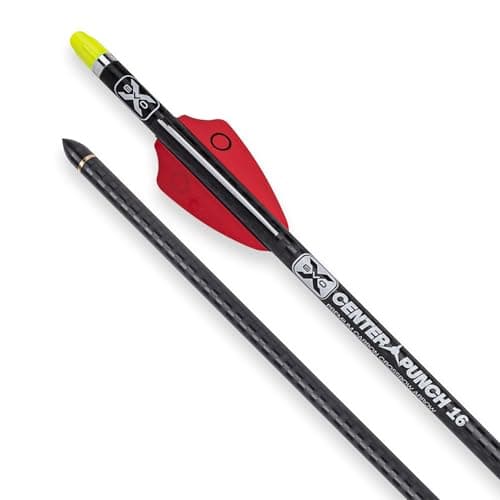
If you want to add weight on purpose rather than by accident, these are the two arrows we point people at. The CenterPunch16 is heavy by design — 410 grains finished, a 92-grain brass insert, about 17 percent FOC — and the Executioner family lets you pick your straightness tolerance and supplies both half-moon and flat nocks in the box.
Check your crossbow’s required nock and minimum arrow length before ordering either one — crossbow arrows are not interchangeable, and the nock is the part the string hits.
Spending the energy you have
Once you know your number, the broadhead is how you spend it. A wide mechanical converts energy into cutting diameter and costs you penetration; a compact fixed head converts it into depth. On a 140 ft-lb bow shooting whitetails, either works. On a lower-energy bow, or on anything bigger than a deer, the fixed head is the safer allocation.
Four mistakes people make with this number
| Treating muzzle energy as downrange energy | The chart figures are at the bow. An arrow sheds energy the whole way to the animal, and lighter arrows shed it faster. Your 40-yard number is lower than your muzzle number, always. |
|---|---|
| Using the bow's bare weight instead of the finished arrow | Insert, point and nock are real grains. A shaft listed at 330 grains can finish near 450 once a 100-grain head and a brass insert are in it - a difference of about 30 ft-lb at 400 FPS. |
| Chasing energy on a bow that already has three times enough | If the goal is deer and your number is above 120 ft-lb, more energy is not what is limiting you. Group size at hunting distance almost always is. |
| Going light to chase advertised speed | Lower energy, more noise, more vibration, and below the published minimum finished weight it is a dry-fire-class risk to the bow and to you. |
Frequently asked questions
How do you calculate crossbow kinetic energy?
Multiply the arrow speed in feet per second by itself, multiply that by the total finished arrow weight in grains, then divide by 450,800. The result is kinetic energy in foot-pounds. Total finished weight means everything that flies: shaft, vanes, nock, insert and point - not the bare shaft weight printed on the box.
How much kinetic energy does a crossbow need for deer?
Easton publishes 25 to 41 ft-lb for medium game, which includes deer and antelope, and the crossbow press commonly quotes a more conservative 40 to 60 ft-lb. A modern hunting crossbow produces roughly 120 to 220 ft-lb at the muzzle, so the bar is cleared several times over by essentially any current bow with a legal arrow.
How much kinetic energy does a 400 FPS crossbow have?
About 142 ft-lb with a 400-grain arrow, 124 ft-lb with a 350-grain arrow and 160 ft-lb with a 450-grain arrow. The spread shows why the bow's advertised speed alone does not give you your number - the arrow is half the calculation.
Does a heavier crossbow bolt have more kinetic energy?
Usually yes, even though it flies slower. Deer & Deer Hunting's worked example has a 445-grain arrow at 410 FPS producing 165.93 ft-lb against a 370-grain arrow at 440 FPS producing 158.89 ft-lb. Adding weight costs speed, but the energy gained from mass normally exceeds the energy lost to the slower speed. The limits are your bow's published minimum finished weight and the extra arrow drop, which means re-sighting.
Is kinetic energy or momentum more important for a crossbow?
They answer different questions. Kinetic energy weights speed twice and weight once, and is a reasonable proxy for how much work the arrow can do. Momentum weights them equally - arrow grains times speed, divided by 225,218 - and is a better proxy for whether the arrow keeps moving after it meets a rib or a shoulder. That is why heavier arrows are recommended for larger animals even when the energy number already looks sufficient.
What is a good kinetic energy for a crossbow?
For whitetail-sized game, anything above roughly 60 ft-lb is comfortable and anything above 100 ft-lb has real margin for a quartering shot or a bone hit. Since the typical modern crossbow lands between 120 and 220 ft-lb, the practical answer for most hunters is that your bow is already good enough and the money is better spent on arrows, a broadhead that matches your quarry, and practice from your actual hunting position.
Sources
- Deer & Deer Hunting - how to get the most power out of your crossbow: the kinetic energy formula (speed squared, times arrow weight in grains, divided by 450,800) and the worked example of a 370-grain arrow at 440 FPS yielding 158.89 ft-lb against a 445-grain arrow at 410 FPS yielding 165.93 ft-lb
- Easton Archery kinetic-energy recommendations by game class, as published in Bowhunt America's arrow kinetic energy calculator - small game 25 ft-lb, medium game (deer, antelope) 25 to 41 ft-lb, large game 42 to 65 ft-lb, toughest game 65 ft-lb and up
- TenPoint - EVO-X CenterPunch16 specifications: 410 grains finished, 92-grain brass insert, about 17 percent FOC, plus or minus .001 straightness, Alpha-Nock HP
- Black Eagle Arrows - Executioner crossbow arrows: 20 and 22 in lengths, .003 and .001 straightness options, both half-moon and flat nocks supplied
- Ravin Crossbows - published speed and kinetic energy figures for the R500 (500 FPS, 222 ft-lb) and R29X (450 FPS, 180 ft-lb)
- Prices, product images and stock status via the Amazon price layer, refreshed daily
Keep reading
Gearing up before your next hunt?
See how we evaluate gear, then dig into the reviews and buying guides — written without inventory to sell.