Buying Guide
Best Coolers for Hunting: Buy for the Heat You Have to Remove
A camping cooler keeps cold things cold. A hunting cooler has to take a 101-degree animal and get it under 40 - which is a completely different job, and it is the job that decides the size you buy and the ice you put in it.
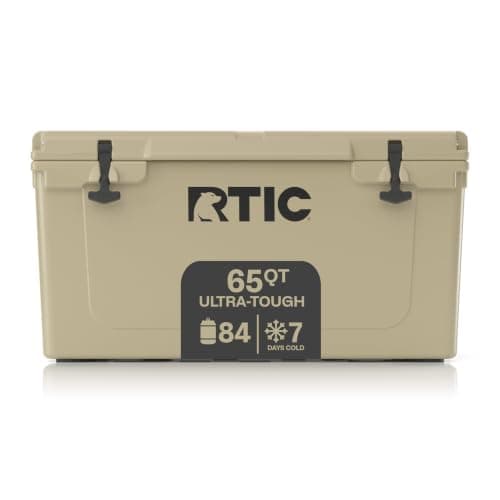
For most hunters the right cooler is a 65-quart rotomolded box, and the RTIC 65 QT Ultra-Tough is the one we would buy: 65 quarts is the size that actually swallows a quartered whitetail with ice packed around it, and thick rotomolded walls with a gasketed lid are what keep that ice alive on a 60-degree drive home. If you load coolers by yourself, the RTIC Ultra-Light 52 QT is the honest compromise. If you hunt in genuinely cold weather and only need a cooler for the trip out, the Coleman Classic 62 Qt does that job for a fraction of the money.
What none of the camping cooler reviews will tell you is why the hunting version of this question is different. A camping cooler is handed food that is already cold and asked to keep it there. A hunting cooler is handed meat coming off an animal whose body temperature was around 101 degrees and asked to drag it below 40 before bacteria get a head start. Removing heat is harder than preventing its arrival, and that one fact drives every decision below.
Why a hunting cooler is not a camping cooler
Put a case of cold drinks in a cheap cooler with a bag of ice and it will be cold tomorrow. Put a warm deer quarter in the same cooler with the same bag of ice and you may have warm meat sitting in bloody water by morning, because all the available cooling capacity went into pulling heat out of twenty-five pounds of muscle instead of holding a temperature.
That changes three things about what you buy:
| You need more ice than you think, and somewhere to put it | Ice does the cooling, so volume you cannot fill with ice is volume that is not working. A cooler that exactly fits the meat is the wrong size cooler. |
|---|---|
| Insulation quality stops being a luxury | A gasketed, thick-walled cooler is not about day five of a camping trip. It is about whether your ice survives the warm afternoon between the field and the processor. |
| Drain and clean-out matter more than cup holders | Meat sheds blood and water. You want a real drain plug you can open on a tailgate and an interior you can scrub with bleach water afterwards. |
The clock you are actually racing
Idaho Fish and Game’s warm-weather guidance for hunters puts the threshold plainly: a deer or antelope can hang and cool as a whole carcass in air 40 degrees or cooler, and “meat can spoil in a matter of hours if the heat cannot escape.” Above that air temperature, the carcass is not cooling on its own and you are on the clock. The same guidance notes that below 40 degrees flies are rarely a problemand that at higher temperatures “flies are your enemy” — which is the second reason to get meat into a closed box rather than hanging in a tree.
The practical read: if the air is below 40 and staying there, a cooler is for transport. If the air is above 40 — which describes most of archery season and a lot of rifle season — the cooler is the refrigeration, and it has to do the work a cold night would otherwise have done for free.
Sizing a cooler to an animal
Hunting coolers get sized in quarts, and the useful translation is not “how many drinks” but “how much animal, plus ice.”
| 20-25 quarts | Backstraps, tenderloins, heart and liver - the cuts you want on ice within minutes. Also the cooler that lives in the truck all season. |
|---|---|
| 45-52 quarts | Most of a quartered whitetail if you pack tight, or half of one with a generous ice bed. The largest size a average adult can still load alone when full. |
| 62-65 quarts | The common recommendation for a whole quartered deer with ice around it. This is the default hunting cooler size for a reason. |
| 100 quarts and up | Elk and moose quarters, multiple deer, or a camp that is also feeding people. Needs wheels, and needs two people when loaded. |
Two cautions on that table. First, “fits a deer” claims assume a quartered deer and vary with the animal — a mature northern buck and a southern doe are not the same problem. Second, a cooler packed to the lid with meat and no ice is a box, not a cooler. Plan on roughly a third of the volume being ice, and size up rather than down if you are between two.
Block ice, cubed ice, and the ratio nobody plans
Ice type is the cheapest performance upgrade in this whole category, and most hunters get it backwards. Idaho Fish and Game’s guidance is direct: block ice lasts longer than crushed, and “block ice stored in a quality cooler that’s left closed will last for days.” Less surface area means a slower melt.
But cubed ice cools faster, because surface area is exactly what moves heat. So the answer for a hunting cooler is both, in a deliberate order:
| Stage | What to use | Why |
|---|---|---|
| Pre-chill, the night before | A sacrificial bag of cubed ice, dumped before you load | A warm cooler steals the first several pounds of your real ice before it does any cooling at all |
| First few hours after loading meat | Cubed ice packed in and around the quarters | Fast contact cooling is what pulls the core temperature down through the range that matters |
| Holding and transport | Block ice, or frozen jugs, on the bottom with meat above | Slow melt, days of life in a gasketed cooler, and no meat sitting in meltwater |
| Never | Meat sitting in standing water | Open the drain periodically. Waterlogged venison is a texture and flavor problem, not just a tidiness one |
Frozen gallon jugs or milk cartons of water are the hunter’s version of block ice: they last like block, they do not flood the cooler as they melt, and they are free.
The four picks compared
| Cooler | Capacity | Construction | Realistic load | Best for |
|---|---|---|---|---|
| RTIC 65 QT Ultra-Tough | 65 qt | Rotomolded, gasketed lid, T-latches | A whole quartered deer with ice | The default hunting cooler |
| RTIC Ultra-Light 52 QT | 52 qt | Injection-molded light build, gasketed | Most of a quartered deer, or half with deep ice | Loading alone, truck beds, longer carries |
| Coleman Classic 62 Qt | 62 qt | Classic thin-wall, no gasket | Similar volume, far shorter ice life | Cold-weather camps and short transport |
| RTIC 20 QT | 20 qt | Rotomolded, gasketed lid | Straps, tenderloins and organ meat | The second cooler, and season-long truck duty |
Capacities are the manufacturers’ published figures. “Realistic load” is our read of what the volume holds once you leave room for ice — not a manufacturer claim, and it varies with how you break the animal down. Prices move constantly; the live figures sit beside each pick below.
Best overall: RTIC 65 QT Ultra-Tough
This is the cooler to buy if you are buying one cooler. Sixty-five quarts is the size that hunters keep landing on because it takes a quartered whitetail and the ice that keeps it, which is the combination that actually matters. The rotomolded construction, thick insulation and gasketed lid are the features that justify the price in warm weather: ice life is not a bragging right here, it is whether the meat is still below 40 when you reach the processor.
Honest cons: it is heavy empty and a two-person lift loaded, which is a real planning constraint if you hunt alone. It takes up serious truck-bed real estate. And if you only ever hunt late season in the cold, you are paying for insulation that the weather was giving you for free.
Best one-person lift: RTIC Ultra-Light 52 QT
The Ultra-Light trades some wall thickness for a large drop in empty weight, and for a hunter who loads and unloads solo that trade is often the right one. Fifty-two quarts still takes most of a quartered deer, and the version of this gear that you can actually get into the truck by yourself beats the version you leave at camp because it is too heavy to bother with.
Honest cons: lighter walls mean shorter ice life than the Ultra-Tough, so it is a weaker choice for a multi-day warm-weather hunt where you cannot resupply ice. And “most of a deer” means you will be making decisions about what goes in the second cooler.
Spend less: Coleman Classic 62 Qt
There is an honest case for a classic cooler in hunting, and it is a narrow one: late season, cold air, short transport. If the ambient temperature is already below 40, the air is doing the refrigeration and the cooler is mostly a clean, fly-proof box to move meat in. In that job a thin-walled cooler at a fraction of the price is not a compromise, it is the correct purchase.
Honest cons: no lid gasket and thin walls mean ice life measured in a day or two rather than days, so this is the wrong cooler for early archery season, for a warm afternoon pack-out, or for any hunt where the cooler has to be the cooling. Latches and hinges are also the known failure points on classic coolers.
The second cooler: RTIC 20 QT
A 20-quart rotomolded cooler is the most used piece of gear in a lot of trucks, and in hunting it has a specific job: the cuts that should be on ice immediately. Backstraps, tenderloins, heart and liver come off first and are the most heat-sensitive, most valuable meat on the animal. Getting them into cubed ice while you are still working on quarters is the single easiest quality win available.
It also earns its keep the other fifty weeks of the year, which is why it is a pick rather than a nice-to-have. Honest cons: 20 quarts is small enough that it is genuinely a second cooler, not a cheaper first one.
The two-cooler system
The setup that works best for most deer hunters is not one big cooler. It is a big one and a small one, each with a job:
| The small cooler, pre-chilled with cubed ice | Lives at the truck or the tailgate. Straps, tenderloins, heart and liver go in first, within minutes of breaking the animal down. |
|---|---|
| The big cooler, block ice on the bottom | Takes the quarters. Drain it periodically so meat is not sitting in water, and keep the lid shut between loads. |
| Neither cooler holds food | Mixing groceries and raw game meat in one box is how a cooler gets opened twenty times a day, and every opening costs ice. |
The other half of the job is the field work that happens before any of this. Our field dressing guide covers the procedure, including the published chronic wasting disease precautions and why boning out beats cutting through bone, and our field dressing kit guide covers the tools. A kit worth owning is the thing that makes quartering fast enough for the cooler strategy above to matter.
The bottom line
Buy for the heat you have to remove, not the drinks you want to keep cold. For most hunters that means the RTIC 65 QT Ultra-Tough, block ice on the bottom, a sacrificial bag of cubes to pre-chill it the night before, and a 20-quart cooler at the tailgate for the straps. If you load alone, take the Ultra-Light 52 and accept the shorter ice life. If you only hunt in genuinely cold weather, the Coleman Classic 62 is enough cooler and you can spend the difference on something that matters more.
Check the RTIC 65 QT price on Amazon, then do the part that costs nothing: pre-chill it, skin and quarter before the meat goes in, and open the drain on the drive home.
Frequently asked questions
What size cooler do you need for a deer?
Sixty-five quarts is the common recommendation, and it is the size most hunters settle on, because it takes a quartered whitetail with ice packed around it rather than just the meat. Fifty-two quarts holds most of a quartered deer and is the largest size a single person can reasonably load when full. Plan on roughly a third of the volume being ice - a cooler that exactly fits the meat is the wrong cooler.
What is the best cooler for hunting?
The RTIC 65 QT Ultra-Tough for most hunters: rotomolded walls and a gasketed lid, in the capacity that handles a quartered deer plus ice. If you load coolers by yourself, the RTIC Ultra-Light 52 QT trades some ice life for a much easier lift. If you only hunt in air below 40 degrees and need transport rather than refrigeration, a classic cooler like the Coleman Classic 62 Qt does that job for far less money.
Block ice or cubed ice for game meat?
Both, in order. Cubed ice has more surface area so it cools faster, which is what you want in the first hours after the meat is loaded. Block ice melts far slower - Idaho Fish and Game notes block ice in a quality cooler that stays closed will last for days - so it is what holds temperature during transport. Frozen gallon jugs are a free substitute for block and do not flood the cooler as they melt.
How cold does venison need to be kept?
Get it below 40 degrees and keep it there. Idaho Fish and Game's guidance is that a deer or antelope can hang and cool as a whole carcass in air 40 degrees or cooler, and that meat can spoil in a matter of hours if the heat cannot escape. The same guidance notes flies are rarely a problem below 40 degrees and become a serious one above it, which is a second reason to get meat into a closed cooler.
Should you skin a deer before putting it in a cooler?
Yes, and quarter it too in anything but cold weather. Hide is insulation doing exactly what the cooler walls do, in the wrong direction. Quarters cool from all sides, while a whole carcass cools slowly from the outside in around a core that stays warm longest. Idaho Fish and Game says elk and moose should always be quartered because of body mass and slow cooling, and the same logic applies to a deer in warm weather.
Can you use a camping cooler for hunting?
Yes, but understand what you are asking of it. A camping cooler is handed food that is already cold and asked to keep it there. A hunting cooler is handed meat from an animal whose body temperature was around 101 degrees and asked to remove that heat. Removing heat takes far more ice than holding a temperature does, so a cooler that is fine for a weekend of groceries can be badly undersized for one deer.
Do you need a rotomolded cooler for hunting?
It depends entirely on air temperature. Above 40 degrees the cooler is the refrigeration, and thick rotomolded walls with a gasketed lid are what keep ice alive long enough to matter - that is worth the money. In late-season cold the air is doing the work and the cooler is mostly a clean, fly-proof box, in which case a classic cooler at a quarter of the price is the correct purchase rather than a compromise.
Sources
- Idaho Department of Fish and Game - 'Warm weather means hunters should take precautions with game meat': a deer or antelope can hang and cool as a whole carcass in air 40 degrees or cooler; meat can spoil in a matter of hours if heat cannot escape; elk and moose should always be quartered; block ice lasts longer than crushed and block ice in a quality closed cooler lasts for days; below 40 degrees flies are rarely a problem
- Outdoor Life - 'Tips for Cooling and Temporary Storage of Wild Game Meat': cooling evenly on all sides, quartering and getting meat onto ice
- RTIC published capacities and construction for the 65 QT Ultra-Tough, Ultra-Light 52 QT and 20 QT hard coolers (rotomolded or injection-molded body, gasketed lid, T-latch closures, drain plug)
- Coleman Classic 62 Qt published capacity and construction
- Prices, product images and stock status via the Amazon price layer, refreshed daily
Keep reading
Gearing up before your next hunt?
See how we evaluate gear, then dig into the reviews and buying guides — written without inventory to sell.