Buying Guide
The Best Hunting Knives: Replaceable Blades vs the Classics
Field dressing a deer dulls a blade faster than anything else you will do with a knife. That single fact has quietly reshaped what belongs in a hunting pack.
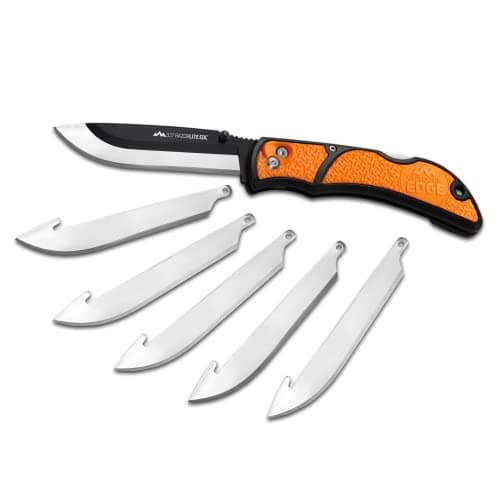
Field dressing is the harshest thing most hunters ever do to a knife. Hair, hide and the occasional contact with bone or gut contents will take a factory edge off a traditional blade before you finish one deer — and finishing the job with a dull knife is how people cut themselves.
That is why replaceable-blade knives now dominate hunting packs: they trade a knife you sharpen for a knife you re-arm. Both approaches are defensible, and this guide covers where each one genuinely wins.
The shift: why replaceable blades took over
A replaceable-blade hunting knife holds a scalpel-thin surgical blade in a locking carrier. When the edge goes, you swap the blade in about ten seconds and carry on with a factory-sharp knife. The blades cost roughly a dollar each in a multi-pack.
Three consequences follow, and together they explain the shift:
- You never work with a dull knife.Which is a safety argument first and a convenience argument second — most field-dressing injuries happen because someone is forcing a blunt blade.
- You do not need to sharpen in the field. Sharpening a knife properly on a cold hillside in failing light is a skill most hunters do not have and cannot practice usefully.
- The edge is thinner than you can produce. A surgical blade is ground far finer than a general-purpose hunting knife, which makes skinning and caping dramatically easier.
What actually matters in a hunting knife
| Blade length | Three to four inches is the sweet spot for deer-sized game. Longer blades are harder to control inside a body cavity and offer no advantage |
|---|---|
| Handle grip when wet | The single most under-rated specification. A handle that is secure with dry hands and slick with blood on them is a hazard. Rubberized or textured polymer beats smooth wood or bone every time |
| Blade shape | A drop point is the general-purpose answer - enough belly for skinning, enough point control for detail work. Gut hooks are a preference rather than a requirement |
| Blade change or sharpening system | Either a locking replaceable-blade carrier that works with cold, wet hands, or a steel that takes and holds an edge you can restore |
| Sheath quality | The part everyone ignores until a knife falls out of it in the timber. Retention matters more than material |
| Blaze color handles | Genuinely useful. A dark-handled knife set down in leaves during field dressing is a knife you will spend twenty minutes finding |
Best overall: Outdoor Edge RazorLite EDC
A 3.5-inch replaceable-blade folder with a pocket clip, non-slip handle and lock-back safety, shipping with six blades at roughly $35 (verify current pricing). This is the knife most hunters should own.
The 3.5-inch drop-point blade is right for whitetail-sized game, the folding format means it lives in a pocket rather than on a belt, and the blaze orange handle is easy to find when you have set it down in leaves. Blade changes are a one-handed operation, which matters when your other hand is occupied.
Honest cons: the blades are brittle and will snap under prying loads, the folding mechanism traps more blood and hair than a fixed blade, and cleaning it properly takes longer than you would like.
Best value in blades: Outdoor Edge RazorPro L
Same replaceable-blade system with a non-slip orange handle and a belt holster, shipping with 12 blades at roughly $50 (verify current pricing). A 30-blade version is also available.
The maths is why this pick exists. Blades are the consumable, and buying them bundled with the knife is significantly cheaper than buying them separately later. If you take more than one or two animals a season, the larger blade packs pay for themselves quickly.
Honest cons: a belt holster rather than a pocket clip, which some hunters prefer and others find bulky under a pack belt.
Best for butchering: Outdoor Edge RazorMax
The RazorMax is a fixed-blade replaceable system that takes both a 3.5-inch drop point and a 5-inch boning and fillet blade, with a belt sheath and a detachable blade carrier, at roughly $60 (verify current pricing).
Two blade profiles is the reason to buy it. The drop point handles field dressing and skinning; the long flexible boning blade handles the part most hunters do badly — getting meat cleanly off bone at the tailgate or on the kitchen counter. Doing that with a 3.5-inch blade is slow and wasteful.
The fixed-blade format also cleans up far more easily than a folder, which matters when you are processing rather than field dressing.
Honest cons: it lives on a belt, not in a pocket, and carrying two blade profiles is overkill for a hunter who takes one deer a year and drops it at a processor.
Best traditional folder: Buck 110 Folding Hunter
The 110 has been in production since 1963 and there is a reason: 3.75-inch 420HC clip-point blade, brass bolsters, ebony handle scales and a leather sheath, at roughly $90 (verify current pricing).
420HC is not an exotic steel, and that is deliberate — it takes an edge easily with basic equipment, which is the correct trade for a knife you will resharpen for thirty years. Buck’s heat treatment is well regarded and the lock-back is genuinely solid.
Buy this if you would rather own one knife for life than a system with consumables, and if you can sharpen.
Honest cons: heavy for its size, the smooth wood-and-brass handle is slick with wet hands, and the clip point has less belly than ideal for skinning. And it will go dull partway through a deer.
Best traditional fixed blade: Buck 119 Special
The 119 is the fixed-blade counterpart — a full-tang-feel classic with a phenolic handle and a leather sheath at roughly $98 (verify current pricing), weighing 7.5 ounces.
A fixed blade is stronger than any folder and vastly easier to clean, which are the two things that matter most when you are elbow-deep in an animal. If you want a traditional knife that can take the prying and levering a replaceable blade cannot, this is it.
Honest cons: the 6-inch blade is longer than field dressing needs and awkward inside a chest cavity, the phenolic handle offers modest wet grip, and it rides on a belt.
Best budget kit: Gerber Ultimate Fixed Blade
Around $43 (verify current pricing) for a fixed blade with a sheath, an integrated blade sharpener and a ferro rod. It is not the best knife here, but it is a complete package that covers a genuine gap.
The integrated sharpener is the useful part for a hunter using a traditional blade — it lets you restore a working edge in the field without carrying a separate stone or knowing how to use one. The ferro rod is a fair emergency addition on a backcountry hunt.
Honest cons: pull-through sharpeners remove more steel than a stone and produce a coarser edge, the steel is basic, and this is a general-outdoors knife adapted to hunting rather than a purpose-built one.
Which type should you carry?
| If you... | Carry | Why |
|---|---|---|
| Take one or two deer a season and use a processor | A replaceable-blade folder | Field dressing only. You will never need to sharpen and you will never work dull |
| Butcher your own animals | A replaceable-blade fixed system with a boning blade | Two profiles, easy to clean, and a fine edge for getting meat off bone |
| Hunt backcountry and pack meat out | A replaceable-blade knife plus a small bone saw | Weight matters, and a saw does the prying jobs a surgical blade cannot |
| Prefer one knife you maintain yourself | A traditional drop-point fixed blade plus a sharpener | Stronger, easier to clean, and nothing to run out of |
| Hunt small game or birds | A small replaceable-blade folder | The fine edge is a genuine advantage on small, delicate work |
Whatever you carry, carry two ways to cut on any hunt where an animal has to come out on your back. Losing a knife in the leaves at dusk is common, and a spare weighs almost nothing.
The bottom line
For how the knife actually gets used, step by step, see how to field dress a deer.
For most hunters the honest answer is a replaceable-blade knife. The RazorLite EDC at around $35 covers field dressing for a fraction of what a traditional knife costs, and it will never be dull when you need it. If you butcher your own animals, the RazorMax and its boning blade are worth the extra.
If you want a knife your grandchildren will use, buy the Buck 110 or 119, learn to sharpen, and accept that you will be touching up the edge partway through a deer.
Check the Outdoor Edge RazorLite price on Amazon. Pair it with a headlamp that stays put— most field dressing happens in the dark.
Frequently asked questions
Are replaceable-blade hunting knives worth it?
For field dressing, yes for most hunters. Hair and hide dull a traditional edge quickly, and a replaceable-blade knife lets you swap in a factory-sharp surgical blade in about ten seconds for roughly a dollar. That is a safety benefit before it is a convenience one - most field-dressing cuts happen when someone forces a blunt blade.
What size blade is best for a hunting knife?
Three to four inches for deer-sized game. Longer blades are harder to control inside a body cavity and offer no real advantage. A 3.5-inch drop point is the most broadly useful profile - enough belly for skinning, enough point control for detail work around the pelvis and diaphragm.
Do replaceable blades break?
Yes, if you pry with them. Surgical blades are ground far thinner than a general-purpose knife, which is what makes them cut so well and also what makes them brittle. Do not twist them in joints or lever against bone. If your process involves splitting a pelvis or sternum, carry a small bone saw for those steps.
What is the best traditional hunting knife?
The Buck 110 Folding Hunter is the default for a folder and the Buck 119 Special for a fixed blade. Both use 420HC steel, which is not exotic but takes an edge easily with basic equipment - the right trade for a knife you intend to resharpen for decades rather than replace.
Should a hunting knife be fixed blade or folding?
Fixed blades are stronger and far easier to clean, which matters when you are working inside an animal. Folders are more convenient to carry and live in a pocket rather than on a belt under a pack. For field dressing only, a folder is fine; for butchering, a fixed blade is meaningfully better.
How many knives should I carry hunting?
Two ways to cut, on any hunt where an animal has to come out on your back. Losing a knife in leaf litter at dusk is common, and a spare - even just a handful of replacement blades and a second carrier - weighs almost nothing against the consequence of being stuck without one.
Sources
Keep reading
Gearing up before your next hunt?
See how we evaluate gear, then dig into the reviews and buying guides — written without inventory to sell.