Buying Guide
The Best Camping Coolers, and What Ice Retention Claims Really Mean
A cooler that holds ice for five days in a lab holds it for two on a campsite. Here is what actually drives the difference, and which cooler is worth the money.
Ice retention claims are produced under ideal conditions: a pre-chilled cooler, packed full, kept shut, in the shade. Change any of those on an actual campsite and a five-day cooler becomes a two-day cooler.
That matters because it means how you use a coolerinfluences ice life at least as much as which cooler you bought — and it means the honest answer to “is a $270 cooler worth it?” depends entirely on how long your trips are.
What ice retention claims really mean
| The test conditions | Cooler pre-chilled, filled to capacity with ice, lid closed for the duration, ambient temperature controlled, kept out of direct sun. Nothing removed and nothing added |
|---|---|
| Your conditions | Cooler loaded warm from the garage, half full, opened twenty times a day by people looking for a drink, sitting in the sun beside a picnic table |
| The realistic gap | Expect meaningfully less than the advertised figure in normal camp use. This is not the manufacturer lying - it is a lab number applied to a real world |
| What closes the gap | Pre-chilling, block ice, filling empty space, shade, and above all keeping the lid shut. These change ice life more than a construction upgrade does |
Rotomolded vs classic: is the premium worth it?
A rotomolded cooler is molded as a single seamless piece with thick insulation and a gasketed lid. A classic cooler is injection-molded with thinner walls and no gasket. The rotomolded design holds ice substantially longer and survives far more abuse; it also costs three to four times as much and weighs considerably more empty.
| Rotomolded (RTIC, EchoSmile) | Classic (Coleman) | |
|---|---|---|
| Insulation | Thick, seamless, gasketed lid | Thinner walls, no gasket |
| Ice life | Substantially longer | Adequate for weekend trips |
| Weight empty | Heavy - a 65 QT is a two-person lift when loaded | Light enough to carry one-handed empty |
| Durability | Very high - bear-resistant models exist | Adequate; hinges and latches are the failure points |
| Price (approx.) | $95 - $279 | $75 - $110 |
| Best for | Multi-day trips, hot climates, hunting camps, boats | Weekends, day trips, drinks duty |
Sizing: the two-cooler rule
The most useful cooler advice has nothing to do with which cooler you buy: run two. A large one for food that stays shut, and a small one for drinks that gets opened constantly.
Opening frequency is one of the biggest variables in ice life, and drinks are what drives it. Split them and the food cooler suddenly performs close to its advertised figure while the drinks cooler absorbs all the abuse.
| 20-25 quart | Drinks cooler, day trips, one or two people overnight |
|---|---|
| 45-52 quart | Weekend for two to four people, or the food cooler in a two-cooler setup |
| 62-65 quart | The standard family camping size. Four people for several days |
| 100 quart and up | Large groups, long trips, or hauling game meat. Needs wheels and two people |
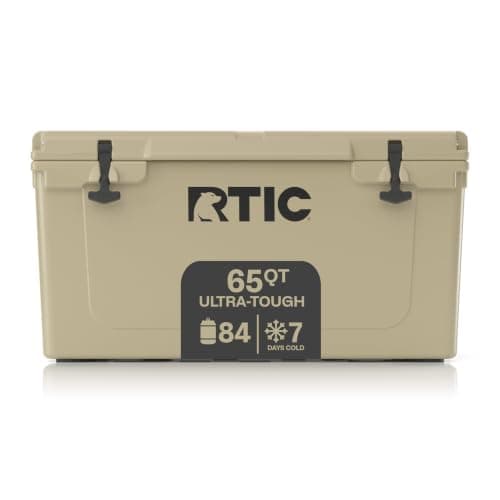
Best overall: RTIC 65 QT Ultra-Tough
Around $269 (verify current pricing) for a rotomolded 65-quart cooler. This is the size and construction combination that suits the most people: enough capacity for a family for several days, and enough insulation that the ice is still there on day three.
RTIC’s position in this category has always been the same — comparable construction to the most expensive premium brands at a lower price. If you have decided you want a rotomolded cooler, this is where the value is.
Honest cons: it is very heavy. A loaded 65-quart rotomolded cooler is a genuine two-person lift, and it takes up substantial trunk space. If you camp alone or have a small vehicle, size down.
Best value: Coleman Classic 62 Qt
Around $75 (verify current pricing) for a 62-quart leak-resistant cooler rated to keep ice up to five days. It is a quarter the price of the RTIC at nearly the same capacity.
For weekend camping this is genuinely the right purchase for most people. Two nights does not test the limits of any decent cooler, and the money saved buys a second small cooler, a better stove, or a sleeping pad that will do more for your trip.
Honest cons: no gasket on the lid and thinner insulation, so real-world ice life falls well short of rotomolded coolers on long trips. Latches and hinges are the parts that eventually fail.
Best liftable: RTIC Ultra-Light 52 QT
Around $229 (verify current pricing) for a 52-quart hard cooler RTIC states is 30% lighter than rotomolded construction. That is the entire pitch, and it addresses the single biggest complaint about premium coolers.
Weight matters more than buyers expect. A cooler you cannot lift alone when loaded is a cooler that stays in the car, or that gets dragged across a campsite until something breaks. Thirty percent is the difference between a two-person lift and a one-person one.
Honest cons: lighter construction means somewhat less insulation than a full rotomolded build, so you trade a little ice life for the weight saving. Still costs premium money.
Best drinks cooler: RTIC 20 QT
Around $135 (verify current pricing) for a rotomolded 20-quart. This is the second half of the two-cooler system, and buying a good one is more logical than it first appears.
The drinks cooler is the one that gets opened forty times a day, sits in the sun by the fire, and rides in the boat. It takes the abuse. Putting the rotomolded construction where the abuse is and the cheap cooler where the lid stays shut is arguably the correct way round.
Honest cons: expensive for its capacity, and 20 quarts fills quickly once you add ice.
Best big-group option: Coleman Classic 100 Qt rolling
Around $110(verify current pricing) for a 100-quart rolling cooler rated to keep ice up to five days. The wheels are not a luxury at this size — a loaded 100-quart cooler is well beyond a comfortable two-person carry.
For large groups, long weekends, or hauling meat home from a hunting camp, capacity beats construction quality. This gets you a lot of cold space for the price of a mid-size rotomolded box.
Honest cons: classic construction means it will not hold ice like a rotomolded cooler, wheels do not help on soft ground, and when full it is genuinely difficult to move at all.
Cheapest rotomolded: EchoSmile 12 Quart
Around $95 (verify current pricing) for a 12-quart rotomolded cooler. Small, genuinely well-insulated, and the cheapest way to own rotomolded construction.
The realistic use case is a personal cooler: a day on the water, a lunch cooler that lives in a truck, or keeping a specific item cold that you do not want buried in the family cooler.
Honest cons: 12 quarts is small, and it is expensive per quart. This is a specialist purchase rather than a main cooler.
How to make any cooler hold ice longer
- Pre-chill the cooler. A cooler stored in a hot garage spends the first several hours cooling its own plastic. Put a sacrificial bag of ice in it the night before and dump it when you load.
- Use block ice, not cubes. Less surface area means slower melting. Cubes for packing gaps, blocks for endurance. Frozen water bottles work and give you drinking water later.
- Fill the empty space.Air is the enemy. A full cooler holds ice far longer than a half-empty one — pack gaps with towels or more ice.
- Keep it shut. The biggest variable you control. Run a separate drinks cooler so the food cooler is opened three times a day rather than thirty.
- Keep it in the shade. Direct sun on a dark cooler lid is brutal. Under the table, under a tarp, or covered with a light-colored blanket.
- Do not drain the meltwater. Cold water keeps contents cold and slows the remaining ice. Drain only if it threatens your food packaging.
- Pack in reverse order. What you need last goes on the bottom. Digging is opening by another name.
The bottom line
For weekend camping, buy the Coleman Classic 62 Qt at $75 and spend the savings elsewhere in your kit. For trips of four days or more, hot climates, or getting meat home from a hunting camp, the RTIC 65 QT earns its price. If lifting is the constraint, the RTIC Ultra-Light 52 solves that specific problem.
Then run a second small cooler for drinks. It does more for your ice life than any construction upgrade.
Check the Coleman Classic 62 Qt price on Amazon, or see the full kit list in our camping equipment list.
Frequently asked questions
How long do camping coolers actually keep ice?
Less than the advertised figure, usually by a considerable margin. Manufacturer claims come from a pre-chilled cooler packed full, kept shut, and stored out of the sun. On a campsite - loaded warm, half full, opened constantly, sitting in daylight - expect substantially shorter ice life from any cooler regardless of construction.
Are rotomolded coolers worth the money?
For trips of four days or more, in hot weather, or for getting meat home from a hunting camp, yes - the ice life difference is real and the durability is far higher. For two-night weekend trips, a $75 classic cooler with block ice does the job, and the $200 saved buys gear that will improve the trip more.
What size camping cooler do I need?
20 to 25 quarts for drinks or one to two people, 45 to 52 quarts for a weekend for a small group, 62 to 65 quarts as the standard family size for several days, and 100 quarts or more for large groups or hauling game. Better still, run two: a large one for food that stays shut and a small one for drinks.
Should I use block ice or cubed ice?
Both. Block ice has less surface area so it melts far more slowly and provides the endurance; cubed ice packs into the gaps around your food and cools things quickly. Frozen water bottles are a good middle ground because they last well and leave you with drinking water.
Should I drain the water from my cooler?
Generally no. Cold meltwater keeps the contents cold and insulates the remaining ice, so draining it actually shortens ice life. Drain only if the water level threatens your food packaging - or keep vulnerable items in sealed containers so you never have to.
Why does my cooler lose ice so fast?
Most often because it was loaded warm, it is not full, and it is being opened frequently. Pre-chill the cooler overnight before the trip, fill empty space with ice or towels, keep it in shade, and run a separate drinks cooler so the food cooler stays closed. Those four changes matter more than which cooler you own.
Sources
Keep reading
Gearing up before your next hunt?
See how we evaluate gear, then dig into the reviews and buying guides — written without inventory to sell.