Buying Guide
The Best Field Dressing Kits for Deer
A field dressing kit is judged at dusk, in the cold, forty minutes from the truck, with one headlamp and blood on your hands. That is a different test than the one it passes in a store, and it is the reason the most important thing about a kit is often what it does not include.
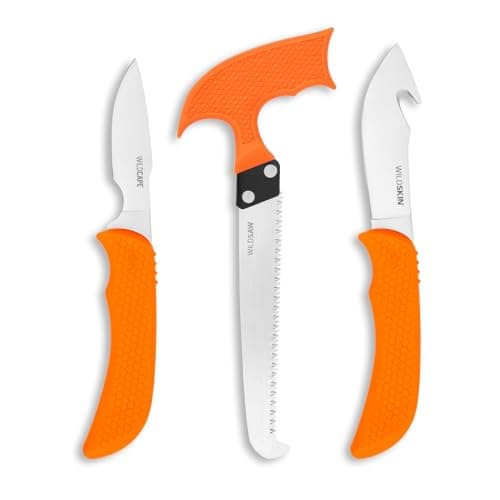
Most people buy a field dressing kit once, and they buy the wrong size of it. The four-piece belt kit is not the same product as the eight-piece hard-case set, and they are not for the same moment in the day.
A field dressing kit is what you carry, in the dark, to open an animal and get it cooling. A processing kit is what lives on a garage bench to turn a hanging carcass into packaged meat. Buying the second when you needed the first is how hunters end up carrying a hard case with a rib spreader in it two miles from the truck.
This guide covers both, the blade debate that actually matters, and the four things nearly every boxed kit leaves out.
Field dressing versus processing: two different kits
| Field dressing kit | Processing kit | |
|---|---|---|
| Where it is used | In the field, at the animal | At camp, a truck tailgate or a garage |
| What it carries in | A belt sheath or a roll | A hard case |
| Contents | A knife or two, a small saw, gloves, a sharpener | Skinner, caping knife, boning knife, fillet blade, saw, spreader, sharpener |
| Weight matters | Enormously | Not at all |
| Who needs it | Every hunter | Hunters who butcher their own animals |
If you are buying one kit, buy the field dressing size. It covers the job that has to be done immediately, and a hunter who takes their deer to a processor never needs the second one.
Replaceable blades versus a traditional edge
This is the real decision, and both sides are defensible.
| Replaceable blade | Traditional fixed edge | |
|---|---|---|
| Sharpness | Surgical-scalpel sharp, every time, all the way through the animal | Excellent at the start, degrades through the job |
| Recovery from dull | Snap in a new blade, ten seconds | Stop and strop, or finish dull |
| Toughness | Blades are thin and can snap - do not pry with them | Handles bone contact, prying and abuse |
| Cold-hands handling | Blade changes are fiddly with numb, bloody fingers | Nothing to change |
| Ongoing cost | Replacement blades every season | None beyond a sharpener |
| Disposal | Used scalpel blades need safe handling and disposal | Not applicable |
Our position: a replaceable-blade knife is the better primary field dressing tool for most hunters, because a razor edge for the whole job is worth more than toughness you rarely need. Carry a small fixed blade as the backup for anything that requires force.
Why disease guidance should shape your kit
Chronic wasting disease is present in cervid populations across a growing number of states, and the published hunter guidance affects what tools you should carry - not just how you handle meat.
The recommendations are specific:
- Wear latex or rubber gloves when field dressing.
- Bone out the meat rather than cutting through bone.
- Avoid severing the brain or spinal column, and minimize handling of those tissues.
- Do not eat brain, spinal cord, eyes, spleen, tonsils or lymph nodes; cutting away all fatty tissue removes remaining lymph nodes.
- Disinfect equipment afterwards - guidance describes soaking in a 40% household bleach solution for five minutes, with no tissue remaining on the tools.
- Check your state wildlife and public health guidance on testing. Testing is disease surveillance, not a food safety guarantee.
The practical consequence for a kit: gloves are not optional, a boning knife is more useful than a bone saw for the field, and every tool you buy should be something you are willing to soak in bleach. Do not buy a kit built around wooden handles you cannot properly disinfect.
What almost every kit leaves out
Four items, in the order you will miss them:
- Gloves. Some kits include one pair. You want shoulder-length gloves and a box of nitrile, and you want them every time.
- Game bags. No boxed kit includes enough. On a warm early-season evening these are the difference between meat that cools clean and meat that is ruined.
- A drag or a pack frame. The kit gets the animal open. Something else has to get it out.
- A good light. Field dressing is almost always done in the dark. A headlamp with a real white beam is part of the kit whether or not it comes in the box. See our headlamp guide.
The kits at a glance
| Kit | Pieces | Carry | Best for |
|---|---|---|---|
| WildGuide | 4 | Belt sheath | The default field kit |
| Wild Roll Pack | 5 | Roll | Cheapest complete kit |
| WildPak | 8 | Hard case | Field to freezer, own processing |
| JaegerPak | 8 | Hard case | Full-tang knives, heavier duty |
| RazorGuide Pak | Kit | Hard case | Replaceable-blade system, complete |
| RazorLite EDC | 1 | Pocket clip | Single knife, always with you |
Best overall: Outdoor Edge WildGuide 4-piece
Four pieces in a camo nylon belt sheath: a gut-hook skinning knife, a caping blade and a bone saw. That combination covers the whole field job and nothing more, which is exactly right for something you carry.
The gut hook is the piece worth having if you are not fully confident opening an animal without nicking the paunch - it is a guided cut that stays shallow. The caping blade is what you use around the head and legs if you plan to keep the hide.
Add gloves and game bags separately and this is a complete field kit for a modest price.
Outdoor Edge Wild Roll Pack
Five pieces - gut hook skinner, caping knife, boning blade and a two-stage sharpener - in a roll rather than a case. The roll is the better carry format for a pack, because it lies flat against the back panel instead of forming a brick.
It is also the cheapest complete kit here, which makes it a strong first kit or a gift.
Outdoor Edge WildPak 8-piece
The field-to-freezer set: caping knife, gut-hook skinner, boning and fillet blade, a wood/bone saw, a rib spreader, gloves and a hard-side case. This is a processing kit, and the case tells you where it belongs - a tailgate or a garage bench, not a day pack.
Buy it if you butcher your own deer. The boning and fillet blades are the pieces that matter, and they are exactly what the CWD guidance to bone out meat calls for.
Outdoor Edge JaegerPak
The heavier-duty eight-piece: full-tang skinning knife, gutting and boning knives, a sharpener, a bone saw and a rib spreader in a hard case. Full-tang construction is the upgrade over the WildPak, and it matters if you process multiple animals a season.
Outdoor Edge RazorGuide Pak
The replaceable-blade system in kit form: two replaceable-blade knives, a bone saw, a gutting blade and a stock of spare blades in a case. If you have decided you want a razor edge from start to finish and you want the whole system in one purchase, this is it.
Outdoor Edge RazorLite EDC
The single best knife purchase for a hunter who wants one blade in their pocket at all times. It takes replaceable blades, clips into a pocket, and is light enough that it lives in the pack year round rather than getting left in a drawer.
Pair it with a small fixed blade for anything requiring force and you have covered the entire field job with two tools.
Havalon Piranta-Edge
Havalon effectively created this category, and the Piranta-Edge remains the reference: a lightweight folding handle taking surgical blades, sold with a dozen spares.
It is the sharpest tool on this page and the most fragile. The blades are genuinely thin - treat it as a skinning and caping instrument, not a general-purpose knife, and never pry with it.
Outdoor Edge SwingBlaze
The traditional-edge answer: one handle with a rotating head carrying both a skinning blade and a gutting blade. No blade changes, nothing to snap, blaze orange so you do not lose it in leaf litter - which is a more common problem than it sounds.
Choose this over the replaceable-blade options if you hunt in genuinely cold weather where blade changes with numb fingers are a real concern.
Building your own kit
A self-assembled kit is usually better and often cheaper than a boxed one, because you skip the pieces you will never use. The complete field list:
- One replaceable-blade knife plus spare blades in a hard container
- One small fixed blade as backup
- Shoulder-length gloves and a few pairs of nitrile
- Four to five game bags
- A compact folding saw
- A drag strap or harness
- Zip ties for a tag, and a pen that writes in the cold
- A headlamp with fresh batteries, plus a backup light
- Hand sanitizer and a rag
Pack it all in a dry bag inside your pack so blood does not end up on everything else you carry.
Gloves
The combo pack with short latex gloves and shoulder-length poly gloves is the right buy. The shoulder-length pair is what keeps a jacket sleeve out of a body cavity; the short pair is what you wear over them for grip.
Game bags
Game bags do two jobs: they keep flies off the meat and they let air circulate so the surface dries into a protective crust while the interior cools. A tarp or a plastic bag does the opposite - it traps heat and moisture, which is how meat sours.
A five-pack of deer-sized bags covers a whole animal with a spare. Larger reusable quarter bags are the choice if you bone out and pack meat any distance.
Saw, drag and sharpener
A compact folding saw handles a pelvis or a sternum and doubles for shooting lanes. A drag harness turns the worst part of a successful hunt into a manageable walk and keeps both hands free on uneven ground in the dark. And a guided sharpener is what keeps a traditional blade working all the way through an animal.
The bottom line
Buy the WildGuide four-piece if you want a boxed kit that covers the field job and nothing you will not carry.
Buy the RazorLite plus a small fixed blade if you would rather assemble your own and want a razor edge for the whole animal.
Buy the WildPak or JaegerPak only if you process your own deer at home.
Buy gloves and game bags regardless. They are what turns a knife into a kit, and no boxed set includes enough of either.
Related: best hunting knives, what to pack for an all-day sit, and the rifle season checklist.
Frequently asked questions
What should be in a deer field dressing kit?
At minimum: a sharp knife (a replaceable-blade design or a fixed blade with a sharpener), shoulder-length and nitrile gloves, four or five game bags, a compact saw, a drag strap, and a headlamp with a backup light. Boxed kits typically cover the knives and the saw and leave out the gloves, bags, drag and light - which are the four things you will actually miss first.
Are replaceable-blade knives better for field dressing?
For most hunters, yes. A scalpel-sharp edge for the entire animal is worth more than the toughness of a traditional blade, which you rarely need once you are boning out rather than cutting bone. The trade-offs are real though: the blades are thin and will snap if you pry, blade changes are awkward with cold wet hands, and used blades need safe disposal. Carrying a small fixed blade as a backup covers the gap.
Do you need a bone saw to field dress a deer?
Increasingly, no. Current CWD guidance for hunters is to bone out the meat and avoid cutting through bone or severing the spinal column, which removes the main reason a saw was standard equipment. A compact saw is still useful for the pelvis if you split it, and for clearing shooting lanes, but a boning knife has become the more important tool in a field kit.
How do you clean and disinfect field dressing tools?
Wash all tissue off first, then disinfect. Published CWD guidance for hunters describes soaking equipment in a 40% household bleach solution for five minutes, with no tissue remaining on the tools, and washing hands and instruments thoroughly afterwards. This is one reason to choose a kit with synthetic handles you can soak rather than wooden ones you cannot properly disinfect.
Are game bags necessary for deer?
Yes, especially in warm early-season weather. Game bags keep flies off the meat while allowing air to circulate so the surface dries into a protective crust as the interior cools. A tarp or a plastic bag does the opposite - it traps heat and moisture against the meat, which is how a carcass sours. A five-pack of deer-sized bags covers a whole animal with one spare.
Sources
- CWD-INFO.ORG - recommendations for hunters (wear latex or rubber gloves when field dressing deer or elk; bone out the meat rather than cutting through bone; avoid severing the brain or spinal column and minimize handling of those tissues; avoid eating brain, spinal cord, eyes, spleen, tonsils and lymph nodes; cutting away all fatty tissue removes remaining lymph nodes; disinfect equipment by soaking in a 40% household bleach solution for 5 minutes; hunters are encouraged to have animals tested before consuming meat in areas where CWD is present, though testing serves disease monitoring rather than food safety verification)
- Amazon product catalog - live availability, current pricing, kit contents and product images verified for every item listed on this page (checked 2026-09-06)
Keep reading
Gearing up before your next hunt?
See how we evaluate gear, then dig into the reviews and buying guides — written without inventory to sell.