Buying Guide
Best Deer Carts, Drags and Sleds for Getting an Animal Out
Recovery is the one part of a deer hunt most hunters never rehearse, and it is measurably the hardest thing they do all season - a lab study of a simulated drag recorded a mean pull of 69 pounds and pushed hunters over 85 percent of max heart rate for half the haul. Here is what the research says about harnesses, carts and sleds, the federal rule that bans a wheeled cart outright on some public land, and eight in-stock picks.
Hunters rehearse everything except the recovery. We sight the bow in, we practice the cocking sequence, we hang the stand in August and climb it once in daylight — and then we find out, in the dark, on a cold evening, 600 yards from the truck, that nobody planned the part where the animal has to come out.
That part is measurably the hardest physical work in deer hunting. In a study of deer-hunting activities presented in the International Journal of Exercise Science, eleven participants hiked 0.8 km over simulated Pennsylvania hunting terrain and then dragged a 56 kg (123-pound) dummy deer 0.4 km. The hike averaged 104.6 bpm. The drag averaged 156.5 bpm and peaked at 179.4 bpm, with the participants spending 49.9% of the drag above 85% of maximum heart rate — in what the authors described as a high-fit population. A cable tensiometer put the mean pull at 69.2 pounds.
Seventy pounds of continuous pull, at near-maximal heart rate, in the cold, after dark, alone. That is the job this gear exists to make survivable, and it is why the choice between a bare rope, a pocket-money harness and a real cart is not really a budget question. This guide starts with the load and the research, covers the federal rule that can make a wheeled cart illegal where you hunt, and then names eight setups that were in stock on the publication date.
The picks at a glance
Four carts, two drag harnesses and two sleds. Capacities and weights are the manufacturers' published figures except where a number is credited to an independent test, and prices come from the live listings rather than typed once and forgotten:
| Product | Price & buy | Type | Published capacity | Best for |
|---|---|---|---|---|
| Rivers Edge game cart (RE790) | $141.95Buy | Two-wheel tri-fold, solid rubber | 300 lbs | Best cart overall |
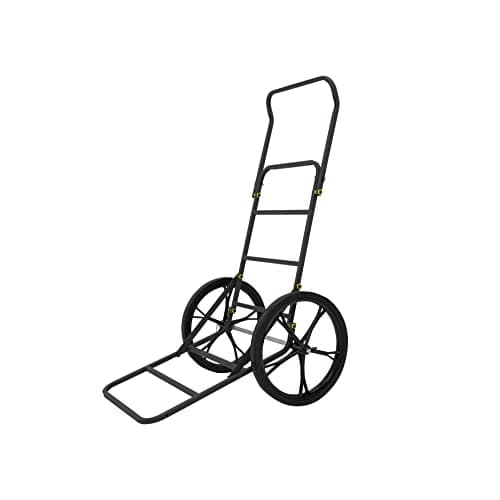
| Hawk Crawler 500 | $234.99Buy | Four-wheel, foam-filled never-flat | 500 lbs | Logs, ruts and rough ground |
| Guide Gear 750-lb with tow bar | $159.99Buy | Two-wheel steel, 20-inch wheels | 750 lbs (see the con) | ATV towing and heavy loads |
| Guide Gear Deluxe deer cart | $89.99Buy | Two-wheel steel, solid rubber | 300 lbs | Cheapest real cart |
| MULTUS deer drag harness | $24.55Buy | Shoulder harness plus extender strap | 400 lb working load | Best drag harness |
| Allen dual harness deer drag | $10.79Buy | Two-inch webbing harness with rope | Not published | Cheapest harness worth owning |
| Beavertail Sport Sled, large | $144.86Buy | Roto-molded poly sled, 64 x 29 in | Not published | Snow, marsh and mud |
| Firegowin drag sled mat (2-pack) | $39.99Buy | 600D PVC mat, 73 x 22.8 in | Not published | Lightest thing that helps |
Prices shown are from Amazon as of October 9, 2026 and change often — the button always goes to the current listing. Some links may earn us a commission at no extra cost to you.
What you are actually moving
Buy for the animal, not for the story. A field-dressed whitetail is lighter than the live weight hunters quote each other in camp: Deer & Deer Hunting's widely-used rule of thumb is to multiply field-dressed weight by roughly 1.28to estimate live weight, which puts a 125-pound field-dressed yearling buck near 160 pounds on the hoof. The number that matters to your back is the field-dressed one — and the two published studies of deer retrieval used dummy loads of 45 kg (99 lbs) and 56 kg (123 lbs), which is a fair bracket for most of the deer most of us shoot.
| Measured pull force, 123-lb dummy deer over hunting terrain | 69.2 ± 5.6 lbs of mean tension (cable tensiometer, Slippery Rock University) |
|---|---|
| Heart rate during that drag | 156.5 bpm mean, 179.4 bpm peak, 49.9% of the drag above 85% of max HR |
| Heart rate during the 0.8 km hike in | 104.6 bpm mean - the drag is a different activity entirely |
| Rule-of-thumb live weight | Field-dressed weight x 1.28 (a camp estimate, not a biologist's figure) |
Two practical conclusions fall straight out of those numbers. First, distance matters more than weight: 400 meters at 70 pounds of pull is the entire event, and a cart that saves you nothing in the first 50 yards saves you everything over the last 300. Second, if you have any cardiovascular risk at all, this is the moment to take seriously. A 2007 American Journal of Cardiologystudy of 25 middle-aged hunters — 17 with diagnosed coronary artery disease — found that all but three exceeded the maximum heart rate they had reached on a clinical treadmill test during deer season, and that dragging downed game produced the highest rates recorded.
Harness or rope? The research is one-sided
Most hunters own a drag rope and think of the harness as an upgrade for people who take it too seriously. The one peer-reviewed comparison of the two says the opposite. Fountaine and Evenson, publishing in Wilderness & Environmental Medicine in 2015, had twelve men move a 45 kg simulated carcass 457 meters two ways: towing with a shoulder harness that let them stay upright, and hand-dragging, which forces trunk flexion — the bent-over posture everyone recognizes.
| Peak oxygen consumption | Significantly lower with the harness (P = .001) |
|---|---|
| Peak heart rate | Significantly lower with the harness (P = .003) |
| Average heart rate | Significantly lower with the harness (P = .028) |
| Perceived exertion | Significantly lower with the harness (P < .001) |
| Time to cover 457 meters | No significant difference (P = .27) |
Read that last line again: the harness was not slower. You give up nothing in time and you take measurably less cardiovascular strain, which is why the authors singled out deconditioned hunters and hunters with cardiovascular risk factors as the people who should be towing rather than dragging. A harness is the cheapest item on this page and the highest-return purchase on it, and it fits in a jacket pocket.
The mechanism is posture, not padding. Standing upright lets your legs drive the load through a straight spine instead of asking your lower back and shoulders to hold a bent position under 70 pounds of tension. That is also why the good harnesses include a short extender strap: it raises the attachment point so the animal follows behind you rather than pulling you down toward it.
Cart, drag or sled: pick by ground, not by price
These three tools are not tiers of the same product. They fail in different places, and the ground you hunt decides which one is worth carrying:
| Your situation | What to buy |
|---|---|
| Field edges, logging roads, mowed trails, food plots - anything a wheel can roll | A cart. Nothing else is close over distance on rollable ground |
| Thick timber, blowdowns, standing corn, steep sidehills | A harness. A cart in a blowdown is 45 extra pounds you also have to carry |
| Snow, hard frost, marsh, wet leaves, sand | A sled. Low friction turns the whole problem into a walk |
| You hunt public land 2 miles from the truck and pack in light | A harness plus a drag mat, or quarter the animal and pack it out |
| Federally designated Wilderness | A harness or a sled - a wheeled game cart is prohibited (see below) |
| You can legally drive an ATV to within a few hundred yards | A cart with a removable tow bar |
The combination most experienced whitetail hunters end up with is a harness in the pack all season and a cart in the truck. The harness handles the drag to the nearest two-track; the cart handles the two-track to the tailgate. Neither one substitutes for the other, and together they cost less than one premium treestand.
Two wheels, four wheels and what the tires cost you
Cart design comes down to three decisions, and manufacturers publish enough to judge all three before you buy.
- Two wheels or four.A two-wheel cart pivots around its axle, so you carry part of the load in your arms and steer by leaning it — light, simple, and tiring on long hauls. A four-wheel cart carries the whole load and rolls straight, which is why Hawk's dual rotating axles matter: the cart can climb over a log instead of stopping dead against it. The cost is bulk, weight and a cart that does not thread between trees as well.
- Wheel diameter beats everything else on rough ground. A 20-inch wheel rolls over a root that stops a 14-inch wheel. This is the single spec most buyers underweight, and it is the reason a cheap cart with big wheels often beats an expensive cart with small ones on real terrain.
- Solid rubber, foam-filled or pneumatic. Nothing here uses inner tubes, and that is correct for a tool that lives in a shed eleven months a year and gets used once in thorns. Solid rubber never goes flat and transmits every rock to the load; micro-cellular polyurethane foam fill (the Hawk Crawler) rides softer with the same no-flat guarantee.
Two things no cart spec sheet mentions. First, strap the animal down — a deer that shifts on a sidehill tips the cart, and righting 150 pounds of loose load on a slope is how people get hurt. Second, assembly happens once, at home, in daylight, with the instructions: every independent test of these carts flags unclear assembly instructions as a recurring complaint, and the parking lot at 9 p.m. is the wrong place to discover a missing cotter pin.
The rule that can make your cart illegal
A game cart is not legal everywhere, and this is the part almost no product page mentions. In federally designated Wilderness areas within the National Forest System, possessing or using a wheeled vehicle — and the Forest Service names game cartsexplicitly — is prohibited under 36 CFR 261.50(a) and (b). The exceptions are a permit authorizing the activity and assistive devices used by persons with disabilities under the ADA. There has been recurring legislative effort to change this (H.R. 1349 in the 115th Congress would have amended the Wilderness Act to allow bicycles, strollers and game carts), but as of this writing the prohibition stands.
Practical version: if your elk or deer hunt is inside a designated Wilderness boundary, plan on a harness, a sled, or quartering and packing the animal out on your back — and check the unit's own rules before you plan around anything else. State wildlife areas, national wildlife refuges and many private leases add their own restrictions on vehicles and on what may be left overnight, and none of those show up in a cart's specifications.
Meat care on the way out
The recovery is also when meat gets ruined, and the failure mode is heat rather than dirt. A whole animal dragged hide-on over frozen ground picks up leaves and mud you can rinse off; a whole animal dragged two miles in 60-degree weather with the hide holding body heat in is a different problem. Three habits fix most of it:
- Get the chest cavity open and spread before the haul, not after. Our field dressing kit guide covers the kit that makes that fast in the dark, including why a bone saw and a rib spreader matter more than a second knife.
- Put something between the meat and the ground. This is the quiet argument for the cart and the sled over the bare drag, and the reason a cheap drag mat earns its place in a pack even when you own a cart.
- If it is warm or far, quarter it. Cooling accelerates the moment the quarters are in game bags, and two trips with a real pack frame beat one heroic drag. See hunting backpacks for the frames that carry meat, and the rifle season gear checklist for what should already be in the truck.
One safety note that belongs with the gear: wear blaze orange for the haul, even if you hunted in camo and even if you are only crossing a field. You are now a large brown shape moving low and slow through cover during an open season. Every harness on this page is orange for that reason.
Best cart overall: Rivers Edge tri-fold game cart
Rivers Edge publishes a 300-poundhauling capacity, a tri-fold frame that goes "from folded to full use" with no tools, and steel wheels with solid rubber tires that cannot go flat. Outdoor Life's deer cart test named it Best Overall and measured it at 29 pounds with two 16-inch airless tireson a 56 x 20-inch frame — the lightest cart in that test — calling it "simple to assemble, lightweight…and low profile, with the most affordable price tag." For one hunter moving one whitetail on ground a wheel can handle, that combination is the right set of trade-offs.
Honest cons: 300 pounds is the lowest capacity here, which is plenty for whitetail and marginal for elk quarters or two hunters' worth of gear; the tri-fold has to be taken apart rather than collapsed in one motion; Outdoor Life's testers noted the open spoke wheels catch debris and that the aluminum frame is easier to damage than steel. Rivers Edge does not publish the cart's own weight or assembled dimensions, so the figures above come from the independent test rather than the manufacturer.
Who it's for: the whitetail hunter who wants one cart in the truck all season and would rather push 29 pounds than 50.
Best on rough ground: Hawk Crawler 500
The Crawler is the cart for ground that stops other carts. Hawk publishes a 500-pound capacity, a 45-pound cart weight, four oversized 3 x 14-inch never-flat tires filled with micro-cellular polyurethane foam, an overall footprint of 31 x 71 inches that folds to 31 x 42 inches without disassembly, and a Textilene DuraMesh sling that also hauls firewood, bait and blind panels. The headline feature is the patent-pending dual rotating axles, which let the cart crawl over an obstacle instead of being lifted across it. Outdoor Life named it Best Foldingand found the axle design handled "uneven terrain, logs like a champ," while Field & Stream named it Best for Rough Terrain.
Honest cons: it is the heaviest and most expensive cart here, and Outdoor Life's testers "struggled with the weight" when maneuvering it empty — 45 pounds of cart is a real decision if the walk in is long. Field & Stream's testers flagged limited collapsibility despite the fold, and the four-wheel footprint is wider than a two-wheel cart in tight timber. Both tests noted the assembly instructions could be clearer.
Who it's for: hunters whose recovery route includes blowdowns, ruts, ditch crossings or old logging slash, and anyone who wants a cart that earns its keep on property work the other eleven months.
Best for ATV towing: Guide Gear 750-lb deer cart
If you can legally drive to within a few hundred yards, a cart with a tow bar changes the arithmetic completely: you pull the load with an engine and use the cart for the last stretch on foot. Guide Gear publishes a 750-pound headline capacity, puncture-proof 20-inch solid-rubber wheels that roll over downed trees, roots and shallow water, a powder-coated steel frame, removable wheels and a removable tow bar that attaches to any ATV. The listed item weight is 51.2 pounds, and the frame folds flat for storage.
Honest cons: the retail listing is internally inconsistent — the 750-pound headline sits above copy describing "a powder-coated steel frame with a 500-lb weight capacity," so treat 500 pounds as the number you can defend and do not load this cart on the strength of the bigger figure. At 51 pounds it is heavy to push empty, towing it behind an ATV is only useful where motorized access is legal, and 20-inch wheels on a two-wheel frame make it tall and tippy on a sidehill unless the load is strapped low.
Who it's for: private ground and managed leases with two-tracks, where the cart spends more time behind a four-wheeler than in front of a hunter.
Cheapest real cart: Guide Gear Deluxe deer cart
This is the cart that has been in the back of farm trucks for twenty years, and it still does the job: a steel frame rated to 300 pounds, puncture-proof solid-rubber spoked wheels, a collapsible frame with removable wheels, and a cart weight that Field & Stream puts at under 30 poundson a 36.5 x 21.25-inch folded footprint. Field & Stream named it Best Budget in its deer cart test, and it is typically the least expensive honest cart on the market.
Honest cons: it is basic on purpose — no adjustable handle, no sling, no tow bar, and Field & Stream's reviewer notes plainly that it "lacks some additional and adjustable features of other more expensive carts." The 300-pound ceiling and the narrow bed mean a big-bodied northern buck rides with legs hanging off, and the spoked wheels collect brush the same way the Rivers Edge wheels do. Retailer listings for this product line vary in stated dimensions between 36.5 and 65 inches depending on whether the figure is folded or assembled, so measure your trunk before you assume it fits.
Who it's for: a first cart, a spare for a guest, or the hunter who wants wheels under the deer and would rather spend the difference on game bags and a harness.
Best drag harness: MULTUS deer drag harness
This is the piece of gear the research argues for, at a price that makes the argument easy. MULTUS publishes a 400-pound working load, a 6.5-foot reflective orange polypropylene harness loopthat goes over the shoulder for hands-free towing, a separate reflective dual-loop strap that attaches to the animal as an extender, and two O-ring buckle slides for adjustment. The manufacturer describes the extender's purpose in exactly the terms the study used: it lets a hunter "drag in an upright position for greater control, improved pulling power and safety." It also works as a hand drag when the cover is too thick to walk upright.
Honest cons: flat polypropylene webbing over one shoulder digs in under 70 pounds of pull and there is no padding — run it over a jacket, not a base layer. There is no sternum strap, so the loop can slide off a shoulder on a sidehill. And 400 pounds is a working-load figure for the webbing, not a promise about the buckles; inspect them, because this is hardware that lives crumpled in a pack pocket for years between uses.
Who it's for:everyone. Put it in the pack in September and forget about it — it weighs ounces and it is the difference the study measured.
Cheapest harness worth owning: Allen dual harness deer drag
Allen's Model 33 is the budget version of the same idea and the better-built harness in one specific way: it uses 2-inch heavy-duty webbing over both shoulders with a sternum strap to keep it in place, a steel D-ring attachment point, and an included drag rope, in blaze orange, at a price most hunters will not think twice about. Wider webbing spread across two shoulders is more comfortable under load than a single narrow loop, which is the whole game once the pull passes 50 pounds.
Honest cons: Allen does not publish a working load rating, which is a real gap on a piece of gear that takes 70 pounds of tension — the honest read is that the webbing is heavier-duty than the MULTUS and the rating is simply unstated, not that it is stronger. The included rope is short, so you will be closer to the animal and its legs than you want on a downhill. And "dual harness" describes the two shoulder straps, not a two-person rig; if you plan to drag with a partner, buy two.
Who it's for: the hunter who wants the harness the research supports for less than a pack of broadheads costs, and anyone outfitting a whole deer camp at once.
Best sled: Beavertail Sport Sled, large
On snow, frost, marsh grass or wet leaves a sled beats every cart made, because the problem stops being rolling resistance and becomes a low-friction slide. Beavertail's large Sport Sled measures 64 x 29 x 11 inches— long enough for a whole whitetail with the hide on — weighs 17 pounds, and is a one-piece roto-molded hull of 100% virgin polyethylene with an aggressive leading edge and an included tow rope. It is sold to duck hunters for decoys, which is exactly why it works here: it is built to be loaded heavy and dragged through mud and ice all season.
Honest cons: Beavertail publishes no weight capacity for the Sport Sled, so the load limit is a judgment call rather than a spec; the manufacturer states it is "best suited for hand pulling," not towing behind a machine; on bare dry ground a poly hull scrapes, grabs and wears instead of sliding; and a 64-inch rigid sled is awkward to store and impossible to carry into a stand. It also costs more than the budget carts here.
Who it's for: late-season and northern hunters, marsh and swamp hunters, and anyone whose recovery route crosses ground too soft for a wheel.
Lightest option: a drag mat in your pack
The cheapest useful thing in this category is a sheet of coated fabric with ropes on it. A drag mat keeps hide and meat off rocks and stubble, slides far better than fur does on leaves or snow, and rolls up small enough to live in a daypack where a cart and a sled cannot follow. This Firegowin set is a two-pack of 600D PVC mats measuring 73 x 22.8 inches with pull ropes, sold as waterproof and tear-resistant, at a price in the same bracket as a pack of field points.
Honest cons: this is a generic-brand product with no published weight capacity, no independent testing behind it and no brand reputation to lean on — judge it as a heavy tarp with grommets, which is what it is. The 22.8-inch width means a mature deer overhangs the sides, a mat does nothing at all for the 70 pounds of pull you still have to generate, and PVC over sharp rock will eventually cut. Buy it as insurance and a meat-care habit, not as a recovery system.
Who it's for: the mobile public-land hunter who carries everything in, and anyone who wants the animal off the dirt on a haul that a cart cannot reach.
What to carry with it
The recovery kit is small, and it is the kit hunters most often leave in the truck:
- Game bags, if there is any chance you quarter the animal. Breathable bags let quarters cool and keep flies off; a contractor bag does neither.
- A headlamp with real output, and a spare.Recovery happens after dark far more often than hunters admit — our hunting headlamp guide covers the beam patterns that matter for trailing and for working over an animal with your hands full.
- Flagging tape.Mark last blood, and mark the animal's location before you walk out for the cart. Both are listed in the bow season gear checklist for a reason.
- Gloves and a knife you can use cold. The hunting knife guide covers handles that stay secure with blood on them, which is the specification that actually matters at 10 p.m.
- Water, and the willingness to sit down. Given the heart-rate data above, stopping twice on a long drag is not weakness; it is the entire risk-management plan.
The bottom line
Buy the harness first, whatever else you do. It costs less than a dozen bolts, it fits in a pocket, and it is the only item here with a controlled study showing lower peak heart rate, lower oxygen cost and lower perceived effort at no loss of speed — the MULTUS harness if you want the extender strap and the reflective webbing, the Allen dual harness if you want two-inch webbing and a sternum strap for less.
Then buy for your ground. Rollable terrain and one hunter: the Rivers Edge tri-fold at 29 pounds. Blowdowns, ruts and ditches: the Hawk Crawler, and accept the 45 pounds. Legal ATV access on private ground: the Guide Gear 750-lb with the tow bar, loaded to the 500-pound figure its own listing describes. On a budget: the Guide Gear Deluxe. Snow and marsh: the Beavertail Sport Sled. And if you hunt designated Wilderness, skip the wheels entirely — the cart is prohibited, and a harness, a sled or a pack frame is the plan.
Whatever you buy, set it up at home in daylight and walk a loaded lap around the yard before opening day. The recovery is the only part of the hunt that is guaranteed to happen in the dark, under time pressure, when you are already tired.
Frequently asked questions
Is a deer drag harness actually better than a rope?
Yes, and it is the rare gear question with a controlled study behind it. Fountaine and Evenson (Wilderness & Environmental Medicine, 2015) had twelve men move a 45 kg simulated carcass 457 meters by towing with a shoulder harness in an upright posture and by traditional hand-dragging. Towing produced significantly lower peak oxygen consumption, lower peak heart rate, lower average heart rate and lower perceived exertion, with no significant difference in completion time. The authors specifically recommended it for deconditioned hunters and hunters with cardiovascular risk factors.
How hard is it really to drag a deer?
Harder than most hunters plan for. In a study presented in the International Journal of Exercise Science, eleven participants dragged a 56 kg (123-pound) dummy deer 0.4 km over simulated hunting terrain: mean pull tension measured 69.2 pounds, mean heart rate hit 156.5 bpm against 104.6 bpm for the hike in, peak heart rate reached 179.4 bpm, and participants spent almost 50 percent of the drag above 85 percent of maximum heart rate - in a group the authors described as high-fit.
Can I use a game cart on public land?
Usually, but not in federally designated Wilderness. Forest Service regulations prohibit possessing or using wheeled vehicles including game carts in National Forest Wilderness areas under 36 CFR 261.50(a) and (b), with exceptions for permit holders and for assistive devices used by persons with disabilities under the ADA. Outside Wilderness, rules vary by agency, state and property - check the specific unit's regulations, since state wildlife areas and refuges often add their own vehicle and overnight-storage restrictions.
Two-wheel or four-wheel deer cart?
Two wheels are lighter, narrower and easier to thread through timber, but you carry part of the load in your arms and balance it by leaning. Four wheels carry the entire load and roll straight, and a design with pivoting or rotating axles - like the Hawk Crawler's dual rotating axles - can climb over logs instead of stopping against them. Wheel diameter matters more than wheel count on rough ground: a 20-inch wheel rolls over roots that stop a 14-inch wheel.
What weight capacity do I need in a deer cart?
For whitetail, 300 pounds is genuinely enough - a field-dressed deer is usually well under 200 pounds, and Deer & Deer Hunting's rule of thumb is that live weight is about 1.28 times field-dressed weight. Go higher if you haul elk quarters, load gear with the animal, or share the cart. Be skeptical of headline numbers: the Guide Gear 750-lb cart's own retail copy describes a frame with a 500-pound capacity, which is the figure to plan around.
When is a sled better than a cart?
Whenever friction beats rolling resistance: snow, hard frost, marsh grass, mud, wet leaves and sand. A sled has no wheels to catch, no axle to bend and no width to thread, and it keeps the animal off dirt and rock. On bare dry ground it is worse than a cart in every way - a poly hull scrapes and grabs instead of sliding. Northern and late-season hunters often own both.
Should I quarter the animal instead of dragging it whole?
If it is warm, far, or uphill, yes. Quartering lets the meat start cooling immediately once quarters are in breathable game bags, splits an unmanageable single load into carryable ones, and lets you use a pack frame where no wheel will go - including designated Wilderness, where game carts are prohibited. The trade is time in the field with a knife and two trips instead of one.
Sources
- Eberhart K., Verba S., Jensen B., Lynn J. (Slippery Rock University) — The Heart Rate Response and Force Production Related to Deer Hunting-Associated Activities, International Journal of Exercise Science (0.8 km hike then 0.4 km drag of a 56 kg dummy deer: hike mean HR 104.6 bpm; drag mean HR 156.5 bpm, max 179.4 bpm, 49.9% of the drag above 85% of max HR; mean drag tension 69.2 ± 5.6 lbs by cable tensiometer)
- Fountaine C., Evenson M.J. — Cardiovascular Demands of Deer Retrieval Methods, Wilderness & Environmental Medicine 26(2):216-220 (2015). Twelve men moved a 45 kg simulated carcass 457 m by shoulder-harness towing vs hand dragging; towing significantly lower peak VO2 (P = .001), peak HR (P = .003), average HR (P = .028) and perceived exertion (P < .001), with no significant difference in completion time (P = .27)
- Deer & Deer Hunting — reporting on the 2007 American Journal of Cardiology study (Barry Franklin et al.): 25 middle-aged hunters, 17 with diagnosed coronary artery disease; all but three exceeded their treadmill-test maximum heart rate during deer season, dragging downed game produced the highest rates, and several showed field heart-rhythm irregularities absent from laboratory EKGs
- Deer & Deer Hunting (Dan Schmidt) — field-dressed to live weight rule of thumb (multiply field-dressed weight by 1.28; yearling bucks typically 105-125 lbs field dressed), described by the author as a deer-camp estimate rather than a biologist's figure
- USDA Forest Service — Wheeled vehicles in Wilderness: possessing or using game carts and other wheeled vehicles is prohibited in National Forest Wilderness areas under 36 CFR 261.50(a) & (b), with permit and ADA assistive-device exceptions
- U.S. House Committee on Natural Resources — markup memo for H.R. 1349 (115th Congress), a bill to amend the Wilderness Act so that use of bicycles, wheelchairs, strollers and game carts is not prohibited in Wilderness areas
- Hawk — Crawler Multi-Use Cart published specifications (500 lb capacity, 45 lb cart weight, four 3" W x 14" H never-flat micro-cellular polyurethane foam-filled tires, 31" W x 71" L overall / 31" W x 42" L folded, patent-pending dual rotating axles, Textilene DuraMesh sling)
- Outdoor Life — The Best Deer Carts, Tested and Reviewed (Rivers Edge Game Cart named Best Overall at a measured 29 lbs, 300 lb capacity, two 16-inch airless tires, 56 x 20 inches, with open spoke wheels and aluminum frame as cons; Hawk Crawler named Best Folding at 45 lbs / 500 lbs, axle system "handles uneven terrain, logs like a champ", testers "struggled with the weight")
- Field & Stream — The Best Deer Carts, Tested and Reviewed (Hawk Crawler named Best for Rough Terrain, oversized foam-filled no-flat wheels, 360-degree pivoting axles, limited collapsibility as the con; Guide Gear Deluxe Deer Cart named Best Budget at 300 lbs, 36.5" L x 21.25" W x 5.5" H, under 30 lbs, puncture-proof solid-rubber spoked wheels)
- Sportsman's Warehouse — Rivers Edge Game Cart (model RE790) published specifications: 300 lb hauling capacity, tri-fold design "from folded to full use - no tools needed", steel wheels with solid rubber tires that won't go flat
- Guide Gear — 750-lb. Deer Cart with Tow Bar listing specifications (750 lb headline capacity above copy describing a powder-coated steel frame with a 500-lb weight capacity; puncture-proof 20-inch solid-rubber removable wheels; removable tow bar for any ATV; 51.2 lb item weight; model GC750-SYT)
- MULTUS — Deer Drag Harness published specifications (400 lb working load; 6.5 ft reflective orange polypropylene harness loop strap for hands-free shoulder towing plus a reflective dual-loop extender strap and two O-ring buckle slides; extender "will allow a hunter to drag in an upright position for greater control, improved pulling power and safety")
- Allen Company — Model 33 Dual Harness Deer Drag published specifications (2-inch heavy-duty webbing over both shoulders, sternum strap, steel D-ring attachment, included drag rope, blaze orange; no working load rating published)
- Beavertail — Sport Sled, large: published dimensions 64" L x 29" W x 11" D, 17 lbs, one-piece roto-molded 100% virgin polyethylene, aggressive leading edge, tow rope included, "best suited for hand pulling"; no weight capacity published
Keep reading
Gearing up before your next hunt?
See how we evaluate gear, then dig into the reviews and buying guides — written without inventory to sell.