Buying Guide
Best Deer Feeders: Tripod, Gravity, and What Your State Allows
A feeder is a management tool, a camera anchor, and in a lot of places a legal question before it is a hunting question. Here is how the two designs differ, what capacity you actually need, and seven feeders that work.
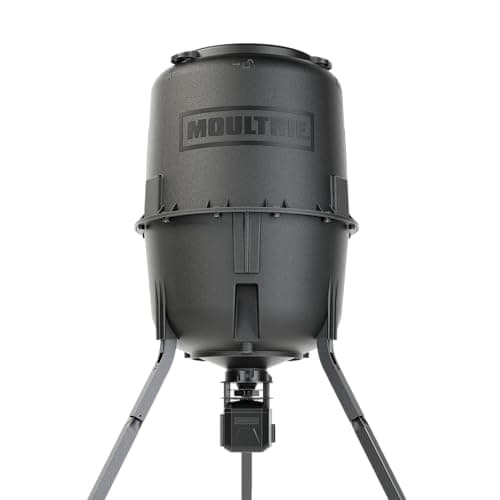
With that out of the way: where feeding is legal, a feeder is one of the most useful tools on a property. It concentrates deer where you can inventory them with a camera, it holds does (and therefore bucks) on your ground through the rut, and it supports herd condition through late winter. This guide covers the two designs, the capacity math, and seven feeders worth owning.
Tripod spinners vs gravity feeders
| Tripod / spinner feeder | Gravity feeder | |
|---|---|---|
| How it works | A timer spins a plate that broadcasts corn on a schedule | Feed flows into ports or a trough as deer eat it |
| Feed control | Precise - you set exactly how much, how often | None - deer eat until it is empty |
| Feed waste | Broadcast feed is exposed to rain, rot and every other animal | Very low - feed stays in the hopper until eaten |
| Best feed type | Corn (free-flowing) | Corn, pellets, protein - anything |
| Power | Battery, often with a solar panel | None |
| Failure modes | Motor, battery, timer, wet corn jamming the spinner | Port clogging with wet or fine feed |
| Cost to run | Higher - broadcast feed disappears fast | Lower - the efficiency argument |
| Best for | Patterning deer to a time of day; camera surveys | Protein programs, herd nutrition, low-maintenance sites |
The practical division: spinners are for hunting and inventory, because a fixed feed time trains deer to arrive predictably and gives your trail camera a reliable window. Gravity feeders are for nutrition, because they waste almost nothing and handle protein pellets that a spinner cannot broadcast well.
Many properties run both: a gravity protein feeder for the spring and summer program, and a spinner near a stand for the season.
Capacity, varmints and the specs that matter
| Capacity, honestly | A 200 lb hopper on a spinner throwing twice a day for six seconds runs a few weeks in low deer density and under two in high density. If your feeder is an hour's drive away, buy 250-350 lb capacity. If you can top it off weekly, 100-200 lb is fine and cheaper |
|---|---|
| Varmint proofing is the real cost driver | Raccoons and squirrels will empty a feeder faster than deer, and hogs will destroy one. Look for varmint-proof legs or cages, hog-proof leg braces, and a lid that latches. This is where the premium brands earn their money |
| Solar panel | Effectively required on a spinner. Battery-only feeders die at the worst moment, and a small panel makes the unit close to maintenance-free |
| Timer programmability | Basic timers run fixed durations at fixed times. App-controlled units - Moultrie's current Bluetooth feeders, for instance - let you change the schedule at the feeder without opening the housing, which matters more than it sounds in November |
| Lid seal and hopper material | Water in the hopper turns corn into a solid plug and kills spinner motors. Metal hoppers are durable; heavy poly hoppers resist condensation better and do not rust |
| Leg design | Adjustable legs let you level the feeder on uneven ground, which is what keeps the spinner throwing an even pattern. Fixed legs on a slope give you a lopsided feed ring |
| Fill height | A feeder you cannot reach is a feeder you will not fill. Gravity feeders on short legs are far easier to service than a tall tripod |
The picks at a glance
| Feeder | Type | Capacity | Standout | Approx. price |
|---|---|---|---|---|
| Moultrie 250 lb Pro Hunter III Tripod | Spinner | 250 lb | Bluetooth app control, complete unit | ~$170 |
| Moultrie Pro Hunter III Feeder Kit | Spinner kit | Fits your own barrel | App control for a third the price | ~$64 |
| American Hunter WF 350 lb Tripod | Spinner | 350 lb | Biggest capacity in the tripod class | ~$260 |
| Boss Buck 200 lb Gravity Tripod | Gravity | 200 lb | The gravity-feeder benchmark | ~$240 |
| Banks Outdoors Feed Bank 300 lb | Gravity | 300 lb | Set-and-forget protein program | ~$394 |
| Wildgame Quick-Set Pro 270 lb | Spinner | 270 lb | Fastest setup, digital timer, varmint guard standard | ~$195 |
| Moultrie Gravity Feeder Kit | Gravity kit | Fits your own barrel | Cheapest way into gravity feeding | ~$60 |
Prices are approximate mid-2026 brackets; verify before buying.
Best overall: Moultrie 250 lb Pro Hunter III Tripod Feeder
Moultrie is the volume leader in this category and the Pro Hunter III is the current expression of why: a complete 250-pound tripod feeder with Bluetooth app control at roughly $170 (verify current pricing), which is a genuinely good price for a finished unit rather than a kit plus a barrel plus legs.
App control is the feature that changes how you use a feeder. Adjusting spin duration and feed times from your phone, standing next to it, means you actually tune the program instead of leaving it on whatever it shipped with — and you are not opening a housing in the rain in November trying to read a tiny LCD.
Honest cons: 250 pounds of corn is not a lot in high deer density, and the tripod class is inherently more vulnerable to hogs and raccoons than a purpose-built varmint-proof unit. Spinner feeders remain the design with the most failure modes — motor, battery, timer and wet corn jamming the plate — so plan on inspecting it, not just filling it.
Best budget upgrade: Moultrie feeder kits
The smartest money in this whole category is usually a kit. Moultrie’s Pro Hunter III feeder kit — the spinner unit, timer and hardware without the barrel or legs — runs about $64 (verify current pricing) and bolts onto a barrel you already own or a 55-gallon drum from a farm supply store.
If you have an old feeder whose motor died, or a barrel sitting behind the shop, a kit gets you modern app-controlled feeding for a quarter of the price of a new unit. The same logic applies to the Moultrie gravity feeder kit at around $60, which converts a barrel into a gravity feeder with a quick-lock adapter.
Honest cons: you are responsible for the barrel, the legs, the mounting and the weatherproofing, and a poorly sealed home-built hopper is exactly how corn gets wet and jams a spinner. Budget the time as well as the money.
Best heavy-duty tripod: American Hunter WF 350 lb
When the feeder is far from a road, capacity beats everything. American Hunter’s 350-pound tripod wildlife feeder at around $260(verify current pricing) is the answer to the "I can only get out there once a month" problem, and American Hunter’s heavy-duty leg kits are among the sturdiest in the class.
The extra hundred pounds over the Moultrie is roughly 40 percent more run time between fills, which on a lease two hours away is the difference between a working feeder and an empty one.
Honest cons: 350 pounds of corn is heavy to get into a tall hopper — plan on a ladder and a second person. The timer is more basic than Moultrie’s app-controlled units, and the taller, heavier build is a real job to relocate once it is set.
Best gravity feeder: Boss Buck 200 lb
Boss Buck is the name serious land managers use, and the 200-pound gravity tripod at around $240 (verify current pricing) is the entry point. Gravity feeding is the efficient way to run a protein program: nothing broadcasts onto the ground to rot, deer eat from ports as they want it, and there is no motor, battery or timer to fail.
Boss Buck’s reputation rests on build quality and varmint resistance — the specific places cheap feeders fail. If you are running a year-round nutrition program rather than a hunting setup, this is the design and this is the brand.
Honest cons: gravity feeding gives you no control over consumption, so a high deer density (or one determined group of hogs) empties it fast and expensively. Ports can clog with wet or finely ground feed, and 200 pounds is modest capacity for the price — you are paying for construction, not volume.
Best capacity: Banks Outdoors Feed Bank 300 lb
Banks Outdoors builds the Feed Bank for people who do not want to think about the feeder again for a long time: 300 pounds at around $394, with a 600-pound version available for larger programs (verify current pricing).
The Banks design is a heavy poly hopper on a low frame, which solves two problems at once: no rust, and a fill height you can actually reach without a ladder. For a genuine year-round protein program on a managed property, this is the most set-and-forget option here.
Honest cons: it is the most expensive feeder on this page, it is bulky and awkward to move once sited, and like all gravity feeders it gives you no control over how fast the feed goes. Hogs, if you have them, will find it.
Fastest setup: Wildgame Innovations Quick-Set Pro 270 lb
The Quick-Set’s pitch is in the name, and the Pro is the version still in the catalogue — a 270-pound spinner feeder Wildgame says is operational in 15 to 20 minutes, at around $195 (verify current pricing), which is still strong capacity per dollar.
If you are putting several feeders out across a property, assembly time is a real cost, and this is the one that gets you from truck to filled in the least time. The Pro is also the only feeder in the Quick-Set family that ships with a rigid varmint guard over the power control unit as standard, and its programmable digital timer runs up to six feeds a day at one to thirty seconds each, over a published 50-foot feed radius.
Honest cons: build quality is still a step below Boss Buck and American Hunter, the poly barrel and powder-coated legs are working-grade rather than heirloom, and Wildgame Innovations’ long-term durability reputation is mixed — its Amazon rating sits at 4.0 across more than 400 buyers. Treat it as a good-value working feeder rather than a decade-long investment.
Placement and timer strategy
- Do not hunt directly over the feeder. Where it is legal to hunt over bait, deer still arrive on the feeder alert and looking. Set your stand on the trail approaching the feeder, downwind, 60-100 yards off.
- Site it near cover, not in the middle of a field. Mature bucks use feeders in daylight far more readily when they can arrive without crossing open ground.
- Two spins a day beats one. A short morning and evening throw trains deer to a window without dumping so much feed that they linger all night.
- Set the evening spin about an hour before last light in the season, so deer arrive while you can still shoot, and shift it earlier as the days shorten.
- Put a camera on it and actually read the data.A feeder’s highest value is often inventory rather than hunting — see cellular trail cameras and when deer move.
- Keep it full or turn it off. A feeder that runs empty in the middle of the season teaches deer to stop checking, which is worse than never having it.
- Re-check the regulations each year. CWD rules change annually, and a feeder that was legal last season may not be this one.
Frequently asked questions
Is it legal to use a deer feeder?
It depends entirely on your state, and the rules change often because of chronic wasting disease management. Colorado prohibits baiting or feeding big game statewide, feeding deer is illegal in Montana, Wisconsin has banned baiting and feeding statewide since 2002, Illinois bans deer feeding statewide, and Michigan bans it in the Lower Peninsula. Virginia bans feeding within 25 miles of a CWD-positive case, covering about half the state. Many states also distinguish between year-round supplemental feeding and hunting over bait. Always verify in your current state regulations before buying.
Should I get a spinner feeder or a gravity feeder?
Spinners for hunting and inventory, gravity for nutrition. A timed spinner trains deer to arrive at a predictable time, which is what makes camera surveys and stand hunting work. A gravity feeder wastes almost no feed and handles protein pellets, which makes it the right tool for a year-round herd-nutrition program. Many managed properties run both.
What size deer feeder do I need?
It depends on how far away it is more than on herd size. If you can top it off weekly, a 100-200 pound hopper is fine and cheaper. If the property is an hour's drive and you get out monthly, buy 250-350 pounds - a 200-pound spinner throwing twice a day can run dry in under two weeks in high deer density.
How do I keep raccoons and hogs out of my deer feeder?
Varmint-proofing is the single biggest cost driver in this category and it is worth paying for. Look for varmint cages or spinner guards, hog-proof leg braces, and a latching lid. Raccoons and squirrels can empty a feeder faster than deer will, and hogs do not just eat the feed - they knock the unit over and destroy it.
Should I hunt directly over a deer feeder?
Even where it is legal, usually not. Deer arrive at a feeder alert and looking around, and mature bucks frequently wait for dark. Set your stand on the trail approaching the feeder, downwind, 60 to 100 yards off, and you will see the same deer in a far more relaxed state.
What time should I set a deer feeder to spin?
Two short spins a day - morning and evening - train deer to a predictable window without dumping so much feed that they graze all night. Set the evening throw about an hour before last legal light so deer arrive while you can still shoot, and move it earlier as the days shorten through the season.
Sources
- Kentucky Department of Fish & Wildlife - baiting rules and CWD surveillance zone changes
- NC Wildlife Resources Commission - special regulations in CWD surveillance and management areas
- Virginia DWR - how hunters can help slow the spread of CWD (feeding and baiting bans)
- Hunting License USA - CWD regulations by state (2026)
- West Virginia Explorer - proposed wildlife disease rule changes affecting deer feeding
- Wildgame Innovations Quick-Set Pro 270 lb Game Feeder - manufacturer listing copy (270 lb capacity, tripod, 50-foot feed radius, programmable digital timer with up to 6 feed times per day of 1 to 30 seconds, rigid varmint guard standard, powder-coated square tube legs, galvanized steel spinner plate, 15-20 minute setup; $194.87 and 4.0 stars from 401 ratings on 2026-09-25)
- Product specs, availability and pricing verified via the Amazon Creators API, 2026-08-13
Keep reading
Gearing up before your next hunt?
See how we evaluate gear, then dig into the reviews and buying guides — written without inventory to sell.