Buying Guide
Best Ground Blinds for Deer and Turkey Hunting
See-through walls changed what a ground blind can do, and blacked-out interiors are still what makes one work. Here is how to choose, how to brush one in, and six blinds worth the money.
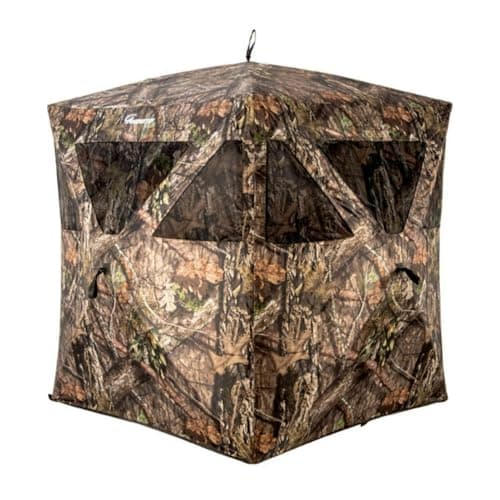
A ground blind does two things a treestand cannot: it lets you hunt where there is nothing to climb, and it hides movement completely — which is why it is the default setup for crossbow hunters, gun hunters with kids, and anyone sitting out a cold late-season evening. The cost is that a blind is a large, unnatural object that deer notice, and the difference between a blind that works and one that gets circled is almost entirely about how you set it up.
This guide covers the see-through revolution, the specs that matter, the setup rules, and six blinds we would buy at different budgets. Prices are approximate mid-2026 street figures; the live price boxes are the number to trust.
See-through vs traditional walls
The biggest change in ground blinds in the last decade is one-way see-through wall fabric — Primos’ SurroundView is the best-known implementation, with equivalents from Muddy, Rhino, TIDEWE and others. From inside you can see out through the walls; from outside the blind looks opaque.
| See-through walls | Traditional opaque walls | |
|---|---|---|
| Situational awareness | Excellent - you see deer approach from any direction | Limited to open windows |
| Movement penalty | Higher - you are visible in silhouette if backlit or if you move fast | Lower - a blacked-out interior hides almost everything |
| Turkey hunting | Outstanding - you watch a gobbler work the whole way in | Frustrating - birds appear in a window with no warning |
| Kids and new hunters | Great - they can watch instead of fidgeting | Fidgeting hidden, but boredom is real |
| Cost | Higher | Lower |
| Wear point | The see-through panel is the part that degrades | Fabric and poles wear conventionally |
The honest summary: see-through walls are transformative for turkey hunting and for keeping a young hunter engaged, and they are a modest step backward for pure concealment. If you sit still, either works. If you have a 10-year-old with you, buy see-through.
What actually matters in a blind
| Interior height and hub width | The two dimensions that decide whether you can draw a bow or swing a crossbow. A crossbow needs lateral room; a vertical bow needs height. Published 'person capacity' is optimistic - buy one size class above what you think you need |
|---|---|
| Blacked-out interior | Non-negotiable on any blind. Black interior fabric is what makes you invisible in the window opening. If a blind's interior is light-colored, you will be a silhouette |
| Shoot-through mesh | Lets you cover windows and still shoot. Crossbow bolts and arrows pass through cleanly; check the mesh is replaceable, because it will not survive many broadheads |
| Window system | Silent adjustment matters more than window count. Zippers are noisy; magnetic and hook-and-loop closures are quieter. Primos' 2026 Double Bull Raised blind adds windows that slide independently left, right, up and down |
| Hub-style setup | The standard for portable blinds - push the hubs out, done in under a minute. Fold-down is the skill; watch the video before you are standing in the dark |
| Ground stakes and tie-downs | The number one blind failure is wind. A blind that is not staked and guyed will roll across a field. Every blind here needs stakes, and most benefit from adding better ones |
| Weight and pack size | Under 20 pounds is genuinely portable; 30-plus pounds is a blind you set once and leave |
| Fabric weight and water resistance | Heavier denier fabric is quieter, more durable and warmer. It is also heavier to carry - the usual trade |
Setup: the part that decides everything
Most blind failures are setup failures, not product failures. In order of importance:
- Set it up weeks early if you can. Deer habituate to a blind that has been there a while. A blind dropped the morning of a hunt is a new object in their world.
- Brush it in.This is the single largest factor. Cut natural vegetation and stack it against the sides and roof to break the blind’s hard geometric outline. An unbrushed blind in an open field is a black box; a brushed blind reads as a bush.
- Back it against cover. Never freestanding in the open if you can help it. Against a treeline, a brush pile or a cedar, the blind has no silhouette.
- Open only the windows you need,and keep the ones behind you closed. Backlight through a rear window turns you into a shadow puppet — the single most common way hunters get busted in a blind.
- Stake and guy it, every time. Wind is what destroys blinds.
- Wear dark clothing inside. The blacked-out interior only works if you are dark too. Camo does nothing in here; black does everything.
- Check your shooting geometry before you need it. Sit down, mount the bow or gun, and confirm you can actually make the shots the setup implies. Crossbows in particular need more width than people expect.
The picks at a glance
| Blind | Walls | Capacity | Best for | Approx. price |
|---|---|---|---|---|
| Ameristep Care Taker | Traditional | 2 person | Best budget, best portability | ~$83-115 |
| Primos Double Bull SurroundView MAX | See-through | Roomy 2-3 | Best overall build and window system | ~$487 |
| Barronett Big Cat | Traditional | 3 person | Two hunters plus gear | ~$200 |
| Rhino Blinds R180 | See-through | 3 person | Best mid-price see-through | ~$200 |
| Muddy VS360 | See-through (360) | 3 person | Full-circle visibility | ~$221 |
| TIDEWE 270 See-Through | See-through (270) | 2-3 person | Cheapest way into see-through | ~$110 |
Prices are approximate mid-2026 brackets and vary by pattern; verify before buying.
Best budget: Ameristep Care Taker
The Care Taker is the blind we would tell most people to buy first, at roughly $83-115 depending on pattern and variant (verify current pricing). It is a compact two-person hub blind with shoot-through mesh windows and a blacked-out interior, and it is light enough to genuinely carry to a spot rather than drive to one.
At this price you can own two — one on the food plot and one on the travel corridor — which is worth more than one premium blind for most hunters. Setup is fast, the footprint is small enough to tuck into a fencerow, and the durability is adequate for several seasons of seasonal use.
Honest cons: it is genuinely a two-person blind, which means one hunter and a crossbow, or one adult and one child. Fabric weight and window hardware are budget-grade, it is not a blind to leave out all year, and the standard hub-blind windows are noisier to adjust than the premium systems.
Who it’s for: almost everyone as a first blind, and anyone who wants two or three blinds on a property rather than one good one.
Best overall: Primos Double Bull SurroundView MAX
Double Bull is the name that made hub blinds serious equipment, and the SurroundView MAX is the flagship: see-through walls all around, a genuinely roomy interior, and the build quality that separates a blind you use for a decade from one you replace in three seasons. It typically runs around $487 (verify current pricing).
The see-through walls are the headline, and for turkey hunting they are close to a cheat code — you watch a gobbler come the entire way instead of guessing from calls. The MAX size is the version to get if you shoot a crossbow or hunt with a partner; the width is what lets you swing without hitting a wall.
Primos continues to develop the platform — the 2026 Double Bull Raised blind adds a window system whose panels slide independently left, right, up and down, which is the kind of iteration that only comes from a company that actually hunts out of these.
Honest cons: the price is five times the Care Taker. It is heavy, so this is a set-and-leave blind rather than a run-and-gun one. And the see-through panel is the wear item — treat it carefully, keep it out of prolonged direct sun where practical, and expect it to be the first thing that degrades.
Who it’s for: serious turkey hunters, crossbow hunters who want room, and anyone setting a permanent blind on a property they hunt every year.
Best for two hunters: Barronett Big Cat
The Big Cat is a roomy hub blind rated for three people at around $200(verify current pricing), with large windows carrying replaceable shoot-through mesh — a detail that matters more than it sounds, because mesh is a consumable once broadheads start passing through it.
"Three person" in blind marketing means "two adults and their gear," which is exactly the use case most people actually have: a parent and a kid, or two hunters filming. Barronett’s fabric is on the heavier side, which makes it quieter and warmer than the budget blinds.
Honest cons: opaque walls mean the situational awareness disadvantage above, it is bulky to carry any real distance, and Barronett’s hub hardware has a mixed reputation for longevity in hard use. Stake it well — a blind this size catches a lot of wind.
Best mid-price see-through: Rhino Blinds R180
The R180 is Rhino’s three-person see-through blind at around $200 (verify current pricing), and it occupies the useful middle: see-through walls at less than half the price of the Primos flagship, in a size that fits two hunters comfortably.
If you want the see-through experience for turkey season but cannot justify $487, this is the rational pick. Rhino’s smaller R100 series is also worth knowing about as a genuinely cheap two-person option in the $80 range.
Honest cons: fabric weight, hub hardware and window mechanisms are all a tier below Double Bull, and the see-through clarity is not as good — you notice it in low light, which is when you need it most. Expect a shorter service life.
Best 360-degree view: Muddy VS360
The Muddy VS360 is a three-person blind whose selling point is in the name: water-resistant construction with 360-degree see-through viewing on sliding shoot-through mesh windows on all four sides, over a 60 by 60-inch footprint with 70 inches of standing height, around $221 (verify current pricing) in Mossy Oak Break-Up Country.
Full-circle visibility is the most useful version of the see-through concept for deer hunting specifically, where the animal that matters usually appears behind you. It is also the version that most punishes movement — there is nowhere in this blind you are not potentially visible.
Honest cons: 360-degree see-through means maximum discipline required, the panels are the wear item as with all such blinds, and at three-person size it is a substantial thing to move. Sit still, wear black, and it is excellent.
Best see-through value: TIDEWE 270-degree blind
TIDEWE’s 270-degree see-through blind at around $110 (verify current pricing) is the cheapest legitimate way to try the see-through concept. The 270-degree layout keeps an opaque wall behind you, which is arguably the smarter geometry — you get the visibility where you need it and keep a solid backdrop to avoid being backlit.
Honest cons: this is a budget blind and it behaves like one. Fabric weight, zipper quality and panel clarity are all a clear step below the $250-plus blinds, and longevity is measured in seasons rather than decades. As a way to find out whether see-through matters to you before spending $487, it is excellent value.
The bottom line
Where baiting is legal, a blind and a feeder are usually bought together — our deer feeder guide covers tripod versus gravity designs and what each state allows.
Buy the Ameristep Care Taker if you want a blind today and want to own more than one. Buy the Primos Double Bull SurroundView MAX if you hunt turkeys seriously or want one blind to keep for a decade. The TIDEWE 270 is the cheap way to find out whether see-through walls change your hunting, and the Muddy VS360 is the full expression of the idea.
Then set it up right: early, brushed in, backed against cover, staked down, with only the front windows open and dark clothing inside. Those seven minutes of work matter more than the $400 difference between the cheapest and most expensive blind on this page.
Pair it with the rest of the setup: cellular trail cameras to know when to sit, a rangefinder to pre-range your windows, a shooting stick or tripod short enough to work from a blind chair, and a crossbow narrow enough to swing inside it.
Frequently asked questions
Do deer get used to ground blinds?
Yes, given time. A blind that has been in place for several weeks becomes part of the landscape, while one dropped the morning of a hunt is a new object deer will circle or stare at. If you cannot set up early, brushing the blind in with natural vegetation and backing it against cover does most of the same work.
Are see-through ground blinds better?
For turkey hunting and for keeping a young hunter engaged, they are a large upgrade - you watch game approach from any direction instead of waiting for it to appear in a window. For pure concealment they are a modest step backward, because you can be seen in silhouette if you move quickly or are backlit. If you sit still, either type works.
What should I wear inside a ground blind?
Black or very dark clothing, including a face mask and gloves. A blind works because its blacked-out interior swallows you in the window opening, and that only functions if you are dark too. Camo patterns do essentially nothing inside a blind; darkness does everything.
Can you shoot a crossbow from a ground blind?
Yes, and blinds are one of the best places to hunt with one - but width is the constraint. A cocked crossbow needs lateral room to swing, so buy a size class larger than you think you need, and sit down with the bow to check your shooting geometry before opening day rather than discovering the problem with a deer in front of you.
How do I keep a ground blind from blowing away?
Stake every corner and use the guy lines, every single time. Wind is the number one cause of blind loss and damage, and hub blinds are essentially large sails. Upgrading the flimsy included stakes to heavier ones is a cheap and worthwhile change, and backing the blind against cover reduces the wind load as well as the silhouette.
Does a ground blind hide your scent?
No. A blind traps human odor and then releases it out the windows in a concentrated plume - in some conditions that is worse than sitting in the open. Ground blinds still have to be hunted on the correct wind, and no blind substitutes for choosing your setup by the forecast.
Sources
- Outdoor Life - the best hunting blinds of 2026, tested and reviewed
- Outdoor Life - the best turkey hunting blinds of 2026
- Archery Street - 9 best ground blinds for hunting
- Outdoor Hunting Gear - best see-through turkey blinds for concealment in 2026
- Archery Talk - Primos Double Bull SurroundView MAX owner discussion
- Product specs, availability and pricing verified via the Amazon Creators API, 2026-08-13
Keep reading
Gearing up before your next hunt?
See how we evaluate gear, then dig into the reviews and buying guides — written without inventory to sell.