Buying Guide
Best Hunting Binoculars (2026)
The binocular is the tool you actually hunt with - you glass a hundred times for every shot you take. Here is how to read the specs that matter (8x vs 10x, exit pupil, ED glass) without paying for marketing, plus six honest picks from a $130 budget pair to premium open-country glass.
Ask a hunter what they shoot and they will talk for an hour. Ask what they glass with and it is usually whatever came in a combo pack. That is backwards. You look through binoculars hundreds of times for every time you press a trigger — picking apart a far tree line at first light, checking whether that is a rock or a bedded deer, reading antlers before you commit to a stalk. Good glass turns a gray, ambiguous dawn into information, and the difference between a $130 pair and a $475 pair is real and visible. So is the difference between the right configuration and the wrong one for how you hunt.
This guide skips the spec-sheet theater and explains the four things that actually change what you see: the 8x-versus-10x decision, exit pupil and low-light brightness, glass and coatings, and the build details that decide whether you still enjoy carrying them at hour ten. Then it names six picks, from an honest budget pair to premium open-country glass. Specifications come from manufacturer data and reputable independent reviews; prices are approximate as of 2026 and move constantly, so treat every number as a starting point and verify before you buy.
8x vs 10x: the one decision that matters
Before brand, before budget, decide on magnification — it shapes everything else. Nearly every serious hunting binocular comes in 8x42 or 10x42, and the choice is a genuine trade-off, not an upgrade path. More magnification is not simply better.
8x gives you a wider field of view, a brighter image, and far more forgiveness for the tremor in your hands. It finds animals faster in thick cover, tracks moving game more easily, and stays steady offhand. 10xpulls detail closer — it reads antler points and picks apart distant hillsides that an 8x leaves fuzzy — at the cost of a narrower view, a dimmer image, and visibly more shake when you are not braced. The extra power that looks appealing in the store is exactly what makes a 10x harder to hold still on a real hillside.
| Choose 8x42 if | You hunt timber, whitetails, close-to-medium cover, or want the most forgiving all-rounder - especially handheld |
|---|---|
| Choose 10x42 if | You hunt open country, glass long distances for hours, judge antlers at range, or shoot out West |
| Field of view | 8x is wider - easier to locate and follow game; 10x trades some view for reach |
| Hand-shake | 8x hides it; 10x shows it - lean on a pack, tree, or trekking pole past 10x |
| If unsure | 8x42 is the safer default for most whitetail and general hunting; 10x42 is the open-country and Western answer |
There is no universally correct answer, which is why this guide includes both. A whitetail hunter working timbered farm country is genuinely better served by 8x; a mule-deer or elk hunter picking apart sagebrush basins wants the 10x reach. Pick the configuration for your terrain first, then choose the best glass you can afford in it.
Exit pupil and low light: when the shot actually happens
Deer move at the edges of the day, which means your binocular earns its price in the worst light, not the best. The spec that predicts low-light performance is the exit pupil— the diameter of the beam of light the binocular delivers to your eye. The math is simple: divide the objective lens size by the magnification. A 8x42 produces a 5.25 mm exit pupil; a 10x42 produces 4.2 mm.
Why it matters: in daylight your pupil constricts to around 2-3 mm, so both easily flood it with light and look equally bright. At dusk your pupil dilates to 5-7 mm, and now the 8x42's larger 5.25 mm beam fills more of it — the 8x looks noticeably brighter in the last twenty minutes of legal light than a 10x of the same glass. This is the quiet second reason 8x wins for timber and low-light hunting, and it is why a 10x42 needs better coatings and glass to hold its own after sunset.
| Exit pupil formula | Objective diameter divided by magnification (42 / 8 = 5.25 mm; 42 / 10 = 4.2 mm) |
|---|---|
| Daylight | Pupil is ~2-3 mm - both 8x42 and 10x42 look equally bright |
| Dawn / dusk | Pupil dilates to 5-7 mm - the larger 8x42 exit pupil delivers a brighter image |
| Takeaway | In poor light, 8x42 has a real brightness edge; a low-light 10x leans harder on premium coatings |
Glass and coatings: where the money actually goes
Two binoculars can share identical 10x42 numbers and show you completely different images, because the price you pay past the basics buys optical quality, not more magnification. Three things separate tiers:
- ED (extra-low dispersion) glasscorrects the way ordinary glass splits colors, which shows up as purple or green fringing along high-contrast edges — an antler against a bright sky. ED glass cleans that up for crisper, higher-contrast detail, and it is the single feature most worth chasing as budget allows.
- Coatings decide how much light survives the trip through the binocular. Fully multi-coated lenses (every air-to-glass surface, not just the outer ones), phase-corrected roof prisms, and dielectricprism coatings together lift light transmission and color fidelity. "Fully multi-coated" is the phrase to demand; "multi-coated" or "coated" alone is a downgrade hiding in similar words.
- Prism type.All six picks here use compact roof prisms. Cheaper roof prisms need phase correction to avoid a subtle loss of contrast — present on every binocular below, which is part of why they made the list.
Build, weight and warranty: the specs you feel at hour ten
Optics get the attention, but three practical specs decide whether a binocular is a pleasure or a chore in the field. Waterproofingis non-negotiable: every pick here is O-ring sealed and nitrogen- or argon-purged, so it shrugs off rain and will not fog internally when you step from a cold truck into humid dawn air. Treat this as a hard requirement — a fogged binocular at first light is a wasted morning.
Weight matters more than the number suggests, because it hangs on your neck for the entire hunt. Full-size 42 mm binoculars run roughly 21-28 ounces, and the difference is felt on a long climb. Whatever you buy, spend the last $30 on a bino harnessrather than the neck strap in the box — it distributes the weight across your shoulders, keeps the glass still against your chest, and is the single best comfort upgrade in this category.
Finally, the warrantyis real money over a hunting lifetime. Vortex, Athlon and Maven back these with fully transferable, no-fault lifetime coverage — drop them off a rock face and they get repaired or replaced, no receipt required. Nikon and Bushnell offer strong limited lifetime coverage. For a tool that lives on rocks, in packs, and in the weather, that guarantee is part of the value.
The picks at a glance
Six binoculars covering every budget and both configurations. Prices are approximate as of 2026 — verify current pricing before buying.
| Binocular | Config | Glass | Best for | Approx. price |
|---|---|---|---|---|
| Nikon Monarch M5 10x42 | 10x42 | ED, fully multi-coated | Best overall | ~$285-300 |
| Vortex Diamondback HD 8x42 | 8x42 | HD, fully multi-coated | Best value | ~$225-250 |
| Maven C1 10x42 | 10x42 | ED, premium | Premium / open country | ~$450-475 |
| Athlon Midas UHD 8x42 | 8x42 | ED, fully multi-coated | Best glass under $300 | ~$240-260 |
| Bushnell Prime 10x42 | 10x42 | Fully multi-coated | Best budget | ~$120-140 |
| Nikon Prostaff P3 8x42 | 8x42 | Fully multi-coated | Best for timber | ~$150-170 |
Best overall: Nikon Monarch M5 10x42
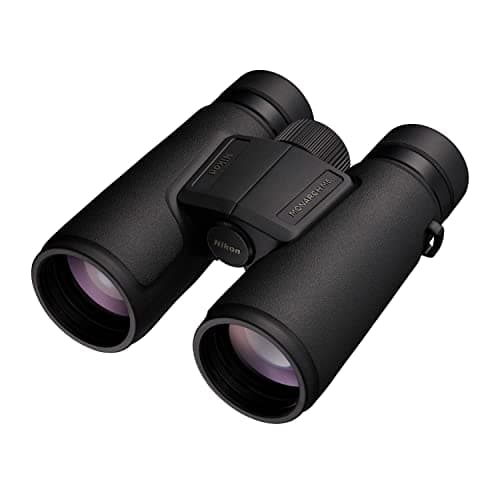
The Monarch line has been the default answer to "what hunting binocular should I buy?" for a decade, and the M5 10x42 is why. It hits the sweet spot where real optical quality meets a price most hunters will actually pay: ED glass to control color fringing, fully multi-coated lenses with dielectric-coated, phase-corrected prisms for a bright, neutral image, and a genuinely useful locking diopterso your fine focus adjustment does not drift out of tune in the pack. It is light for a full-size 10x at roughly 21 ounces, has long eye relief that works well with glasses, and carries Nikon's limited lifetime warranty. Street pricing typically lands around $285-300— verify current pricing.
Honest cons: as a 10x42 it gives up field of view and a touch of low-light brightness to the 8x options, so timber hunters may prefer an 8x version of the same binocular. And while the glass is excellent for the money, a true alpha pair (three times the price) still pulls ahead in the last minutes of light. Neither changes the verdict for most buyers.
Who it's for:the hunter who wants one do-everything binocular with honest ED glass and does not want to overthink it. If you buy one pair off this list, buy this one — or its 8x42 sibling if you hunt tight cover.
Best value: Vortex Diamondback HD 8x42
The Diamondback HD is the binocular that made "good enough to stop looking" cheap. Vortex's HD optical system delivers a bright, sharp, color-accurate image with fully multi-coated lenses and phase-corrected, dielectric-coated roof prisms — genuinely more performance than the price suggests, which is why it shows up on so many first-binocular shortlists. In 8x42it is the forgiving all-rounder: wide field of view, bright at dusk thanks to that 5.25 mm exit pupil, and steady in the hands. Behind it stands Vortex's VIP warranty— unconditional, fully transferable, no receipt or fault required — which is remarkable insurance at a street price typically around $225-250 (verify current pricing).
Honest cons: this is HD glass, not ED — look hard at a high-contrast edge and you will find a hint of color fringing the Monarch and Maven suppress better. Edge-to-edge sharpness falls off slightly toward the rim of the view. For the money, those are easy trade-offs.
Who it's for: the hunter who wants the safest value buy on the list, an 8x for timber and general use, and the best warranty in optics standing behind it.
Best premium: Maven C1 10x42
Maven built its reputation selling optics factory-direct and skipping the retail markup, and the C1 10x42 is the payoff: ED glassand premium coatings in a package that competes with binoculars priced hundreds higher. The image is where it earns the money — high contrast, excellent color, and clean, resolved detail out toward the edges that reveals more on a distant hillside than any other pick here. It is the open-country and Western glassing choice, the one you can sit behind for an hour without your eyes tiring. Maven backs it with an unconditional lifetime warranty. Expect around $450-475— verify current pricing.
Honest cons: it is the heaviest pick here at roughly 28 ounces, so a harness is mandatory and a long climb makes you feel every one of them. It costs roughly double the value picks, and the last increment of image quality follows diminishing returns — the Monarch already shows you most of what matters. As a smaller direct-to-consumer brand, it is also less of a known name at camp, if that matters to you.
Who it's for:the serious open-country hunter who glasses for hours and wants near-alpha image quality — especially edge clarity and contrast — without paying alpha prices.
Best glass under $300: Athlon Midas UHD 8x42
Athlon has quietly become the value-optics story of the last few years, and the Midas UHD 8x42 is the clearest example: ED glass, advanced dielectric and phase coatings, and a scratch-resistant exterior lens coating, at a price that undercuts the brands you have heard of. Optically it punches straight into Monarch territory — a bright, high-contrast, color-accurate image with ED glass suppressing the fringing that budget pairs show — and in 8x42 it keeps the wide, bright, forgiving handling that makes an 8x so easy to live with. It carries Athlon's fully transferable lifetime warranty. Street pricing typically runs about $240-260 (verify current pricing).
Honest cons: Athlon still lacks the name recognition of Nikon or Vortex, so resale and camp credibility lag the glass, which is better than the badge suggests. This is the established Midas UHD rather than the newest revision, and this particular listing is the gray-finish model — cosmetic, not optical. None of that shows up in the view.
Who it's for:the value hunter who specifically wants ED glass under $300 and does not care whether the badge is famous — the most glass-per-dollar on the list.
Best budget: Bushnell Prime 10x42
Sometimes the honest answer is a capable binocular that costs less than a tank of premium gas feels like it should, and the Bushnell Prime 10x42 is it. For roughly $120-140you get fully multi-coated optics, a genuinely waterproof (IPX7) and fogproof build, and Bushnell's EXO Barrierexterior lens coating that sheds water, oil and dust so the glass stays clear in bad weather. It is covered by Bushnell's Ironclad limited lifetime warranty. As a first real binocular or a knock-around truck pair, it does the core job — find the animal, confirm what it is — without apology.
Honest cons: this is entry-level glass, and it shows exactly where you would expect — dimmer and softer in the last light of the day, with more edge falloff and less resolved detail than the ED-glass picks above. The 10x configuration on a lightweight budget build also shows hand-shake, so brace it against a pack or tree for anything past a quick look. Spend more if you glass seriously; buy this if the choice is this or nothing.
Who it's for: the new or budget hunter, the backup-pair buyer, and anyone who needs real waterproof glass for the price of a decent pack.
Best for timber: Nikon Prostaff P3 8x42
If the Bushnell is the absolute-floor budget pick, the Prostaff P3 8x42 is the small step up that buys a better all-around timber binocular. Nikon's entry hunting line pairs fully multi-coated optics with a light (~20 ounce), compact, waterproof and fogproof body, a smooth central focus, and the long eye relief Nikon is known for — comfortable with or without glasses. In 8x42it is the easy, forgiving choice for close-to-medium cover: wide field of view to find game fast, bright enough at dusk, and steady in the hands. It carries Nikon's limited lifetime warranty, and street pricing typically sits around $150-170 (verify current pricing).
Honest cons: no ED glass here, so it gives up some contrast and low-light punch to the Monarch and Athlon above — the difference is visible side by side, especially late. The field of view is good rather than class-leading. It is a budget binocular that behaves like a good one, not a mid-tier one in disguise.
Who it's for:the whitetail and timber hunter who wants a light, comfortable 8x from a trusted name for the price of a weekend's gas and tags — a clear upgrade over combo-pack glass without the mid-tier spend.
The bottom line
Decide 8x versus 10x by your terrain first — 8x for timber and whitetails, 10x for open country and Western hunts — then buy the best glass you can afford in that configuration. For most hunters the Nikon Monarch M5 is the do-everything answer, with the Vortex Diamondback HD 8x42 holding the value seat behind a no-fault lifetime warranty. Open-country glassers who live behind their binoculars should step up to the Maven C1; value hunters chasing ED glass under $300 want the Athlon Midas UHD; and if the budget is firm, the Bushnell Prime and Nikon Prostaff P3both do the real job for little money. Then buy a harness, not the neck strap — your shoulders will thank you at hour ten.
Binoculars find the animal; the rest of the kit closes the distance. Once you have spotted, a hunting rangefinder turns guessed yardage into a known number, a good pair of hunting boots gets you into position, and if you are running a stand, our best trail cameras guide helps you know what is out there before you ever glass it.
Frequently asked questions
Are 8x or 10x binoculars better for hunting?
It depends on your terrain, and neither is universally better. 8x42 has a wider field of view, a brighter image in low light (a larger 5.25 mm exit pupil versus 4.2 mm), and is far more forgiving of hand-shake - the better choice for timber, whitetails, and general use. 10x42 pulls more detail closer for judging antlers and glassing long distances, which suits open country and Western hunting, but it shows more shake handheld and is dimmer at dusk. Choose 8x for close cover, 10x for open country.
What is exit pupil and why does it matter for hunting binoculars?
Exit pupil is the diameter of the beam of light the binocular sends to your eye - objective size divided by magnification. An 8x42 gives 5.25 mm and a 10x42 gives 4.2 mm. In daylight your pupil is small (2-3 mm) so both look equally bright, but at dawn and dusk your pupil dilates to 5-7 mm and the larger exit pupil delivers a visibly brighter image. Since game moves in low light, exit pupil is a real predictor of when a binocular performs - and part of why 8x has a low-light edge.
Is ED glass worth it in hunting binoculars?
For most hunters, yes - it is the single feature most worth paying for as budget allows. ED (extra-low dispersion) glass corrects the color fringing that ordinary glass produces along high-contrast edges, like an antler against a bright sky, giving a crisper, higher-contrast image with more resolved detail. Given a choice between more magnification and ED glass at the same price, buy the ED glass. Picks like the Nikon Monarch M5, Athlon Midas UHD, and Maven C1 all use it.
How much should I spend on hunting binoculars?
Capable waterproof binoculars start around $120-140 (Bushnell Prime), and the value sweet spot with ED glass and better coatings is roughly $225-300 (Vortex Diamondback HD, Athlon Midas UHD, Nikon Monarch M5) - where most hunters should land. Premium options like the Maven C1 (~$450-475) add edge sharpness and contrast for hunters who glass for hours in open country. Above that, alpha binoculars deliver diminishing returns for most hunting. Buy the best glass you can afford in the configuration your terrain needs.
Do hunting binoculars need to be waterproof?
Yes - treat it as a hard requirement. Quality hunting binoculars are O-ring sealed and purged with nitrogen or argon gas, which makes them waterproof against rain and, just as important, prevents internal fogging when you move between temperatures - like stepping from a cold truck into humid dawn air. A binocular that fogs internally at first light is useless exactly when you need it. Every pick in this guide is waterproof and fogproof.
Sources
- Nikon - Monarch M5 10x42 specifications
- Nikon - Prostaff P3 8x42 specifications
- Vortex Optics - Diamondback HD 8x42 specifications
- Vortex Optics - VIP unconditional lifetime warranty
- Maven - C1 10x42 ED binocular specifications
- Athlon Optics - Midas UHD 8x42 specifications
- Bushnell - Prime binoculars and Ironclad warranty
Keep reading
Gearing up before your next hunt?
See how we evaluate gear, then dig into the reviews and buying guides — written without inventory to sell.