Buying Guide
The Best Hunting Binoculars Under $500
Somewhere between $250 and $500 a hunting binocular stops being a compromise and starts being a tool you will keep for twenty years. This is the tier where ED glass becomes standard, dielectric prism coatings show up, and the last twenty minutes of legal light stop being a problem.
The honest way to describe the $500 tier is this: it is the last price band where every extra hundred dollars buys you something you can actually see. Above it, you are paying steeply for smaller and smaller increments.
Three things change between the $200 tier and this one. ED or UHD glass stops being an occasional feature and becomes standard. Prism coatings improve from aluminum or silver to dielectric, which measurably raises light transmission. And the mechanical build - focus wheel feel, locking diopters, hinge tension - stops feeling like a compromise.
The practical result is the one that matters to a deer hunter: at legal light, a $280 binocular shows you an animal that a $120 binocular shows you as a shape.
What actually changes between $200 and $500
- ED / UHD glass becomes standard. Extra-low-dispersion elements bring different wavelengths of light to the same focal point, which is what removes the purple or green fringing you see on a backlit antler tine or a branch against a bright sky. It shows up as apparent sharpness even though the resolution number has not changed.
- Dielectric prism coatings. Roof-prism binoculars need a mirror coating on one prism face. Cheap models use aluminum, mid models use silver, and this tier uses dielectric multi-layer coatings with substantially higher reflectivity. That is light reaching your eye at dusk.
- Phase correction. Roof prisms split and recombine light in a way that shifts phase and costs contrast. Phase-correction coatings fix it. It is common at this price and rare below it.
- Mechanical quality. A focus wheel that moves smoothly with gloves on, a diopter that locks so it does not drift in a pack, eyecups that hold their detents. None of these are optical, and all of them determine whether you actually use the binocular.
The three price steps inside this band
| Price step | What it buys | Models |
|---|---|---|
| Around $240-280 | ED/HD glass, dielectric coatings, solid build. The value sweet spot. | Vortex Diamondback HD, Athlon Argos G2 UHD, Bushnell Engage EDX |
| Around $280-350 | Better low-light contrast and color fidelity, nicer mechanics | Nikon Monarch M5 |
| Around $450-500 | Near-alpha resolution and contrast, best-in-band mechanics | Maven C1, Vortex Viper HD, Athlon Midas G2 UHD 10x50 |
If you are cost-sensitive, the first step is where the money goes furthest. If this is a buy-once binocular, the third step is genuinely close to glass costing twice as much.
Choosing the configuration: 8x42, 10x42, 10x50, 12x50
Exit pupil - objective divided by magnification - is the number that predicts low-light usefulness, because a dark-adapted human pupil opens to roughly 5 to 7mm.
| Config | Exit pupil | Best for |
|---|---|---|
| 8x42 | 5.25mm | Timber, still-hunting, glassing offhand, low light |
| 10x42 | 4.2mm | The all-round default - fields, edges, mixed country |
| 10x50 | 5.0mm | Dark timber and last-light glassing, at a weight penalty |
| 12x50 | 4.17mm | Open country from a rest or tripod, western hunting |
A 12x binocular offhand is not usable for careful judging - your pulse is visible in the image. If you buy 12x50, plan on a tripod adapter or a rest, otherwise buy 10x50 instead.
The picks at a glance
| Model | Config | Why it is here |
|---|---|---|
| Vortex Diamondback HD | 10x42 | Best value entry to the tier, unconditional warranty |
| Nikon Monarch M5 | 10x42 | ED glass and dielectric coatings; excellent at dusk |
| Athlon Argos G2 UHD | 10x42 | UHD glass at a discount to the name brands |
| Maven C1 | 10x42 | Direct-to-consumer glass that punches above the price |
| Vortex Viper HD | 10x42 | The last step before alpha glass |
| Athlon Midas G2 UHD | 10x50 | Maximum light gathering inside the budget |
| Leupold BX-3 Alpine HD | 12x50 | Reach for open country, needs a rest |
Best overall: Vortex Diamondback HD 10x42
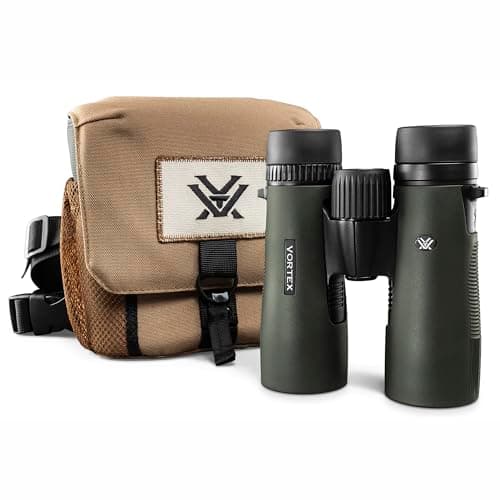
The Diamondback HD is the entry point to this tier and the binocular that most hunters should buy. It brings HD glass, dielectric prism coatings, a locking diopter and a body that is genuinely comfortable for a long glassing session, and it carries Vortex's unconditional, transferable VIP warranty.
Against the $150 Crossfire HD, the difference is visible at last light and in color fidelity on high-contrast edges - the exact conditions in which you are trying to decide whether that is a branch or a tine. Against the $450 to $500 models here, the Diamondback gives up some edge sharpness and a little contrast, and gives up nothing in durability.
Diamondback HD 8x42 and 10x50
Same optical platform, different jobs. The 8x42 is the timber and still-hunting configuration - wider field, steadier, brighter exit pupil. The 10x50 is the last-light configuration, trading about six ounces for a 5mm exit pupil that keeps working after the 10x42 has gone dim.
Best low-light glass: Nikon Monarch M5 10x42
The Monarch M5 is the low-light specialist of this group. Nikon pairs ED glass with dielectric high-reflective prism coatings, and the result is a binocular that holds contrast later into the evening than most things at its price.
For a whitetail hunter whose season is decided in the last twenty minutes of legal light, that is the specification that matters most. The 8x42 version is the choice for timber.
Best value: Athlon Argos G2 UHD 10x42
Athlon is the value play in this tier. The Argos G2 UHD brings ultra-high-definition glass and generous eye relief at a price that undercuts the equivalent Vortex and Nikon models, which is possible because Athlon has less brand premium to charge.
The trade is service network and resale value rather than optics. If you buy on specification per dollar, this is the pick.
Athlon Midas UHD 8x42 and Midas G2 UHD 10x50
The Midas line sits above the Argos. The 8x42 is a serious timber binocular with ED glass; the 10x50 is the maximum-light-gathering choice inside this budget and the one to buy if your hunting is genuinely dark - big timber, river bottoms, heavy canopy.
Be realistic about the weight. A 50mm objective binocular hangs heavier on a harness all day, and that is the reason most hunters end up back at 42mm.
Best at the ceiling: Maven C1 10x42
Maven sells direct rather than through distributors, which is the entire reason the C1 can put this level of glass at this price. It is an ED optic with a Japanese-sourced optical system, and in side-by-side terms it competes with binoculars that retail well above the $500 line.
Where it differs from the Vortex and Nikon options: no big-box dealer network, and the styling is deliberately utilitarian. If you want the most optic per dollar at the ceiling of this budget and you do not need a store to hand it to you, this is the one.
Vortex Viper HD 10x42: the last step before alpha
The Viper HD sits right at the top of this band and is the highest-performing binocular Vortex makes before the Razor line. It brings better glass than the Diamondback, an improved coating stack, and the same unconditional warranty.
This is the "buy once" recommendation for a hunter who is not going to shop binoculars again for fifteen years and does not want to spend four figures.
Bushnell Engage EDX
Bushnell's ED-glass model with EXO Barrier exterior coating, which sheds water and oil rather than smearing it. If you hunt genuinely wet country - coastal blacktail, Gulf Coast swamps, late-season rain - a hydrophobic exterior coating is a bigger day-to-day quality of life feature than a small step in glass quality.
Leupold BX-3 Alpine HD 12x50
Leupold's Alpine HD in 12x50 is the open-country configuration in this list: enough reach to judge an animal across a canyon or a section of prairie, with a 50mm objective keeping the exit pupil usable.
Buy a tripod adapter with it. Twelve power offhand is not a judging tool.
Athlon Midas Pro G2 12x50
The other 12x50 worth naming, with UHD glass and ESP dielectric coating at the very top of this budget. Same caveat: this is a tripod binocular, and buying one without a way to stabilize it wastes the magnification you paid for.
Where the diminishing returns start
Above roughly $500 you enter the territory of Vortex Razor, Leupold BX-5, Zeiss Conquest and eventually the European alpha glass. Those binoculars are better. They are not proportionally better.
The honest breakdown of what another $500 to $1,500 buys you: a few more minutes of usable light at each end of the day, flatter edge-to-edge sharpness during multi-hour glassing sessions, and lower eye fatigue. If you are a western hunter who glasses for six hours a day, all three are worth real money. If you sit a stand over a food plot for three hours an evening, none of them will change your season.
Our advice: buy at the $250 to $300 step, put the difference into a harness and a rangefinder, and revisit binoculars in five years.
The bottom line
Buy the Vortex Diamondback HD 10x42 if you want the best combination of optics, durability and warranty and you do not want to overthink it.
Buy the Nikon Monarch M5 if your season is decided in the last twenty minutes of legal light.
Buy the Maven C1 or Vortex Viper HD if this is a buy-once purchase and you want to spend the full budget on glass.
Buy a 10x50 or 12x50 only if you hunt genuinely dark timber or genuinely open country, and in the 12x case, only with a tripod.
Smaller budget? Binoculars under $200. Want the whole category in one place? Best hunting binoculars.
Frequently asked questions
Are $500 binoculars worth it for hunting?
For most hunters, the $250 to $300 step inside this band is where the money goes furthest - that is where ED glass, dielectric prism coatings and phase correction all appear together. Going from $300 to $500 buys real but smaller gains in edge sharpness and low-light contrast. Going above $500 buys a few more minutes of usable light and less eye fatigue during long glassing sessions, which matters to western hunters glassing for hours and much less to someone sitting a food plot.
What is ED glass in binoculars and does it matter?
ED stands for extra-low dispersion. Ordinary glass bends different wavelengths of light by slightly different amounts, which produces color fringing - a purple or green halo on high-contrast edges like a backlit antler tine. ED elements bring those wavelengths closer to a common focus, which removes the fringing and reads as noticeably sharper. It matters most in exactly the conditions hunters care about: bright sky behind a dark animal.
Should I buy 10x42 or 10x50 binoculars for hunting?
The 10x50 gathers more light - a 5mm exit pupil versus 4.2mm - which extends usable glassing into darker conditions. The cost is weight, typically several extra ounces hanging on a harness all day, plus a bulkier body. Buy the 50mm if you hunt heavy timber, river bottoms or the last legal minute of light. Buy the 42mm if you cover ground on foot, where the weight difference is felt on every step.
Are Maven and Athlon binoculars as good as Vortex or Nikon?
Optically, at this price, yes - both use comparable glass and coatings and in some cases better ones, because they carry less brand premium and, in Maven's case, sell direct rather than through distributors. What you give up is dealer presence, resale value and the size of the service network. If you value being able to walk into a store and hand over a broken binocular, the established brands still have an edge.
Do I need a tripod for 12x50 binoculars?
In practice, yes, or at least a solid rest. At 12x magnification your heartbeat and hand tremor are visible in the image, which makes careful antler judging difficult and long glassing sessions genuinely tiring. A 12x50 on a tripod is a superb open-country tool; the same binocular offhand delivers less usable detail than a steady 10x42.
Sources
Keep reading
Gearing up before your next hunt?
See how we evaluate gear, then dig into the reviews and buying guides — written without inventory to sell.