Buyer's Guide
Best Meat Grinders for Wild Game: Buy the Head Size, Not the Watts
Two of the three numbers on a grinder box are not comparable between brands, and the third is not actually a standard. These five are compared on what can be verified - head size, motor rating as published, what is in the box and who sells you parts five years from now.
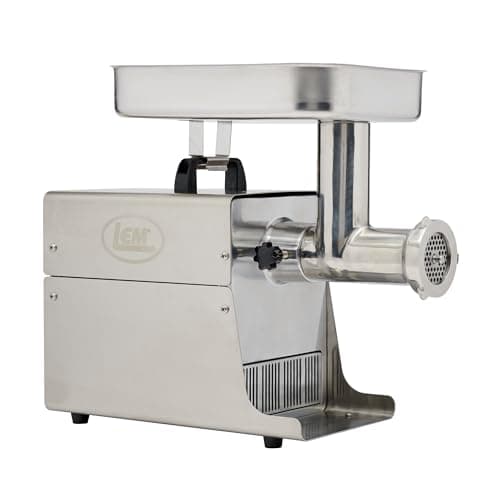
For most hunters the right grinder is the LEM BigBite #8: a #8 head, a published half horsepower, stainless plates and knife, and a five-year warranty from a company that still sells you a replacement plate in year eight. It is the grinder that turns up in more deer camps than anything else, and the reason is not the spec sheet — it is that it keeps working and you can get parts.
If you are doing more than a deer or two a year, step up a head size: the Weston #12 publishes 1 HP and 4 pounds per minute for meaningfully less money. If budget is the constraint, LEM's MightyBite #8 is the cheapest way into a hunting brand. If you want every attachment in one box, the STX Turboforce 3000 ships with five grinding plates, three blades, a foot pedal and stuffing tubes. And if you process several animals a season, the Weston Pro Series publishes 1.5 HP and 14 pounds per minute.
The verdict
Grinding your own venison is the last step in a chain this site covers end to end — field dressing, a cooler that actually holds temperature, a knife and a way to keep it sharp. The grinder is where the trim, the neck, the shanks and everything you could not make a steak out of turns into the burger you actually eat all year.
It is also a category where the published specifications are close to useless for comparison shopping, and we are going to say so plainly before recommending anything. One grinder on this page advertises 3,000 watts and costs less than another advertising 750. Those two numbers are not measuring the same thing. The section below is the most useful part of this page.
Two numbers you cannot compare, and one that is not a standard
Three figures appear on every grinder listing. Here is what each is actually worth.
| The number | Why it fails | What to do instead |
|---|---|---|
| Wattage | Brands publish different things under the same word. STX's Turboforce 3000 is marketed on a 3,000-watt figure that listings describe as a locked-motor or peak output, with running draw reported at roughly 800 to 1,200 watts under load and about 600 with no load. Sellers do not even agree with each other: one listing gives 1,800 watts and another describes the same grinder as 1,200 watts maximum. Meanwhile Weston publishes 750 watts and 1 HP for its #12, and LEM publishes half a horsepower for the BigBite #8 - figures in a completely different accounting system. | Ignore peak wattage entirely. If a brand publishes horsepower, use that; if it publishes only a headline wattage with no 'continuous' qualifier, assume it is peak and discount it heavily. |
| Pounds per minute or per hour | Measured under ideal conditions with pre-cut, partially frozen meat and a coarse plate, and quoted inconsistently. The same STX unit is quoted at 175-225 lb/hr by one source, 180-240 by another and 320-360 by a third. LEM's #8 is commonly listed around 7 lb per minute, while a Dual Grind version of the same head size is listed at about 4.5. | Treat it as a rough class indicator, not a number. The difference between a #8 and a #12 head is real; the difference between two listings for the same machine is noise. |
| The head size number (#8, #12, #22, #32) | This is the most useful number on the box and it is still only a convention, not a standard. Sources disagree on whether the number refers to the diameter of the throat and auger or the diameter of the grinding plates, and one explicitly warns that neck size openings are not standard to the plate size. Published plate diameters for a #8 vary between sources at about 2-3/8 in and about 2-1/2 in. | Use it to pick a class of machine, which it does well. Do not use it to order replacement plates sight unseen - measure your own plate and throat first. |
The spec table
Every figure below is a published number from the maker or a retailer listing, not something we measured. Where it is a peak or marketing figure rather than a continuous rating, the table says so.
| Grinder | Head size | Motor (as published) | Throughput (as published) | Notable inclusions |
|---|---|---|---|---|
| LEM BigBite #8 | #8 | 0.5 HP (most listings); one retailer titles it .35 HP | About 7 lb/min on standard listings | Stainless coarse and fine plates, stuffing plate, stuffing tubes, stainless knife and auger; 5-year warranty per LEM; 2 in head opening |
| Weston #12 | #12 | 750 W / 1 HP | 4 lb/min published | Sausage stuffer function included |
| LEM MightyBite #8 | #8 | 500 W | Not published in the listing | Aluminum construction, compact footprint |
| STX Turboforce 3000 | Not published as a # size | 3,000 W marketed as max/locked-motor; reported running draw roughly 800-1,200 W; other sellers publish 1,800 W and 1,200 W for the same unit | Quoted 175-360 lb/hr depending on the source | 6-in-1: 5 grinding plates, 3-speed, foot pedal, kubbe attachment, sausage stuffing tubes |
| Weston Pro Series | Commercial grade | 1,120 W / 1.5 HP | 14 lb/min published | Stainless steel commercial-grade construction |
Read the STX row next to the Weston Pro row. The STX advertises nearly three times the wattage of a grinder that costs three times as much and publishes 1.5 horsepower. That is not a bargain; that is two companies using the word “watts” to mean different things.
What actually decides a grinder
Four things separate these machines in a garage in November, and only one of them is on the front of the box.
| Criterion | Why it decides the purchase |
|---|---|
| Head size against how many animals you do | This is the real decision. A #8 handles occasional home use and suits a hunter doing one or two deer a year. A #12 is the most commonly recommended size for deer and balances a kitchen-sized footprint against enough capacity for roughly two to four animals. A #22 is for someone processing a lot of game every year and takes real space; a #32 is butcher-shop scale. Buying too big is a storage problem; buying too small is an afternoon that turns into an evening. |
| Who sells you parts in five years | Plates and knives are wear items - they dull, and a dull pair is the single most common cause of mushy, smeared burger. The brands here that sell replacement plates, knives, augers and stuffing tubes as stock items are the ones worth buying. A grinder you cannot re-plate is a grinder with an expiry date, and this is a tool you will own far longer than you expect. |
| Duty cycle and the motor you actually get | A deer is not a steady workload - you grind forty pounds in an afternoon, then stop for a year. What matters is whether the motor can run for an hour without heat-soaking and shutting down. Published horsepower from a brand that publishes horsepower is the best available proxy. A peak-wattage figure tells you nothing about the twentieth minute. |
| The tray and the throat, not the badge | A large meat pan means fewer trips back to the bowl, and a wide throat means less time pushing with a stomper. LEM publishes a 2-inch head opening and a large stainless pan on the BigBite. These are unglamorous specs that decide whether an afternoon of grinding is pleasant or tedious. |
Note what is not on that list: wattage, maximum throughput, and the number of attachments. None of the three changes how the machine behaves on the tenth pound of neck meat.
Best overall: LEM BigBite #8
The BigBite #8 is the grinder we would buy for a household that takes a deer or two a year and intends to keep the machine for a decade. LEM publishes a 0.5 HP motor, a 2-inch head opening, stainless steel coarse and fine plates, a stuffing plate and tubes, a stainless knife and auger, a large stainless meat pan, and a five-year warranty on its own store. Retailer listings put throughput around 7 pounds per minute.
The reason it is first is not that it wins a spec comparison — the Weston #12 has a bigger head and more published horsepower for less money. It is that LEM is a hunting-market company whose entire catalog is processing equipment, and that is what you want behind a machine you will use two weekends a year for fifteen years. Plates, knives, augers, stuffing tubes and pans are all stock items. In a category where the spec sheets contradict themselves, buying the company with the parts channel is the rational hedge.
Honest cons:it is the most expensive #8 on this page by a wide margin, and you are paying for brand and support rather than for horsepower — the Weston #12 publishes double the power and a larger head for less. The published specs are not clean either: most listings say 0.5 HP and at least one large retailer says .35, and published weight ranges from about 28.7 to 36 pounds. And a #8 is a #8 — if you are putting three or four animals through it a year, this is the wrong size and you will feel it.
Best value: Weston #12
On paper this is the best buy on the page. Weston publishes a #12 head, a 750-watt, 1 HP motor and 4 pounds per minute, with sausage stuffing included, at a price well below the LEM BigBite #8. A #12 is the size most commonly recommended for deer specifically, and it is the one that handles two to four animals a year without the footprint of a #22.
It is also the grinder that makes the wattage argument concrete. Weston publishes 750 watts and a horsepower figure, which is a brand describing a continuous rating rather than a locked-motor peak. A 750-watt figure stated alongside 1 HP is a more useful number than a 3,000-watt figure stated alone.
Honest cons:4 pounds per minute is a lower published throughput than the LEM #8's roughly 7, which is counterintuitive for the bigger head and a good reminder that throughput figures across brands are not measured the same way. A #12 is bigger and heavier to store than a #8, which matters in a kitchen. And Weston's warranty terms are not published on the listing, so check them before you buy if long-term support is the reason you are shopping.
Best budget hunting brand: LEM MightyBite #8
The MightyBite is LEM's entry line: a 500-watt, #8-size aluminum grinder with a compact footprint, at roughly half the BigBite's price. The argument for it is simple — it is the cheapest way to get a grinder from the company most likely to still sell you a plate for it in 2034.
For a hunter who takes one deer most years and grinds twenty or thirty pounds of trim, this is enough machine. The honest framing is that it is a step down in construction rather than a different kind of tool: same head size as the BigBite, less motor, aluminum instead of the BigBite's build.
Honest cons:500 watts with no published horsepower is the thinnest spec disclosure on this page, and no throughput figure is published in the listing at all — so you are buying on brand and head size alone. Aluminum construction is lighter and easier to move and is a step down from stainless for a tool that lives in contact with raw meat and needs thorough cleaning. If you have any intention of doing more than one animal a year, the Weston #12 is more machine for similar money.
Most accessories: STX Turboforce 3000
The Turboforce is the accessory play: a 6-in-1 machine with five grinding plates, three cutting blades, three speeds, a foot pedal, a kubbe attachment and sausage stuffing tubes, at a mid-budget price. If you want to grind, stuff sausage and make kibbeh out of one box without ordering anything else, this is the most complete kit here.
The foot pedal is the underrated inclusion. Grinding is a two-handed job — one hand feeding, one on the stomper — and being able to stop the auger with your foot when a piece of silverskin wraps is genuinely useful and not something the premium machines offer.
Honest cons: the headline specification is the least trustworthy on this page and we would rather say it than sell around it. The 3,000-watt figure is described in listings as a locked-motor or peak output, with reported running draw of roughly 800 to 1,200 watts under load; one seller publishes 1,800 watts for the same grinder and another describes it as 1,200 watts maximum. Published throughput ranges from 175 to 360 pounds per hour depending on which listing you read. STX also does not publish a # head size, so matching replacement plates means measuring rather than ordering by number. Buy it for the accessory bundle and the foot pedal, not for the wattage on the front.
Best for volume: Weston Pro Series
If you are the person in camp who processes everyone's deer, this is the machine. Weston publishes commercial grade, 1,120 watts, 1.5 HP and 14 pounds per minutein stainless steel. Fourteen pounds a minute is three and a half times the company's own #12 figure, and it is the difference between an afternoon and an hour when there are three animals on the table.
The case for it is narrow and real: volume, and not stopping. A motor with this much published headroom is not working hard on venison trim, which means it is not heat-soaking and shutting down in the middle of a session.
Honest cons:it is the most expensive item on this page by a clear margin, and for one deer a year it is money spent on capacity you will never reach. Commercial-grade machines are heavy and large, which is a storage problem eleven months of the year. And like everything else here, the 14 lb/min figure is a published best case with ideal, partially frozen, pre-cut meat — not what you will see feeding trim by hand.
The part that matters more than the grinder
Three habits do more for the quality of your burger than any upgrade on this page, and all three are free.
Grind the meat partially frozen.Cut the trim into strips that fit the throat, spread them on a tray and put them in the freezer until they are firm at the edges but not solid — roughly thirty to sixty minutes depending on thickness. Cold, firm meat shears cleanly against the plate. Warm meat smears, and smeared fat and connective tissue is what makes home-ground venison pasty. Chilling the plate, knife and auger with the meat helps for the same reason.
Keep the knife and plate sharp, and keep them as a pair. The cutting action happens between the rotating knife face and the stationary plate face, so they wear against each other and bed in together. Keep each knife with its plate, install the knife the right way round with the sharpened edges facing the plate, and snug the ring so the two faces are in contact without binding. A dull or loose pair tears rather than cuts, which is the same failure mode as grinding warm meat. The principle is identical to the one in our knife sharpening guide: a clean cut comes from a sharp edge meeting the material at the right angle, not from force.
Trim ruthlessly before it reaches the grinder.Silverskin, sinew and heavy connective tissue do not grind — they wrap the auger, wedge against the plate and force you to stop and clear it. Every minute spent trimming on the board saves two at the machine. This is also where a good knife earns its keep, which is why our hunting knife roundup and field dressing kit guide are the pages to read alongside this one.
Who should not buy one
Two hunters are better off spending the money elsewhere, and it is worth saying plainly before you add a grinder to the cart.
If you take a deer every few years,a processor is cheaper than a grinder and a chest freezer's worth of learning. The case for owning one is control over the grind, the fat ratio and what goes in — not cost per pound on one animal.
If you have not solved cold yet, solve that first. Meat quality is decided between the field and the fridge, not at the grinder: a deer that sat warm will not be rescued by any machine on this page. A cooler that holds ice for days and a clean field dressing job are the higher-leverage purchases, in that order.
Everyone else — a freezer that needs filling, trim that deserves better than a processor's shared grind, and a November weekend — is buying the right tool. Start with the head size, buy the brand that sells parts, and put the meat in the freezer for an hour first.
Frequently asked questions
What size meat grinder do I need for deer?
A #8 head suits a hunter doing one or two deer a year, and a #12 is the size most commonly recommended for deer specifically - it balances a kitchen-sized footprint against enough capacity for roughly two to four animals. A #22 is for someone processing a lot of game every year and takes real space; a #32 is butcher-shop scale. Be aware that the # number is a loose convention rather than a standard: sources disagree on whether it refers to the throat and auger diameter or the plate diameter, so measure your own plate before ordering replacements.
How many watts does a meat grinder need for venison?
Wattage is the least useful number on the box, because brands publish different things under the same word. STX markets the Turboforce 3000 on a 3,000-watt figure that listings describe as locked-motor or peak output, with reported running draw of roughly 800 to 1,200 watts - and other sellers publish 1,800 and 1,200 watts for the same machine. Weston publishes 750 watts alongside 1 HP for its #12, which is a continuous-rating disclosure. If a brand publishes horsepower, use that; if it publishes a big headline wattage with no 'continuous' qualifier, assume it is peak.
Should meat be frozen before grinding?
Partially frozen, not solid. Cut the trim into strips that fit the throat, spread them on a tray and freeze for roughly thirty to sixty minutes until they are firm at the edges but still yielding. Cold, firm meat shears cleanly against the plate; warm meat smears, and smeared fat and connective tissue is what makes home-ground venison pasty. Chilling the plate, knife and auger alongside the meat helps for the same reason.
Why is my ground venison mushy or pasty?
Almost always one of three things. The meat was too warm when it went through - partially freeze it. The knife and plate are dull or not seated against each other, so they tear rather than cut - keep each knife with its plate, install the knife with the sharpened edges facing the plate, and snug the ring so the faces contact without binding. Or there was silverskin and sinew in the trim, which wraps the auger and smears everything behind it. Trim ruthlessly on the board first.
How much fat should I add to ground venison?
Venison is extremely lean, so most people add pork or beef fat, commonly somewhere between 10 and 20 percent by weight depending on taste and what they intend to cook. This is a preference rather than a rule. Decide before you start rather than partway through - mixing fat in evenly is far easier on the first pass than the second.
Can I use a stand mixer grinder attachment for deer?
For small quantities of well-trimmed meat it will work, and for a whole animal it is the wrong tool. Attachment grinders have small throats, small plates and a motor designed for dough rather than an hour of continuous grinding, so they heat-soak and clog on sinew. If you are grinding twenty or thirty pounds of trim a year, a dedicated #8 is the right class of machine. If you are doing a whole deer, a #12.
Do meat grinder plates and knives wear out?
Yes, and they are the most commonly overlooked wear item. The cutting happens between the rotating knife face and the stationary plate face, so the two wear against each other and bed in as a pair. A dull or mismatched pair tears rather than cuts, which produces exactly the mushy result people blame on the motor. Keep each knife with its plate, and buy from a brand that stocks replacement plates, knives and augers - which is a large part of why we rank LEM first.
Sources
- LEM BigBite #8 retailer-published specifications: 0.5 HP on most listings (one large outdoor retailer titles the same product .35 Horsepower), roughly 7 lb per minute, 2 in head opening, stainless steel coarse and fine plates, stuffing plate and tubes, stainless knife and auger, large stainless meat pan; published weight ranging from about 28.7 to 36 lb across listings; LEM's own store lists a 5-year warranty. A Dual Grind version of the same head size is listed at about 4.5 lb per minute
- Meat grinder head-size convention: sources disagree on whether the # number refers to the diameter of the throat and auger or the diameter of the grinding plates, and one explicitly warns that neck size openings are not standard to the plate size. Published #8 plate diameters vary between about 2-3/8 in and about 2-1/2 in. Usage guidance cited on this page - #8 for occasional home use, #12 as the common deer recommendation for roughly two to four animals, #22 for high-volume game processing, #32 for butcher-shop scale
- STX Turboforce 3000 wattage and throughput disclosure: listings describe the 3,000 W figure as locked-motor or peak output, with typical running draw reported at roughly 800 to 1,200 W under load and about 600 W with no load; a Desertcart listing publishes 1,800 W and a Walmart listing describes the grinder as 1,200 W maximum; quoted throughput ranges across sources from 175-225, 180-240 and 320-360 lb per hour. Included accessories per the product listing: 6-in-1 function, 3 speeds, foot pedal, 5 grinding plates, 3 cutting blades, kubbe attachment and sausage stuffing tubes
- Weston #12 published specifications per the product listing: 750 watt, 1 HP motor, grinds 4 lbs per minute, electric meat grinder and sausage stuffer
- Weston Pro Series published specifications per the product listing: commercial grade, 1,120 watts, 1.5 HP, 14 lbs per minute, stainless steel
- LEM MightyBite #8 published specifications per the product listing: 500 watt aluminum electric meat grinder for home use, compact. No horsepower or throughput figure is published in the listing
- Product availability, titles and stock status verified via the Amazon Creators API, 2026-11-04
- Prices, product images and stock status via the Amazon price layer, refreshed daily
Keep reading
Gearing up before your next hunt?
See how we evaluate gear, then dig into the reviews and buying guides — written without inventory to sell.