Alternatives Guide
Spypoint Alternatives
Most people searching for a Spypoint alternative are really searching for a way out of a monthly plan. That is worth separating out, because Spypoint is one of the few makers with a genuine free tier - so leaving it for another cellular camera may cost you more, not less, and the only real escape from a subscription is a camera that has no radio in it.
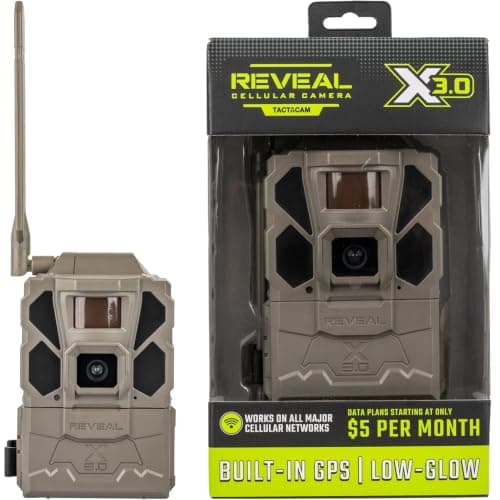
The verdict: the best Spypoint alternative is the Tactacam REVEAL X 3.0— it costs about what the Spypoint it replaces costs and publishes more across the board: 4K photo, auto-connect multi-carrier LTE, IP66, a stated 6-plus month battery life and no SD card needed. It is for the hunter who wants a cellular camera that keeps working without being managed. The budget pick is the GardePro A3S, and it is also the only honest answer to the question most people are really asking: it is not cellular at all, so there is no plan, no carrier and no monthly cost — you walk to the camera and pull the card.
Before the picks, one correction that will save some readers money. Spypoint is one of the few cellular camera makers with a genuine free data tier— in the region of a hundred photos a month at no cost, which is enough to run a camera casually without ever paying a subscription. If the plan is your reason for leaving, moving to another cellular brand may well cost you more rather than less. The alternatives below are ranked on what they actually beat Spypoint at, and we say plainly where they do not.
Why people look for a Spypoint alternative
Four reasons come up repeatedly, and they point at different cameras:
- The monthly plan.By far the commonest. The honest answer is not another cellular camera — it is a non-cellular camera, where the recurring cost is zero by construction.
- Image quality, especially at night. The Spypoint Flex-M publishes 28MP photos and 720p video; the Flex-M2 publishes 32MP and 1080p. Several alternatives publish considerably more — see the Stealth Cam and the Reveal X 3.0.
- Signal in a specific spot. Spypoint’s answer is dual-SIM LTE; Tactacam’s is auto-connect multi-carrier; Moultrie publishes multi-carrier too. All three improve the odds. None creates coverage where there is none, and the only way to know is to test at the tree.
- Wanting a screen. Some hunters want to see what the camera sees while they are standing at it. The Reveal Ultra publishes an LCD screen and live view.
Work out which of those four is yours before you shop, because the right alternative is different in each case. Our cellular versus non-cellular comparison is the place to start if it is the first one.
What Spypoint actually does that others do not
Two things, and both are worth knowing before you switch:
| A free data tier | Spypoint offers a no-cost plan tier - in the region of a hundred photos a month - which is genuinely unusual in the category and is enough to run a camera casually with no subscription at all. If you run several cameras and want to keep recurring costs near zero while still getting photos to your phone, this is the reason to stay rather than switch. |
|---|---|
| Dual-SIM LTE on the Flex-M2 | Spypoint publishes dual-SIM LTE on the Flex-M2 twin pack, which lets the camera connect to whichever network is strongest rather than being tied to one carrier. Tactacam publishes auto-connect multi-carrier and Moultrie publishes multi-carrier, so this is matched rather than exclusive - but it is a real feature and the cheap no-name cameras do not have it. |
| Price per camera, in twin packs | Spypoint sells the Flex-M2 as a twin pack, and twin packs are how the per-camera cost in this category actually comes down. Moultrie, Stealth Cam and Browning all do the same, so check whether the figure you are comparing is for one camera or two before you conclude anything about value. |
The alternatives at a glance
| Camera | Price & buy | Cellular? | Published image | Trigger | Beats Spypoint on |
|---|---|---|---|---|---|
| Tactacam REVEAL X 3.0 | $84.99Buy | Yes - auto-connect multi-carrier LTE | 4K photo, 1080p video | Not published | Image, IP66, battery, no SD card needed |
| GardePro A3S | $56.99Buy | No - SD card only | 64MP photo, 1296p video with sound | 0.1 second | No plan at all; image; trigger speed |
| Moultrie Edge 3 (2-pack) | $97.49Buy | Yes - multi-carrier | 40MP photo, 1080p video | 0.5 second | Two cameras; GPS; low-glow flash |
| Tactacam Reveal Ultra | $138.00Buy | Yes - LTE | 4K photo, 1080p video | Not published | LCD screen, live view, switchable flash |
| Stealth Cam Deceptor MAX 3.0 (2-pack) | $139.99Buy | Yes - live on demand | 50MP photo, 1440p video | 0.3 second | Night images (940nm), resolution, GPS |
| Browning Command Ops Elite 40MP (2-pack) | $199.95Buy | No - SD card only | 40MP photo, HD video | 0.3 second | No plan; brand track record; cards included |
Prices shown are from Amazon as of November 21, 2026 and change often — the button always goes to the current listing. Some links may earn us a commission at no extra cost to you.
Best overall: Tactacam REVEAL X 3.0
Best for: the hunter who wants a cellular camera at Spypoint money that needs less looking after.
This is the switch to make if you want to stay cellular. Tactacam publishes 4K photo and 1080p video, auto-connect multi-carrier LTE, night vision, an IP66 waterproof rating, a stated 6-plus month battery life, and — the quietly important one — no SD card needed.
Take those against the Spypoint Flex-M2’s published 32MP, 1080p, dual-SIM LTE and IP65, where the card is explicitly not included. The card is a real-world failure point: cards corrupt, cards get forgotten in a laptop, and a camera with no card is a camera that has recorded nothing all week. A camera that does not use one removes the commonest unforced error in trail camera ownership.
Honest cons:Tactacam publishes no trigger speed for the X 3.0, where Moultrie publishes 0.5 seconds and Stealth Cam 0.3 — so on the one specification that decides whether you photograph a deer or its hindquarters, this camera says nothing. There is no free plan tier to match Spypoint’s, so the subscription remains. And Tactacam does not publish a detection range or a flash range on this listing.
Budget pick and no-plan answer: GardePro A3S
Best for: anyone whose actual problem is the monthly plan.
The A3S is the camera that makes the strongest case against paying a subscription at all, and it does it with numbers rather than argument. GardePro publishes 64MP photos, 1296p video with sound, a 0.1-second trigger and 100 feet of no-glow night vision— and it is the cheapest camera on this page.
Read that trigger figure again: 0.1 second, against Moultrie’s 0.5 and Stealth Cam’s 0.3. Trigger speed is the specification that decides whether a walking deer is centered in the frame or half out of it, and the cheapest camera here publishes the fastest one. The recurring cost is zero, because there is no radio to pay for.
Honest cons:you have to walk to it. That is the entire trade, and it is a real one — every card pull is scent, noise and disturbance in the spot you are scouting, which is the whole reason cellular cameras exist. GardePro is also a value brand rather than a hunting institution, with a shorter track record than Browning or Moultrie. And a non-cellular camera cannot tell you anything until you visit it, so it is the wrong tool for monitoring a spot you are deliberately staying out of.
Best value: Moultrie Edge 3 two-pack
Best for: covering two locations for roughly the price of one Spypoint twin pack.
The Edge 3 is the value play and the most direct like-for-like replacement for a Spypoint twin pack. Moultrie publishes 40MP photos, 1080p video, a 0.5-second trigger, multi-carrier connectivity, a low-glow flash, GPS, and it ships as a two-pack.
Two things distinguish it. The published trigger speed is a real number where the Tactacams publish none, and Moultrie’s app integrates with onX mapping, so camera locations and detections appear on the same map you plan hunts on. Our cellular plan comparison covers how its plan pricing stacks up, which matters more than the camera price over three seasons.
Honest cons: it uses a low-glowflash rather than no-glow, so there is a faint visible flash at night — the Stealth Cam’s 940nm is the no-glow option if that matters on a pressured property. Forty megapixels is below the GardePro and the Stealth Cam. And a two-pack means two plan subscriptions, which is the thing most readers of this page were trying to reduce.
Best screen and live view: Tactacam Reveal Ultra
Best for: the hunter who wants to aim and check the camera at the tree rather than guess and come back.
The Reveal Ultra is the camera to buy if setup frustration is your real complaint. Tactacam publishes 4K photo, 1080p video, live view, GPS tracking-enabled, a switchable no-glow / low-glow flash, LTE connectivity and an LCD screen.
The screen and the switchable flash are the features worth paying for. An LCD means you aim the camera once, correctly, instead of discovering a week later that it has been photographing a branch. And switchable flash lets you run no-glow on a pressured property and low-glow where image quality matters more than invisibility — a choice no other camera here offers. It is also the camera our cellular trail camera guide names as the dependable, no-drama pick.
Honest cons: it costs meaningfully more than the Spypoint it replaces and more than our top pick, and the LCD is a convenience rather than a performance feature. Tactacam publishes no trigger speed here either. And a screen is another thing to break and another small drain on the batteries.
Best night images: Stealth Cam Deceptor MAX 3.0 two-pack
Best for: identifying individual animals after dark on a pressured property.
If image quality is why you are leaving, this is the camera. Stealth Cam publishes 50MP photos, 1440p video, a 0.3-second trigger, 100 feet of 940nm no-glow infrared, dual-core AI, live on demand and built-in GPS, in a two-pack.
The number that matters is 940nm. That is the true no-glow infrared wavelength — invisible to deer and to people, unlike the 850nm low-glow emitters that produce a faint red shine. On a property where other hunters walk, or where you are trying to keep a mature buck from patterning your camera, that is the specification worth paying for. Most of the deer you care about move in the dark, which our when do deer move guide covers in detail.
Honest cons:it is one of the two most expensive options here, and per-camera it is not cheap even as a two-pack. No-glow infrared always costs you some night image brightness and range compared with a low-glow emitter at the same power — that is physics, not a defect. And two cellular cameras means two plans.
Also considered: Browning Command Ops Elite 40MP two-pack
The Browning is the other non-cellular route out of a subscription, and it is the one to choose over the GardePro if brand track record matters to you. Browning publishes 40MP photos, HD video, a 0.3-second trigger speed, infrared LED night vision, and the bundle includes two 32GB SD cards and a USB card reader— so it arrives ready to hang.
We are listing rather than ranking it for one reason, stated plainly: it is several times the price of the GardeProfor a lower published photo resolution and a slower published trigger, and it uses infrared LED rather than a no-glow emitter. What you are buying is Browning’s long record in trail cameras and the cards in the box. That is a legitimate thing to buy; it is not a specification advantage, and we are not going to present it as one.
The bottom line
Start by naming your reason. If it is the monthly plan, the alternative is not another cellular brand — buy the GardePro A3Sand accept walking to it, or stay on Spypoint’s free tier, because switching cellular brands usually costs more. If it is image quality at night, buy the Stealth Cam Deceptor MAX 3.0 for its 940nm no-glow. If it is signal, the Tactacam REVEAL X 3.0 publishes auto-connect multi-carrier and is our overall pick on everything else too. If it is setup frustration, the Reveal Ultra has the LCD screen and live view.
And whichever you buy, the camera matters less than where and how you hang it. A cellular camera is the most setup-sensitive piece of equipment in hunting, because every false trigger costs battery and plan data — our how to set up a trail camera guide and our battery and solar panel guide both do more for your results than a resolution upgrade will.
Frequently asked questions
What is the best alternative to Spypoint?
The Tactacam REVEAL X 3.0, if you want to stay cellular. It costs about what the Spypoint it replaces costs and publishes more on every axis: 4K photo against Spypoint's 32MP, auto-connect multi-carrier LTE, an IP66 rating against IP65, a stated 6-plus month battery life, and no SD card needed. If your actual reason for leaving is the monthly plan, the honest alternative is the GardePro A3S - it is not cellular at all, so the recurring cost is zero, and it publishes a faster 0.1-second trigger and 64MP photos than any cellular camera here.
Is there a trail camera with no monthly fee?
Yes - any non-cellular camera, because the fee pays for the data connection. The GardePro A3S is the cheapest here and publishes 64MP photos, 1296p video with sound, a 0.1-second trigger and 100 feet of no-glow night vision. The Browning Command Ops Elite two-pack is the other route and ships with two 32GB cards and a reader. The trade in both cases is that you walk to the camera to pull the card, and every visit is scent, noise and disturbance in the spot you are scouting - which is precisely why cellular cameras exist.
Does Spypoint have a free plan?
Yes, and it is the main reason not to switch. Spypoint offers a no-cost plan tier - in the region of a hundred photos per month - which is genuinely unusual in the category and enough to run a camera casually with no subscription. If the plan cost is your reason for looking elsewhere, moving to a different cellular brand typically swaps one subscription for a dearer one. The alternatives on this page win on image quality, trigger speed, weather rating, battery life and card handling, not on recurring cost.
Which trail camera has the best night pictures?
Of the cameras here, the Stealth Cam Deceptor MAX 3.0. It publishes 50MP photos, 1440p video, a 0.3-second trigger and 100 feet of 940nm no-glow infrared. The 940nm figure is the one that matters: that is true no-glow, invisible to deer and to people, where 850nm low-glow emitters produce a faint visible red shine. The trade is that no-glow always costs some night brightness and range at the same power, and that this is one of the dearer options on the page.
Will another cellular camera get better signal than my Spypoint?
Possibly, but none of them can create coverage. Spypoint publishes dual-SIM LTE on the Flex-M2, Tactacam publishes auto-connect multi-carrier, and Moultrie publishes multi-carrier - all three let the camera use whichever network is strongest, which meaningfully improves the odds in a marginal spot. What none of them does is work in a genuine dead zone. Test at the actual tree before the season rather than at the truck, and if the spot is truly dead, buy a non-cellular camera instead of a different radio.
Is trigger speed or megapixels more important on a trail camera?
Trigger speed, by a wide margin. Trigger speed decides whether a walking deer is centered in the frame or half out of it; megapixels decide how large you can print a photo you will only ever view on a phone. It is worth noting which cameras publish a figure at all: GardePro publishes 0.1 second, Stealth Cam and Browning 0.3, Moultrie 0.5 - and neither Tactacam listing publishes one. That absence is a real gap on the specification that matters most.
Sources
- SPYPOINT Flex-M and SD Card Pack - published listing specification (28MP photos, 720p video, GPS-enabled, IP65 waterproof)
- SPYPOINT Flex-M2 Twin Pack - published listing specification (32MP, 1080p video, dual-SIM LTE, GPS, IP65, microSD not included)
- Tactacam REVEAL X 3.0 - published listing specification (4K photo, 1080p video, auto-connect multi-carrier LTE, no SD card needed, 6+ month battery life, IP66)
- GardePro A3S Non-Cellular Trail Camera - published listing specification (64MP photo, 1296p video with sound, 0.1s trigger, 100 ft no-glow night vision)
- Moultrie Edge 3 Cellular 2-Pack - published listing specification (40MP, 0.5s trigger, 1080p video, multi-carrier, low-glow flash, GPS)
- Tactacam Reveal Ultra - published listing specification (4K photo, 1080p video, live view, GPS tracking-enabled, switchable no-glow/low-glow flash, LCD screen)
- Stealth Cam Deceptor MAX 3.0 2-Pack - published listing specification (50MP, 1440p, 0.3s trigger, 100 ft 940nm no-glow, dual-core AI, live on demand, built-in GPS)
- Browning Command Ops Elite 40MP 2-Pack Bundle - published listing specification (40MP, HD video, 0.3s trigger, infrared LED night vision, two 32GB SD cards and USB reader)
Keep reading
Gearing up before your next hunt?
See how we evaluate gear, then dig into the reviews and buying guides — written without inventory to sell.