How-To Guide
How High Should a Tree Stand Be?
The honest answer is 15 to 20 feet for most hunters and most woods - high enough to get above a deer's normal line of sight, low enough that your shot angle still reaches both lungs. Beyond that, the thing that hides you is the cover behind your silhouette, not another five feet.
For most hunters in most woods: 15 to 20 feet to the platform. Getting above a deer’s normal line of sight — higher than about 15 to 20 feet — is what improves your odds, and on genuinely flat ground many hunters settle at 19 to 21 feet. Many experienced hunters hang lower than that, around 15 feet at the footrest, and kill deer every year.
The reason the range is wide rather than a single number is that height is not the variable doing most of the work. Cover behind you is. A hunter at 15 feet with a trunk and a tangle of limbs breaking up his outline is harder to pick out than a hunter at 25 feet skylined against nothing.
The short answer
| Most woods, most hunters | 15 to 20 feet to the platform. This is the range that clears a deer's normal line of sight while keeping your shot angle workable. |
|---|---|
| Flat terrain, open timber | 19 to 21 feet is a common target when there is nothing else to break up your outline and no slope working for you. |
| Thick cover or a well-chosen tree | 15 feet is plenty. If there is cover behind your silhouette and limbs around you, the extra height buys very little. |
| The practical ceiling | Somewhere between 20 and 30 feet is plenty high to take almost any deer. Above that you are adding risk and steepening your shot angle for no measurable gain. |
| The rule that overrides all of the above | Pick the tree first and let it set the height. A good tree at 16 feet beats a bare pole at 24. |
Why 15 to 20 feet
A whitetail’s eyes sit roughly three to four feet off the ground and its visual system is built to catch horizontal movement at that level. Getting well above that line is what lets you get away with lifting a bow, turning your head, or shifting a boot — the movements that actually get hunters caught.
The returns taper quickly. The jump from 10 feet to 16 feet is a large change in how much movement you can get away with; the jump from 20 feet to 26 feet is a small one, bought with a steeper shot angle, a longer climb and more exposure.
There is also a counter-argument worth taking seriously: as a general rule, if you can stay lower and still get the job done, there is no reason not to. Climbing is the risky part of tree stand hunting, so unnecessary height is unnecessary risk.
Cover beats height
This is the part most height discussions bury. Good cover behindyou, and cover between you and the deer, is the key to defeating a deer’s eyesight — not altitude. A deer does not resolve a hunter the way we imagine; it resolves an outline that does not belong, and then movement inside that outline.
| Behind you | A trunk wider than your shoulders, a fork, a clump of limbs, or a second tree. Anything that stops you appearing as a dark shape against bright sky. |
|---|---|
| Beside you | Limbs at shoulder and head height break up movement specifically. They also catch arrows, so clear a lane rather than the whole tree. |
| Between you and the trail | Screening cover means a deer is already committed before it has a clear view of your tree. This is worth more than five extra feet. |
| Sun angle | An east-facing stand at dawn puts a bright background behind you and your face in the light. Height does not fix that; tree choice does. |
The shot-angle cost of going higher
Height is not free. The higher you sit, the steeper the angle into the animal, and the smaller the window where an arrow or bolt passes through both lungs. At a sharp downward angle a shot that looks centered on the ribs can clip one lung and exit low behind the opposite shoulder.
| Height | What it buys | What it costs |
|---|---|---|
| 10-14 ft | Flattest shot angle; quietest climb; least exposure | Not reliably above a deer's line of sight in open timber |
| 15-20 ft | Above normal line of sight with a workable shot angle | Needs a reasonable tree; a real climb |
| 20-25 ft | More freedom to move; better in open, flat timber | Steeper angle, smaller vital window, more climbing risk |
| 25 ft and up | Very little a good tree at 18 ft does not already give you | Steep angles, longer sticks, more exposure to wind and falls |
The practical fix for the angle problem is to take the shot when the deer is quartering away and a few yards out rather than directly under you, and to practise from an elevated position before the season rather than only off flat ground.
What height does and does not do for scent
Height helps with scent less than hunters hope, because thermals move air up in the morning and down in the evening, and a swirling wind in broken terrain does not care how high you are. What matters is the direction the air is moving relative to where you expect deer.
The standard answer is to let the prevailing wind pick the stand, not the height: when you are scouting a new site, take the prevailing wind into account, and where it is worth the effort, hang two stands on opposite sides of a field so whichever way the wind blows on the day you hunt, one of them is downwind.
Two stands at 17 feet beat one stand at 27 feet, every time.
Adjusting for terrain and weapon
| Hunting a slope | Deer on the upslope are effectively level with you, which erases your height advantage. Either hang higher on the downhill side or move to a tree where the trail is below you. |
|---|---|
| Bow and crossbow | Favour the lower half of the range. Vertical shooting lanes are shorter than they look, and steep angles cost you vital-zone depth - which matters more with an arrow than with a bullet. |
| Rifle and muzzleloader | You can afford more height because range is not the constraint, and a shooting rail at height is steadier than an unsupported standing shot. |
| Standing corn or thick brush | Height is about seeing out as much as not being seen. Add a few feet so you can see over the cover rather than into it. |
| Public land with no good trees | Stop optimizing height and start optimizing the tree. A crooked, limby trunk at 15 feet - which rules out a climber and calls for a hang-on - is a better stand than a clean pole at 22. |
How many sticks that actually takes
If you hunt a hang-on, your height is set by the hardware you carry, and stick length is not climbing height. Overlap at the base, the gap up to the platform and the fact that you stand on the top step all eat into the total.
Who the Hawk Helium Gen 2 sticks are for:the hunter targeting 18 to 20 feet with a hang-on. Four 20-inch sections, 2.5 pounds per stick, rated to 300 pounds — which is the right amount of hardware for this height range rather than an aspirational stack of six.
Three sticks is realistically 15 to 18 feet, which is a perfectly good stand. A climbing stand sidesteps the arithmetic entirely — you simply stop climbing when you are high enough — but needs a straight, limbless trunk, which is the trade.
The safety chain height makes mandatory
Whatever height you pick, the fall happens during the climb or during the transition onto the platform far more often than from a seated position. So the equipment that makes a height decision safe is not the stand — it is the three things that keep you attached.
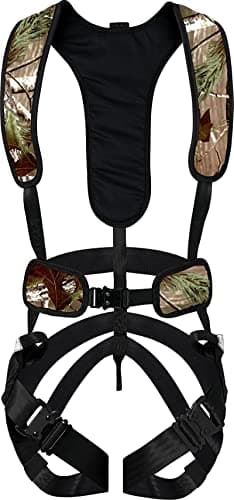
Who the Hunter Safety System X-1 is for: most hunters, and bowhunters especially. Rated to 300 pounds, 2.5 pounds, sizes S through 3XL so it closes over late-season layers, Treestand Manufacturers Association certified, with a 5-year warranty.
Who the reflective lifeline is for:anyone hunting a fixed stand. It runs from the ground to above your platform so you clip in once, at the bottom, and stay attached through the climb and the transition — which is precisely the window the harness alone does not cover.
Who the lineman’s belt is for: anyone hanging their own stand. It holds you against the trunk so both hands are free for the stand and the straps, and the relief strap addresses suspension trauma if you do end up hanging.
Buy all three before you argue about the last three feet of height. The height question has a comfortable range of right answers; being unattached has none.
Frequently asked questions
How high should a tree stand be?
For most hunters and most woods, 15 to 20 feet to the platform. Getting above a deer's normal line of sight - higher than roughly 15 to 20 feet - is what improves your odds, and on flat ground many hunters aim for 19 to 21 feet. Plenty of experienced hunters hang around 15 feet at the footrest and do well, because the cover behind your silhouette matters more than the last few feet of height.
How high should a tree stand be for bow hunting?
Favour the lower half of the range, around 15 to 18 feet. A steeper downward angle shrinks the window where an arrow passes through both lungs, and vertical shooting lanes are shorter than they appear from the ground. Practise from an elevated position before the season rather than only off flat ground, and prefer shots a few yards out and quartering away over shots directly beneath you.
Is 15 feet high enough for a tree stand?
Yes, in most situations. 15 feet puts you well above a whitetail's eye level and keeps your shot angle manageable, and the general principle is that if you can stay lower and still get the job done, there is no reason to climb higher - climbing is the risky part of stand hunting. What makes 15 feet work is cover behind you; in open, flat timber with a bare trunk you may want closer to 20.
Can a tree stand be too high?
Yes. Somewhere between 20 and 30 feet is plenty high to take almost any deer, and above that you are paying with a steeper shot angle, a smaller vital window, a longer and riskier climb, and more movement from wind. Height also stops compensating for a bad tree - a hunter skylined at 25 feet is easier to pick out than one broken up by cover at 16.
Does a higher tree stand help with scent?
Less than most hunters hope. Morning thermals carry air up and evening thermals carry it down, and a swirling wind in broken terrain is unaffected by your height. The effective answer is to let the prevailing wind choose the stand site, and where it is worth the effort, to hang two stands on opposite sides of a field so one is downwind whichever way the wind blows on the day.
How many climbing sticks do I need to reach 20 feet?
Four 20-inch sticks puts most hunters at a working height of roughly 18 to 20 feet. Three gets you to about 15 to 18 feet. Stick length is not climbing height: you lose some to overlap at the base, some to the gap up to the platform, and some because you stand on the top step rather than above it.
What is the most important thing about tree stand height?
Picking the tree before picking the number. A tree with a wide trunk, a fork or a clump of limbs behind your silhouette hides you better at 16 feet than a clean pole does at 24. After that, the safety chain - a full-body harness, a lifeline you clip into from the ground, and a lineman's belt for the hang - is what makes any height you choose survivable.
Sources
- Mossy Oak - treestand height guidance: getting above a deer's normal line of sight (higher than 15-20 feet) improves your chances; good cover behind you and between you and the deer is the key to defeating a deer's eyesight; prevailing-wind stand selection and hanging two stands on opposite sides of a field
- Bowhunting.com - what's the best treestand height: 19-21 feet on generally flat terrain, a generally preferred 15 feet at the footrest, and the principle that somewhere between 20 and 30 feet is plenty high to harvest almost any deer - with the note that staying lower when you can still get the job done reduces climbing risk
- onX Hunt - top tactics for setting up a tree stand: terrain, upslope deer and cover considerations
- Hunter Safety System - X-1 harness published specifications: 300 lb rating, 2.5 lb, sizes S through 3XL, Treestand Manufacturers Association certified, 5-year warranty
- Sportsman's Warehouse - Hawk Helium Gen 2 20-inch climbing stick 4-pack published specifications: 2.5 lb per stick, 300 lb capacity, 20 in length
- Prices, product images and stock status via the Amazon price layer, refreshed daily
Keep reading
Gearing up before your next hunt?
See how we evaluate gear, then dig into the reviews and buying guides — written without inventory to sell.