How-To Guide
How to Break In Hunting Boots
Both Danner and Kenetrek publish break-in instructions, and they agree: a couple of hours a day, starting well before the hunt, stopping the moment you feel a hot spot. There is no fast version that does not cost you either the boot or the skin on your heels.
Wear the boots around the house or on short outings for a couple of hours a day for a week or more, in the socks you intend to hunt in, and stop as soon as you feel a hot spot. Start at least a couple of months before the hunt if the boots are stiff mountain boots. That is Danner’s published method and Kenetrek’s published method, almost word for word, and the agreement between two makers with very different boots is the strongest signal available.
The useful insight behind it: for the first few weeks it is your foot that gives, not the leather. The schedule exists to keep that from happening all at once, on a mountain, on day one of a hunt.
The short answer
| Start when | Weeks out for a hunting boot; at least a couple of months out for a stiff mountain boot. If the hunt is next week, the honest plan is to hunt in boots you already own. |
|---|---|
| How long per session | A couple of hours a day, or longer if you can wear them all day without doing your foot any damage. |
| The stop signal | The first hot spot. Change shoes. A hot spot is the stage before a blister, and the only one you get to act on for free. |
| What to wear | The socks you will hunt in, every session. The boot molds around the sock as much as the foot. |
| The accelerators | A leather conditioner, or wetting the leather and wearing it until dry. Both are optional, both are Danner-sanctioned, and conditioner darkens leather. |
What the makers actually publish
| Danner | Kenetrek | |
|---|---|---|
| Lead time | Plan for break-in before and during your first few weeks of wear | Start at least a couple of months before your hunt |
| Session length | A couple of hours a day for a week or more, around the house or on shorter outings | A few hours a day, daily - all day if you can do it without damaging your foot |
| Stiffer boots | Allow longer for thicker leathers and stiffer components | The leather gradually conforms; for now it is your foot that gives in |
| Hot spots | Not addressed directly | Switch to other shoes; use well-trimmed moleskin on the tender area next time out |
| Accelerators | Optional leather conditioner, or wet the leather and wear until dry | A quality supportive insole improves initial fit and eases break-in |
Note the one place they differ in emphasis. Danner, with a broader range including boots that are comfortable out of the box, frames break-in as a few weeks of normal wear. Kenetrek, which builds stiff full-grain mountain boots, frames it as a two-month project. Match the timeline to your boot, not to the calendar you wish you had.
A four-week schedule
| Week 1 - indoors only | Two hours a day around the house, laced properly, in your hunting socks. Carpet and hard floors, no mileage. You are looking for pressure points while you can still take the boots off instantly. |
|---|---|
| Week 2 - short walks on flat ground | A mile or two at a time, still two to three hours a day. Flat ground first because flat ground does not load the heel and toe the way slope does. |
| Week 3 - hills and a light pack | Add elevation and 15 to 20 pounds. Downhill is the test that matters: it is where toes hit the front and where lacing errors show up. |
| Week 4 - hunt weight, hunt terrain | Your loaded pack, your actual ground, and at least one session as long as a real hunting day. If the boots pass this, they will pass the season. |
| Mountain boots - double it | Run the same four stages over eight weeks, which is Kenetrek's couple-of-months guidance in practice. |
Hot spots: stop, do not push through
Kenetrek’s instruction is explicit: once you start to get a hot spot, it is time to put on other shoes. This is the single most ignored piece of break-in advice, and the reason most people’s break-in stories are blister stories.
For the next session, put moleskin on the tender area and trim the edges very well— a poorly trimmed patch with square edges tends to roll up and cause even more damage. The moleskin does two jobs: it minimizes friction inside the boot, and it pushes outward on the leather, so it actively helps the boot form around the spot that is giving you trouble.
If the same hot spot keeps returning in the same place after three or four sessions, it is probably a fit problem rather than a break-in problem. Hot spots at the ball of the foot usually mean the boot is too narrow; at the heel, that the heel pocket is wrong for you or the lacing is loose through the ankle.
Break the boot in with the sock you will hunt in
A boot molds to the volume inside it, and a sock is a surprising amount of that volume. Break a boot in with thin cotton socks and then hunt in heavy merino and you have broken in a boot you are not wearing.
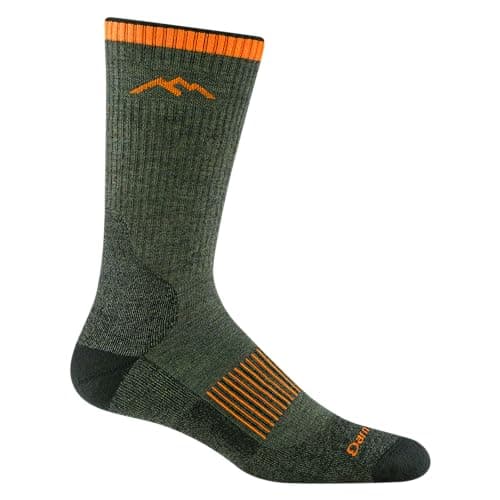
Who the Darn Tough Hunting Boot Midweight is for:most hunters, and the default for break-in — merino, midweight, cushioned where the boot rubs without adding so much bulk that the fit changes. Use the same pair, or an identical pair, for every session.
Who the Smartwool Hunt Classic Max Cushion Tall Crew is for:hunters breaking in a tall or stiff boot. Maximum cushioning and a tall crew height put material between the leather and the two places tall boots punish — the back of the heel and the front of the shin.
Kenetrek also notes that a quality supportive insole can make a real difference to initial fit and comfort, which makes the break-in easier. If you intend to run an aftermarket insole in these boots, install it at the start rather than halfway through.
What legitimately speeds it up
| Leather conditioner | Danner's own suggestion when boots are not loosening up naturally. The caveat is also Danner's: conditioner will darken the leather, so test a small hidden section before doing the whole boot. |
|---|---|
| Wet the leather and wear until dry | Also Danner-sanctioned. The leather relaxes and then sets around your foot as it dries. Do it with the boots on - that is the whole mechanism - and let them finish drying slowly afterwards. |
| A supportive insole | Kenetrek's recommendation. It changes how your foot sits in the boot, which often removes a pressure point without any leather having to move at all. |
| Lacing technique | Free, instant, and underrated. A heel-lock lacing pattern through the top two eyelets stops heel lift, which is the cause of most heel blisters during break-in. |
| Carrying weight | Loaded walking compresses the midsole and flexes the upper the way hunting will. It is not a shortcut so much as making your practice match the test. |
What not to do
| Do not heat them to stretch them | An oven, a hair dryer held in one place, a fire or a heater vent dries and hardens leather, shrinks it, and can delaminate adhesives. Heat is how a break-in becomes a replacement. |
|---|---|
| Do not soak them and leave them to dry empty | Wetting works because the leather sets around your foot. Wet boots dried on a radiator with nothing in them set around nothing and come back stiffer than they started. |
| Do not double-sock to fill a loose boot | Two layers slide against each other, and that sliding is what raises blisters. One correct sock beats two compensating ones. |
| Do not push through a hot spot | A hot spot you keep walking on becomes a blister, and a blister stops the break-in for a week. Stopping early is faster. |
| Do not start the week of the hunt | There is no method in either maker's guidance that compresses this into days. If the hunt is imminent, wear the old boots and break the new ones in afterwards for next season. |
Drying between sessions
Break-in means wearing the same boots day after day, which means they do not get a chance to dry on their own — and a damp boot both rubs more and breaks down faster. This is where a dryer earns its place: gentle, moving air rather than heat.
Who the DryGuy forced-air dryer is for: hunters drying boots on a schedule, between consecutive sessions. Forced air moves moisture out faster than convection alone, which is what you want when you are wearing the same pair tomorrow morning.
Who the PEET Original is for: hunters who would rather run a quiet, fan-free unit overnight and not think about it.
Pull the insoles and loosen the laces fully before drying either way. A closed, laced boot traps the moisture you are trying to remove.
How long it should take, by boot type
| Boot type | Realistic break-in | What tells you it is done |
|---|---|---|
| Rubber boots | None to speak of | They fit or they do not - there is no leather to mold |
| Lightweight leather/nylon hunting boots | 1 to 2 weeks of short daily wear | A loaded downhill mile with no hot spots |
| Full-grain leather hunting boots, 8-10 in | 2 to 4 weeks | A full hunting-day walk at hunt weight |
| Stiff full-grain mountain boots | 6 to 8 weeks, started a couple of months out | Side-hilling under a pack without heel lift or toe contact |
One last honest note. Break-in makes a correctly sized boot comfortable; it does not make a wrongly sized boot fit. If after three or four weeks the same spot still hurts, the problem is the shape of the boot against the shape of your foot — and the fix is a different width or a different last, not more miles.
Frequently asked questions
How do you break in hunting boots?
Wear them around the house or on short outings for a couple of hours a day for a week or more, in the socks you plan to hunt in, and stop as soon as you feel a hot spot. That is Danner's published guidance, and Kenetrek's is nearly identical with a longer runway - start at least a couple of months before your hunt and wear them daily for a few hours. Add distance, slope and pack weight gradually.
How long does it take to break in hunting boots?
One to two weeks of short daily wear for lightweight leather and nylon boots, two to four weeks for full-grain leather hunting boots, and six to eight weeks for stiff full-grain mountain boots - which is why Kenetrek tells you to start a couple of months out. Rubber boots need no break-in at all; they either fit or they do not.
How do you break in hunting boots fast?
There is no method either Danner or Kenetrek endorses that compresses this into days. The legitimate accelerators are a leather conditioner, or wetting the leather and wearing the boots until dry - both of which Danner suggests when boots are not loosening naturally - plus a supportive insole, which Kenetrek recommends. Conditioner darkens leather, so test a hidden section first. If the hunt is next week, wear the boots you already own.
What do you do about hot spots when breaking in boots?
Stop that session and change shoes - Kenetrek's instruction is explicit about this. For the next outing, apply moleskin to the tender area and trim the edges very carefully, because a patch with square edges tends to roll up and cause more damage. The moleskin reduces friction and pushes outward on the leather, so it helps the boot form around the trouble spot.
Should you get boots wet to break them in?
You can, and Danner lists it as an option: wet the leather and wear the boots until dry. The mechanism is that the leather relaxes and then sets around your foot, so it only works with the boots on your feet. Do not soak boots and dry them empty, and never dry them with direct heat - heat hardens and shrinks leather and can delaminate adhesives.
Can you break in boots that are the wrong size?
No. Break-in makes a correctly sized boot comfortable; it cannot change the shape of the boot against the shape of your foot. If the same spot still hurts after three or four weeks of proper break-in, you need a different width or a different last. Hot spots at the ball of the foot usually mean the boot is too narrow; at the heel, that the heel pocket or your lacing is wrong.
What socks should you wear to break in hunting boots?
The socks you will actually hunt in, the same pair every session. A boot molds to the volume inside it, and sock thickness is a meaningful part of that volume - break a boot in with thin cotton and hunt in heavy merino and you have broken in a boot you are not wearing. A midweight merino hunting sock is the right default; a max-cushion tall crew helps with stiff or tall boots.
Sources
- Danner - new boots care guide: plan for break-in before and during your first few weeks of wear; wear them around the house or on shorter outings for a couple of hours a day for a week or more, longer for thicker leathers and stiffer components; optionally apply a leather conditioner or wet the leather and wear until dry, noting that conditioner darkens leather and should be tested on a hidden section
- Kenetrek - breaking in a new pair of boots: start at least a couple of months before your hunt and wear them daily for at least a few hours; stop and change shoes at the first hot spot; apply well-trimmed moleskin to the tender area, since a poorly trimmed patch with square edges rolls up and causes more damage; a quality supportive insole eases initial fit and break-in
- Danner support - what is the best way to break in my new Danner boots
- Prices, product images and stock status via the Amazon price layer, refreshed daily
Keep reading
Gearing up before your next hunt?
See how we evaluate gear, then dig into the reviews and buying guides — written without inventory to sell.