Buying Guide
The Best Mountain Hunting Boots for Steep, Loaded Country
A mountain boot is a different tool from a whitetail boot. It has to carry weight on a sidehill, edge on scree, and survive being wet for a week. Here is what that costs.
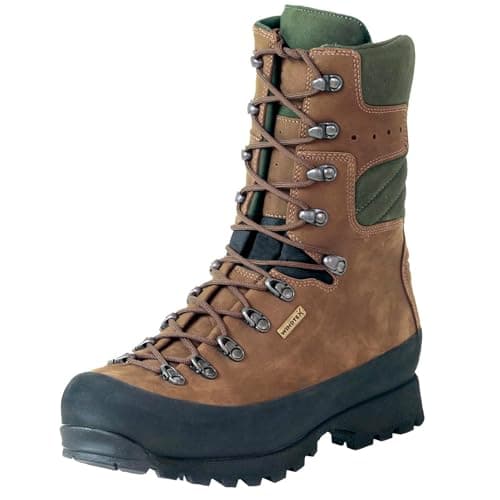
A mountain hunting boot has three jobs a whitetail boot does not: carry a loaded pack across a sidehill without rolling your ankle, edge on loose rock and scree, and stay structurally sound after a week of being soaked and dried repeatedly. That is why they cost two to three times what a good stand boot costs, and why substituting one for the other ends elk hunts.
If you hunt from a stand or a blind, you do not need any boot on this page — our roundup of the best hunting boots of 2026 is the right one. This guide is for people walking up steep country with weight on their back.
Why a mountain boot is a different tool
| Shank stiffness | A stiff shank lets the boot edge on a small foothold and stops the sole flexing under a loaded pack. A soft-shanked boot on a steep sidehill transmits every rock into your arch, and by day three your feet are done |
|---|---|
| Ankle height and structure | Nine to ten inches of structured upper. Not just tall - stiff enough to actually resist a roll when your foot lands wrong on a rock under 50 pounds of pack |
| Full-grain leather uppers | Survives abrasion from rock and brush and can be re-waterproofed indefinitely. Synthetic uppers are lighter and dry faster but wear through in mountain terrain |
| Outsole and lugs | Deep, widely spaced lugs that shed mud and bite on loose ground. A worn outsole on scree is genuinely dangerous |
| Resolability | The best mountain boots can be resoled, which turns a $550 purchase into a decade of use rather than three seasons |
| Weight | All of the above makes mountain boots heavy - typically well over two pounds a pair more than a light hiker. That is the trade you are making |
What actually matters
Ranked honestly by how much each affects your hunt:
- Fit, by an enormous margin. A perfectly specified boot in the wrong shape ends your hunt on day two. Foot volume and width matter more than brand. Buy from somewhere with a real returns policy and walk stairs in them before you commit.
- Shank stiffness matched to your terrain. Genuinely steep, rocky country wants a stiff boot. Rolling timber does not, and a too-stiff boot is punishing on flat ground.
- Insulation weight matched to your season. More on this below. Getting it wrong in the too-warm direction causes sweat, and sweat causes blisters and cold feet.
- Waterproofing you can maintain. Leather boots need re-treating. Factor that in.
- Weight, last. It matters, but not enough to override the first four. A lighter boot that lets your ankle roll is not lighter in any sense that counts.
Choosing insulation weight
| Insulation | Best for | Typical use |
|---|---|---|
| None | Early season, warm weather, high-output hiking | August-September archery elk, scouting, any hunt where you are moving most of the day |
| 200g | The all-round default for western hunts | September through October, mixed hiking and glassing |
| 400g | Cold-weather mountain hunting with sitting time | Late-season rifle hunts, high country in November, long glassing sessions |
| 1000g | Extreme cold and long stationary periods | Late-season high country, deep winter. Too warm for anything involving sustained climbing |
Best overall: Kenetrek Mountain Extreme 400
The Mountain Extreme is the boot that western hunters keep coming back to, and the 400g version is the most broadly useful of the family. Full-grain leather uppers, a genuinely stiff shank, a tall structured cuff and a resolable construction, at roughly $540 (verify current pricing).
What you are paying for is a boot that holds its shape under load for years rather than seasons. Cheaper boots pack out — the structure softens, the ankle support fades and the sidehill performance goes with it. A Kenetrek that has been resoled twice is still doing the job it did new.
Honest cons: heavy, genuinely expensive, and the break-in is real work — this is not a boot you wear out of the box. The fit runs narrow through the heel, which suits some feet and rules the boot out entirely for others.
Best uninsulated: Kenetrek Mountain Extreme Non-Insulated
Same boot, same construction, no insulation, at roughly $525 (verify current pricing). For early-season archery elk, September mule deer, sheep and goat hunts, and anything where you will be climbing hard in daylight temperatures, this is the correct version.
The logic is simple: you can add a warmer sock, but you cannot remove insulation. An uninsulated boot with a heavy merino sock covers a far wider temperature range than a 400g boot with a thin one, and it dries faster overnight.
Honest cons: not enough for a stationary late-season glassing session in the cold, and no cheaper than the insulated version despite having less in it.
Coldest: Kenetrek Mountain Extreme 1000
The 1000g version at roughly $565 (verify current pricing) exists for late-season high-country hunts where you are glassing from a fixed position in genuine cold. It is a specialist tool and it is very good at that specific job.
Honest cons: too warm for any hunt involving sustained climbing, which is most mountain hunting. Buy this as a second pair rather than a first, and only if your season genuinely runs into deep cold.
Best all-round western: Schnee's Beartooth v3 200g
The Beartooth is Schnee’s answer to the same problem with a slightly different philosophy: 200ginsulation, mountain-boot structure, and a fit that many hunters find more accommodating than Kenetrek’s. Around $499 (verify current pricing).
Two hundred grams is arguably the smartest single choice for a western hunter who owns one pair of mountain boots. It handles a warm September climb without cooking your feet and still has enough in it for an October morning on a glassing knob.
Honest cons: still a $500 boot, still heavy, and still needs proper break-in. If you have narrow feet, the roomier last that makes this boot work for many people may leave you with heel movement.
Best on a budget: Rocky RKS0529 Mountaineering
Not everyone hunts the mountains often enough to justify $500 boots. The Rocky RKS0529 is a mountaineering-pattern boot at roughly $230 (verify current pricing) that gets you a meaningfully stiffer shank and higher structured ankle than any general-purpose hunting boot in its price bracket.
For an annual week-long trip, or for a first western hunt where you do not yet know whether this becomes a habit, this is the rational purchase. Spend the difference on a pack that carries properly— a bad pack does more damage on a mountain than a merely adequate boot.
Honest cons: it will pack out faster than the premium boots, it is not built to be resoled indefinitely, and the uppers will not take the same abrasion. Treat it as a three-to-four-season boot rather than a decade-long one.
Break-in: the step that decides everything
Every boot on this page needs breaking in, and skipping it is how people end up hunting in flip flops on day three. A workable schedule:
- Start eight weeks out.Wear them around the house with your hunting socks for a few hours at a time. Return them if the fit is wrong — this is why you start early.
- Move to short walks on flat ground. Two to three miles. Watch for hot spots at the heel and the outside of the little toe.
- Add hills, then add weight. Loaded pack, real elevation. This is where a boot that fits standing still reveals whether it fits climbing.
- Treat the leather. Full-grain leather needs conditioning and waterproofing before the hunt, not after it gets wet.
- Sort your socks now. One good merino sock, correctly sized so it does not bunch. Sock choice belongs to the same system as layering— wet feet get cold feet.
The bottom line
If you hunt western mountains seriously and can afford one pair for life, the Kenetrek Mountain Extreme in 400g is the default answer, with the non-insulated version if your seasons run warm. The Schnee’s Beartooth at 200g is the smartest single-pair compromise and fits a broader range of feet. If this is one trip a year, the Rocky RKS0529 gets you most of the structure for less than half the money.
Whichever you buy, buy it early enough to break in and to return if the fit is wrong. Fit beats every specification on this page.
Frequently asked questions
What makes a mountain hunting boot different from a regular hunting boot?
Three things: a stiff shank that lets the boot edge on small footholds and stops the sole flexing under a loaded pack, a tall structured ankle that resists rolling on uneven ground, and full-grain leather uppers that survive rock abrasion and repeated soaking. A stand boot needs none of that and is usually lighter and cheaper as a result.
How much insulation do I need in a mountain hunting boot?
Match it to your activity level, not the forecast low. Uninsulated for early-season archery and any hunt with sustained climbing, 200g as the all-round western default, 400g when there is real sitting and glassing time in cold weather, and 1000g only for late-season stationary hunts. Over-insulating causes sweat, and wet feet get colder than dry ones.
Are expensive mountain boots worth it?
If you hunt steep country regularly, yes - largely because premium boots hold their structure for years rather than packing out after a couple of seasons, and the best ones can be resoled indefinitely. If you make one western trip a year, a $230 mountaineering-pattern boot gets you most of the shank stiffness and ankle support for less than half the money.
How long does it take to break in mountain hunting boots?
Start at least eight weeks before your hunt. Wear them indoors first with your hunting socks, then flat walks of two to three miles, then hills, then hills with a loaded pack. A boot that fits standing still can still fail climbing, so the loaded-hill stage is the one that actually validates the fit.
Can I use mountain boots for whitetail hunting?
You can, but they are the wrong tool. Mountain boots are heavy, stiff and built for load-carrying on steep ground, none of which helps in a treestand. They are also punishing on flat terrain. For stand and blind hunting, a lighter insulated boot is more comfortable and considerably cheaper.
Should I size up in mountain hunting boots?
Size for the sock you will actually wear, and check heel hold on a slope rather than on flat carpet. Cramming a thick sock into a snug boot compresses the insulation and restricts circulation, which makes your feet colder. Excess room is equally bad - a heel that lifts on a climb produces blisters within miles.
Sources
Keep reading
Gearing up before your next hunt?
See how we evaluate gear, then dig into the reviews and buying guides — written without inventory to sell.