Buying Guide
Best Air Rifles for Hunting: Picks by Quarry (2026)
Hunting is the one job where an air rifle has to clear a real bar: enough energy at the animal for a clean kill, in a caliber your state actually allows. Here is how to size both - then six rifles that cover squirrels through hogs, each with its honest cons attached.
Plinking forgives a marginal air rifle. Hunting does not. The moment you point one at an animal, the gun has to do two things the marketing never talks about: put enough energy into the quarry to kill it cleanly, in a caliber and at a power level your state actually permits. Miss either and the rifle is the wrong tool no matter how good the box looks.
So this guide sizes those two bars first, then names six rifles against them — sorted by what you are hunting rather than by price. Every velocity and energy figure below is either a manufacturer's published spec (labeled as such) or a number an independent reviewer actually put across a chronograph; where those two disagree, we print both, because the gap is usually the whole story. Every pick is current production and buyable through ordinary retail. And every pick gets its honest cons, because a hunting rifle that annoys you is a hunting rifle you leave at home.
Energy at the animal, not FPS at the muzzle
The number on the box is a best case measured with featherweight alloy pellets that nobody should hunt with. Advertise a break-barrel at 1,300 FPS in .22 and it will send real lead hunting pellets somewhere in the 900s. That is not unique to one brand — everyone quotes the same way — but it means the only spec worth comparing is muzzle energy in foot-pounds (FPE) with lead pellets.
Margin buys you forgiveness, not permission. More FPE does not license a bad angle or a 200-yard hero shot — it just means a slightly imperfect hit still kills instead of wounding. Pair the energy bar with an accuracy bar: if you cannot keep every pellet inside a quarter-sized group at your intended range, from field positions, that range is too far regardless of what the rifle makes at the muzzle.
Caliber by quarry
Caliber is a matching exercise, not a bigger-is-better contest. Heavier pellets carry more energy and shed it more slowly; they also cost more, drop more, and need more air to push.
| .177 | A target and plinking caliber. Flattest trajectory and cheapest pellets, but light for clean kills on game past close range - not our recommendation if hunting is the job |
|---|---|
| .22 | The small-game hunting standard. Squirrels, rabbits, and pest birds, and the caliber nearly every hunting pick here is chambered in |
| .25 | The step up for raccoon-class quarry at PCP power levels. Costlier pellets, more drop, and only worth it in a rifle with the air to drive it |
| .30 and up (big bore) | A different category entirely - hogs and predators, 10-shot fills, tank-or-compressor logistics, and state rules that get specific fast |
If the quarry is squirrels and rabbits, a .22 is the answer and the decision is over. Step to .25only when you are regularly shooting raccoon-sized animals and you already own a PCP with the reservoir to feed it. Big bore is not an upgrade to the same hobby — it is a separate one, with its own budget and its own legal homework.
Check your state before you buy
This is the step buyers skip, and it is the one that can make an expensive rifle useless for the season you bought it for. Airgun hunting regulations are written per state, per species, and they are frequently caliber- and energy-specific— not a blanket yes or no. Three real examples, straight from the regulations:
| Virginia | Pneumatic rifles must be .35 caliber or larger to hunt deer; pneumatic rifles are prohibited for bear and elk (4VAC15-270-96) |
|---|---|
| Missouri | Deer require air-powered firearms of .40 caliber or larger - which rules out a .357 big bore entirely (Missouri Dept. of Conservation) |
| Texas | Pre-charged pneumatics must fire a projectile of at least .30 caliber and at least 150 grains at 800+ FPS, or any weight/velocity combination producing at least 215 FPE (TPWD) |
Read those three together and the point lands: the same .357 big bore is explicitly legal for deer in one state, categorically illegal in the next, and in Texas has to clear a grain-weight and energy bar that the factory ammunition does not obviously meet. Small game and pest rules vary just as much, and non-game animals like hogs are often governed separately again — hog legality tells you nothing about deer legality.
The fill-gear question decides your rifle
Before you compare models, answer one question: are you willing to own air? A PCP stores compressed air in an onboard reservoir at roughly 3,000-4,500 PSI, and that air has to come from a hand pump (cheap, and genuine work), a pre-filled tank, or a compressor. In exchange you get recoilless accuracy, quiet shots, magazine feeding, and the highest energy on this page.
Say no, and you are shopping break-barrels: self-contained, nothing to refill, cheapest route to real hunting power, and hold-sensitive in a way that punishes sloppy technique. Say yes, and the PCPs open up. That fork — not the FPS number — is what actually sorts the list below, which is why the top pick is the one rifle here that hands you the answer in the box.
The picks at a glance
Six rifles, six hunting jobs. Energy figures below are the honest lead-pellet numbers — measured by independent reviewers where available, manufacturer-published where noted:
| Rifle | Powerplant | Realistic lead energy | Best for | Price bracket |
|---|---|---|---|---|
| Umarex Origin .22 | Unregulated PCP (3,625 PSI) | ~28 FPE measured (14.3gr) | Best overall hunting rifle | Mid |
| Gamo Swarm Magnum 10X GEN3i .22 | Gas-piston break-barrel, 10-shot | ~30 FPE (900s FPS with lead) | No fill gear | Mid |
| Hatsan Mod 95 Vortex QE .22 | Gas-piston break-barrel | ~20 FPE (800 FPS published, lead) | Budget hunting rifle | Entry |
| Air Venturi Avenger .25 | Regulated PCP (4,351 PSI) | ~45 FPE rated at 900 FPS | Raccoon-class quarry | Mid |
| Umarex Notos Carbine .22 | Regulated PCP (1,900 PSI reg) | ~19 FPE measured (14.35gr) | Compact stalking rifle | Entry-mid |
| Benjamin Bulldog .357 | PCP big bore (3,000 PSI) | ~180 FPE measured (200 claimed) | Hogs and predators | Premium |
Best overall hunting air rifle: Umarex Origin .22
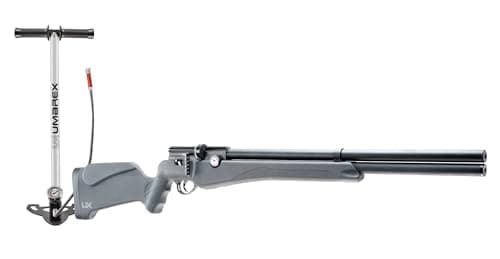
The Origin wins this category by removing the objection that stops most hunters from buying a PCP: it ships with a three-stage high-pressure hand pump and fill probe in the box. No separate compressor decision, no second purchase, no research detour — buy the rifle, fill the rifle, hunt.
What makes that practical is Umarex's Ever Pressure Tank design, which keeps constant pressure on the reservoir air via a gas piston so you get usable shots without topping off to the maximum every time. Hard Air Magazine measured the effect directly: the Origin reached 2,000 PSI after only 50 pump strokes, where a conventional Benjamin Maximus needed 115 strokes to hit its own full 2,000 PSI fill. Umarex publishes a 3,625 PSI max fill and 40 shots per fill; HAM got 60 shots at an average of 28.31 FPE(944 FPS with 14.3-grain Crosman pellets) — comfortably more than twice our 12 FPE small-game bar, with squirrel and rabbit margin to spare. Two 10-shot magazines are included, the barrel is shrouded, and Pyramyd Air rates the report at 85.9 dB.
Honest cons, and they are real ones. The rifle is unregulated, so velocity drifts across the shot string in a way a regulated PCP's does not — HAM concedes outright that "this is not regulated PCP consistency." There is a high-pitched firing twang that HAM found gets markedly louder as fill pressure falls. The advertised pump count is optimistic: HAM needed 140 strokes to reach a full 3,650 PSI, not the 100 claimed. And the Ever Pressure reservoir is not owner-serviceable— Umarex is adamant that only its own trained gunsmiths should ever open it, which is a genuine long-term ownership consideration. It also ships without sling studs.
Who it's for: the hunter who wants real PCP energy and shot count this season without researching compressors first. If you already own fill gear and want regulated consistency instead, read our air rifle buying guide for the platform comparison.
Best with no fill gear: Gamo Swarm Magnum 10X GEN3i
If the answer to the fill-gear question was a hard no, this is the most hunting rifle you can get with nothing but a tin of pellets. The Swarm Magnum pairs Gamo's most powerful 33mm IGT Mach 1 gas piston with a horizontal 10-shot inertia-fed magazinethat indexes the next pellet as you cock the barrel — which fixes the break-barrel's oldest hunting liability, the slow single-shot reload with a squirrel watching you. Gamo advertises 1,300 FPS in .22 with alloy; with lead hunting pellets that translates to the 900s and roughly 30 FPE, genuine squirrel-through-raccoon authority with no air tank in your truck.
Honest cons: cocking takes about 41 poundsof effort, which is a real consideration if you are recoiling from a full day of it. It is long and muzzle-heavy, the magnum piston is hold-sensitive and demands a consistent artillery hold before it groups, and it is hard on optics — the bundled 3-9x40 is a starting point, not a keeper. Follow-up shots still require re-cocking; the magazine removes the fumbling, not the work.
Who it's for: the small-game and pest hunter who wants maximum self-contained knockdown and refuses to buy into fill gear. Full breakdown in our Gamo Swarm Magnum review, and see our air rifle scope guide for glass that survives a magnum springer.
Best budget hunting rifle: Hatsan Mod 95 Vortex QE
The cheapest rifle here that still honestly hunts. The Mod 95 runs Hatsan's Vortex gas piston— smoother and less temperature-sensitive than a steel spring, which matters in a November treestand — behind a QuietEnergy integrated moderator that Hatsan rates as cutting downrange noise by up to half. Hatsan advertises 1,000 FPS in .22 with alloy pellets and publishes an unusually honest 800 FPS with lead, which works out to roughly 20 FPE— past our 12 FPE bar with margin for pests and small game at sensible range. At this price you also get a genuine Turkish walnut stock, Hatsan's fully adjustable two-stage Quattro trigger, and a 3-9x32 Optima scope in the combo.
Honest cons: the bundled scope is serviceable at best and the first thing to outgrow, cocking effort is real for smaller-framed shooters, and like every break-barrel it wants a relaxed, repeatable hold before it will group. It is a rifle that shoots above its price only after you put in the practice.
Who it's for: the pest-control pragmatist, or the hunter who wants to find out whether airgunning sticks before spending real money on it. Check the Hatsan Mod 95 Vortex QE price on Amazon.
Best for raccoon-class quarry: Air Venturi Avenger .25
When the quarry gets bigger than a rabbit, the .25 Avenger is the value answer. It carries hardware that cost triple this a few years ago: an externally adjustable regulator, adjustable hammer spring, a 4,351 PSI (300 bar) fill, and a shrouded barrel. Air Venturi rates the .25 at up to 900 FPS and about 45 FPE— the most pellet energy on this page short of going big bore, and genuine authority for raccoon-class pests where a .22 leaves you hoping. Being regulated is the part that matters for hunting: shot-to-shot velocity holds steady across the string, so your zero means the same thing on shot 20 as on shot one.
Honest cons: fit and finish are budget-tier — the stock feels plasticky and the trigger, while adjustable, is not a match trigger. The big .25 pellets cost more per tin and drop noticeably more than a .22's, so you are trading trajectory for energy. All that adjustability invites tinkering that can eat a weekend before you ever hunt with it. And unlike the Origin, no pump is included — budget for fill gear separately.
Who it's for: the hunter whose quarry outgrew .22, who wants regulated consistency at the minimum spend and does not care that the money went into the machinery rather than the furniture.
Best compact stalking rifle: Umarex Notos Carbine .22
Every other rifle here is a full-size gun. The Notos is 31.5 to 34 inches overall on an 11.75-inch barrel and 4.15 poundsbare — a rifle you can actually still-hunt a hedgerow with, or leave behind the truck seat without resenting it. The surprise is that the compactness costs you less than you would expect. It is regulated at 1,900 PSI, and Hard Air Magazine chronographed 18.99 FPEwith 14.35-grain JSB Exact pellets (772 FPS), rising to 22.60 FPE with 25.39-grain Monsters — well past the 12 FPE small-game bar, from a gun Umarex conservatively markets at 700 FPS. HAM measured an average standard deviation of just 2.35 FPS, called that the kind of consistency "normally expected from a $2,000 air rifle," and gave the rifle 88% and a Gold Award. A 7-shot auto-indexing rotary magazine, side-lever action, and a 3-baffle SilencAir muzzle device round it out; Airgun Depot measured the report in the mid-80s dB.
Honest cons, and the first is the important one for hunting: the 66cc reservoir gives you about 21 fully regulated shots, so a long day afield means carrying a fill source. Outdoor Life is blunt about the range ceiling — "at sub-20 fpe, the power output is at the lower end of the spectrum. It is fine for small game inside of 45 yards but is underpowered for long-range shooting" — though the same reviewer cleanly took jackrabbits at 45 yards and doves with it. The magazines draw near-universal complaints (Field & Stream had one break early), the pressure gauge sits at the front of the tube where reading it means pointing the barrel the wrong way, the cocking lever is heavy, and the trigger is gritty. It is .22 only.
Who it's for: the walk-and-stalk squirrel hunter, and anyone whose real constraint is carrying the rifle rather than the last five foot-pounds.
Best big bore for hogs and predators: Benjamin Bulldog .357
This is the category jump. The Bulldog is a bullpup .357— 36 inches overall on a 28-inch shrouded barrel, 7.7 pounds bare — that fires 145-grain Benjamin eXTREME bullets at an advertised ~800 FPS for a claimed 200 FPE. Outdoor Life's reviewer used it on hogs, rams, coyote, fox, and bobcat, judged it "at its best as a predator gun," and called it appropriately powered for clean 100-yard kills on coyote, with roughly 1.5-inch groups given the right ammunition.
Now the honest part, because two independent sources agree and it matters. The gun does not make its advertised number: Airgun Depot — a retailer that sells it — reports that "Crosman claimed the .357 Bulldog could achieve 200 foot-pounds of power; the best our full-production Bulldog could reach at the time of testing was right around 180 foot-pounds," and that the Nosler bullets "didn't reach the 800 fps that is advertised." Hard Air Magazine independently measured 182.1 FPE. Call it ~180 FPE real against 200 claimed, about 10% under.
More honest cons: it is loud— roughly 93 dB by Airgun Depot's measurement, and the SoundTrap shroud does not change that. You get about 10 useful shotsfrom the 340cc reservoir's 3,000 PSI fill before velocity falls off sharply, and hand-pumping that is punishing enough that a tank or compressor is realistically mandatory — add it to the budget. The sidelever sits behind your cheek weld, so cycling means reaching back past your own face. The stock feels plasticky for the money, and the 7.7-pound bare weight is not what you carry: HAM's scoped Bulldog weighed 10 pounds 14 ounces. Outdoor Life is candid that "the Bulldog is not an exceptionally powerful big bore, in part because of the caliber selection."
Who it's for: the hog or predator hunter who wants a quiet-by-firearm-standards, short, hard-hitting bullpup and has already confirmed it is legal for their quarry.
The bottom line
Answer the fill-gear question, match the caliber to your quarry, then confirm your state allows it — the model almost picks itself after that. For most hunters the Umarex Origin .22 is the best overall buy because it makes a genuine ~28 FPE hunting PCP a single purchase instead of a project. If you will never own air, the Gamo Swarm Magnum is the self-contained hammer and the Hatsan Mod 95 is the budget version of the same idea. Step to the Avenger .25 when the quarry outgrows .22, take the Notos Carbine when carrying the rifle matters more than the last five foot-pounds, and go Bulldog .357 only for hogs and predators, with your regulations read first.
Whatever you pick, do the last 10% that actually kills cleanly: buy quality lead pelletsin three or four weights and let the barrel tell you which it likes, then practice from field positions until your group at your intended range is honest. Pellet choice and shot placement move more animals than any spec on this page. And treat it like the gun it is — a hunting-power .22 pellet stays dangerous well past 100 yards.
Frequently asked questions
How much energy do you need to hunt with an air rifle?
A common field standard for cleanly taking squirrel- and rabbit-sized game is roughly 12 FPE at the animal, with head shots inside about 25-35 yards. Because pellets shed energy quickly, muzzle energy needs margin over that figure at your actual shooting distance. Compare rifles on muzzle energy with lead pellets rather than advertised FPS, which is measured with ultralight alloy pellets nobody should hunt with.
Is .22 or .25 better for hunting?
For squirrels, rabbits, and pest birds, .22 is the standard and the decision is over - pellets are cheaper, trajectory is flatter, and energy is ample. Step up to .25 when you regularly shoot raccoon-class animals and already own a PCP with the reservoir to drive it, accepting costlier pellets and more drop. A .177 shoots flattest and is the better pure target caliber, but it is light for clean kills on game past close range.
Can you hunt deer with an air rifle?
In some states, with a big bore, subject to specific caliber and energy minimums - and the rules differ enough that a rifle legal in one state is illegal in the next. Virginia permits pneumatic rifles of .35 caliber or larger for deer. Missouri requires .40 caliber or larger. Texas requires at least a 150-grain projectile at 800+ FPS, or any combination producing at least 215 FPE. Always read your own state wildlife agency's current regulations for your species; counts of 'how many states allow it' circulate online but trace back to undated retailer articles.
Do you need a PCP to hunt with an air rifle?
No. Gas-piston break-barrels like the Gamo Swarm Magnum and Hatsan Mod 95 deliver roughly 20-30 FPE with lead pellets, which clears the small-game bar with nothing to refill. PCPs buy you recoilless accuracy, magazine feeding, quieter shots, and the highest energy available, at the cost of owning a hand pump, tank, or compressor. The Umarex Origin splits the difference by including a hand pump in the box.
Are hunting air rifles quiet?
Quieter than a firearm, but not silent. Shrouded and moderated barrels are standard on the PCPs here - Pyramyd Air rates the Umarex Origin at 85.9 dB, and Airgun Depot measured the Umarex Notos in the mid-80s dB. Big bores are the exception: Airgun Depot measured roughly 93 dB from the .357 Bulldog, and its shroud does not make it a quiet gun. Break-barrels sit in between, with integrated moderators like Hatsan's QuietEnergy helping meaningfully.
Sources
- Umarex USA — Origin .22 PCP with hand pump specifications
- Hard Air Magazine — Umarex Origin PCP review: summary and conclusions
- Hard Air Magazine — Umarex Origin: the best first PCP air rifle
- Pyramyd Air — Umarex Origin PCP with hand pump specifications
- Gamo USA — Swarm Magnum 10X GEN3i .22 product page
- HatsanUSA — Mod 95 Combo Vortex QE specifications
- Outdoor Life — Air Venturi Avenger review
- Airgun Depot — Air Venturi Avenger specifications
- Umarex USA — Notos carbine specifications
- Hard Air Magazine — Umarex Notos CRK .22 test review
- Outdoor Life — Umarex Notos review
- Airgun Depot — Umarex Notos review and testing
- Outdoor Life — Benjamin Bulldog review
- Airgun Depot — Benjamin Bulldog testing
- Hard Air Magazine — Benjamin Bulldog big bore launch specifications
- Virginia Administrative Code 4VAC15-270-96 — pneumatic rifle deer regulations
- Missouri Department of Conservation — deer hunting regulations
- Texas Parks & Wildlife — air gun and arrow gun regulations
Keep reading
Gearing up before your next hunt?
See how we evaluate gear, then dig into the reviews and buying guides — written without inventory to sell.