Buying Guide
Best Air Rifle Pellets (2026)
The cheapest part of your setup is the one that decides whether it groups. Pellet shape, weight and head size matter more than the rifle - so here is how to read all three, then six pellets that earn their tin, from the accuracy benchmark to the best hunting pick.
People spend $400 on an air rifle and $6 on the pellets, then blame the rifle when it will not group. It is backwards. The pellet is the only part of the whole system that actually touches the target, and swapping tins can turn a shotgun-pattern rifle into a one-hole gun without changing anything else. The catch is that there is no single "best" pellet: every barrel has a shape, a weight and a head size it prefers, and the only way to find it is to shoot a few good candidates and let the groups decide.
So this guide does the criteria first — what each pellet shape is actually for, how weight interacts with your powerplant, and why head size is the spec nobody tells beginners about — and then names six pellets that are worth feeding a rifle, each with its honest cons and the job it is built for. Weights and head sizes below come from manufacturer data; pellet prices are low and move around, so we show the live price rather than printing a number that goes stale. If you own a springer or PCP from our best-air-rifles guide, start here before you blame your hold.
Pellet shape: the five profiles and what each is for
Nearly every airgun pellet is a diabolo— a wasp-waisted shape with a solid head and a hollow, flared skirt that the air pressure grips to stabilize the pellet in flight. Within that family, the nose shape decides the job. Get the shape right for what you are doing and everything else gets easier.
| Domed (round nose) | The all-rounder. Best aerodynamics, holds accuracy at all practical ranges, preferred by field-target shooters and most hunters. Start here |
|---|---|
| Wadcutter (flat nose) | Flat face punches clean, scoreable holes in paper. Excellent to ~25 yards, then sheds velocity fast. The 10-meter target and close plinking pellet |
| Pointed | Cast to a sharp tip for penetration. Looks like the hunting choice but is usually the least accurate profile - the tips deform easily and drift. Skip for most uses |
| Hollowpoint | Dishonest-looking cavity that mushrooms on impact and dumps energy fast. Great terminal effect up close on game; accuracy falls off at distance |
| Polymer-tip | A hollowpoint with a hard plastic tip driven back into the pellet on impact to force expansion. Better ballistic coefficient than a bare hollowpoint - the modern hunting pellet |
The practical takeaway is simple. For paper and cans, a wadcutteris cheap and cuts clean holes. For everything that matters at range — field target, plinking at distance, and honestly most hunting — a domed pellet is the default, because a stray-accurate hunting pellet that misses the vitals is worse than an accurate domed one that hits them. When you specifically want maximum shock on small game at close range, a polymer-tip or quality hollowpoint earns its place. Pointed pellets are the one profile we would generally steer you away from: they promise penetration and mostly deliver flyers.
Pellet weight and your powerplant
Pellet weight is measured in grains, and it is the second big lever. The rule of thumb that actually holds up: lighter pellets go faster but are shoved around more easily; heavier pellets fly slower but carry energy and buck the wind better. What decides which way to lean is your rifle's powerplant.
- Spring-piston and gas-ram break barrelshave a hard, snappy firing cycle that punishes very light pellets — go too light and the pellet leaves the barrel before the piston finishes its stroke, wrecking consistency and sometimes dieseling. A mid-weightpellet (roughly 8–10 grains in .177, 14–16 in .22) generally shoots best in a springer, which is why so many of them love a standard domed like the Crosman Premier or an H&N Field Target Trophy.
- PCPs are far more forgiving and often shine with heavierpellets — a regulated PCP can push an 18–25 grain .22 slug or heavy dome to real energy, which is why the H&N Baracuda Match exists. Heavy-in-a-PCP is the recipe for downrange authority on larger quarry.
- Multi-pump and CO2 guns make modest power, so a light-to-mid domed keeps velocity respectable without demanding pumps you do not have.
Head size and fit: why your barrel has a favorite
This is the spec that separates people who "can't get their gun to shoot" from people whose gun shoots. Premium pellets are sold not just by caliber and weight but by head size, measured to a hundredth of a millimeter — a .177 pellet comes in 4.50mm, 4.51mm and 4.52mm heads; a .22 in 5.50, 5.51, 5.52mm and up. The reason is that airgun barrels vary slightly in bore, and a head that is a hair too small rattles down the rifling while one a hair too large fits tight and consistent. The difference between the right head size and the wrong one, in the same pellet, can be the difference between a one-inch group and a half-inch group at 30 yards.
One more fit detail: keep pellets clean and store them nose-down in the tin. Do not resize, lube heavily, or reuse a pellet that hit something hard — a bent skirt is an instant flyer, and no amount of hold will fix it.
The hyper-velocity alloy trap
It is worth naming the category we are not sending you to buy, because the boxes are loud and the shelves are full of them. Lead-free alloy pelletssold on a headline velocity — the "1,400 FPS!" PBA/Raptor-style rounds — are the classic airgun trap. They are lighter than lead, so they clear the chronograph number the box promises, but that same light weight and hard material makes them less accurate, poorer at holding energy downrange, and rough on some barrels. The advertised FPS is usually measured with exactly these pellets precisely because the number sells rifles.
There are two legitimate reasons to buy lead-free — local law where lead pellets are restricted, and a few genuinely good tin/copper match pellets like H&N's lead-free line — but chasing muzzle velocity is not one of them. For accuracy and clean kills, a quality leaddomed or hunting pellet at sane velocity beats a hyper-velocity alloy every time. If you care about the FPS number, the honest way to raise it is the right mid-weight lead pellet in a rifle that is tuned for it — not the lightest projectile on the rack.
The picks at a glance
Six pellets, six jobs. Every one is a proven, widely available design that a lot of rifles shoot well — but remember the head-size rule above: treat these as the candidates to test in your barrel, not a guarantee. Weights are the common versions; most are sold in both .177 and .22 and in multiple head sizes.
| Pellet | Shape | Typical weight | Best for | Powerplant fit |
|---|---|---|---|---|
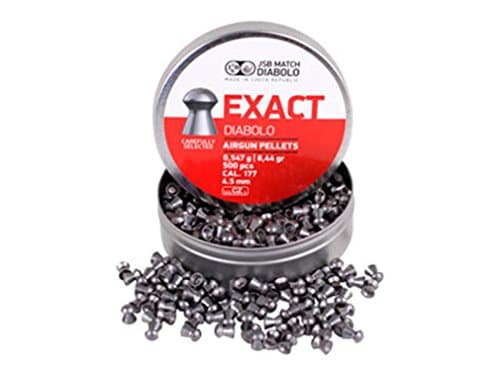
| JSB Match Diabolo Exact | Domed | .177 8.44 gr / .22 15.9 gr | Best overall accuracy | PCP + tuned springer |
| Predator Polymag | Polymer-tip | .22 16 gr | Small-game hunting | PCP, magnum springer |
| Crosman Premier | Domed | .22 ~14.3 gr | Value / everyday | Springer + multi-pump |
| H&N Field Target Trophy | Domed | .22 14.66 gr | Field target / precision | PCP + springer |
| H&N Baracuda Match | Heavy domed | .22 21.14 gr | Heavy pellet for PCPs | PCP |
| RWS Meisterkugeln | Wadcutter | .177 8.2 gr | 10m target / plinking | Springer, pistol, CO2 |
Best overall accuracy: JSB Match Diabolo Exact
If there is a benchmark pellet in this whole category, it is the JSB Exact. Made in the Czech Republic and sold in the U.S. under both the JSB and Air Arms names, the Exact domed line is the pellet that field-target podiums and PCP accuracy threads are built on — a soft, consistent lead alloy, tight weight sorting, and a shape that simply groups. The .177 8.44 grain is the classic all-rounder here; .22 shooters want the Exact Jumbo in roughly 15.9 grains, and heavier-hitting PCPs step up to the Jumbo Heavy or Monster weights in the same family. Across that range, JSB is the pellet most rifles either love outright or lose to only by a hair.
Honest cons: the soft lead that makes them accurate also makes them easy to damage— a dented head or a nicked skirt from rough handling becomes a flyer, so they reward careful storage. They are a notch pricier than a bulk domed like the Crosman Premier, and because JSB sells so many near-identical variants (Exact, Exact RS, Express, Jumbo, Jumbo Heavy, Monster), it is genuinely easy to buy the wrong weight for your rifle. Match the weight to your powerplant using the section above.
Who it's for:anyone chasing the smallest possible group — PCP shooters, field-target competitors, and springer owners who have tuned to a mid-weight dome. If you buy one tin to find out what your rifle can really do, buy this one in the right head size.
Best for small-game hunting: Predator Polymag
When the job is a clean kill on squirrels, rabbits or pest birds rather than a tight paper group, the Predator Polymag is the specialist. Manufactured by JSB, it pairs a JSB-quality lead body with a hard red polymer tip that is driven back into a hollow cavity on impact, forcing the pellet to expand and dump its energy in the animal instead of zipping straight through. In .22 at 16 grains it carries real terminal authority, and unlike a bare hollowpoint the pointed tip gives it a better ballistic coefficient, so it holds its line and energy noticeably better downrange. Airgun hunters who swear by them cite the same thing: fewer pass-throughs, faster, more humane kills.
Honest cons: they cost meaningfully more than plinking pellets, so they are a hunting round you sight in with and reserve for game, not a tin you burn through on cans. Accuracy is very good but usually a hair behind a top domed like the JSB Exact at the longest ranges, and not every barrel loves the polymer tip — a few rifles group the plain domes tighter, which is another vote for testing before you commit. They need enough power to expand, so they suit a PCP or a magnum springer more than a low-powered plinker.
Who it's for: the small-game and pest hunter running a hunting-capable air rifle who wants decisive terminal performance and is willing to pay for it on the shots that count.
Best value / everyday: Crosman Premier
The Crosman Premier is the pellet more airgunners have put downrange than any other, and it earns the spot on a genuinely good price-to-accuracy ratio. Made from a harder antimony-lead alloythan most match pellets, the Premier domed is more resistant to handling damage and shoots surprisingly tight for its bulk-tin price — it is a long-standing favorite in spring-piston rifles, where its mid weight (about 14.3 grains in .22, 7.9 or 10.5 grains in .177) suits the powerplant. For practice, plinking, and pest control on a budget, it is the honest default, and the sealed "cardboard box" Premier lots have a cult following for lot-to-lot consistency.
Honest cons: the harder alloy that makes them durable also means the very best PCP setups can usually out-group them with a softer JSB or H&N match pellet — this is a value champion, not the outright accuracy king. Finish and sizing are a touch less refined than the premium tins, and the plastic-tin version is not always as consistent as the boxed lots. None of that matters much at plinking and pest ranges.
Who it's for:the springer or multi-pump owner who wants a reliable, accurate everyday pellet by the thousand without paying match prices — the tin that lives in your range bag. Pair it with a proper air rifle scope and most rifles will shoot better than their owner.
Best for field target: H&N Field Target Trophy
H&N's Field Target Trophy — "FTT" to the people who shoot it — is the German answer to the JSB Exact, and in a lot of barrels it is the pellet that finally wins. It is a precision domed match pellet built specifically for the accuracy game, sorted tightly by weight and, crucially, offered in a full spread of head sizes (4.50/4.51/4.52mm in .177; 5.53/5.54/5.55mm in .22) so you can dial in the exact fit your bore wants. At 14.66 grains in .22 (and 8.64 in .177) it is a true mid-weight that shoots beautifully in both quality springers and PCPs, and the fit-tuning option is the reason it shows up on so many field-target guns.
Honest cons: the head-size choice that is its superpower is also a small barrier — buy the wrong head size blind and you will not see the pellet at its best, so this is one to buy a couple of sizes of and test. Like all soft match pellets it dents easily, and it sits at premium pricing rather than bulk. It is an accuracy pellet, not a dedicated hunting one; for game, the Polymag above expands where the FTT tends to pencil through.
Who it's for:the accuracy-first shooter — field target, benchrest, serious pest control — who is willing to test head sizes to extract the last fraction of an inch from their barrel.
Best heavy pellet for PCPs: H&N Baracuda Match
When you have a powerful regulated PCP and want to turn its air into downrange authority, you go heavy, and the H&N Baracuda Match is the classic heavy domed pick. At 21.14 grains in .22(and 10.65 in .177) it is a big, round-nosed match pellet — the same DNA as the old Beeman Kodiak, which is literally a Baracuda under a different name — and heavy pellets like it hold energy and resist wind drift far better than a light dome at distance. Fed enough air, a Baracuda hits with a thump a 14-grain pellet cannot match, which is exactly what you want for bigger pests and longer pokes. Like the FTT it comes in multiple head sizes for fitting.
Honest cons: heavy pellets need power. In a springer or a modest PCP a 21-grain .22 leaves the muzzle slow, drops like a rock, and often groups worse than a mid-weight — this is a pellet for rifles that can actually push it, not a universal upgrade. It also arcs steeply, so holdover at unknown distances is less forgiving. Match it to a high-power PCP and it sings; put it in a plinker and you have made things worse.
Who it's for:owners of high-power, regulated PCPs — think a tuned Benjamin Marauderor bigger — who want maximum energy and wind-bucking weight downrange.
Best target and plinking: RWS Meisterkugeln
Sometimes the job is just holes in paper and cans off a fence post, and for that a heavy domed match pellet is overkill. The RWS Meisterkugeln — German for "master bullet" — is a classic wadcutter: a flat-nosed .177 8.2 grain (and .22) target pellet whose flat face cuts clean, easily scored holes and whose modest, consistent weight makes it a natural fit for lower-powered spring, CO2 and pistolshooting at 10 meters. It is inexpensive, widely stocked, and accurate exactly where a wadcutter should be — inside about 25 yards.
Honest cons: that flat nose is draggy, so past ~25 yards the Meisterkugeln sheds velocity and drops fast, and it is not the pellet for hunting or long-range work — use a dome for that. It is a target and plinking specialist, full stop. Some rifles also prefer the slightly heavier "Meisterkugeln Rifle" over the pistol version, so match the label to your gun.
Who it's for: 10-meter target shooters, new airgunners learning fundamentals, and anyone who wants a cheap, accurate tin for backyard plinking and paper punching where clean holes and low cost beat downrange reach.
The bottom line
Buy for the job, then let your barrel vote. For the smallest group your rifle is capable of, start with the JSB Match Diabolo Exactin the right head size; if H&N's fit suits your bore better, the Field Target Trophy is its equal and offers more head sizes to tune with. For small-game hunting, the Predator Polymag is the terminal specialist. For everyday practice and pest control on a budget, the Crosman Premier is the value default; for a high-power PCP that can push it, the heavy H&N Baracuda Match adds downrange authority; and for cheap, clean 10-meter paper and plinking, the wadcutter RWS Meisterkugeln is all you need.
Whatever you choose, remember the two rules that outrank any single pick: match the pellet weight to your powerplant, and test a couple of good candidates in yourbarrel before you buy in bulk — the tin that groups best in your rifle wins, no matter what won in ours. Then put it behind the right glass with our air rifle scope guide, or step up to a better platform entirely in our best air rifles roundup.
Frequently asked questions
What are the most accurate air rifle pellets?
For pure accuracy, domed (round-nose) match pellets win, and the JSB Match Diabolo Exact and H&N Field Target Trophy are the two benchmarks - both are soft, tightly weight-sorted lead pellets used by field-target competitors. But 'most accurate' is barrel-specific: every airgun has a pellet shape, weight and head size it prefers, so the truly most accurate pellet is whichever of a few good candidates groups best in your rifle. Buy a couple of head sizes and test before committing to a case.
What is the difference between domed, wadcutter, pointed and hollowpoint pellets?
Domed (round-nose) pellets have the best aerodynamics and hold accuracy at all ranges - the all-round and hunting default. Wadcutters have a flat face that punches clean, scoreable holes in paper, ideal to about 25 yards for 10-meter target and plinking. Pointed pellets are cast for penetration but are usually the least accurate and prone to flyers. Hollowpoints (and polymer-tipped pellets) expand on impact to dump energy into game, giving strong terminal effect up close at some cost to long-range accuracy.
Are heavier or lighter air rifle pellets better?
It depends on your powerplant. Lighter pellets fly faster but get pushed around more; heavier pellets fly slower but carry energy and buck wind better. Spring-piston and gas-ram break barrels generally shoot mid-weight pellets best (roughly 8-10 grains in .177, 14-16 in .22) and dislike very light ones. PCPs are more forgiving and often excel with heavier pellets, like the 21-grain H&N Baracuda Match in .22, which is why heavy domes exist. Match the weight to the rifle, not to a velocity number.
What does pellet head size mean and does it matter?
Head size is the diameter of the pellet's head, measured to a hundredth of a millimeter - a .177 pellet comes in 4.50, 4.51 and 4.52mm heads; a .22 in 5.50mm and up. It matters because barrel bores vary slightly, and a head that fits your barrel snugly shoots far more consistently than one that is loose or tight. The same pellet in the right head size versus the wrong one can be the difference between a one-inch and a half-inch group. Premium pellets (JSB, H&N) are sold by head size for exactly this reason - buy a couple and test.
Should I buy high-velocity lead-free 'alloy' pellets?
Usually no. Lead-free alloy pellets sold on a headline velocity (the '1,400 FPS' PBA/Raptor type) are lighter than lead, so they clear the box's velocity number, but that light, hard construction makes them less accurate, worse at holding energy downrange, and rougher on some barrels - the advertised FPS is typically measured with these exact pellets to sell rifles. The legitimate reasons to go lead-free are local lead restrictions or a genuinely good tin/copper match pellet; chasing muzzle velocity is not one of them. A quality lead domed or hunting pellet at sane speed outperforms them for accuracy and clean kills.
Sources
- Pyramyd AIR — Types of Airgun Ammo (shapes and styles)
- Airgun Depot — How Pellet Choice Affects Performance and Accuracy
- Airgun Depot — Top Precision Pellets
- Abbey Supply — What Are The Best Air Rifle Pellets?
- The Gun Zone — Most Accurate .22 Caliber Pellets (2026)
- Crosman — Premier / Domed pellets product data
Keep reading
Gearing up before your next hunt?
See how we evaluate gear, then dig into the reviews and buying guides — written without inventory to sell.