Buying Guide
The Best Sleeping Pads, and Why R-Value Beats Thickness
The ground will take heat out of you all night regardless of how good your sleeping bag is. A pad is not a comfort item - it is the insulation between you and that problem.
Your sleeping bag insulates you from the air. Nothing in it insulates you from the ground, because the down or synthetic fill underneath your body is compressed flat and has almost no loft left. A sleeping pad is what does that job.
That is why a $45 pad often improves a cold night more than a $200 bag upgrade would. Ground conducts heat away from you far faster than air convects it, and it does so continuously for eight hours.
Why a pad matters more than a warmer bag
Two mechanisms are at work overnight, and they are not equally important.
- Convectionmoves heat into the air around you. Your sleeping bag’s loft traps that air and stops it, which is what the bag’s temperature rating measures.
- Conduction moves heat directly into whatever you are touching. Ground is enormously better at absorbing heat than air is, and it never warms up. Compressed bag fill underneath you does essentially nothing against it.
The practical test is one most campers have already run without realizing: a night in a good bag on bare ground versus a night in a mediocre bag on a decent pad. The second is warmer.
R-value: the only spec that matters
R-value measures resistance to heat flow. Higher numbers insulate better, the scale is roughly linear, and R-values are additive — stacking two pads gives you approximately the sum of their values, which is a genuinely useful trick for cold trips.
| R-value under 2 | Summer only, warm nights. Comfort more than insulation |
|---|---|
| R-value 2 to 4 | Three-season use in mild climates. The most common backpacking range |
| R-value 4 to 6 | Genuine shoulder-season insulation. Frosty mornings, cold ground, autumn hunting camps |
| R-value 6 and above | Winter and hard cold. Also the range where car camping pads live because weight is not a constraint |
| Stacking pads | R-values add. A closed-cell foam pad at R2 under an inflatable at R4 gives you roughly R6 and a puncture backup |
Note that thickness and R-value are not the same thing. A 4-inch uninsulated air pad can have a lowerR-value than a 1-inch insulated one, because a big empty air chamber convects heat internally. Insulation inside the pad — synthetic fill or reflective film — is what produces the number.
The three types of pad
| Type | How it works | Pros | Cons |
|---|---|---|---|
| Inflatable (air) | Inflated by pump, breath or built-in bellows; insulated internally with fill or reflective layers | Most comfort per ounce, packs smallest, highest available R-values | Punctures end the night; noisier; needs inflating |
| Self-inflating | Open-cell foam inside a sealed shell that draws air in when the valve opens | Very reliable, comfortable, moderate R-value, partially works even if punctured | Heavier and bulkier than inflatable for the same warmth |
| Closed-cell foam | A solid foam mat, no air involved | Cannot puncture, instant setup, cheap, works as a stacking layer | Least comfortable, bulkiest to carry, modest R-value |
For car camping, comfort and R-value matter and weight does not, so buy thick and warm. For backpacking, every ounce counts and you are trading comfort against pack weight. For cold-weather hunting camps, stack a foam pad under an inflatable and get both warmth and a backup.
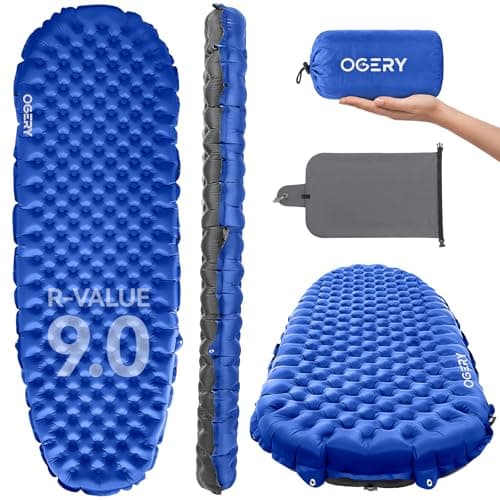
Warmest: OGERY R-Value 9.0
Around $60 (verify current pricing) for an insulated pad rated at R-value 9.0— the highest here by a clear margin, and comfortably into winter territory.
At this R-value the ground stops being a factor. That matters most for cold-weather car camping, late-season hunting camps, and anyone who consistently sleeps cold regardless of what bag they use.
Honest cons: high-R pads are bulkier and heavier than three-season pads, and R9 is more insulation than a summer camper will ever need. As with any air pad, a puncture is the failure mode — carry the repair kit.
Best all-season value: TREKOLOGY 4-inch
Around $46 (verify current pricing) for a 4-inch-thick pad rated at R-value 7.2. That combination — genuine all-season insulation plus enough thickness for a side sleeper — is the sweet spot for most campers.
Four inches is the depth at which hips and shoulders stop finding the ground. If you sleep on your side, this matters as much as the insulation number does.
Honest cons: bulkier packed than a dedicated backpacking pad, and thick air pads take longer to inflate and deflate. Fine in a car, less so in a pack.
Best backpacking: Gear Doctors ApolloAir 5.2
Around $85 (verify current pricing) for an insulated inflatable at R-value 5.2 weighing a stated 17 ounces. That is a genuinely good warmth-to-weight ratio, and it is what backpacking pads are judged on.
R5.2 at a pound is enough for three-season use anywhere and for cold nights with a warm bag. It pairs naturally with the tents in our backpacking tent guide, where the same weight logic applies.
Honest cons: the most expensive pad here, and inflatable pads are the ones that fail from punctures. On a trip where you cannot bail out, carry the patch kit and consider a thin foam pad underneath as insurance.
Best self-inflating: Gear Doctors Oxylus 4.3
Around $50 (verify current pricing) for a self-inflating foam pad at R-value 4.3. Open the valve, wait, top it off with a couple of breaths, and it is done.
The real advantage of self-inflating construction is failure behavior. A punctured air pad becomes a groundsheet; a punctured self-inflating pad still has foam in it and still insulates, just less comfortably. For a family camping trip where a ruined night is a real cost, that resilience is worth having.
Honest cons: heavier and bulkier than an inflatable of similar R-value, and it needs to be stored unrolled with the valve open to keep the foam healthy.
Best budget: FUN PAC ultralight
Around $25(verify current pricing) for an ultralight pad with an attached pillow and a built-in foot pump. The foot pump is the notable feature — inflating by mouth puts moisture inside a pad, which degrades insulation over time and encourages mildew.
At this price it is the obvious answer for an occasional camper, a spare for guests, or a second pad to stack under a better one on a cold trip.
Honest cons: no stated R-value, which means it should be treated as a summer pad rather than a three-season one. Construction at $25 will not last like the pads above.
Best add-on layer: insulated thermal mat
Around $22(verify current pricing) for a 78.7″ x 59″ insulated thermal blanket that goes under your pads on the tent floor.
This is the cheapest cold-weather upgrade available. R-values add, so a thermal layer under your existing pad raises the whole system without replacing anything — and it covers the whole tent floor rather than just your pad footprint, which means your gear stays warmer too.
Practical notes that affect your sleep
- Do not inflate by mouth if you can avoid it. Breath carries moisture into the pad where it degrades insulation and grows mildew. Use a pump sack, a built-in foot pump or an electric pump.
- Under-inflate slightly. A rock-hard pad transmits pressure to hips and shoulders. Let a little out until you just float clear of the ground.
- Carry the repair kit. It is small and it saves a trip. Locate a leak by over-inflating and listening, or by wiping soapy water over the surface.
- Store inflatables loosely and self-inflating pads unrolled with the valve open. Long-term compression is what kills foam.
- Match the pad to the bag. A cold-rated bag on a summer pad still sleeps cold, and the reverse is a waste. Our sleeping bag guide covers the rating side.
- Check the length. A pad your feet hang off leaks heat exactly where circulation is worst. Regular length fits most people; tall campers should check dimensions rather than assume.
The bottom line
Buy on R-value and match it to your coldest realistic night. The TREKOLOGY 4-inch at R7.2 is the best all-round value and thick enough for side sleepers. For genuine cold, the OGERY at R9.0. For backpacking, the ApolloAir at R5.2 and 17 ounces. If reliability matters more than weight, the self-inflating Oxylus.
And if you already own a pad and sleep cold, the $22 thermal mat underneath it is the cheapest fix in camping.
Check the TREKOLOGY sleeping pad price on Amazon, or see the full kit in our camping equipment list.
Frequently asked questions
What is R-value on a sleeping pad?
R-value measures resistance to heat flowing from your body into the ground. Higher numbers insulate better, and the values are additive - stacking a foam pad under an inflatable gives you roughly the sum of the two. Under 2 is summer only, 2 to 4 is mild three-season, 4 to 6 covers genuine shoulder-season cold, and 6 or above is winter territory.
Do I really need a sleeping pad?
Yes, and it matters more than a warmer sleeping bag. The fill in your bag underneath your body is compressed flat and provides almost no insulation, while the ground conducts heat away from you continuously all night. A $45 pad will improve a cold night more than a $200 bag upgrade.
Is a thicker sleeping pad warmer?
Not necessarily. Thickness affects comfort; R-value affects warmth. A 4-inch uninsulated air pad can be colder than a 1-inch insulated one, because a large empty air chamber lets heat convect inside it. What produces the R-value is insulation inside the pad - synthetic fill or reflective layers - not the depth.
Should I inflate my sleeping pad by mouth?
Avoid it where you can. Your breath carries moisture into the pad, where it degrades the insulation over time and encourages mildew that you cannot clean out. Use a pump sack, a built-in foot pump or a small electric pump - several pads now include one.
Can you stack two sleeping pads?
Yes, and it is one of the most useful tricks in cold-weather camping. R-values are approximately additive, so a closed-cell foam pad at R2 under an inflatable at R4 gives you around R6. It also gives you a puncture backup, which matters on trips where you cannot bail out.
What sleeping pad is best for side sleepers?
A thicker one - around 4 inches - so your hips and shoulders do not bottom out against the ground. Under-inflate it slightly rather than pumping it rock hard, because a firm pad transmits pressure straight into your pressure points. Prioritize thickness once you have the R-value you need for the season.
Sources
Keep reading
Gearing up before your next hunt?
See how we evaluate gear, then dig into the reviews and buying guides — written without inventory to sell.