Buying Guide
Best Crossbow Targets Under $100
Under a hundred dollars buys you the volume half of a crossbow practice setup - a target you can shoot hundreds of field points into. What it mostly does not buy is broadhead verification, and the honest reason why is worth knowing before you order rather than after.
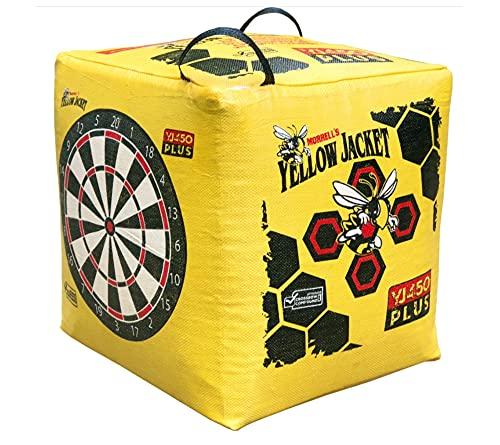
The verdict: the best crossbow target under $100 is the Morrell Yellow Jacket YJ-450 Plus — Morrell rates it to stop 450 fps and beyond, which is the only sensible speed margin in this band for a modern 400-fps crossbow, and it is built as a fully shootable 19″ cube that pulls easier than anything else here. That last point is not a comfort note: a target that fights you every shot is a target you shoot less. The budget pick is the Black Hole 4-Sided, the cheapest target on this page and, uniquely in this band, one that takes broadheads on two of its four faces. If your crossbow is at the fast end or you sight in at distance, the Delta McKenzie Crossbow MAX Speedbag is the pick: a 525 fps rating and a 24″ aiming face.
Here is the framing that makes this band worth its own page rather than a cheaper slice of our full crossbow target guide: under $100 you are buying the volume half of a two-target setup, not a complete one. This is the target you shoot hundreds of field points into while you sight in and learn your hold. Broadhead-rated foam — the other half — starts above this band, and the arithmetic on that is in its own section below. Knowing that going in is the difference between a satisfied purchase and a target you blame for something it was never sold to do.
The best crossbow targets under $100 at a glance
| Target | Price & buy | Speed rating | Size | Broadheads? | Best for |
|---|---|---|---|---|---|
| Morrell Yellow Jacket YJ-450 Plus | $79.99Buy | 450 fps and beyond | 19" x 19" x 19" cube | No - field points only | Best overall |
| Black Hole 4-Sided Crossbow | $54.95Buy | 375 fps and above | 16" x 16" x 14" | Front and back only; wrapped sides are field points only | Budget pick |
| Delta McKenzie Crossbow MAX Speedbag | $87.29Buy | 525 fps | 24" x 24" x 10", 50 lb | No - field points only | Fast bows; distance work |
Prices shown are from Amazon as of November 8, 2026 and change often — the button always goes to the current listing. Some links may earn us a commission at no extra cost to you.
Three targets is the honest list at this price, and it is a genuine subset rather than a filtered one: we only put a target in a price band when it has a live, buyable price under the number in the title. Several targets that belong in the full guide sit above $100, and one sub-$100 discharge target we would otherwise have included had no buyable offer when we built this page, so it is not here.
What $100 buys - and what it does not
The good news is real. Under $100 you can buy a target that will stop a modern crossbow bolt reliably, from a company that publishes a speed rating it is willing to stand behind, in a size you can hit at 40 yards. Fifteen years of crossbow speed inflation has not priced that out of reach.
Here is the honest list of what the band does not buy:
- Broadhead capacity, with one partial exception. Two of the three targets here are explicitly field point only. The Black Hole takes broadheads on its front and back faces only — its polypropylene-wrapped sides do not — so even the exception is a partial one. Solid self-healing foam, the material that genuinely tolerates broadheads, sits above this band.
- Speed margin for the fastest crossbows, at the cheap end.The Black Hole’s rating is 375 fps and above, which is the lowest figure in our whole target guide. If you shoot a 480-fps flagship, the budget pick is not your target.
- Weatherproofing you can ignore. Every option in this band wants to come inside or be covered. A soaked bag target is a dead bag target, and that is the most common way a sub-$100 target dies before its time.
- A lifetime. These are two-to-four-season targets shot regularly, not buy-once purchases. The replaceable-core blocks that are genuinely buy-once are a different price class.
What the band does buy that matters enormously: a target you will shoot a lot. The most common crossbow accuracy problem we see is a hunter who sights in once in August and does not shoot again until the season. A cheap target in the backyard fixes that better than an expensive one in a catalogue.
The speed-rating margin to insist on
A published fps rating is a stopping guarantee on a new target, not a durability promise, and it is the spec that matters most in this band because the cheap end of the market is where ratings stop keeping up with crossbows. Two reasons to buy margin rather than a matching number:
- Your bow is probably faster than the box says it is for your bolt. Advertised crossbow speeds come from the maker’s own test bolt, usually at the light end of what the bow will shoot. A lighter bolt than the one quoted beats the published figure. Our roundup of the fastest crossbows lists published speeds across current flagships if you are not sure where yours sits.
- Targets slow down as they age.Layers pack, fill channels, foam loses its bite. A target rated exactly at your bow’s speed is at its rating on day one and under it by mid-summer.
| A 350-375 fps crossbow | The Black Hole's 375 fps floor is thin margin; the YJ-450's 450 fps rating is the comfortable choice |
|---|---|
| A 400 fps crossbow (most current models) | Want a 450 fps rating or better - the Morrell YJ-450 Plus or the Delta McKenzie Speedbag |
| A 480-515 fps flagship | Only the Delta McKenzie Crossbow MAX's 525 fps rating gives margin in this band. Do not gamble a fast bow on a 375 fps target |
| How to read 'and above' | Feradyne's wording on the Black Hole is '375 fps and above', which reads as a floor rather than a ceiling - but it is not a published maximum, so do not treat it as permission for a 500 fps bow |
Why broadhead practice costs more than $100
This is the section we would want to read before buying, so here it is plainly. The constraint that shapes this whole category is that the targets with the highest speed ratings are almost all field point only, and the material that takes broadheads is expensive. Both targets in this band with a 450-fps-or-better rating are field point only. The one with broadhead faces has the lowest speed rating here, and only two of its four faces take them.
So the honest budget for a crossbow hunter who intends to verify that their broadheads group with their field points is a sub-$100 bag or layered target plus a foam block, and the cheapest genuinely broadhead-rated block in our guide is the Rinehart 18-1 at well above this band. That is not a failure of planning — it is how the ratings work out, and most crossbow hunters end up owning two targets for exactly this reason.
One more warning that catches people in this band specifically, because two of three picks here are bags: bags and outserts do not mix. Morrell explicitly warns against outserts and field points wider than the shaft, which rules its bags out for micro-diameter bolt owners. If you shoot micro-diameter shafts with outserts, the Black Hole is your pick in this band, not the Morrell — check our crossbow bolt guide if you are unsure what you are shooting.
Best overall: Morrell Yellow Jacket YJ-450 Plus
Best for:field-point volume on a 400-fps crossbow — sighting in, testing bolt weights, and practising your hold until it is boring.
This is the target to buy, and the case is speed margin plus removal force. Morrell rates it to stop 450 fps and beyond using 100 layers of stopping material, built around a patented nucleus centre and an Internal Frame System that makes the whole 19″ × 19″ × 19″ cube shootable rather than just the middle. It stands on its own, is weather resistant, has a tote handle, and is approved for crossbows, compounds and traditional bows.
The 450-fps rating is the right number for this band. Most current crossbows are in the 400 fps class, and a 450 rating gives you the margin the ageing argument above says you need. And nothing pulls easier than a bag — which is the specification that decides whether you shoot fifty bolts in an evening or twelve.
The honest cuts: field points only, no broadheads. Morrell explicitly warns against outserts and field points wider than the shaft, which rules it out for micro-diameter bolt owners. It is bulky at 19 inches on a side, and it is the kind of target you bring inside or cover, because a soaked bag is a dead bag.
Budget pick: Black Hole 4-Sided Crossbow
Best for: the cheapest genuinely crossbow-rated target here, a mid-speed bow, and anyone who wants some broadhead capability without leaving the band.
The Black Hole is our budget pick and it is the most interesting product in the band, because it is the only one that is not a bag. The 16″ × 16″ × 14″ block is rated to stop all crossbows shooting 375 fps and above, and it uses an open-face layered design that stops bolts with friction rather than force— which is why a layered target pulls easily despite not being a bag. There are aiming points on all four sides and a carry strap.
The face policy is the detail to get right, and it is the reason this target earns a place: front and back take broadheads and field points; the polypropylene-wrapped sides are field points only. Shoot broadheads into the wrapped sides and you will cut the wrap. Used correctly, that gives you a limited amount of broadhead verification inside this band, which nothing else here offers at all.
The honest cuts: the 375 fps rating is the lowestin our whole target guide, and while Feradyne’s wording is “375 fps and above,” it is not a published maximum — if you own a 480-fps bow, this is not the target to gamble on. Four faces is half the rotation of a six-sided block, and only two of them take broadheads, so the broadhead-capable surface area is small and wears fast. Treat it as a two-to-three season target for a mid-speed bow rather than a lifetime buy.
Best for fast bows: Delta McKenzie Crossbow MAX Speedbag
Best for: a 480-fps-class crossbow, and anyone whose practice is mostly distance work at 50 or 60 yards.
The Crossbow MAX is the high-speed bag and the only target in this band with real margin for a flagship. It is a 24″ × 24″ × 10″ bag weighing 50 pounds, rated to 525 fps, with two shootable sides carrying high-contrast graphics for visibility.
Two specs make it the right pick for its job. The 525 fps rating is the only figure in this band that gives a 480-to-515-fps bow genuine margin rather than a matching number. And a 24-inch faceis a real advantage when you are sighting in at 50 or 60 yards and your groups are not yet where you want them — a miss still lands in the target rather than in the grass behind it, which saves bolts, and bolts are not cheap.
The honest cuts: field points only, two faces rather than four, and the same outsert caveat that applies to every bag. At 50 pounds with a 10-inch depth it is awkward to move and wants a stand or a frame to hang from, so it is less of a carry-it-to-the-yard target than the other two. Unlike the Black Hole there is no broadhead face at all — this is strictly the volume half of a two-target setup.
Making a sub-$100 target last
In this band the target is a consumable, so the habits that extend its life are worth more than they would be on an expensive block. Four that cost nothing:
- Keep it dry.The single biggest factor. Water is what kills a bag target — it packs the fill, rots the cover and ends the target’s life well before the shooting does. Bring it in, or cover it properly. Every option in this band is weatherresistant at best.
- Rotate the faces every session, not every month. The Black Hole has four faces and the Morrell is shootable on its whole cube. Use that. Shooting one spot until it is a hole is how a two-season target becomes a one-season target.
- Move your aiming point, not just your face. Shoot the corners and the edges deliberately. On a target built to be shootable across its whole area, the middle is not more valuable than the rest, and spreading the damage is free durability.
- Match the point to the target. Field points in bags, and broadheads only into faces rated for them. One broadhead into a wrapped side cuts the wrap, and the wrap is the thing holding the target together.
And shoot it properly while it lasts — our crossbow sight-in guide covers the process, and crossbow scopes covers what you are sighting in.
The bottom line
Buy the Morrell Yellow Jacket YJ-450 Plus: a 450-fps rating is the right margin for a modern 400-fps crossbow, a 19-inch shootable cube is plenty of target, and the easiest pull in the band is what keeps you practising. Buy the Black Hole 4-Sided if you want to spend the least, you shoot a mid-speed bow, or you specifically want two faces that will take a broadhead. Buy the Delta McKenzie Crossbow MAX Speedbag if your bow is at the fast end or your practice happens at 50 and 60 yards.
Then plan on the second target. Under $100 buys the half of the setup you shoot hundreds of field points into; broadhead verification lives above the band, and buying the volume target first is the right order to do it in.
Frequently asked questions
What is the best crossbow target under $100?
The Morrell Yellow Jacket YJ-450 Plus. Morrell rates it to stop 450 fps and beyond, which is the right margin for a modern 400-fps crossbow, and it is built as a fully shootable 19-inch cube rather than a target with a usable middle. It also pulls easier than anything else in the band, which matters more than it sounds: a target that fights you every shot is a target you shoot less. The Black Hole 4-Sided is the budget choice and the only target here that takes broadheads at all, and the Delta McKenzie Crossbow MAX Speedbag's 525 fps rating is the pick for a flagship-speed bow.
Can you shoot broadheads into a crossbow target under $100?
Mostly no, and that is the defining limit of this band. Two of the three targets here are explicitly field point only. The Black Hole 4-Sided is the partial exception: its front and back faces take broadheads and field points, but its polypropylene-wrapped sides are field points only, and shooting broadheads into the wrapped sides will cut the wrap. The material that genuinely tolerates broadheads - solid self-healing foam - starts above $100, and the cheapest broadhead-rated block in our full guide is the Rinehart 18-1. Most crossbow hunters end up owning two targets for exactly this reason.
What speed rating do I need on a crossbow target?
Buy margin, not a matching number. A published fps rating is a stopping guarantee on a new target, and two things erode it: advertised crossbow speeds come from the maker's own test bolt at the light end of what the bow will shoot, so a lighter bolt beats the box figure; and targets slow down as they age because layers pack and fill channels. As a working rule, a 400-fps bow wants a 450 rating or better, and a 480-to-515-fps bow wants 520-plus. In this band that means the Morrell YJ-450 Plus for a typical crossbow and the Delta McKenzie Crossbow MAX for a fast one - the Black Hole's 375 fps is thin margin for anything quick.
Is a bag target or a block target better for a crossbow?
They do different jobs. A bag pulls easiest, which means you shoot more, and the bags in this band carry the highest speed ratings - 450 fps on the Morrell and 525 on the Delta McKenzie. But bags are field point only, and makers of them warn against outserts and field points wider than the shaft, which rules them out for micro-diameter bolts. A layered block like the Black Hole stops bolts by friction rather than force so it still pulls reasonably, takes broadheads on two faces, and handles outserts - at the cost of the lowest speed rating here. For field-point volume on a standard bolt, buy the bag.
Why are only three crossbow targets listed under $100?
Because that is the honest number. We only put a product in a price band when it has a live, buyable price below the figure in the title, and several targets that belong in our full crossbow target guide sit above $100. One sub-$100 discharge target we would otherwise have included had no buyable offer when this page was built, so it is not on it. Prices move, so check the live figure on the buy buttons rather than any number typed into an article.
How long should a crossbow target under $100 last?
Treat it as a two-to-four-season target shot regularly, not a buy-once purchase - the replaceable-core blocks that genuinely last are a different price class. Four free habits extend it: keep it dry, because water packs the fill and rots the cover and kills more cheap targets than shooting does; rotate faces every session rather than every month; move your aiming point around the whole shootable area instead of drilling one spot; and match the point to the face, because one broadhead into a wrapped side cuts the wrap that holds the target together.
Sources
- Morrell Yellow Jacket YJ-450 Plus - published listing and manufacturer specification
- Black Hole 4-Sided Crossbow Target - published listing specification (16x16x14, 375 fps, friction-stop layered design)
- Delta McKenzie Crossbow MAX Speedbag - published listing and manufacturer specification
- Rinehart 18-1 Archery Target - published listing specification (broadhead and field point compatible)
Keep reading
Gearing up before your next hunt?
See how we evaluate gear, then dig into the reviews and buying guides — written without inventory to sell.