Buyer's Guide
Best Ladder Stands: Height, Capacity, and the Spec Nobody Publishes Consistently
A ladder stand is the one stand you buy once and leave up all season, which makes the purchase harder to undo than any other stand type. These four are compared on the published numbers that decide a sit - advertised height, rated capacity, platform and seat - with the capacity disagreements between retailers stated rather than smoothed over.
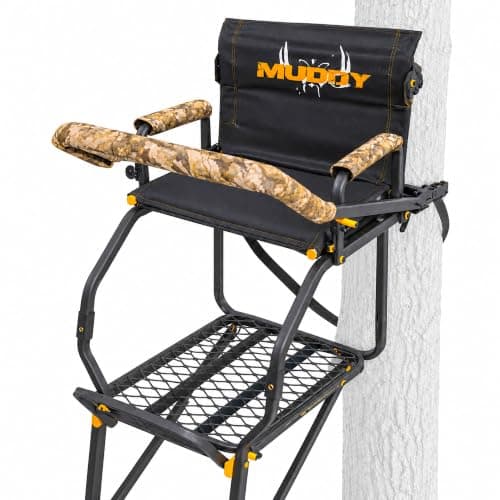
For most hunters the best ladder stand is the Muddy Skybox Deluxe: 20 feet tall, a 19 by 25 inch foot platform under a flip-back seat, a two-way adjustable padded shooting rail, and a flip-back footrest, in four sections that one person can at least move alone. It wins because a ladder stand is a commitment — you hang it in September and you are still sitting in it in December — and the Skybox is the one here that does not force a trade you will resent in week nine.
If you want maximum height and the widest seat on the page, the Rivers Edge Lockdown 21' Wide is 21 feet with a 24-inch seat and a ratcheting strap system you tighten from the ground. If two people are going up, Big Game's Big Buddy gives you a 38-inch bench rated to 500 pounds. And if you are hanging three stands on one farm this fall, the Muddy Huntsman Deluxe is the one whose price lets you do that.
The verdict
A ladder stand solves a problem the rest of the stand world does not. A climber needs a straight, limbless tree. A hang-on needs you to carry sticks and hang it yourself at height. A ladder stand needs a tree, a helper, and an afternoon — and then it is simply there, every morning, with a seat and a rail and a way up that you can do in the dark half-asleep without thinking about it.
That is also the catch. It is heavy (64 to 111 pounds across the stands here), it is loud to install, it is effectively permanent for the season, and it tells every other hunter on the property exactly where you sit. You are buying convenience and comfort with mobility and discretion. If that trade sounds wrong for how you hunt, read our climbing stand roundup or the hang-on versus climber comparison instead — both solve for the hunter who moves.
The spec table
Every figure below is a published number from the maker or the retailer listing, not something we measured. Where listings disagree — and on ladder stands they disagree more than on any other stand type — we say so in the next section rather than picking the flattering figure.
| Stand | Height | Capacity (published) | Platform | Seat | Stand weight |
|---|---|---|---|---|---|
| Muddy Skybox Deluxe | 20 ft | 350 lb (Amazon, Home Depot); 300 lb (Walmart, Tractor Supply) | 19 x 25 in | 22 x 17 in, 21 in seat height | 82 lb |
| Rivers Edge Lockdown 21' Wide (LD205) | 21 ft; 20 ft 6 in to the shooting rail | 350 lb (retailer listing) | 25 x 32.5 in | 24 x 16 in | 111 lb |
| Big Game The Big Buddy | 16 ft | 500 lb, two person | 38 x 12 in | 38 x 17 in bench, 20 in seat height | 64 lb |
| Muddy Huntsman Deluxe | 17 ft | 300 lb | 19 x 25 in | 22 x 17 x 19 in | 61 lb (OpticsPlanet) |
The capacity number, and why we do not trust it
Here is the honest state of this category: the single most safety-relevant spec on a ladder stand is the one published least consistently. The Muddy Skybox Deluxe is listed at 350 pounds by Amazon and Home Depot and at 300 pounds by Walmart and Tractor Supply. Those are not two products. That is one product with two numbers attached to it by four large retailers.
The Rivers Edge Lockdown 21' Wide has the same problem from the other direction. The 350-pound figure in the table comes from a single retailer spec table; Rivers Edge's own operator manual for the closely related LD200 states a maximum field rating of 300 pounds, and an older 21-foot one-man Lockdown is listed by Lancaster Archery at 300 pounds and 94 pounds of stand weight. We could not find a published Rivers Edge spec sheet for the LD205 itself.
We would rather tell you the numbers conflict than quietly print whichever one makes a pick look better. The same honesty applies to stand weight, where OpticsPlanet lists the Huntsman Deluxe at 61 pounds and other listings at 64.
What actually decides a ladder stand
Four things separate these stands in the field, and only one of them is the number on the box.
| Criterion | Why it decides the sit |
|---|---|
| Height to the rail, not advertised height | Advertised height is usually the top of the ladder or the platform. What matters to a bowhunter is where the shooting rail sits, because that is where your arms end up. Rivers Edge publishes both for the Lockdown - 21 ft advertised, 20 ft 6 in to the rail - which is more useful than a single number. |
| Platform depth with the seat flipped up | Almost every ladder stand here converts to a standing platform by flipping the seat back. The usable number is the platform with the seat up: 19 x 25 in on both Muddy stands, 25 x 32.5 in on the Lockdown. A two-man bench stand gives you width instead - 38 x 12 in on the Big Buddy - which is a different shape of standing room and worse for pivoting. |
| Seat geometry, not seat padding | Seat height off the platform decides whether your thighs go numb: 20 to 21 in is the normal range here. Seat depth decides whether you can lean back. A 17-inch-deep seat with a backrest beats a thicker pad on a shallow seat every time, because the problem at hour six is posture, not cushioning. |
| The shooting rail you will probably remove | Every stand here ships with a padded shooting rail, and plenty of bowhunters take it off. It is a rifle and crossbow feature that gets in the way of a drawn bow. Buy the rail if you shoot a gun from the stand; treat it as optional weight if you do not. |
Note what is not on that list: camo pattern, brand, and the word “deluxe.” None of the three changes how a stand sits at first light.
Best overall: Muddy Skybox Deluxe 20 ft
The Skybox Deluxe is the ladder stand we would hang first on a new property. Twenty feet is enough height to get your silhouette and most of your scent above a deer's normal attention without pushing the shot angle to the point where a quartering deer gives you one lung. The flip-back seat opens a 19 by 25 inch foot platform, the footrest flips back out of the way, and the padded shooting rail is adjustable in two directions, which matters more than it sounds when you are trying to find a rest for a crossbow and a rail position that does not block a left-hand shot.
Muddy publishes a 22 by 17 inch Flex-Tek seat with a 21-inch seat height and a 22 by 19 inch backrest, 82 pounds of stand in four sections, and a 9-inch minimum tree diameter. Four sections is the detail that sells it: you can walk this stand into the woods in two trips rather than dragging a single 20-foot spine through brush.
Honest cons:the capacity conflict above is this stand's biggest question mark, and it is not a small one — two of the four largest retailers selling it say 300 pounds. At 82 pounds it is also genuinely heavy to walk in, and the four-section design means four sections to align while someone else holds the tree end. The Flex-Tek seat is comfortable for a category that is not, which is not the same as comfortable.
Most height and seat: Rivers Edge Lockdown 21' Wide
The Lockdown is the stand for the hunter whose complaint about ladder stands is that they are not tall enough and the seats are too narrow. At 21 feet it is the tallest here, with the shooting rail published at 20 feet 6 inches, and the seat is 24 inches wide against 22 on both Muddy stands. The platform is 25 by 32.5 inches, which is the most standing room on this page by a comfortable margin and the one stand here where turning 90 degrees for a shot behind you is a normal movement rather than a project.
The feature worth paying for is the ratcheting strap system, which Rivers Edge describes as ground-level: you tension the stand to the tree from the ground rather than from the top of a ladder with one arm wrapped around a trunk. Anyone who has done the alternative in the dark understands why that is on the box.
Honest cons:111 pounds. That is 29 pounds more than the Skybox and 47 more than the Big Buddy, and it is the number that decides whether this stand gets hung where you want it or where you can get a truck. It is also the most expensive stand here by a wide margin, and the 350-pound capacity rests on one retailer listing while a related Rivers Edge manual states 300. Finally, 21 feet is more height than most whitetail setups need — see how high a tree stand should be for why extra altitude costs you shot angle and buys less than hunters expect.
Best two-man: Big Game The Big Buddy
Two-man ladder stands exist for three reasons: taking a kid, taking a camera, and taking a friend who has never hunted. The Big Buddy is the straightforward version. Big Game publishes a 16-foot height, a welded steel frame at 64 pounds, a 38 by 17 inch bench seat at 20 inches of seat height with a 38 by 18 inch backrest, a 38 by 12 inch foot platform, and a 500-pound weight rating. It ships with two four-point full-body harnesses, stabilizer straps and an adjustable support bar.
That 500-pound figure is the most honest safety margin on this page. Two adults in cold weather gear is a realistic 450 to 500 pounds loaded, and this is the only stand here rated for it. It is also the lightest stand on the page, which is the opposite of what people expect from a two-man.
Honest cons:16 feet is the shortest stand here, and with two bodies on a bench you are twice as visible and twice as loud at half the height — brush this one in properly or hunt it only with the wind right. The 38 by 12 inch platform is wide and shallow, so there is nowhere to really stand and pivot; it is a sitting stand. And the honest truth about every two-man stand is that two hunters moving in sequence is the loudest thing in the woods. Hunt it as a mentor stand, not as your primary.
Best value: Muddy Huntsman Deluxe 17 ft
The Huntsman Deluxe is the Skybox's cheaper sibling and it is a better buy than it looks on paper. You lose three feet of height and 50 pounds of rated capacity — 300 lb against the Skybox's disputed 350 — and you keep the 19 by 25 inch platform, the 22-inch-wide Flex-Tek seat with lumbar support and padded armrests, the flip-back adjustable shooting rail, and the flip-back seat that converts the stand to a standing platform.
Seventeen feet is a working height, not a compromise height. The practical case for this stand is arithmetic: most people who hunt a farm want stands on three different wind directions, and three Huntsman Deluxes cost less than two of most of the alternatives. A mediocre stand on the right wind kills more deer than a great stand on the wrong one.
Honest cons:300 pounds is the lowest rating on the page, and for a big hunter in late-season layers with a pack that is a real constraint rather than a theoretical one — see our big-and-tall stand guide if that is you. Published stand weight varies by source (61 lb at OpticsPlanet, 64 lb elsewhere). And at 17 feet in open hardwoods with no cover behind you, you are skylined; this stand wants a tree with a trunk fork or cedar behind it.
Setup is a two-person job, every time
Every manufacturer here says it, and it is the instruction hunters ignore most. A ladder stand is assembled on the ground into a 16-to-21-foot lever, walked upright against a tree, and held there while someone ratchets a strap. One person doing that alone with an 82-pound stand is the most dangerous thing that happens in the whole ownership cycle, and it happens in daylight on a warm afternoon when nobody feels like they are doing anything risky.
The sequence that works: assemble flat on the ground, attach the top strap loosely before raising, raise with a second person walking the base in, tension the top strap, then climb with a lineman's belt and install the stabilizer straps that came in the box. The stabilizer straps are not optional. They are what stops the stand twisting around the trunk when you shift your weight at the top, and they are the first component people leave in the packaging.
Then go back in the spring. Trees grow, straps stretch, ratchets loosen, and a stand that was tight in September is not necessarily tight in October of the following year. Treat a strap inspection as part of hanging season and replace anything sun-faded or frayed.
The harness and the part of the climb that hurts people
The Big Buddy ships with two four-point harnesses and the Skybox Deluxe ships with one. A harness that comes in the box is a real harness and it is better than nothing by an enormous margin. What none of these stands ship with is a lifeline — the rope that runs from the ground to above the platform with a prusik knot you clip into before your boot leaves the dirt.
That gap matters because a ladder stand changes where the risk lives. A climber's risk is mostly at height; a ladder stand's risk is concentrated in the transition between the top rung and the platform, and in the descent at the end of a cold sit when your hands do not work properly. A lifeline covers exactly that window. If you buy one accessory with the stand, buy that.
The Hunter Safety System X-1 is the harness we point people to when the included one does not fit or does not get worn: 2.5 pounds, rated to 300 pounds, Treestand Manufacturers Association certified, sizes S through 3XL. The size range is the point — a harness that does not fit is a harness that stays in the truck. Our harness roundup covers the rest of the category.
Who should not buy a ladder stand
Three hunters are better served by something else, and it is worth saying plainly before you spend the money.
If you hunt public land, a ladder stand is usually either prohibited or a donation. Most public ground bans stands left overnight, and a 20-foot ladder is not a carry-in-and-out proposition. Hunt a climber or a hang-on and sticks instead.
If deer patterns on your ground move week to week, the permanence that makes a ladder stand comfortable makes it wrong. A climbing standthat goes wherever the sign is will out-hunt a better stand bolted to last year's hot tree.
If your trees are crooked, limby or small, a ladder stand wants a straight trunk of at least 9 inches with room to stand the ladder up against it. Scrubby field-edge cedars and multi-trunk trees are hang-on country, because a hang-on and sticks will fit a tree a ladder simply cannot be leaned against.
Everyone else — private ground, a known travel corridor, a hunter who wants to be comfortable for ten hours in November — is buying the right tool. Start with the Skybox Deluxe, add a lifeline, and hang it in September rather than the week before you want to hunt it.
Frequently asked questions
How tall should a ladder stand be?
Sixteen to twenty feet covers almost every whitetail setup, and the stands here span 16 to 21 feet. Height is not the variable most hunters think it is: cover behind you matters more than altitude, and every extra foot steepens the shot angle, which narrows the vitals you can actually reach on a deer standing close. Use the tree and the cover behind it to pick the height, not the number on the box.
What weight capacity do ladder stands have?
One-man ladder stands here are published at 300 to 350 pounds and the two-man Big Game Big Buddy at 500. Treat the rating as a loaded figure - you, clothing, boots, pack and weapon - not your bodyweight. Be aware that retailers publish conflicting capacities on the same stand: the Muddy Skybox Deluxe is listed at 350 lb by Amazon and Home Depot and at 300 lb by Walmart and Tractor Supply. Plan against the lower number and confirm on the stand's own label.
Can one person set up a ladder stand?
No, and every maker says so. Raising a 16-to-21-foot assembled stand that weighs 61 to 111 pounds against a tree is a two-person job, and doing it alone is the single most dangerous part of owning one. Assemble on the ground, attach the top strap loosely before raising, have a second person walk the base in, then tension the strap and install the stabilizer straps before anyone climbs.
Is a ladder stand better than a climbing stand?
They solve different problems. A ladder stand is more comfortable, easier to climb in the dark, usable in crooked or limby trees a climber cannot take, and ready every morning without setup. A climbing stand is portable, legal to use on public land, and lets you move to wherever the sign is this week. If you hunt private ground on known travel corridors, the ladder stand wins; if your deer move or your ground is public, the climber does.
Do ladder stands need a safety harness?
Yes, on every sit. The Big Game Big Buddy includes two four-point harnesses and the Muddy Skybox Deluxe includes one. What none of them includes is a lifeline, and on a ladder stand that is the bigger gap - the risk is concentrated in the step between the top rung and the platform and in the descent at the end of a cold sit, which is exactly the window a ground-to-platform lifeline covers.
How long can you leave a ladder stand in a tree?
Mechanically most are left up for a season, and many hunters leave them for years, but the straps are the limit rather than the steel. Ratchet straps stretch, trees grow into them and UV degrades webbing. Inspect every strap before the season, retension the top strap and stabilizer straps, and replace anything faded, stiff or frayed. If a stand has been up more than a year untouched, re-strap it before you climb it.
Sources
- Muddy Outdoors Skybox Deluxe (MUD-MLS1550) retailer-published specifications: 20 ft height, steel, flip-back Flex-Tek seat 22 x 17 in at 21 in seat height, 22 x 19 in backrest, 19 x 25 in foot platform, 82 lb, four sections, 9 in minimum tree diameter, two-way adjustable padded shooting rail, flip-back footrest, harness included. Capacity published as 350 lb by Amazon and Home Depot and as 300 lb by Walmart and Tractor Supply - the conflict is unresolved and is stated on the page
- Rivers Edge Lockdown 21' Wide (LD205) retailer-published specifications via Jay's Sporting Goods: 350 lb capacity, 24 x 16 in seat, 25 x 32.5 in platform, 111 lb product weight, 20 ft 6 in height to the shooting rail, ground-level ratcheting strap system, flip-up TearTuff mesh seat. Rivers Edge's own operator manual for the related LD200 states a 300 lb maximum field rating; no manufacturer spec sheet for the LD205 was found
- Big Game The Big Buddy (BGM CR4802 S) published specifications via Sportsman's Warehouse: 16 ft height, steel construction, 38 x 12 in foot platform, 38 x 17 in seat at 20 in seat height, 38 x 18 in backrest, 500 lb weight rating, 64 lb stand weight, padded flip-up shooting rail, stabilizer straps, adjustable support bar, two 4-point full-body harnesses included
- Muddy Huntsman Deluxe (MUD-MLS1300) retailer-published specifications via OpticsPlanet: 17 ft height, 300 lb capacity, 19 x 25 in foot platform, 22 x 17 x 19 in Flex-Tek seat with lumbar support and padded armrests, flip-back adjustable shooting rail, 61 lb (other listings publish 64 lb)
- Hunter Safety System X-1 harness published specifications: 300 lb rating, 2.5 lb, sizes S through 3XL, Treestand Manufacturers Association certified
- Product availability, titles and stock status verified via the Amazon Creators API, 2026-10-21
- Prices, product images and stock status via the Amazon price layer, refreshed daily
Keep reading
Gearing up before your next hunt?
See how we evaluate gear, then dig into the reviews and buying guides — written without inventory to sell.