Comparison
Hang-On vs Climbing Tree Stand: The Tree Decides, Not the Spec Sheet
One stand carries itself up a perfect tree in ten minutes. The other hunts the crooked, limby, branchy trees that make up most real woods - but only if you also carry the way up. Here is how the two actually compare once you count everything you have to put on your back.
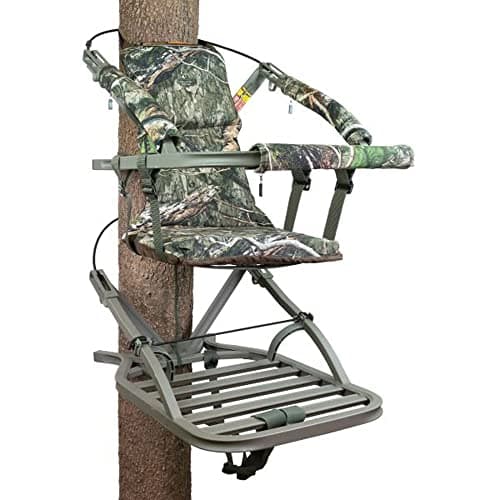
Buy a climbing stand if the trees you hunt are straight, round and limbless up to 20 feet. Buy a hang-on and sticks if they are not. That is the whole decision, and almost every other comparison of these two stand types buries it under weight charts. A climber is the better machine on a perfect tree and physically cannot be used on an imperfect one. A hang-on works on nearly any tree and asks you to bring your own way up.
Everything below is the detail behind that sentence: what each type really weighs once you count the climbing sticks, which one is quieter to set up, which one you can sit in at hour ten, and what each costs when you stop pricing the stand alone.
The quick verdict
| If this is you | Buy | Because |
|---|---|---|
| You hunt mature hardwoods or planted pines with clean, straight trunks | Climbing stand | Nothing else gets you to height with one trip, one piece of gear and no hardware left in the tree |
| Your woods are crooked, limby, multi-trunk or heavily branched below 20 ft | Hang-on and sticks | A climber cannot pass a limb. This is not a preference, it is a physical limit |
| You hunt the same two or three trees all season on private ground | Hang-on | Hang it once in September, leave the sticks, and every sit after that is a quiet walk-in |
| You scout, move and re-hang weekly, often on public land | Climber, or a light hang-on | A climber leaves nothing behind. A 12-lb hang-on with four sticks is the other answer and opens more trees |
| You want to be comfortable for a full dark-to-dark sit | Hang-on | Platform and seat geometry on a good hang-on beat what a climber's packable frame can offer |
| The walk in is the hard part of the hunt | Climber | A 20-lb climber is lighter on your back than most hang-on plus stick combinations |
Head to head
Published manufacturer figures for the stands we actually recommend in each category. The climbers carry nothing extra; the hang-ons carry sticks, and the table says so.
| Climbing stand | Hang-on stand | |
|---|---|---|
| Representative model | Summit Viper SD - 20 lb, 300 lb capacity, 20 x 36 in platform frame | Millennium M50 - 20 lb, 300 lb capacity, 24 x 33 in platform |
| Lightest serious option | XOP Revolt, 11.7 lb, 300 lb, ASTM F2123-21 / F3249-20 | Hawk Helium Ultra Lite, 11 lb, 300 lb, but a 16 x 10 in platform |
| What else you must carry | Nothing | Two to four climbing sticks, roughly 10-12 lb for a four-stick set |
| Trees it can use | Straight, round, limbless to height, within the stand's diameter range | Nearly any tree that will hold you, including crooked and limby |
| Time to height | 10-20 minutes of continuous climbing effort | 15-30 minutes the first time, under 5 minutes every sit after |
| Left in the tree between sits | Nothing | Stand and sticks, unless you strip it each time |
| Noise profile | Repeated, rhythmic, from the ground up | Concentrated in the one-time hang, then silent |
| Physical demand | High - it is a full-body climb | Moderate - a ladder climb with a loaded pack |
The tree decides, not you
A climbing stand works by biting into the trunk with two separate frames and inchworming up. That mechanism has one unforgiving requirement: an uninterrupted trunk. One branch at 12 feet ends the climb. A fork ends the climb. A trunk that tapers too fast ends the climb at the point where the stand's bite angle runs out, and a trunk that is too fat for the cable or too skinny to grip never starts it — Summit publishes an 8 to 20 inch diameter range on the Goliath SD, which is typical.
A hang-on has none of those constraints. You climb with sticks, you strap a platform to whatever is there, and the stand does not care whether the trunk is round, straight or leaning. Hawk publishes a 9-inch minimum tree diameter on the Helium Pro and nothing else.
This is also why regional advice about these two stand types contradicts itself so violently. A hunter in mature Midwestern oak timber and a hunter in a Southern cedar-and-scrub creek bottom are both right about their own woods and both wrong about each other's.
Carried weight: the number that lies
Stand weight is the spec people compare, and on its own it is close to meaningless for a hang-on. The Millennium M50 and the Summit Viper SD both weigh 20 pounds. They are not equivalent loads, because the M50 does not include a way up the tree and the Viper does.
| Setup | Stand | Sticks | Real carried weight |
|---|---|---|---|
| Summit Viper SD climber | 20 lb | None | 20 lb |
| XOP Revolt climber | 11.7 lb | None | 11.7 lb |
| Millennium M50 + 4 sticks | 20 lb | ~10-12 lb | Roughly 30-32 lb |
| Hawk Helium Pro + 4 sticks | 12 lb | ~10-12 lb | Roughly 22-24 lb |
| Hawk Helium Ultra Lite + 4 sticks | 11 lb | ~10-12 lb | Roughly 21-23 lb |
Read that table twice, because it reverses the usual assumption. A lightweight hang-on plus sticks lands in the same weight class as a mid-weight climber, while a comfortable hang-on plus sticks is substantially heavier than any climber here. The hunter who wants both comfort and a light pack is being asked to pick one, and the honest answer is that a dedicated ultralight climber like the 11.7-pound XOP Revolt is the lightest way to get a human 20 feet up a tree — provided the tree cooperates.
Stick weight varies enough that we have given it as a range rather than invented a figure; a four-stick set is typically in the 10 to 12 pound neighborhood, and our climbing stick guide compares the options on published weight and step design.
Setup noise and time to height
These two types fail noisily in opposite ways. A climber makes a moderate amount of noise for the entire climb — metal on bark, the cable settling, your boots on the platform, repeated twenty times in sequence from the ground to height. That noise is predictable and it is over in ten to twenty minutes, but it happens on every single sit, in the dark, directly under where you intend to kill a deer.
A hang-on makes considerably more noise once: sticks going on, the stand being hauled up on a rope, straps ratcheting, the platform settling against the trunk. Then it makes none at all, forever. Every sit after the hang is a quiet climb up a fixed ladder.
Which matters depends on your calendar more than your preference. If you hang stands in late summer and hunt them from October, the hang-on's noise lands eight weeks before anything is listening. If you are a mobile hunter dropping into new ground on a hot sign report in November, the hang-on's noise lands at the worst possible moment and the climber's is the lesser evil.
Comfort on a ten-hour sit
The hang-on wins this and it is not close at the top of the category. A climber has to fold flat enough to wear on your back and still work as a two-piece climbing machine, which constrains platform shape and, above all, seat design. A hang-on only has to fold flat; everything else is free.
The published numbers show it. The Millennium M50 carries a 24 by 33 inch platform and a 20 by 16 inch ComfortMAX sling seat at 21 inches of seat height. The Summit Viper SD is a 20 by 36 inch platform frame with a 22.5 inch seat frame. Both are rated to 300 pounds. The M50 is the one you will still be sitting in during the last hour of a November all-dayer, and the one Summit answer is to step up to the 350-pound Goliath SD and its 24.5 inch seat frame — which is a capacity upgrade more than a comfort one.
The counterpoint is the climber's front bar. On the Viper SD it is a padded rest that makes the sit-and-climb motion almost effortless and doubles as a gun rest at height. Rifle and crossbow hunters often prefer the climber for exactly that, which is the subject of the next section from the opposite direction.
Public land, leaving it up, and theft
On most public ground the rules settle this argument before gear preference does. Stands left overnight are commonly prohibited, screw-in steps are commonly prohibited, and anything you leave can be removed by the agency or by another hunter. A climber is the natural public-land tool because it goes home with you every evening.
A hang-on is still usable on public land — you carry the stand and the sticks in and out, which is the 22 to 32 pound load in the weight table — but you give up the hang-on's real advantage, which is that the hard work happens once. The hunters who run hang-ons on public ground are doing it to reach trees a climber cannot take, and they are paying for it in weight and setup time on every sit.
On private ground the calculus flips completely. A hang-on left in a known travel corridor with the sticks in place is the quietest, fastest way into a tree that exists. Check it in the spring, re-tension the straps, and it is ready.
Bowhunting and shot geometry
Bowhunters care about two things a gun hunter does not: whether anything blocks the draw, and whether they can turn.
On blocking, the climber's front bar is the problem and the manufacturers know it, which is why Summit sells the OpenShot SD — a 15-pound climber with an open front specifically for bowhunters. If you shoot a bow from a climber, buy the open-front version; if you shoot a gun or a crossbow, the bar is an asset.
On turning, the hang-on usually wins on platform area. A 24 by 33 inch M50 platform is 792 square inches of floor against the Viper SD's 20 by 36 inch frame, and the difference shows up when a deer comes from the wrong side. The exception is the ultralight hang-on: the Hawk Helium Ultra Lite's 16 by 10 inch platform is 160 square inches, which is a standing area, not a pivoting one.
Height interacts with both. Steeper angles from a taller setup shrink the vital area you can actually reach on a close deer, which is covered in detail in how high a tree stand should be.
What each actually costs
Price the system, not the stand. Summit's own published MSRPs run from $249.99 for the steel Viper to $399.99 for the aluminum Viper SD and OpenShot SD, $469.99 for the Goliath SD and $529.99 for the Viper PRO SD and Titan SD; XOP lists the ultralight Revolt at $699.99. Those are complete, ready-to-hunt prices apart from a harness.
A hang-on price is never complete. The stand is one line, a four-stick set is another, and the two together routinely land in the same bracket as a mid-tier climber or above it. The budget version of a hang-on setup is a budget stand with budget sticks, which is the part of this category where we would spend the money — the sticks are what you stand on at height with one hand free.
Two different risk windows
Both stand types are safe when used with a harness and a lifeline and dangerous when they are not, but the dangerous moment is in a different place for each.
A climber's risk is distributed across the climb and concentrated in one specific failure: separating the platform from the seat section. Every climber manual tells you to tether the two halves together so a dropped platform does not leave you stranded at height or falling. People skip it.
A hang-on's risk is concentrated almost entirely in the transition from the top climbing stick onto the platform. That is the move where your weight shifts from a ladder you are facing to a platform beside you, usually in the dark, usually with a pack on. A lifeline running from ground level to above the platform, with a prusik you slide as you climb, covers that entire window and is the single highest-value safety purchase for a hang-on hunter.
Whichever you buy, the harness is not optional. The Hunter Safety System X-1 is 2.5 pounds, rated to 300 pounds, Treestand Manufacturers Association certified and available from S through 3XL — and the size range matters, because a harness that fits badly is a harness that gets left behind. More options are in our harness roundup.
If you choose a climber
Summit Viper SD is the default. Twenty pounds, a 300-pound rating, a 20 by 36 inch platform frame and the padded front bar that makes the sit-and-climb motion nearly effortless. It is the climber most hunters should buy and then stop thinking about.
Summit OpenShot SDis the bowhunter's version: 15 pounds with an open front and no bar to shoot around. You give up the gun rest and the climbing aid the bar provides, which is a real loss on a cold climb, in exchange for an unobstructed shot.
Full comparisons, including the 350-pound Goliath SD and the 11.7-pound XOP Revolt, are in our climbing tree stand roundup.
If you choose a hang-on
Millennium M50 if comfort is why you are here: a 24 by 33 inch platform and a 20 by 16 inch ComfortMAX sling seat at 21 inches of seat height, rated to 300 pounds, 20 pounds on your back. It is the hang-on you will still be sitting in at hour nine.
Hawk Helium Pro if you move: 12 pounds with a 24 by 30 inch platform, a 300-pound rating, a flip-back footrest and a 9-inch minimum tree diameter. Eight pounds lighter than the M50 for very little platform.
And whichever stand you choose, budget the sticks in the same purchase rather than three weeks later.
More hang-on options, including kits that ship with sticks in the box, are in our hang-on roundup.
Why a lot of hunters end up with one of each
The two stand types are not really competitors once you own both. The common end state on private ground is two or three hang-ons left up on the best trees for the best winds, plus one climber in the truck for the morning somebody reports fresh sign in a block you have never hunted. The hang-ons are the plan; the climber is the response.
If you are buying your first stand and your ground genuinely supports a climber, buy the climber — it is one purchase, one price, and it teaches you more about reading trees than a hang-on will. If your ground does not support one, do not buy a climber hoping the woods will cooperate. Buy the hang-on, buy decent sticks, and hang it in September.
If neither appeals — if the climb itself is the part you would rather not do — a ladder stand removes the climbing problem entirely at the cost of mobility, and a ground blind removes height from the equation altogether.
Frequently asked questions
Is a hang-on or a climbing tree stand better?
It depends almost entirely on your trees. A climbing stand needs a straight, round, limbless trunk and is the simpler, lighter, faster system when it has one. A hang-on works on crooked, limby and multi-trunk trees that a climber physically cannot pass, and is generally more comfortable for an all-day sit, but you must also carry and climb two to four climbing sticks. Walk your five best trees and look up before you choose.
Which is lighter to carry, a hang-on or a climber?
Compare the whole system, not the stand. A Summit Viper SD climber is 20 lb complete. A Millennium M50 hang-on is also 20 lb, but a four-stick set adds roughly 10-12 lb, so the real load is about 30-32 lb. A light hang-on such as the 12-lb Hawk Helium Pro lands around 22-24 lb with sticks - comparable to a mid-weight climber. The lightest way to get up a tree is a dedicated ultralight climber like the 11.7-lb XOP Revolt, if the tree allows it.
Can you use a climbing stand on a tree with branches?
No. A climbing stand ascends by biting a continuous trunk, so a single limb at head height ends the climb there. Forks, heavy taper and trunks outside the stand's published diameter range - Summit lists 8 to 20 inches on the Goliath SD, which is typical - rule a tree out the same way. That limitation, not weight or price, is the main reason hunters own hang-ons.
Which stand is quieter to set up?
They are noisy at different times. A climber makes moderate, repeated noise on every single climb, in the dark, under the tree you intend to hunt. A hang-on makes much more noise once, during the hang, and essentially none afterward. If you hang stands in late summer for an October hunt, the hang-on's noise is harmless. If you are dropping into new ground mid-November, the climber's distributed noise is usually the lesser problem.
Which is safer, a hang-on or a climbing stand?
Both are safe with a full-body harness and a lifeline and dangerous without. The risk sits in different places: on a climber it is spread through the climb and concentrated in the platform separating from the seat section, which is why every manual tells you to tether the halves together. On a hang-on it is concentrated in the step from the top climbing stick onto the platform. A ground-to-platform lifeline with a prusik knot covers the hang-on's worst moment and is the highest-value safety purchase for that setup.
How many climbing sticks do I need for a hang-on?
Four 20-inch sticks puts most hunters at roughly 18 to 20 feet of working height, and three gets you to about 15 to 18 feet. Stick length is not climbing height - overlap at the base, the gap up to the platform and the fact that you stand on the top step rather than above it all subtract from the total.
Sources
- Summit Treestands - Viper SD published specifications: 20 lb, 300 lb capacity, 20 x 36 in platform frame, 22.5 in seat frame; published MSRP ladder across the Summit climbing lineup ($249.99 steel Viper to $529.99 Viper PRO SD / Titan SD / Max SD)
- Summit Treestands - OpenShot SD published specifications: 15 lb open-front climbing treestand
- Summit Treestands - Goliath SD published specifications: 350 lb capacity including gear, 24.5 in seat frame, 20 x 36 in platform frame, 21 lb, 8-20 in tree diameter range
- XOP Outdoors - Revolt published specifications: 11.7 lb, 300 lb capacity, ASTM F2123-21 / F3249-20, MSRP $699.99
- Millennium Treestands - M50 published specifications: 300 lb capacity, 24 x 33 in platform, 20 x 16 in ComfortMAX sling seat, 21 in seat height, 20 lb
- Hawk Treestands - Helium Pro and Helium Ultra Lite published specifications: Helium Pro 300 lb, 24 x 30 in platform, 12 lb, fits trees over 9 in; Helium Ultra Lite 300 lb, 16 x 10 in platform, 11 lb
- Hunter Safety System - X-1 harness published specifications: 300 lb rating, 2.5 lb, sizes S through 3XL, Treestand Manufacturers Association certified
- Prices, product images and stock status via the Amazon price layer, refreshed daily
Keep reading
Gearing up before your next hunt?
See how we evaluate gear, then dig into the reviews and buying guides — written without inventory to sell.