Buying Guide
Best Rangefinders for Bow Hunting: Angle, Not Distance
A rifle hunter can be ten yards wrong at 300 and still kill the deer. A bowhunter cannot be three yards wrong at 35. That is why an archery rangefinder is judged on different specs than a rifle one - and why the headline yardage on the box is the least useful number on it.
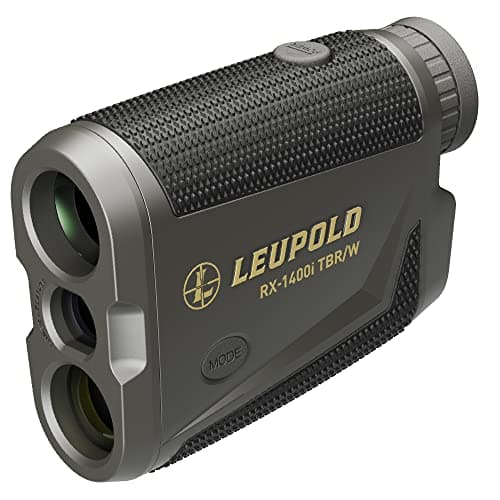
The best rangefinder for most bowhunters is the Leupold RX-1400i TBR/W Gen 2, because it has the one feature archery actually requires — true-horizontal angle compensation — plus a basic version of Leupold’s Flightpath arrow-clearance display, at roughly a quarter of what the purpose-built archery unit costs. If you hunt dense timber and want the full arc modeled, the Leupold RX-FullDraw 5 is the real archery instrument and nothing else on this page replaces it. If you want the essentials and a lifetime warranty for under half of that, the Vortex Crossfire HD 1400 is the value pick.
Here is what almost every rangefinder roundup gets wrong for archery: it ranks units by maximum yardage. For a bowhunter the maximum range is the single least relevant spec on the box. Nobody shoots an animal with a bow at 1,400 yards. Your shots happen between 15 and 45 yards, from an elevated position, often in the first or last twenty minutes of light, at an animal that is not a reflective target. Those four conditions are what a rangefinder should be judged on.
Archery asks a different question
A rifle rangefinder answers “how far, and how much does my bullet drop over that distance?” A bow rangefinder answers something narrower and harder: “which pin, and will the arrow get there?”
The difference is error tolerance. A centerfire rifle zeroed at 200 yards has a trajectory flat enough that a ten-yard ranging error at 300 moves the impact point a couple of inches. A compound bow at 40 yards is dropping fast enough that being three yards wrong can be the difference between lungs and liver. Precision at short range, not reach at long range, is the archery requirement.
| Rifle hunting | Bow hunting | |
|---|---|---|
| Typical shot distance | 100-400 yards | 15-45 yards |
| Cost of a 3-yard ranging error | Negligible at any normal distance | Potentially the whole shot at 35-45 yards |
| Angle compensation | Useful on steep western terrain | Essential - almost every treestand shot is angled |
| Projectile path above line of sight | An inch or two - irrelevant for clearance | Feet, at peak - a real collision risk with limbs |
| Maximum range that matters | Often the headline spec | Essentially never the headline spec |
Why angle compensation is the whole ballgame
Shoot from 20 feet up a tree at a deer 25 yards away along your line of sight, and your sight pin does not want 25 yards. Gravity only acts over the horizontalcomponent of that distance, so the correct pin is for something closer to 22 or 23 yards. Hold 25 and you shoot high. The steeper the angle and the closer the animal, the bigger the error — which is exactly the geometry of treestand hunting.
Every pick on this page handles that, under one of two names:
| Leupold TBR/W - True Ballistic Range with Wind | Leupold's angle-compensated output. On the archery side it reports the equivalent horizontal shooting distance, which is the number your pin wants. |
|---|---|
| Vortex HCD - Horizontal Component Distance | Vortex's version, and it is always on with no setup required. HCD is the default display rather than an option you have to remember to enable. |
| Line of sight (LOS) mode | Raw distance along the beam. Useful for scouting and for measuring a shooting lane on the ground, wrong for an elevated shot at an animal. |
The problem no rifle hunter has: the branch you cannot see
An arrow does not travel in a straight line to 40 yards. It arcs, and at the top of that arc it can be well above your line of sight. That means the shooting lane your eye says is clear can contain a limb your arrow will hit — and you will never see the collision coming through the sight, because you are not looking where the arrow is going.
This is the specific problem Leupold’s Flightpathdisplay exists to solve. On the RX-FullDraw 5 you enter your actual setup — Leupold accepts arrow velocities from 170 to 550 fps, arrow weights from 200 to 900 grains and peep heights from 1 to 6 inches— and the unit models where the arrow will be in the air, showing an obstruction indicator out to roughly 85 yards. You can set the indicator to show the arrow’s height at 20 yards or its peak height for the ranged distance.
Is that worth the money? In open country or from a ground blind with cut lanes, honestly no. In hardwood timber with a lattice of limbs between you and the trail, it is the only feature on this page that addresses a failure mode you cannot otherwise detect. Decide by the cover you hunt, not by the spec sheet.
The specs that matter, and the one that does not
| Published range on DEER, not on reflective targets | The headline number is measured against a reflective panel. Leupold and Vortex both publish a separate deer figure, which is the honest one. Any brand that prints only the big number is telling you less. |
|---|---|
| Minimum range | More relevant than maximum for archery. A unit with a 5-yard minimum can range the base of your own tree; some long-range rifle units cannot focus that close. |
| Scan mode | Hold the button and sweep to read continuously. This is how you range the three trees along a trail before the deer arrives, which is the only ranging you should be doing with an animal in sight. |
| Display type and brightness | Archery light is dawn and dusk light. A red OLED or TOLED display reads against dark timber in a way a black LCD does not. |
| Angle compensation | Non-negotiable. TBR/W on Leupold, HCD on Vortex. Without it an elevated shot is guesswork dressed up as a measurement. |
| Does NOT matter: maximum reflective range | A 1,800-yard unit and a 450-yard unit are identical at 32 yards. Buy the features, not the headline. |
The five picks compared
| Rangefinder | Published deer range | Angle mode | Archery extras | Best for |
|---|---|---|---|---|
| Leupold RX-1400i TBR/W Gen 2 | About 900 yd | TBR/W | Basic Flightpath mode | Best overall - one unit for bow and rifle |
| Leupold RX-FullDraw 5 | Published to 1,200 yd reflective, about 1,100 on trees | TBR | Full Flightpath, arrow velocity 170-550 fps, 200-900 gr, peep 1-6 in | Dedicated bowhunters in heavy cover |
| Vortex Crossfire HD 1400 | Up to 750 yd (950 trees, 1,400 reflective) | HCD | Scan mode, 5-yard minimum | Best value |
| Vortex Sonora HD 1800 | 700 yd (1,000 trees, 1,800 reflective) | HCD | Scan mode, VIP lifetime warranty | Best budget with honest specs |
| Halo Optics XL 450 | Rated to 450 yd | Angle compensated | None | Cheapest workable unit |
Every figure is the manufacturer’s published specification, not our measurement. Note how little the deer-range column matters for the use case: the shortest unit here reaches ten times the longest shot you should be taking with a bow.
Best overall for bowhunters: Leupold RX-1400i TBR/W Gen 2
This is the unit we would hand most bowhunters. It publishes an honest 900 yards on deer, carries full TBR/Wangle compensation, runs a common CR2 battery, and — the part that matters here — includes a basic Flightpath archery mode borrowed from the FullDraw line. You get the feature archery requires and a taste of the feature archery uniquely benefits from, in a unit that also does everything a rifle hunter needs come November.
Honest cons: the basic Flightpath is not the FullDraw’s full arrow model, so if branch clearance in timber is your actual problem this is a partial answer. It is also not the cheapest way to get angle compensation — both Vortex units do that for less.
Best dedicated archery unit: Leupold RX-FullDraw 5
The FullDraw 5 is what a rangefinder looks like when it is designed around an arrow instead of a bullet. You feed it your real arrow velocity, arrow weight and peep height, and the ballistic engine works in your arc rather than a generic one. The Flightpath display then shows whether the arrow will clear what is between you and the animal out to about 85 yards, with a selectable indicator for either the 20-yard height or the peak height at the ranged distance. It ranges in half-yard increments to 175 yards— which is the spec that tells you who it was built for — and to 1,200 yards on reflective targets, with TBR angle compensation and a red display.
Honest cons: it is a lot of money for archery distances, and a rifle-first hunter gets more capability elsewhere for less. The Flightpath value also depends entirely on entering honest arrow data — a guessed velocity produces a confident, wrong answer. Chronograph your setup or get it chronographed before you trust the display.
Best value: Vortex Crossfire HD 1400
The Crossfire HD 1400 is the one to buy if you want the essentials and nothing you will not use. Vortex publishes 1,400 yards on reflective targets, 950 on trees and up to 750 on deer, with a 5-yard minimum range that will happily range the trunk you are strapped to. HCD angle compensationis the default mode with no setup, there are line-of-sight and scan modes plus Normal, First and Last target modes, and it is a 5x21 optic weighing 4.8 ounces with a red TOLED display. Vortex’s unconditional VIP lifetime warranty stands behind it.
Honest cons: no archery-specific features at all beyond the angle compensation — no arrow modeling, no clearance display. Five-power magnification is modest if you also want to use it to look at antlers.
Best budget: Vortex Sonora HD 1800
The Sonora HD 1800 is Vortex’s current budget unit and it publishes its specs the way we wish everyone did: 1,800 yards reflective, 1,000 on trees, 700 on deer, all three printed rather than one flattering number. HCD angle compensation is standard with no input needed, accuracy is rated at plus or minus one yard, it runs a CR2 battery at 6.1 ounces, and the VIP lifetime warrantyapplies — unusual insurance at any price and remarkable at this one.
Honest cons: it is the heaviest of the compact units here, and like the Crossfire it has no archery-specific modeling. For a bowhunter the practical difference between this and the Crossfire is small, so buy whichever is cheaper on the day.
Cheapest workable: Halo Optics XL 450
Rated to 450 yards with angle-compensated ranging, the XL 450 covers every distance a bowhunter will ever shoot with roughly ten times the margin, for a fraction of the money. If the alternative is guessing yardage because a rangefinder was not in the budget, buy this one and move on — a cheap rangefinder you own beats an expensive one you do not.
Honest cons: build quality, display brightness in low light and glass are all where the savings came from, and low light is exactly when bowhunters range. Treat it as the floor of the category, not a bargain version of the units above.
How to actually use it from a stand
The gear is the small half of this. The technique that separates hunters who range well from hunters who fumble is pre-ranging.
| Range the landmarks, not the deer | When you settle into the stand, range the trees, rocks and fence posts along each likely approach and memorize three numbers. When an animal arrives you read a landmark, not a moving target. |
|---|---|
| Use scan mode to do it in one pass | Hold the button and sweep the trail. Ten seconds of scanning when you sit down removes the need to range anything at the moment of truth. |
| Range in the angle-compensated mode you will hunt in | Pre-ranged numbers taken in line-of-sight mode are the wrong numbers. Set the mode once, then never change it. |
| Keep it where one hand can reach it | A bino harness pocket or a chest pocket. A rangefinder in a pack is a rangefinder you will not use, and reaching for it is movement. |
| Confirm it against a known distance | Before the season, range a measured 30 yards from your actual stand height. You want to have seen what the angle-compensated number looks like before it matters. |
Our rangefinder buying guide goes deeper on the spec vocabulary, and best hunting rangefinders covers the rifle-first side of the category, including long-range ballistic units that make no sense for archery. Keeping it reachable is a bino harness question more than a rangefinder one.
The bottom line
Ignore the headline yardage. Buy angle compensation first, close-range precision second, and arrow-clearance modeling only if you hunt timber tight enough to need it. For most bowhunters that is the Leupold RX-1400i TBR/W Gen 2. For a bowhunter in hardwoods with the budget, the RX-FullDraw 5 addresses a failure you cannot see coming. For everyone watching the money, the Vortex Crossfire HD 1400 or Sonora HD 1800— whichever is cheaper that week — does the real job with a lifetime warranty attached.
Check the Leupold RX-1400i TBR/W Gen 2 price on Amazon. Then set the angle-compensated mode, put it in a harness pocket, and pre-range your lanes before opening day. Our bow season gear checklist covers what else belongs in that pre-season pass.
Frequently asked questions
What is the best rangefinder for bow hunting?
The Leupold RX-1400i TBR/W Gen 2 for most bowhunters. It has TBR/W angle compensation - the one feature archery genuinely requires - plus a basic version of Leupold's Flightpath arrow-clearance display, and it publishes an honest 900 yards on deer. If you hunt dense timber and want your actual arrow arc modeled against branches, the purpose-built Leupold RX-FullDraw 5 is the real archery instrument.
Do I need angle compensation on a bow hunting rangefinder?
Yes. Gravity acts over the horizontal component of the shot, not the line-of-sight distance, so a 25-yard line-of-sight shot from 20 feet up a tree needs a pin closer to 22 or 23 yards. Hold the raw number and you shoot high. The steeper the angle and the closer the animal, the larger the error - which is exactly treestand geometry. Leupold calls it TBR/W, Vortex calls it HCD.
How many yards does a bow hunting rangefinder need?
Far fewer than the box advertises. Archery shots happen between roughly 15 and 45 yards, so even a 450-yard unit has about ten times the reach you need. Maximum range is the least useful spec on an archery rangefinder. What matters is the published range on deer rather than on reflective targets, the minimum range, scan mode, display brightness in low light, and angle compensation.
What is Flightpath on a Leupold rangefinder?
It models where your arrow will actually be in the air and shows whether it will clear obstructions out to roughly 85 yards. On the RX-FullDraw 5 you enter real arrow data - Leupold accepts velocities from 170 to 550 fps, arrow weights from 200 to 900 grains and peep heights from 1 to 6 inches - and you can set the indicator to the arrow's 20-yard height or its peak height for the ranged distance. It only works if the data you enter is honest, so chronograph your setup.
Is a cheap rangefinder good enough for bow hunting?
Often, yes - provided it has angle compensation. A unit like the Halo Optics XL 450 covers every archery distance with enormous margin, and a cheap rangefinder you own beats an expensive one you do not. What you give up at the bottom of the market is glass, build quality and display brightness in low light, which is unfortunately exactly when bowhunters range. The Vortex Crossfire HD 1400 and Sonora HD 1800 are the sweet spot.
Should you range the deer or range landmarks?
Range landmarks. When you settle into a stand, use scan mode to sweep each likely approach and memorize the distance to three fixed objects - a tree, a post, a rock. When an animal shows up you read a landmark instead of trying to range a moving target, which means no extra movement and no fumbling at the moment of truth. Do it in the angle-compensated mode you will hunt in, or the numbers you memorized are the wrong ones.
Can I use a rifle rangefinder for bow hunting?
Yes, if it has angle compensation and a short minimum range. What you do not need is a long-range ballistic engine, Bluetooth rifle profiles or 1,800-yard reach. What you might miss is any archery-specific feature - no rifle unit models arrow arc for branch clearance. A unit like the RX-1400i TBR/W Gen 2 is a genuinely good compromise because it does both jobs competently.
Sources
- Leupold RX-FullDraw 5 published specifications - arrow velocity input range 170-550 fps, arrow weight 200-900 grains, peep height 1-6 inches, Flightpath obstruction indicator to about 85 yards with 20-yard or peak-height modes, ranging in half-yard increments to 175 yards, 1,200 yards maximum reflective, 6x22mm, TBR angle compensation, red OLED display
- Leupold RX-1400i TBR/W Gen 2 published specifications - about 900 yards on deer, TBR/W angle compensation, basic Flightpath archery mode, CR2 battery
- Vortex Crossfire HD 1400 published specifications - 1,400 yards reflective, 950 yards trees, up to 750 yards deer, 5-yard minimum, LOS/HCD/scan modes, Normal/First/Last target modes, 5x21, 4.8 oz, red TOLED display, VIP lifetime warranty
- Vortex Sonora HD 1800 published specifications - 1,800 yards reflective, 1,000 yards trees, 700 yards deer, HCD angle compensation standard, plus or minus 1 yard accuracy, 6x21, 6.1 oz, CR2 battery, VIP lifetime warranty
- Halo Optics XL 450 published rating of 450 yards with angle-compensated ranging
- Prices, product images and stock status via the Amazon price layer, refreshed daily
Keep reading
Gearing up before your next hunt?
See how we evaluate gear, then dig into the reviews and buying guides — written without inventory to sell.