Gift Guide
The Best Gifts for Bowhunters
Bowhunting is a game of twenty-five yards, absolute silence and a hand that still works in the cold. Almost every worthwhile gift for a bowhunter serves one of those three things, and a surprising number of them cost less than a tank of gas.
A bowhunter is not a rifle hunter with a shorter range. The whole discipline is built around three constraints, and once you understand them, gift shopping stops being guesswork.
First, everything happens inside about forty yards, which makes exact yardage and wind discipline non-negotiable. Second, the shot requires a draw - a large, slow movement made while an animal is close enough to see it. Third, the release hand has to work: a numb finger on a release aid is a missed or, worse, a marginal shot.
Every pick below serves one of those three. Items were checked against Amazon's live catalog on the date at the top of the page; use the check-price buttons rather than trusting a number in prose.
The three things that decide an archery hunt
- Getting to close range. Wind discipline, a quiet approach, and gear that does not clatter. This is where wind checkers, hoists and hangers earn their keep.
- Knowing the exact distance. A rifle hunter can be ten yards wrong at 200 and still be fine. A bowhunter cannot be five yards wrong at 40. Rangefinders are not a luxury item in archery.
- A functioning release hand. Cold destroys fine motor control before it destroys comfort. Warmth gear for a bowhunter has a different requirement than warmth gear for anyone else: it has to come off instantly and leave a sensitive hand behind.
The picks at a glance
| Gift | Serves | Notes |
|---|---|---|
| Angle-compensating rangefinder | Exact distance | The single most useful bowhunting purchase |
| Retractable bow hoist | Quiet, safe climb | Under $30, used on every single sit |
| Folding bow hanger | Quiet setup | Ends the bow-across-the-lap problem |
| Heated hand muff | Release hand | Better than heated gloves for archery |
| Arrow puller | Practice sessions | Saves fingers and arrow inserts |
| Wind checker | Getting close | Cheapest high-impact item in archery |
An angle-compensating rangefinder
This is the gift. If a bowhunter does not own a rangefinder with angle compensation, that is the hole in their kit.
Here is the physics in one sentence: from an elevated stand, gravity acts on the horizontal distance the arrow travels, not the straight-line distance to the deer, so a plain rangefinder gives you a number that is too big. Realtree's testing puts a practical boundary on it - shots at 20 degrees or less show little difference in point of impact inside 40 yards - but past those thresholds the gap between line-of-sight and true horizontal distance widens quickly, and that is the range where the compensating unit becomes, in their words, nearly invaluable.
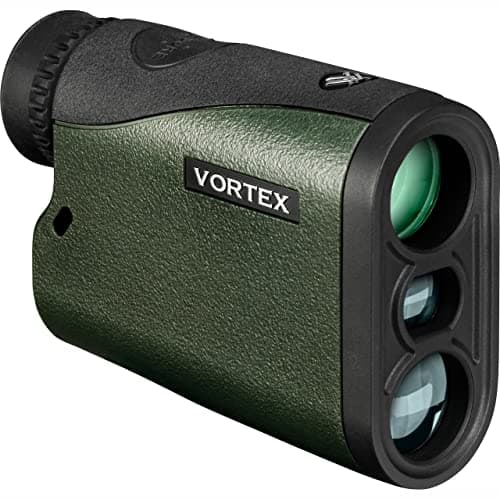
The Crossfire HD 1400 is the practical sweet spot: angle compensation, an archery-friendly close range, and Vortex's warranty.
Our rangefinder buying guide explains which specifications matter for archery specifically, and our rangefinder roundup covers the full ladder.
The archery-specific upgrade
Leupold's RX-FullDraw line is built specifically for vertical bows: it takes arrow weight and bow speed as inputs and returns a true archery ranging solution rather than a generic angle-compensated number. It is a serious gift for a serious bowhunter who already owns a basic rangefinder.
A bow hoist
A retractable hoist keeps a bow from being carried up a ladder in one hand, which is one of the more preventable ways bowhunters get hurt, and it does it without a loose rope tangling in the dark. Retractable versions are quieter and faster than a coiled paracord line - no spooling, no slap against the tree.
Bow hangers and gear hooks
A bow held across the lap for five hours is a bow that gets bumped when the moment arrives. A folding hanger screwed or strapped into the tree at arm's reach means the bow hangs silently at the ready and the hunter's hands are free.
Buy the multi-pack rather than a single. Hunters run more than one stand, and the second and third hangers get used for a pack and a rangefinder. Check local regulations first, because screw-in accessories are prohibited on some public land.
A heated muff, not heated gloves
This is the one place where the standard cold-weather advice is wrong for archery. Heated gloves keep hands warm but leave a thick layer between the finger and the release trigger, and they take two motions to remove at the exact moment when movement is fatal.
A muff strapped at the waist heats the air around bare or lightly gloved hands, and the hands come out in one motion, sensitive and warm. It is the correct architecture for a bowhunter, and the heated version removes the need to feed it disposable warmers.
The full comparison is in our hand warmer guide and our heated hunting gear guide.
Flip-top mitts
The second-best answer to the same problem: an insulated mitt with a fold-back top over a thin liner glove. The mitt keeps fingers together and warm; the flip-back exposes a lightly gloved hand for the shot without removing anything.
More options in our hunting glove guide.
String wax and a broadhead wrench
Two items that cost almost nothing and that most bowhunters do not own. String wax keeps serving from separating and strands from fraying, which is real maintenance, not a nicety. A broadhead wrench lets a hunter tighten and spin-test fixed-blade heads without gripping a razor blade.
The fixed-versus-mechanical debate is covered in our broadhead guide.
An arrow puller
Anyone shooting a high-density foam target is fighting it for every arrow, and pulling by hand is how inserts get twisted loose and fletchings get damaged. A grip puller costs almost nothing and gets used every practice session all summer.
A bino harness sized for archery
A bowhunter's bino harness has an extra requirement: it cannot interfere with the string on the draw. A minimal shoulder harness or a low-profile chest pack sits closer to the body and clears the string path better than a bulky sealed case.
Draw clearance and fitment are covered in our bino harness guide.
A lifeline
Bowhunters climb in the dark, early, with a bow, and often into hang-on stands with climbing sticks - the exact conditions in which the National Deer Association's treestand accident data says falls happen. A lifeline keeps a hunter attached from the ground to the platform and back.
A seat cushion
Archery season in most states runs from warm September into cold December, and the October lull rewards long sits. A cushion is the cheapest way to make a five-hour sit physically possible.
A wind checker
At bow range, wind is not one factor among many - it is the factor. A puff bottle of odorless powder costs a few dollars and shows what the air is actually doing at ground level in timber, which is frequently not what the forecast says.
Read our assessment of scent control for what the rest of that aisle can and cannot do.
What not to buy a bowhunter
- Arrows. Spine, length, insert weight and nock type are all matched to a specific bow and draw length. Guessing produces arrows that cannot be used.
- A release aid.Release preference is intensely personal - wrist strap versus handheld, index versus thumb versus hinge - and switching releases changes a shooter's whole shot process. A gift card is the right move here.
- A sight or rest. Same problem, plus it requires re-tuning the bow.
- Anything that clicks, rattles or zips loudly. It will be left in the truck.
Shopping other budgets? Gifts under $50, gifts under $100, and stocking stuffers. Shopping for a crossbow hunter instead? Start with our crossbow versus compound comparison.
Frequently asked questions
What is the best gift for a bowhunter?
A rangefinder with angle compensation, if they do not already own one. Archery shots happen inside about forty yards where a five-yard error is a miss, and from an elevated stand the straight-line distance to a deer is longer than the distance gravity actually acts over. An angle-compensating unit returns the number to aim for instead of the number the laser measured.
Do bowhunters really need an angle-compensating rangefinder?
It depends on how steep their shots are. Realtree's testing found that shots at 20 degrees or less show little difference in point of impact inside 40 yards, so a hunter in a low stand on flat ground can get by without one. Once the angle or the distance increases - a tall stand, a saddle high in a tree, or any hill country - the gap between line-of-sight and horizontal distance widens quickly and compensation becomes genuinely important.
Are heated gloves or a heated muff better for bowhunting?
A muff. Heated gloves put insulation between the finger and the release trigger and require two motions to remove at the moment when any movement can end the hunt. A muff strapped at the waist warms bare or lightly gloved hands and lets them come out in a single motion with full sensitivity. Flip-top mitts over a thin liner are the second-best answer for the same reason.
Should you buy arrows for a bowhunter as a gift?
No. Arrow spine has to match draw weight and draw length, and length, insert weight, nock type and fletching are all matched to a specific setup. An arrow that is wrong for the bow is not slightly worse, it is unusable and potentially unsafe. The same reasoning applies to releases, sights and rests - buy a gift card for those categories.
Sources
- Realtree - can you trust angle-compensating rangefinders (shots at 20 degrees or less show little difference in point of impact inside 40 yards; once distance or angle increases the gap between line of sight and horizontal distance widens significantly, making angle compensation nearly invaluable; the technology is accurate but not perfect and steep-angle practice is still required)
- National Deer Association - treestand accident statistics from the Tree Stand Safety Awareness Foundation (approximately 3,000 treestand-related injury accidents in 2018; in 21% of falls the hunter was wearing a safety harness at the time)
- Amazon product catalog - live availability, current pricing and product images verified for every item linked on this page (checked 2026-09-06)
Keep reading
Gearing up before your next hunt?
See how we evaluate gear, then dig into the reviews and buying guides — written without inventory to sell.