Gear Checklist
The Ground Blind Hunting Kit
Ground blind hunting fails for reasons that have nothing to do with the blind. It fails because the chair squeaks, because the hunter is backlit against an open rear window, because the blind went up two days before the hunt, and because nobody brought a way to stay warm sitting still at ground level.
A ground blind puts you at eye level with the animal you are hunting, inside a fabric box, with your scent released at the height a deer actually smells. It is a demanding way to hunt and it is dramatically better than a tree stand for certain situations - open country with no trees, hunting with kids, filming, bad weather, and any hunter who cannot or should not climb.
What ruins it is almost never the blind. It is a squeaky chair, an open back window turning you into a silhouette, a blind that went up two days before the hunt, and a hunter who cannot sit still because they are freezing at ground level.
This is the kit and the discipline that fixes each of those.
Why ground blinds fail
| Failure | What actually happened | Fix |
|---|---|---|
| Deer bust you turning | A camp chair had to be lifted and repositioned | A silent 360-degree swivel chair |
| Deer see you moving inside | An open rear window backlit you against daylight | Close all but the shooting windows; wear black inside |
| Deer avoid the blind | It appeared two days ago and looks like a box | Brush it in, and set it weeks early where possible |
| You leave early | Ground level is colder and there is no sun | A heater, a real chair and hot liquid |
| Deer wind you | Scent releases at nose height instead of 20 feet up | Ruthless wind discipline on blind selection |
The chair matters more than the blind
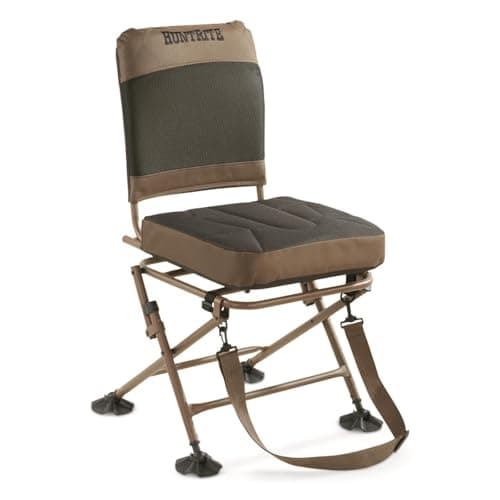
This is the single highest-impact purchase in ground blind hunting and the one hunters skip. A folding camp chair fails on three counts at once: it squeaks under any weight shift, it sits too low to shoot comfortably out of a blind window, and turning in it means lifting the whole chair and setting it back down while an animal watches the blind wall move.
A purpose-built blind chair fixes all three. Look for:
- A genuinely silent 360-degree swivel on a bearing, not a plastic pivot.
- Adjustable heightso you can match the seat to the blind's window height, which varies a lot between models.
- A compact footprint that fits inside a hub blind without pushing the walls, which is what makes a blind bulge visibly from outside.
- A backrest. On a five-hour sit this is not optional.
Blackout discipline and the backlighting mistake
The interior of a blind is dark. That darkness is what conceals you - as long as no light comes in behind you. Open a rear window and you have turned yourself into a silhouette in a lit frame, which is exactly what a deer's vision is built to detect.
The rules are simple and they are non-negotiable:
- Close every window except the ones you will shoot out of. Two or three, not eight.
- Wear black or very dark clothing inside a blind - not camo. Camo patterns are designed to break up a shape against vegetation; inside a blind you want to disappear into shadow, and dark solid colors do that better.
- Cover your face and hands. They are the brightest, most mobile things in the blind. A dark face mask or balaclava and dark gloves are the cheapest fix on this page.
- Keep your face back from the window opening, not pressed into it.
Window management
Set your windows before daylight, not when a deer appears. Opening or adjusting a window with an animal in view is the most common way hunters get caught in a blind.
- Open only the windows covering the direction deer will actually come from, based on the wind and the trail.
- Open them narrow - a slot rather than a square. You need enough to shoot through, not enough to see everything.
- If your blind has mesh, use it. Shoot-through mesh works for firearms and, with the right broadhead setup, for archery - but test it before opening day rather than discovering the answer on a live animal.
- Range your shooting lanes at first light and note the numbers. That way nothing moves when the deer arrives.
Brushing in and settling time
A ground blind is a large, hard-edged, geometric object that appeared overnight in a place where nothing like it has ever been. Deer notice. How much they care depends almost entirely on how long it has been there and how well it is broken up.
- Set it early where you can. Weeks, not days. Deer habituate to objects that do not change and do not smell like people.
- Brush it in. Cut vegetation from away from the blind - not from immediately around it, which creates a bare halo - and lean it against the sides and roof to break up the outline.
- Back it into cover. A blind against a treeline, a brush pile or a fence row reads as part of the background. A blind alone in the middle of a field reads as a box.
- Stake it down properly. A blind wall flapping in wind is more alarming than the blind itself, and a hub blind that blows over ends the hunt.
On public land where blinds cannot be left overnight, accept the compromise: back into cover, brush in what you can, and hunt it knowing that mature deer may give it a wide berth the first few sits.
Heaters and the ventilation rule
A radiant propane heater is the reason many hunters choose a blind at all. It is also the piece of equipment on this page with real safety requirements attached.
The two features to insist on are an oxygen depletion sensor, which shuts the heater off if oxygen in the space drops, and an automatic tip-over shutoff. The Mr. Heater Buddy line includes both.
Three sizes cover the range: the 3,800 BTU Little Buddy for a tight pop-up, the 9,000 BTU Portable Buddy as the general-purpose choice, and the 12,000 BTU Hunting Buddy for a larger box blind. Bring more fuel cylinders than you think you need - they run down faster in cold weather.
If you would rather not run a combustion heater, the alternative is battery-heated clothing plus hand warmers - see our heated hunting gear guide.
Wind, scent and blind placement
A blind contains some scent, and hunters routinely overestimate how much. Your scent still leaves through the windows, the seams and the door, and it does so at ground level - the height a deer's nose actually works at, rather than twenty feet up where a tree stand puts it.
Which means blind selection is a wind decision before it is anything else. Check the wind on the walk in and again from inside, because thermals shift at first and last light and what the forecast says at truck level is often not what the air is doing in a bottom.
For what the rest of the scent-control aisle can and cannot do, see our honest assessment of scent control.
What to carry into a blind
A blind removes the weight constraint of a tree stand - you can bring things you would never hoist thirty feet up. Use that.
- Hot liquid in a real thermos. Warm liquid raises core temperature and resets your tolerance for a few more hours.
- Hand warmers, even with a heater running - the heater warms the space, the warmers warm your hands.
- A headlamp with a red mode for the walk in and the walk out.
- Gear hooks or a small hanger so your bow or pack is not on the ground where you will kick it.
- A ground pad or piece of carpet under your feet. Boots shifting on dry leaves inside a blind is a surprisingly loud sound.
- Your kill kit - knife, gloves, game bags, drag.
If you still need the blind itself
Three directions worth knowing: a one-way see-through blind removes the tunnel vision and the backlighting problem at a price premium; a conventional hub blind is the value standard; and a large hub is what you want for two people or for filming.
Full comparison in our ground blind roundup, and the head-to-head decision is covered in ground blind versus tree stand.
The best argument for a blind
A ground blind is the best way to take a kid or a new hunter into the woods, and it is worth naming because it changes what you should buy.
Inside a blind, small movements are hidden, quiet conversation is possible, a heater makes cold weather survivable, and nobody has to climb anything. Buy a larger blind than you need for yourself, buy two chairs, and expect to run the heater more than you would alone.
Related: gifts for new hunters.
The full kit list
| Category | Item | Why |
|---|---|---|
| Setup | Ground blind, staked down | A flapping wall is worse than the blind |
| Setup | Brush and cordage to brush it in | Break the geometric outline |
| Setup | Ground pad or carpet square | Silences boots on dry leaves |
| Seating | 360-degree silent swivel chair | Turn without moving the blind wall |
| Concealment | Black or dark clothing | Disappear into the dark interior |
| Concealment | Dark face mask and gloves | Face and hands are the giveaway |
| Warmth | Propane heater with ODS and tip-over shutoff | Ventilate at all times |
| Warmth | Spare fuel cylinders | They run down faster in cold |
| Warmth | Hand warmers | The heater warms the room, not your hands |
| Warmth | Thermos of something hot | Resets your cold tolerance |
| Hunting | Rangefinder | Range lanes at first light |
| Hunting | Binocular | Sort deer without leaning into a window |
| Hunting | Wind checker | Blind choice is a wind decision |
| Hunting | Gear hooks | Bow off the ground |
| Light | Headlamp with red mode | In and out in the dark |
| After the shot | Knife, gloves, game bags, drag | Same kill kit as any hunt |
Hunting from a tree instead? See our tree stand day pack list.
Frequently asked questions
What do you need for ground blind hunting?
A blind that is staked down and brushed in, a silent 360-degree swivel chair, dark clothing plus a face mask and gloves for blackout discipline, a heater with an oxygen depletion sensor and tip-over shutoff, a wind checker, a rangefinder for setting your lanes at first light, and a ground pad to silence your boots. The chair and the blackout gear matter more than most hunters expect - and more than the blind model itself.
Should you wear camo in a ground blind?
Wear black or very dark solid colors instead. Camo is designed to break up your outline against vegetation, but inside a blind the concealment comes from darkness, and dark solids disappear into shadow better than a pattern does. Cover your face and hands as well - they are the brightest and most mobile things in the blind, and they are what deer catch first.
How long before hunting should you set up a ground blind?
As far in advance as your land rules allow - weeks rather than days. A blind is a large, hard-edged object that appeared overnight, and deer habituate to objects that stay put, do not change and do not smell like people. Where a blind cannot be left overnight, back it into a treeline or brush pile, brush it in with vegetation cut from elsewhere, and expect mature deer to be cautious for the first few sits.
Is it safe to run a propane heater in a hunting blind?
It is, provided you use a heater with an oxygen depletion sensor and an automatic tip-over shutoff and you keep a window or door cracked at all times. Any combustion heater consumes oxygen and produces carbon monoxide and water vapor, so a sealed blind is genuinely dangerous. Never fall asleep with one running, and be aware that the moisture a heater releases will condense on you and your gear in a closed space.
Does a ground blind contain your scent?
Only partially, and hunters routinely overestimate it. Scent still escapes through windows, seams and the door, and it does so at ground level - the height a deer's nose actually works at, rather than twenty feet up as it would from a tree stand. That makes wind direction the first factor in choosing which blind to sit, not an afterthought.
Sources
- CDC / NIOSH - cold stress overview and prevention (several layers of loose clothing for insulation, waterproof insulated boots and headwear; hats reduce body heat escaping from the head)
- Amazon product catalog - live availability, current pricing, BTU ratings, sizes and product images verified for every item linked on this page (checked 2026-09-06)
Keep reading
Gearing up before your next hunt?
See how we evaluate gear, then dig into the reviews and buying guides — written without inventory to sell.