Buying Guide
Best Camo for Turkey Hunting: Why Full Coverage Is Not Optional
A turkey sees color, resolves detail roughly three times better than you do, and watches nearly 360 degrees at once. Bare hands and a pale face are what get you busted - not your jacket brand.
Turkeys are a harder visual problem than deer, and it is not close. They have full color vision, resolution commonly described as roughly three times sharper than a person with 20/20, and effectively 360-degree awareness. A whitetail might tolerate a bare hand at 30 yards in low light. A gobbler at 40 yards in full spring sun will pick up your face, your hands, and the flash of your watch, and it will leave without ever committing.
So turkey camo is a coverage problem before it is a pattern problem. This guide covers what you must cover, the colors that are genuinely dangerous to wear in turkey woods, and five pieces that get you dressed correctly for spring.
What a turkey actually sees
| Full color vision | Unlike deer, turkeys see the red and orange end of the spectrum clearly. Nothing about your loadout gets a free pass because 'deer cannot see it' |
|---|---|
| Roughly 3x human visual acuity | Detail that a deer's fuzzy vision would blur is legible to a turkey. This is the practical reason your face and hands matter so much |
| Near-360-degree awareness | Wide-set eyes and a mobile neck mean a turkey covers almost the full circle. There is no reliable blind side to move on |
| Motion detection at range | A gobbler will pick up a hand adjusting a gun barrel at distances that would never register to a deer |
| What they hunt for | Pattern disruption - anything in the landscape that does not belong. Consistency across your whole outfit matters more than which pattern family you chose |
The three colors you must never wear
Red, white and blue. This is not a concealment guideline — it is the most important safety rule in turkey hunting.
Those three colors are exactly the colors of a mature gobbler’s head. Turkey hunting is the one discipline where hunters deliberately call other hunters toward them, sitting still and camouflaged against a tree. A flash of red on a hat, a white t-shirt collar, or blue jeans below a jacket is the single most common factor in turkey-hunting shooting incidents.
- No red, white or blue anywhere in your outfit, including socks, undershirt collars and pack accents.
- Carry blaze orange to wear when moving between setups and when carrying a bird out.
- Never stalk a gobble. The thing making it may be a person.
- Set up against a tree wider than your shoulders and taller than your head — concealment and a backstop at the same time.
Head-to-toe coverage, piece by piece
| Piece | Why it matters | What to look for |
|---|---|---|
| Face mask | Your face is the brightest, most mobile thing about you | Mesh or thin knit that breathes, does not fog optics, and does not shift when you shoulder a gun |
| Gloves | Hands move constantly - calling, adjusting, mounting the gun | Thin enough to run a call and find a safety by feel. Thick gloves get pulled off, which defeats them |
| Long sleeves, always | Forearms are pale and mobile | Spring-green pattern in a breathable fabric |
| Hat | Breaks the round human head shape | Brimmed, matte, with no logos in bright colors |
| Pants | You sit on the ground for hours | Durable seat, and ideally water resistant - spring ground is wet |
| Vest | Carries calls, seat, decoys and shells where you can reach them silently | Padded seat, kickstand frame if you sit long, quiet closures over noisy zippers |
| Boots | Wet spring mornings and mud | Waterproof, and rubber if you also worry about scent on the walk in |
One more time on consistency: turkeys read pattern disruption, so an outfit that is broadly the same tone and family head to toe reads better than a premium jacket over mismatched pants. Full coverage in a $150 outfit beats partial coverage in a $600 one.
Dressing for spring weather swings
A spring turkey morning routinely starts at 35 degrees and ends at 70. You will walk in the dark, sit still while it is coldest, then move and sweat once the sun is up. The system that works:
- A light merino or synthetic base layer— enough to take the edge off the pre-dawn sit without cooking you at 10 a.m. See hunting base layers.
- A long-sleeve camo shirt as the main garment for the day.
- A packable wind and rain jacket that comes off and goes in the vest by mid morning. Spring rain is the norm, not the exception.
- Mask and gloves in a pocket, on before the setup, off for the walk between spots.
The picks at a glance
| Piece | Role | Standout | Approx. price |
|---|---|---|---|
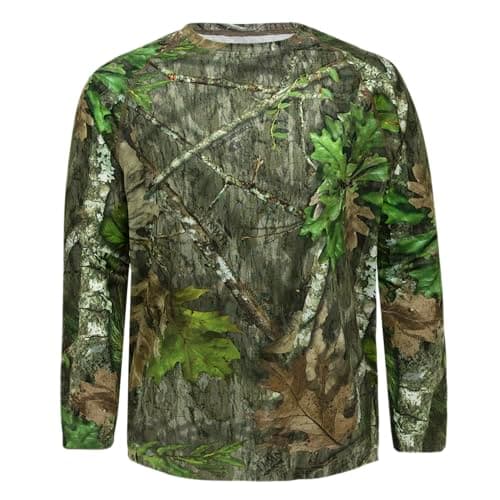
| Mossy Oak Long Sleeve Camo Shirt | Main spring garment | Breathable, cheap enough to own two | ~$27 |
| 3-Piece 3D Camo Face Mask Set | Face coverage | Three styles for the price of one premium mask | ~$22 |
| Camo Mesh Balaclava | Warm-weather face coverage | Lightest and most breathable option | ~$10 |
| Nomad Barrier NXT Jacket | Wind and rain shell | Wind and waterproof with a quiet face | ~$119 |
| Nomad Turkey Vest | Carry system and seat | Padded seat plus organized call storage | See our turkey vest guide |
Prices are approximate mid-2026 brackets; verify before buying.
Best spring base garment: Mossy Oak Long Sleeve Camo Shirt
The workhorse. A long-sleeve camo shirt at roughly $27 (verify current pricing) is the single most useful turkey garment you can buy, because turkey hunting is warm-weather hunting where a jacket comes off by 9 a.m. and the shirt is what the bird actually sees for the rest of the morning.
Mossy Oak’s spring-oriented patterns are built for exactly this background: new green foliage, hardwood trunks, and the dappled light of an April morning. At this price, buy two — one stays in the truck, and you will be glad of it the first time you crawl a wet ridge.
Honest cons: it is a basic shirt. Do not expect technical moisture management, a hunting-specific articulated cut, or thorn resistance. Sizing runs generous, which is actually welcome over a base layer.
Best mask value: 3-piece 3D camo face mask set
Face masks are personal and no single style suits everyone, which is why a multi-piece set at around $22 (verify current pricing) is smart money: you find out which style you actually tolerate for four hours without spending $25 three times.
The three things that decide whether a mask works: it breathes well enough that you are not panting inside it, it does not fog a scope or a red dot, and it stays put when you mount a gun. A mask you keep pulling down is worse than no mask, because pulling it down is movement.
Honest cons: budget masks vary in fabric quality, and the 3D leafy styles catch on brush and gun stocks. Check that the mouth opening lines up if you run a diaphragm call.
Lightest option: camo mesh balaclava
For late-season, warm-morning hunts, a lightweight mesh balaclava at around $10 (verify current pricing) is the most breathable way to keep your face covered. Mesh is the material that lets you sit through a 75-degree late-April morning without deciding that hiding your face is optional.
Honest cons: mesh offers no warmth, it snags easily, and cheap versions stretch out after a season. At this price that is an acceptable trade — treat it as a consumable.
Cold, wet mornings: Nomad Barrier NXT Jacket
Spring rain is not an edge case. The Barrier NXT is a wind- and waterproof hunting jacket at roughly $119 (verify current pricing) with the quiet face fabric Nomad builds its reputation on, which matters at turkey ranges where a bird is inside 30 yards and hyper-alert.
It handles the coldest part of the day and the wettest, and it packs into a vest once the sun is up — the two things a spring shell has to do.
Honest cons: it is a shell, not an insulated jacket, so a genuinely cold April morning needs a layer under it. It is also more jacket than a hunter in the Deep South will ever need — match the purchase to your latitude.
For the wider rain-gear picture, see our hunting rain gear guide.
The vest that carries it all
The turkey vest is the piece that turns a pile of gear into a hunt: calls where your hand can find them without looking, a padded seat so you can sit out a stubborn gobbler, and shell loops within reach. Nomad’s vest is the one we cover in detail in our best turkey vests guide, along with the alternatives at every price point.
The features that actually matter: a real padded seat (or a kickstand frame if you sit for hours), silent closures rather than noisy zippers, and pockets sized for the specific calls you run.
The Kings turkey collection
Kings Camo runs a dedicated turkey-gear collection with spring patterns sized from kids through 3XL, which makes it a practical option for outfitting a young hunter head to toe at once — the situation where full coverage matters most and budgets are tightest.
The bottom line
Cover everything, match the tone head to toe, and never wear red, white or blue. A long-sleeve camo shirt, a mask, thin gloves and a vest is a complete turkey outfit for under $100, and it will outperform a premium jacket worn with bare hands every single time.
Then the rest of the spring loadout — calls, decoys and the choke that patterns — is in our spring turkey gear guide, and the vision science behind all of this is in hunting camo patterns explained.
Frequently asked questions
Do I really need a face mask and gloves for turkey hunting?
Yes. Turkeys have full color vision and visual acuity commonly described as roughly three times sharper than human 20/20, plus near-360-degree awareness. Your face and hands are the palest, most mobile things about you, and they are what a gobbler picks up at 40 yards in spring sun. Full coverage is the requirement that separates turkey camo from deer camo.
What colors should you never wear turkey hunting?
Red, white and blue - the exact colors of a mature gobbler's head. This is primarily a safety rule rather than a concealment one: turkey hunters deliberately call other hunters toward them while sitting camouflaged against a tree, and a flash of those colors is the most common factor in turkey-hunting shooting incidents.
Does turkey camo pattern matter, or just coverage?
Coverage first by a wide margin, then consistency. Turkeys look for pattern disruption - anything that does not belong in the landscape - so an outfit that reads as one consistent tone and family head to toe works better than a premium jacket paired with mismatched pants. Match the pattern to spring green foliage and you have done the important part.
Do turkeys smell as well as deer?
No, and it is the one advantage you get. A wild turkey's sense of smell is poor compared with a whitetail's, which means the scent-control budget you would spend on a deer hunt goes to concealment and stillness instead. Wind direction still matters for sound, not for scent.
What should I wear turkey hunting in warm weather?
A light base layer, a breathable long-sleeve camo shirt, durable pants with a seat you can sit on wet ground in, a mesh face mask, and thin gloves. Carry a packable wind and rain shell for the pre-dawn sit and the inevitable spring shower, and shed it into your vest once the sun is up.
Is a turkey vest worth buying?
For anyone hunting more than a couple of mornings a year, yes. The vest is what lets you carry multiple calls where you can reach them silently, sit comfortably enough to outlast a hung-up gobbler, and keep shells and a bird carrier accessible. A padded seat alone changes how long you are willing to stay put, which is most of turkey hunting.
Sources
- National Wild Turkey Federation - turkey vision
- HuntWise - what to wear turkey hunting in the spring
- TideWe - turkey hunting and colors: what to avoid
- Massachusetts Division of Fisheries and Wildlife - turkey hunting safety
- Maine Department of Inland Fisheries and Wildlife - turkey hunting regulations and safety
- Product specs, availability and pricing verified via the Amazon Creators API, 2026-08-13
- Kings Camo - turkey gear collection
Keep reading
Gearing up before your next hunt?
See how we evaluate gear, then dig into the reviews and buying guides — written without inventory to sell.