Buyer's Guide
Best Hunting Bibs: Insulation Weight, Leg Zips, and Why Your Legs Get Cold First
Bibs beat insulated pants for one reason that has nothing to do with warmth ratings: they cover the lower back you uncover every time you sit down. Here are four compared on the numbers makers actually publish, with honest cons on every pick.
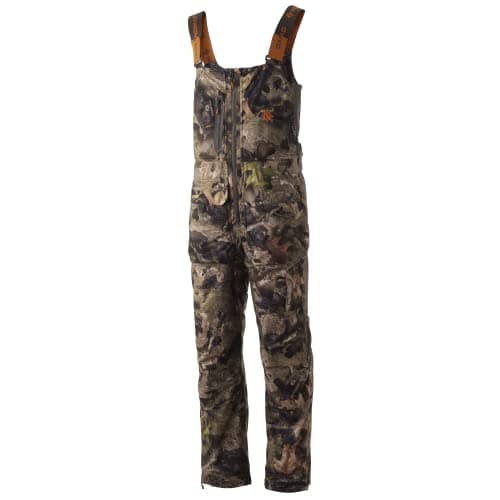
For most hunters the best hunting bib is the Nomad Conifer NXT: 100 grams of PrimaLoft insulation behind a waterproof, windproof shell with a brushed fleece interior, taped seams, waterproof zippers and Ever-adjust suspenders. It wins because 100 grams is the weight that still works in October and can be layered under for December, and because a quiet face fabric is the one property you cannot add later.
If your problem is that nothing keeps you warm past about 20 degrees, the sherpa-lined Huntworth Matterhorn Heat Boost is built for exactly that and its maker rates it for it. If you hunt a gun season from a box blind and do not need camo, the Carhartt Washed Duck gives you 80 grams of Thinsulate under 12-ounce duck for a lot less money. And if you are the hunter who genuinely stops functioning in the cold, TideWe's heated bibs solve it with a battery rather than with bulk.
The verdict
Hunting bibs are a category where the marketing talks about warmth and the field problem is almost always something else: wind on a tree stand platform, a wet seat on a 40-degree morning, a side zip that will not go over a boot in the dark, or a bib so loud that the deer leaves before the shot. The four picks here are separated by insulation weight and shell construction, both of which makers publish, rather than by feel claims that nobody can verify.
We have not worn-tested these bibs side by side and we are not going to pretend otherwise. Every figure below is the maker's or the retailer's published specification, cited at the bottom of the page, and where retailers disagree we say so.
The spec table
| Bib | Insulation (published) | Shell | Waterproofing | Price bracket |
|---|---|---|---|---|
| Nomad Conifer NXT | 100g PrimaLoft, brushed fleece interior | Waterproof and windproof shell, DWR finish | Taped seams, waterproof zippers | Mid |
| Huntworth Matterhorn Heat Boost | 60g polyfill plus graphene Heat Boost sherpa lining | Suede-finished tricot bonded to a film membrane | Stated 100% waterproof with taped seams; reinforced seat | Premium |
| Carhartt Washed Duck Insulated Bib Overall | 80g 3M Thinsulate featherless through the legs | 12-oz ring-spun washed cotton duck | Water-repellent duck, not a waterproof membrane | Mid |
| TideWe Heated Hunting Bibs | Battery-heated, three levels; 140g insulation per the Lowe's listing | 100% polyester, reinforced knees | Sealed seams, listed as waterproof | Mid |
Price brackets rather than numbers, deliberately: bib prices move with the season and a figure typed here in October is wrong by December. The live price sits in the buy row on each pick.
Why bibs and not insulated pants
There is one real argument for bibs and it is worth stating precisely, because it is not the one most people give.
When you sit down in a tree stand, your jacket rides up and your waistband drops. The gap that opens across your lower back and kidneys is a large surface area of thin base layer directly against a cold seat, and it stays open for the entire sit because you are not standing up to fix it. Insulated pants do nothing about that gap. A bib covers it with the same insulation as the rest of the garment and holds it there with suspenders rather than a belt.
That is also why the bib matters more for a stand hunter than for a walker. On the move, your legs generate heat and the gap closes every stride. On a stand you lose heat conductively to the seat for ten hours and generate almost none. Our guide to staying warm in a tree stand makes the same point from the other direction, and the layering guide covers where the bib sits in a full system.
The costs of bibs are real too: they are harder to get on and off over boots, they are warmer than you want on the walk in, and the bathroom logistics are worse. Nearly all of that is solved by leg zips, which is the next section.
What actually decides a hunting bib
| Criterion | Why it decides the sit |
|---|---|
| Insulation weight against your activity level | Grams of synthetic fill is the one comparable warmth number makers publish. Roughly: 60-80g suits an active hunter or a mild sit, 100g is the all-round stand weight, and anything heavier is a sitting-still-in-the-cold garment you will overheat in on the walk. The number is only meaningful next to how much you move. |
| Waterproof membrane vs water-repellent fabric | A taped-seam membrane with waterproof zippers keeps rain out for hours. A DWR finish on cotton duck sheds a shower and then wets through and gets heavy and cold. Both are legitimate; they are for different weather, and the price gap between them is mostly this. |
| Leg zips - how far up they go | Zip-to-hip or full-length side zips let you put bibs on over boots, dump heat on the walk in, and get out of them without a wrestling match in the dark. Ankle-only zips are the single most common reason an otherwise good bib annoys its owner. |
| Face fabric noise | Brushed fleece and suede-finished tricot are quiet against brush and against a bow riser. Hard-shell nylon and stiff duck are not. If you bowhunt, this outranks insulation weight - a warm hunter who gets busted at 18 yards has gained nothing. |
| The harness and the seat | You wear a safety harness over the bib, so suspender adjustability and a non-bulky bib front matter. And the seat fabric takes everything: a reinforced or abrasion-resistant seat panel is a durability feature worth paying for on a stand bib. |
Best overall: Nomad Conifer NXT Bib
The Conifer NXT is the bib that fits the most of the season. Nomad builds it with 100 grams of PrimaLoft insulation, a brushed fleece interior, a waterproof and windproof shell with a DWR finish, taped seams, waterproof zippers, Ever-adjust suspenders and an adjustable waistband. The brushed fleece is the detail that makes it a bowhunting bib rather than just a warm one.
One hundred grams is the right default for a stand hunter in most of the whitetail range. It is warm enough on its own for October and November and it accepts a heavy base layer underneath for the cold end of the season, which a 200-gram bib does not — you cannot subtract insulation from a garment, only add it underneath. If you are buying one bib and you do not already know you run cold, buy this weight.
Honest cons: 100 grams is not a late-December-in-Wisconsin bib, and hunters who sit all day in single digits will want the Matterhorn below. Published waterproof and breathability ratings for this bib circulate in hunting media as 35K and 15K, but we could not confirm those on a Nomad spec sheet and the same figures are attributed elsewhere to the Hailstorm NXT line, so we are not treating them as verified. Nomad has also moved the Conifer line to a VX3 generation, so check which generation a listing is selling before you buy on a review you read somewhere else. It pairs naturally with the Harvester NXT jacket we pick in our whitetail camo guide.
Coldest sits: Huntworth Matterhorn Heat Boost
The Matterhorn is the answer to a specific complaint: “I own good bibs and I am still cold at hour six in December.” Huntworth builds it with 60 grams of polyester fill plusa graphene Heat Boost sherpa lining, a suede-finished tricot shell bonded to a film membrane, taped seams, and a reinforced seat in a waterproof, abrasion-resistant material. North40 publishes a recommended temperature range of −10 °F to 20 °F with proper layering, which is an unusually specific claim for this category and the clearest statement of intent we found.
The construction is worth understanding, because the fill number alone makes it look thinner than the Conifer. It is not: the sherpa lining is doing most of the insulating work, and a lofted sherpa against a base layer traps more air than an equivalent weight of flat fill. The suede-finished face is also genuinely quiet, which is rare at this warmth level.
Honest cons:this is the most expensive bib on the page and it is a single-purpose garment — you will cook in it above about 35 degrees, and the walk in is a problem rather than a warm-up. Retailer listings also disagree on the camo and membrane description: Tractor Supply lists Tarnen camo with a waterproof membrane while Scheels describes Vertek camo bonded to a windproof film, so confirm the colorway and the membrane on the specific listing you buy. The warranty is one year limited.
Best value: Carhartt Washed Duck Insulated Bib Overall
The most under-rated hunting bib is not a hunting bib. Carhartt's Washed Duck Insulated Bib Overall is 12-ounce ring-spun washed cotton duck with 80 grams of 3M Thinsulate featherless insulation carried through the legs, and for a firearm-season hunter in a box blind or a ground blind it does the job at a fraction of what a camo equivalent costs.
Two things make it a legitimate pick rather than a compromise. Washed duck is soft and quiet in a way that new, stiff duck is not — the washing is the point — and cotton duck is close to indestructible against brush, steel ladder rungs and blind frames. Carhartt describes this bib as the update to the R27, one of its most popular lined bibs, and it is the same garment farmers wear every winter for a living.
Honest cons:it is not camo, and it is not waterproof. Cotton duck sheds a light shower and then wets out, and wet cotton is heavy and actively cold — this is a dry-cold bib, full stop. Eighty grams is also the lightest insulation here, so it is a layering piece rather than a standalone late-season answer. If you bowhunt or hunt a state where blaze is not required and camo matters, buy one of the others; if you sit a blind with a rifle in dry cold, this is the value pick on this page by a distance. Note also that Carhartt's older R41 quilt-lined bib is a different product with a midweight polyester fill that Carhartt does not publish a gram figure for.
Best heated: TideWe Heated Hunting Bibs
Heated apparel is the honest answer for a specific hunter: the one whose circulation, age, medication or old injury means that no amount of insulation fixes the problem, because the body is not producing the heat the insulation is supposed to trap. Insulation is a container. If there is nothing to contain, you need a heat source.
TideWe's heated bibs run three heat levels from an included 10,000 mAh power bank, with heating elements at the front pockets and the mid-back — which is exactly the lower-back-and-kidneys zone the whole bib argument is built around. The listed battery life is about 10 hours on low, 5.5 on medium and 3 on high, the shell is 100% polyester with sealed seams and reinforced knees, and Lowe's lists a 140-gram insulation layer underneath the heating.
Honest cons:a heated garment is a garment with a failure mode. Cold kills lithium battery capacity, so the 10-hour low-setting figure is a room-temperature number and you should plan on less in the conditions you actually bought it for. The high setting's three hours will not cover a dark-to-dark sit. You also have to remember to charge it, which is a new way to be cold that an unheated bib does not offer. Treat the heat as a supplement to a proper layering system, not a replacement for one — and see our heated gear roundup for how the rest of the category compares.
The system option: Kings XKG
The other way to buy bottoms is to stop buying a bib and buy into a layering system, where the insulation lives in dedicated layers and the outer bottom is a shell. Kings builds the XKG series around that idea, and it is the approach we describe in the cold-weather clothing guide: base, mid, insulation, shell, each one doing a single job.
The system approach is more expensive up front and more versatile afterward, because every piece gets worn on more days than a single heavy bib does. The bib approach is cheaper, simpler and better at the one thing it does. Neither is wrong; buy the system if you hunt a wide temperature range, buy the bib if you mostly hunt cold.
Sizing bibs over a layering system
The most common sizing mistake is buying a bib in your pants size. A bib goes over a base layer and often over a mid layer, and a bib that fits over jeans in a store is a bib that compresses your insulation in the field — which makes you colder, because compressed loft is not loft.
Three practical rules. Size for the layers you will actually wear underneath on the coldest day you expect, not the average day. Check the inseam separately from the waist, because bib sizing collapses both into one number far more often than pants sizing does. And check that the suspenders adjust enough to let the bib sit high across the lower back while still clearing a harness buckle — which is the fit detail nobody tries in a store and everybody discovers in a tree.
Who should buy pants instead
Bibs are not universally correct, and the hunters they are wrong for are easy to identify.
If you walk more than you sit— spot-and-stalk, still-hunting, elk country, a mile-plus hike to the stand — a bib is a heat trap with no good way to vent. Insulated or softshell pants with a separate insulating layer you add at the stand work far better, which is the approach in our still-hunting layering guide.
If you hunt early season, skip the category entirely. Nothing here is right for 50-degree mornings; see the early-season clothing guide instead.
If you already own a good insulated pant and a full base and mid system, a bib is a duplicate purchase for most of the season. The honest upgrade in that case is a better base layer or a heated vest, not a fourth bottom.
Everyone else — stand hunters, blind hunters, anyone who sits still in cold weather and has noticed their lower back is the part that goes first — is buying the right garment. Start with the Conifer NXT, size it over your layers, and check it against your harness before opening day.
Frequently asked questions
Are hunting bibs warmer than insulated hunting pants?
At the same insulation weight, the bib is warmer in practice for a seated hunter, and not because of the fabric. Sitting down lifts your jacket and drops your waistband, opening a gap across the lower back and kidneys that stays open for the whole sit. A bib covers that gap with full insulation and holds it in place with suspenders. On the move, where your legs generate heat and the gap closes every stride, the difference largely disappears.
How many grams of insulation do I need in hunting bibs?
Match it to how much you move. Roughly 60 to 80 grams of synthetic fill suits an active hunter or a mild sit, 100 grams is the all-round stand weight for most of the whitetail range, and heavier than that is a sitting-still-in-serious-cold garment you will overheat in on the walk. Buy 100g if you are buying one bib, because you can add a base layer underneath but you cannot remove insulation from a garment.
Do hunting bibs need to be waterproof?
It depends on your weather, and it is most of the price difference in this category. A taped-seam membrane with waterproof zippers - the Nomad Conifer NXT and the Huntworth Matterhorn both have one - keeps rain out for hours. Water-repellent cotton duck like the Carhartt sheds a shower and then wets through, and wet cotton is heavy and actively cold. If you hunt wet country, buy the membrane; if you hunt dry cold, the duck is a far better value.
Can you wear a safety harness over hunting bibs?
Yes, and you should, but check the fit before the season rather than at the stand. Bibs add bulk at the waist, hips and thighs, and the leg straps on a full-body harness can run out of adjustment over a heavy pair. Put the bib on over your full layering system with boots, then fit the harness over the top and adjust it. Four minutes in October prevents a bad improvisation in the dark in December.
Are heated hunting bibs worth it?
For a specific hunter, yes. Insulation only traps heat your body produces, so if circulation, age or an old injury means the heat is not there, more insulation does not help and a heat source does. TideWe's bibs run three levels off a 10,000 mAh power bank with listed run times of about 10 hours on low, 5.5 on medium and 3 on high. Plan on less in real cold, because low temperatures cut battery capacity, and treat the heat as a supplement to a proper layering system rather than a replacement for one.
What size hunting bibs should I buy?
Size for the layers you will wear underneath on the coldest day you expect, not for your pants size. A bib that fits over jeans compresses your insulation in the field, and compressed loft does not insulate. Check the inseam separately from the waist, since bib sizing often collapses both into one number, and confirm the suspenders adjust enough for the bib to sit high across the lower back while still clearing a harness buckle.
Sources
- Nomad Conifer NXT Bib published description: 100g PrimaLoft insulation, brushed fleece interior, waterproof and windproof shell, DWR coating, taped seams, waterproof zippers, Ever-adjust suspenders, adjustable waistband. 35K waterproof / 15K breathable figures are reported by hunting media and were not confirmed on a Nomad spec sheet; Nomad has since introduced a Conifer VX3 generation
- Huntworth Matterhorn Heat Boost bib overalls retailer-published specifications: 60g polyfill insulation, graphene Heat Boost sherpa lining, suede-finished tricot shell bonded to a film membrane, 100% waterproof with taped seams, reinforced waterproof abrasion-resistant seat, one-year limited warranty; North40 publishes a recommended range of -10 F to 20 F with proper layering. Camo and membrane descriptions differ between Tractor Supply (Tarnen, waterproof membrane) and Scheels (Vertek, windproof film)
- Carhartt Washed Duck Insulated Bib Overall (style 104031) published specifications: 12-oz ring-spun washed cotton duck, 80g 100% polyester 3M Thinsulate featherless insulation through the legs; described by Carhartt as an update to the R27. The separate R41 Duck Zip-to-Thigh Bib uses an unspecified midweight polyester fill
- TideWe heated hunting bibs published specifications: three heat levels, heating zones at the front pockets and mid-back, included 10,000 mAh power bank, listed run time approximately 10 hours low / 5.5 medium / 3 high, 100% polyester shell with waterproof sealed seams, reinforced knees, sizes S-3XL; Lowe's lists a 140g insulation layer
- Kings Camo - XKG series layering system
- Product availability, titles and stock status verified via the Amazon Creators API, 2026-10-21
- Prices, product images and stock status via the Amazon price layer, refreshed daily
Keep reading
Gearing up before your next hunt?
See how we evaluate gear, then dig into the reviews and buying guides — written without inventory to sell.