Buying Guide
Best Camo for Whitetail: What Actually Matters from a Treestand
Whitetails do not read your pattern - they catch movement, silhouette and anything that glows in ultraviolet. Here is how to choose camo for the way deer actually see, and five jackets that do the job.
Ask what the best camo for whitetail is and you will get brand names. The honest answer is that the pattern is the least important variable on the garment. A whitetail has two color receptors instead of three, resolves detail poorly, sees ultraviolet directly because it lacks the UV filter in our eyes, and detects motion across roughly 300 degrees. It is superb at spotting a moving, overly bright human shape and mediocre at reading printed leaves.
So this guide ranks jackets on what a deer can actually detect: noise, tone, macro contrast, and UV brightness. The full vision science is in hunting camo patterns explained; this page is the shopping half of it.
What a whitetail actually sees
| Two color receptors | Blue and green/yellow. No red cone, so red reads as gray or black and orange and yellow look muted - which is why blaze orange is a workable safety compromise in deer woods |
|---|---|
| Extreme blue and UV sensitivity | Deer lack the UV-blocking lens humans have. Fabric washed in ordinary detergent with optical brighteners can appear conspicuously bright, especially at dawn and dusk when UV is a bigger share of ambient light |
| Poor detail resolution | Detailed leaf-and-twig prints blur into one solid tone well inside shooting distance. Large light-and-dark blocks are what keep working |
| Motion detection across ~300 degrees | The primary defense. No pattern compensates for a hunter who moves at the wrong moment |
| Excellent low-light vision | Peaking in exactly the hours you will be hunting - see when deer move |
The four criteria that matter
- Fabric noise.Brushed polyester, tricot, fleece and micro-suede faces are quiet. Crisp ripstop nylon is not. Test it by rubbing the sleeve against itself next to your ear — if it crackles, put it back.
- Tone match. Get the overall lightness right and you are most of the way there. Early-season eastern woods are green and dark; late-season hardwoods are gray and brown; a green jacket in November stands out more than the wrong brand of brown one.
- Macro contrast. Squint at the garment from 15-20 yards. If large contrasting blocks still break up the shape, the pattern is working. If it goes to a uniform blob, the print is decorative.
- UV management. Wash in a UV-free hunting detergent, never with household laundry, and skip fabric softener. Free, and the highest-leverage change most hunters never make.
Then there is fit, which is not about deer at all: a jacket that binds at full draw or rides up when you sit costs you shots. Treestand cuts run longer in the body and are articulated through the shoulder for exactly this reason.
Early, mid and late season are three different problems
| Season | The problem | What to buy |
|---|---|---|
| Early (Sept-Oct) | Warm, buggy, green foliage, sweat on the walk in | Lightweight quiet shirt or soft-shell in a green-forward pattern. Breathability over insulation |
| Mid / rut (Nov) | Wide temperature swings, long sits, the most movement of the year | A quiet wind-resistant mid-season jacket over a midweight base layer. The single most useful jacket to own |
| Late (Dec-Jan) | Cold, still, bare gray woods, minimal movement | Insulated quiet outer layer in gray/brown tones, sized to fit over a heavyweight base layer |
| Wet, any season | Noise and wet-out | A brushed-face waterproof shell - see our rain gear guide |
The single most common mistake is buying one heavy insulated jacket and wearing it from October to January. You sweat through the shoulder seasons and you are not warm enough in January anyway. Two layers of moderate warmth beat one heavy layer every time — the full logic is in cold weather hunting clothes.
The picks at a glance
| Jacket | Season | Fabric noise | Standout | Approx. price |
|---|---|---|---|---|
| Nomad Harvester NXT | Mid / rut | Very low | Sound-suppressing face fabric, wind resistant | ~$100-110 |
| Mossy Oak Sherpa Fleece Lined | Mid to late | Very low | Fleece hand at a mid price | ~$100-110 |
| ScentLok BE:1 Reactor | Mid season | Low | Carbon scent-control layer built in | ~$190 |
| TIDEWE Silent Fleece-Lined | Mid to late | Very low | Best cost per warm, quiet sit | ~$105 |
| Under Armour Brow Tine ColdGear | Cold, active | Moderate | Warmth for the weight when you are moving | ~$115 |
Prices are approximate mid-2026 brackets and vary by pattern and size; verify before buying.
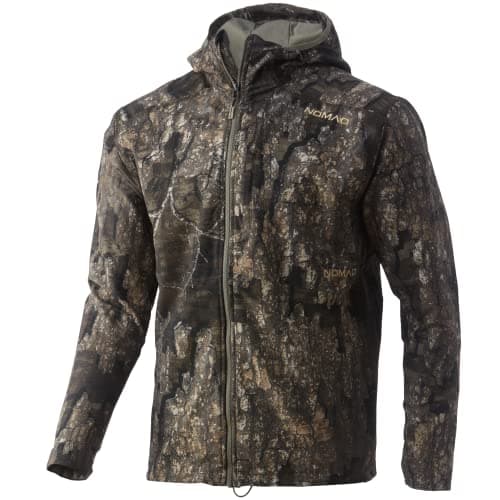
Best all-around: Nomad Harvester NXT Jacket
Nomad built the Harvester line around the whitetail hunter’s actual problem, and the NXT is the version that gets it right: a wind-resistant mid-season jacket with a sound-suppressing face fabric, cut long enough to stay put seated, at roughly $100-110 (verify current pricing).
Wind resistance is the underrated half of that description. A November sit at 40 degrees with a 15-mph wind is colder than a still 25-degree morning, and a wind-blocking outer layer over a midweight base layer covers a genuinely enormous range of conditions. It is the jacket we would own if we could own one.
Honest cons: wind resistant is not waterproof — you still need a shell for real rain — and it is not an insulated jacket, so single-digit sits need a layer under it that this jacket has to fit over. Buy accordingly rather than sizing tight. Nomad’s pricing also moves a lot by pattern and size; check more than one colorway.
Who it’s for: the rut hunter who wants one jacket for the month that matters most.
Quietest for the money: Mossy Oak Sherpa Fleece Lined Jacket
Fleece is the quietest common hunting fabric, full stop — there is essentially no contact noise to make — and Mossy Oak’s sherpa-lined camo jacket delivers that property with real warmth for around $100-110 (verify current pricing).
For a bowhunter in a stand, this combination is close to ideal: silent at draw, warm enough for mid-to-late season over a base layer, and available in patterns designed for eastern hardwood tones rather than western open country.
Honest cons: fleece is the worst common fabric in wind and it soaks up rain readily, so this is a jacket that wants a shell over it in weather rather than one that handles weather itself. It also picks up burrs and seeds like Velcro, and it is bulkier in a pack than a shell of equivalent warmth.
Who it’s for: bowhunters and anyone whose deer woods are calm and timbered rather than open and windy.
Best with scent control: ScentLok BE:1 Reactor
ScentLok’s pitch is that the carbon-based adsorption layer built into the garment captures human odor. The BE:1 Reactor is their mid-season wind-resistant jacket with that technology integrated, at around $190(verify current pricing) — a real premium over the jackets above.
Our position on scent-control clothing is stated plainly in our scent control guide: the category is contested, the effect is bounded, and nothing in it substitutes for hunting the wind. What is not contested is that the BE:1 Reactor is a well-built, quiet, wind-resistant mid-season hunting jacket independent of the carbon. If you value the technology, you are not paying a premium for a bad jacket.
Honest cons: you are paying roughly $80 over comparable jackets for a technology whose real-world benefit is debated and which requires a specific care routine to maintain. It is also a mid-season weight — not a late-season jacket — despite the price suggesting otherwise.
Who it’s for: hunters who already believe in scent-control apparel and want the best-built version, and anyone hunting small properties where the wind cannot always be respected.
Best budget: TIDEWE Silent Fabric Fleece-Lined Jacket
TIDEWE has become the default answer to "I need hunting clothes and I do not have $400," and it earns that on merit rather than on price alone. This is a silent-face, fleece-lined camo jacket around $105 (verify current pricing), often sold as a jacket-and-bib set, which puts a complete quiet outer layer in reach for a first-season hunter.
The fabric hand is genuinely quiet — not "quiet for the price" — and the warmth is real. For a new hunter, spending here and putting the savings into boots or a rangefinder is the correct allocation.
Honest cons: this is where the value shows. Zipper quality, DWR longevity and pattern registration are all a tier below the name brands, sizing runs inconsistent enough that reading recent reviews for your size is worth the five minutes, and the water resistance is light-rain only. Expect three or four seasons, not fifteen.
Who it’s for: new hunters, hunters outfitting a kid, and anyone who wants a quiet spare set in the truck.
Best for cold, active sits: Under Armour Brow Tine ColdGear Infrared
Under Armour’s Brow Tine is the outlier here and useful precisely because it is different: a ColdGear Infrared insulated hunting jacket at around $115 (verify current pricing) that prioritizes warmth-to-weight over dead silence.
That trade makes sense for a specific hunter — one who walks a long way to a stand in the cold, or who still-hunts and needs a jacket that does not overheat on the move. The insulation is light for the warmth and the cut is athletic rather than boxy.
Honest cons: the face fabric is the noisiest on this page. It is not a crackling shell, but a bowhunter drawing at 18 yards will notice the difference against the Sherpa or the Nomad. Sizing runs athletic, so layering room is tight, and Under Armour’s hunting patterns rotate in and out of availability.
Who it’s for: gun hunters, still-hunters, and anyone whose walk in is long enough that jacket weight matters.
The Kings Camo value play
Kings Camo’s hunting lineup covers the same ground as the picks above at prices that undercut the premium technical brands, with patterns built around both eastern timber and western terrain. If you are buying a full system rather than one jacket, keeping it in one line keeps layering thickness and sizing consistent — a real, unglamorous advantage. Our Kings XKG review and Kings vs Sitka comparison cover where the value holds up and where it does not.
The bottom line
For most whitetail hunters the Nomad Harvester NXT is the single best jacket to own, because wind resistance plus a quiet face covers the widest range of November days. Add the Mossy Oak Sherpa if you bowhunt calm timber and want the quietest thing available, the TIDEWE if the budget is the binding constraint, and the ScentLok BE:1 if scent-control apparel is part of your system.
Then remember the ordering. Sit still, keep cover behind you, wash your camo in UV-free detergent, and hunt the wind. Those four cost almost nothing and matter more than any jacket on this page. For the rest of the system, see base layers, rain gear and when deer move.
Frequently asked questions
Does camo pattern really matter for whitetail hunting?
Less than most hunters think. Deer are dichromatic with poor detail resolution, so fine printed leaf detail blurs into one tone at normal shooting distance. What matters is overall tone match, large-scale light-and-dark contrast that breaks your outline, fabric that does not make noise, and not glowing in ultraviolet. Movement and silhouette outrank all of it.
Can deer see blaze orange?
They see it, but not as orange. Deer lack the long-wavelength red receptor humans have, so orange reads as a muted gray-brown. That is why blaze orange works as a hunter-safety requirement without wrecking concealment. The larger risk is UV brighteners in the fabric, which deer detect readily.
What is the best camo color for late season?
Gray and brown dominant. Late-season eastern woods have lost their green, and a green-forward pattern that worked in September is now the wrong overall tone. Tone match matters far more than which brand's pattern you choose - a correct-tone budget pattern beats a wrong-tone premium one.
Is scent control clothing worth it for deer hunting?
It is contested, and the honest answer is that it is a supplement rather than a solution. Carbon and other adsorbent layers can reduce the odor leaving a garment, but no clothing eliminates human scent, and none of it substitutes for hunting the wind. Buy scent-control apparel because the jacket itself is good, and treat the technology as a margin rather than a plan.
How quiet does a hunting jacket need to be?
Quiet enough that rubbing the sleeve against the body of the jacket next to your ear produces a whisper rather than a crackle. Fleece and brushed polyester faces pass; crisp ripstop nylon fails. For bowhunters at 20 yards this is the single most important property of the garment.
Should I wash my hunting camo in regular detergent?
No. Household detergents contain optical brighteners - fluorescent compounds that absorb ultraviolet and re-emit it as visible blue. Deer see UV directly and are most sensitive to blue, so brightener-treated fabric can appear noticeably brighter to them, particularly at dawn and dusk. Use a UV-free hunting detergent, wash camo separately, and skip fabric softener.
Sources
- Field & Stream - the science of camouflage (deer vision, macro vs micro patterns)
- SITKA Gear - best camo for deer hunting explained
- Wide Open Spaces - the science behind deer vision
- Atsko - how game animals see and smell (UV reflectance)
- Code of Silence - whitetail vision explained and why UV management matters
- Product specs, availability and pricing verified via the Amazon Creators API, 2026-08-13; Harvester NXT listing re-verified 2026-09-25
- Kings Camo - hunting gear collections
Keep reading
Gearing up before your next hunt?
See how we evaluate gear, then dig into the reviews and buying guides — written without inventory to sell.