Buyer's Guide
Best Air Rifle Scope Mounts: The Three Numbers Nobody Publishes
A mount is the cheapest part of an air rifle optic and the part most likely to ruin it. These five are compared on the figures the mount makers do publish - center height, saddle height, maximum objective bell, stop-pin design and torque - against the three figures your rifle's maker almost certainly does not.
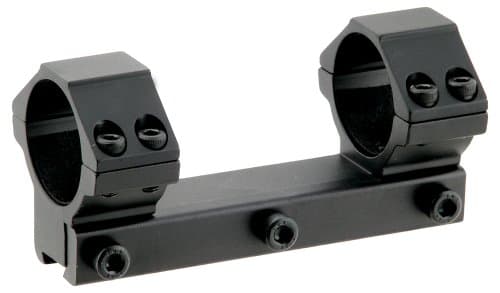
For most air rifles the right mount is the UTG 1PC Medium Profile Airgun Mount: one piece, a stop pin in the box, a published 1.06 inch center height and a published 2.09 inch maximum objective bell — which together are the only way to know before you order whether your scope will clear the barrel. It costs less than the pellets you will put through the rifle this season, and it is the mount we would buy first for any dovetail-railed airgun wearing a one-inch scope.
If your scope has a 50mm or larger adjustable-objective bell, step up to the UTG High Profile and its published 2.64 inch bell clearance. If the tube is 30mm rather than one inch, the UTG 30mm High Profile rings are the same design in the right diameter. If the rifle is a magnum springer or a Diana/RWS pattern gun, the RWS Lock Down adds four clamping lug screws, two recoil pins and a small amount of built-in elevation. And if your scope turned up with Picatinny rings and your rifle has a dovetail, an eight-dollar adapter fixes it without returning anything.
The verdict
Scope mounts are the least interesting thing you will buy for an air rifle and the most common reason a scoped air rifle does not work. Three failures account for almost all of it: the scope will not clear the barrel, the rings will not fit the rail, or the whole assembly walks backwards under recoil and takes your zero with it. Every one of those is a dimension problem, and every one is knowable before you order — if you measure your own rifle, because the rifle's maker is not going to tell you.
That is the honest state of this category. Leapers publishes center height, saddle height, ring width, maximum objective bell, required dovetail length, weight and torque figures to the millimeter for every UTG mount here. Airgun makers, by and large, publish “11mm dovetail” and leave you to it. The mount makers are being more transparent than the rifle makers, which is an unusual thing to be able to say, and it means the useful work on this page is matching a published mount figure to a measurement you take yourself.
Pick the glass first — our air rifle scope roundupcovers the parallax and recoil-rating problems that are specific to airgun optics — then come back here and buy the mount that fits both the scope and the rail.
The spec table
Every figure below is the maker's published number, not something we measured. Center height is the distance from the base of the mount to the center of the scope tube: it is the figure that decides barrel clearance, cheek weld and whether you can still see the open sights underneath.
| Mount | Tube | Center height | Max objective bell | Rail | Recoil lock |
|---|---|---|---|---|---|
| UTG 1PC Medium Profile (RGPM2PA-25M4) | 1 in | 1.06 in (27 mm) | 2.09 in (53 mm) | Airgun / .22 dovetail, reversible locking plate | Stop pin included, 1 |
| UTG 1PC High Profile (RGPM2PA-25H4) | 1 in | 1.34 in (34 mm) | 2.64 in (67 mm) | Airgun / .22 dovetail, reversible locking plate | Stop pin included, 1 |
| UTG 30mm High Profile rings (RGPM-30H4) | 30 mm | 1.42 in (36 mm) | 2.80 in (71 mm) | Airgun / .22 dovetail, reversible locking plate | Stop pin included, 1 |
| RWS Lock Down 1-inch | 1 in | Not published | Not published | 11 mm flat-top dovetail or 3/8 in rimfire | 2 recoil pins, retractable; 4 mounting lug screws |
| Dovetail-to-Picatinny adapter | n/a - converts the rail | Adds rail height; figure not published | n/a | 11 mm dovetail in, 21 mm Picatinny out | None - the Picatinny rings above it provide the lock |
Two gaps in that table are worth naming rather than glossing. The RWS Lock Down publishes no center height anywhere we could find, which on a mount sold specifically for scope clearance is a real omission; retailer listings give its length as 4.75 inches and credit it with 0.025 inch of built-in elevation, and that is the whole published dimensional record. And the adapter raises your scope by its own thickness, which no listing quantifies — so if clearance is already tight, the adapter is the wrong answer and a taller dovetail mount is the right one.
The three numbers nobody publishes
Before you order anything, spend five minutes with a caliper or a steel rule on the rifle you already own. These are the three figures that decide the purchase, and your rifle's spec sheet almost certainly lists none of them.
| Measure this | Why it decides the mount |
|---|---|
| The actual width of the dovetail | "11mm" is a nominal label rather than a standard, and real airgun dovetails run from roughly 9.5mm to 14mm depending on who made the rifle. This is why airgun rings advertise a width range and a reversible locking plate instead of a single number - UTG's clamp is designed to take the full span. Measure across the widest part of the groove; if you land outside 9 to 14mm you are looking at an adapter rather than a ring. |
| Objective bell diameter, and the gap to the barrel | Measure the outside diameter of the scope's front bell, then sit the scope on the rail by hand and look at the gap. Match the bell against the mount's published maximum - 2.09 in on the UTG medium, 2.64 in on the high, 2.80 in on the 30mm rings. A scope that fouls the barrel cannot be fixed by tightening anything, and an adjustable-objective ring on the bell needs clearance to rotate, not just to sit still. |
| Whether the receiver has a stop-pin hole, and where | A stop pin only works if there is a hole or a transverse slot for it to drop into. Some airguns have one, some have several at different spacings, and some have none. Look along the top of the receiver behind the breech. No hole means the pin has nothing to bite and the mount is relying on clamping friction - which is fine on a PCP and a gamble on a magnum springer. |
What a stop pin does, and when you do not need one
A dovetail ring holds position by friction. You tighten a clamp onto a smooth trapezoidal groove, and nothing but that clamping force stops the whole scope sliding along the rail. A spring-piston air rifle recoils in two directions — the piston slams forward, then the rifle jolts back — and that repeated two-way shove is exactly the load that walks a friction-held mount backwards a thousandth of an inch at a time until your zero is somewhere else.
A stop pinis a small peg on the underside of the mount that seats into a hole in the receiver and converts that friction joint into a mechanical one. All three UTG mounts here ship with one, described by Leapers as “complete with Stop-pin for Rock Solid Application.” The RWS Lock Down uses two recoil pins instead of one, and usefully makes them retractable— Umarex's manual notes they can be pulled back for rifles that have no pin depressions, which is the right engineering answer to a rail standard that is not a standard.
It does not follow that everyone needs one. On a lower-recoiling gun — a mild springer, or any PCP, CO2 or multi-pump — the recoil is simply not enough to cause creep, which is why plenty of PCP owners run plain rings for years without a problem. The pin matters on a magnum break-barrel, and the more magnum the rifle, the more it matters. If you are not sure which camp your rifle is in, read PCP vs break-barrel— the recoil difference between the two powerplants is the whole reason this section exists.
Dovetail vs Picatinny: the fitment trap
Airguns traditionally wear an 11mm (3/8 inch) dovetail: a smooth groove that rings clamp onto. Weaver and Picatinny rails are a different idea entirely — transverse slots that ring lugs drop into, so the assembly resists creep mechanically rather than by grip. Both are common on modern airguns, and a growing number of rifles carry both. The Umarex Origin, for instance, publishes a “combination Picatinny and 11mm dovetail” rail, which means you get to choose.
The trap is in the scope box. Several of the most popular airgun-market scopes ship with Picatinny or Weaver rings rather than dovetail rings. Put one of those scopes on a dovetail-only rifle and the rings are simply the wrong shape — not too tight, not too loose, wrong. That is an easy fix with an adapter, but only if you know before the scope arrives, which is why we flag it on the scope page too.
Barrel droop, and the mount that fixes it
Plenty of air rifles, break-barrels especially, point their barrels slightly below the line of the receiver rail. The usual symptom is that you run out of elevation adjustment while still shooting low at 25 yards: the scope's internal travel is being spent correcting the rifle's geometry rather than your zero. Shooting a scope near the end of its elevation range is also where optical quality and tracking repeatability go to die.
Three honest fixes exist. A droop-compensating or adjustable mounttilts the scope down relative to the rail so your zero sits back near the middle of the scope's travel. Shimming— a sliver of aluminum can or a proper shim under the rear ring — does the same thing for free and is perfectly serviceable, though it loads the tube unevenly if you overdo it. Or you pick a scope with enough travel to absorb the droop and accept the off-center zero.
The RWS Lock Down is the pick here because it carries a published 0.025 inch of built-in elevation specifically described as droop compensation. That is a small correction, not a cure for a badly bent barrel, and we would rather say so than let the spec imply more than it delivers. If your rifle droops hard enough that 0.025 inch does not touch it, an adjustable-elevation ring set or a shim is the answer — and if the scope will still not zero after that, the problem is the rifle or the scope, not the mount.
Best overall: UTG 1PC Medium Profile Airgun Mount
This is the mount to buy if you are not sure which mount to buy. Leapers publishes it as a one-piece aluminum mount with a 1.06 inch (27mm) center height, a 0.56 inch (14.2mm) saddle height, 0.83 inch (21mm) ring width, 2.3 inches between the rings, a 2.09 inch (53mm) maximum objective bell, 4.7 ounces of weight and a 3.94 inch required run of dovetail. It clamps with locking hex screws onto airgun and .22 dovetail dimensions, carries a reversible locking plate to span the full range of airgun rails, and includes the stop pin and all three Allen wrenches you need to fit it.
That specification list is the reason it wins. A 2.09 inch bell clearance covers a 40mm and most 44mm objectives with room for an adjustable-objective ring to turn, which is the majority of airgun scopes sold. One piece means the ring spacing is fixed by the manufacturer rather than by how carefully you aligned two separate rings, which removes the most common cause of a pinched scope tube. And the 3.94 inch dovetail requirement is the one figure to check against a short-receiver rifle before ordering.
Honest cons:medium profile is medium for a reason — a 50mm objective will not clear, and the 2.09 inch published bell limit is the number that tells you so. One piece also means no ring-spacing flexibility, so a short-tubed scope with little room between the turret and the bell can run out of mounting surface. A one-piece mount demands a continuous 3.94 inch dovetail, which some compact rifles and most pistols do not have. And at 4.7 ounces it is not the lightest way to hold a scope up, though on a six-to-nine pound air rifle that is noise rather than signal.
Best for big objectives: UTG 1PC High Profile
Same mount, more air underneath. Leapers publishes a 1.34 inch (34mm) center height, a 0.84 inch (21.3mm) saddle height and a 2.64 inch (67mm) maximum objective bellat 5.25 ounces — so this is the one that takes a 50mm or 56mm front end, and the one to buy if your scope has an objective-mounted parallax ring that needs room to spin. Ring width, ring spacing, dovetail requirement, torque figures and included parts are identical to the medium.
It is also the honest answer to a specific piece of advice you will see about PCPs with shrouded barrels: that low mounts may not clear and a medium or higher profile is the safer order. Outdoor Life made exactly that point about the Umarex Origin. A fat shroud occupies the same space a fat objective does, and the fix is the same — more center height.
Honest cons: height you do not need is cheek weld you lose. Every extra millimeter between the bore and the scope center raises your head off the stock, widens the sight-over-bore offset that makes close-range holdover confusing on an air rifle, and makes a consistent position harder to find. It also costs meaningfully more than the medium for the same hardware. Buy it because your objective needs the room, not as a default.
Best for a 30mm tube: UTG 30mm High Profile Rings
Thirty-millimeter tubes have arrived on airgun-market scopes, and a one-inch mount will not hold one. These are the same design in the right diameter: two-piece high-profile rings with a published 1.42 inch (36mm) center height, a 0.83 inch (21mm) saddle height, a 2.80 inch (71mm) maximum objective bell, 1.9 ounces each, the same reversible locking plate for the full airgun dovetail range, and a stop pin in the box.
Two-piece is the right call at this diameter, because a 30mm tube usually means a longer, heavier scope and you want to choose where the rings land rather than take what a one-piece bridge dictates. Leapers publishes 21mm of required dovetail per ring, which is the figure to care about: you need two clear landing zones, not one long run.
Honest cons:two pieces means you have to align them yourself, and a misaligned pair of rings will stress a scope tube in a way a one-piece mount will not — take the extra two minutes with a lapping bar or at minimum a slow, cross-pattern tightening sequence. A 1.42 inch center height is the tallest on this page, so cheek weld takes the same hit as the high-profile one-piece and then some. Only one stop pin is supplied for the pair, which is normal and sufficient but worth knowing before you open the package looking for two.
Best for magnum springers: RWS Lock Down
The Lock Down exists because magnum springers eat ordinary dovetail rings. Umarex describes it as a one-piece mount for 11mm flat-top dovetails or 3/8 inch rimfire rails, built around an integral wrap-around ring design and a full-length clamping bar, secured by four mounting lug screws and located by two recoil pins rather than one. Retailer listings give its length as 4.75 inches and credit it with 0.025 inch of elevation to compensate for barrel droop, in aircraft-grade aluminum with a matte black finish.
Four clamping screws and two pins is simply more mechanical lock than anything else here, and the retractable pins mean the mount still works on a receiver with no pin depressions at all. If you are mounting glass on a high-powered break-barrel — the kind of rifle discussed in our break-barrel roundup— this is the mount that is least likely to move.
Honest cons:no published center height and no published objective clearance, which on a mount whose job is clearance is the biggest mark against it — you are buying on reputation and a 4.75 inch length rather than on numbers. Owner reports include at least one scope whose tube was too short to span the mount's long clamping area, so measure the straight section of your scope tube between the turret housing and the bell before ordering. It is the most expensive of the four real mounts here, it needs a long clear run of rail, and 0.025 inch of droop correction is modest — call it a nudge, not a solution.
Best fitment fix: dovetail-to-Picatinny adapter
This is not a mount. It is a short rail that clamps onto an 11mm dovetail and presents a 21mm Picatinny rail on top, with its own locking screws, and it is the cheapest item on this page by a wide margin. Buy it when you already own a scope that came with Picatinny or Weaver rings, your rifle has a dovetail, and you would rather spend eight dollars than send the scope back.
It solves a second problem too. Picatinny rings lock into transverse slots, which means that once the adapter itself is clamped down, the ring-to-rail joint above it cannot creep — the recoil resistance moves from friction to a lug in a slot. On a rifle with no stop-pin hole, an adapter plus Picatinny rings is a legitimate alternative route to a mount that stays put.
Honest cons:you are adding a joint. The adapter's clamp on the dovetail is now the weakest link in the stack, and it is the joint with no stop pin, so on a magnum springer this is the wrong answer and a Lock Down is the right one. It raises the scope by its own unpublished thickness, which eats cheek weld and can push a marginal clearance situation into a bad one. The listing is a generic-brand part rather than a named optics maker, so treat it as a consumable: check the screws after the first fifty shots, and again after a hundred.
One-piece or two-piece?
The short answer: one piece if your rail is long enough, two pieces if it is not or if the scope is long and heavy.
A one-piece mountfixes ring alignment and ring spacing at the factory. That removes the most common amateur mounting error — two rings tightened out of line, which pinches the tube and can dent it — and it spreads the recoil load across a single long clamp instead of two short ones. The cost is flexibility: you need a continuous run of dovetail (3.94 inches for both UTG one-piece mounts here), and the ring positions are wherever the designer put them.
Two-piece ringslet you place the rings where the scope's straight tube sections actually are, work on short receivers and around loading ports, and weigh less. They ask you to do the alignment work. For a 30mm-tube scope with a long body and a big objective, that trade is usually worth making.
Mounting it so it stays mounted
Three things matter once the right mount is on the bench, and the first one is the one most people skip.
Torque to the published figure.Leapers publishes 35 inch-pounds for the M4 hex side plate and 15 inch-pounds for the M3 hex top screw across all three UTG mounts here. Those are small numbers — 15 inch-pounds is barely more than a firm wrist — and they are the difference between a ring that grips and a ring that crushes. An inch-pound torque driver is the single most useful tool in this job; our scope mounting tool roundup covers the rest of the kit.
Seat the stop pin before you tighten anything. Drop the pin into the receiver hole, slide the mount forward until the pin is hard against the front of the hole, and only then clamp the rail screws. Tighten first and the pin may be sitting in the middle of a slot with room to move, which is the same as not having a pin.
Check it again after fifty shots.Mark the rail just behind the mount with a paint pen or a sliver of tape when you finish mounting. If the mark and the mount have parted company after a tin of pellets, the mount is creeping and no amount of scope adjustment will fix it. Then zero properly — our air rifle sight-in guide walks the parallax, artillery hold and group-center sequence that follows.
Who should not buy any of these
Three shooters are better served by something else, and it is worth saying plainly.
If your rifle has a Picatinny rail already, skip this page and buy ordinary Picatinny rings in the height your objective needs. The dovetail problem is the only reason airgun-specific mounts exist; a Picatinny-railed PCP is just a rifle, mounting-wise.
If your scope came with rings that fit, use them. Several airgun-market scopes include a correct one-piece dovetail mount with a stop pin in the box, and buying a second mount to replace a perfectly good included one is spending money to change nothing. Check what is in the box before you add to the cart.
If the rifle is a multi-pump or a low-power plinker with no dovetail,the answer may be a receiver upgrade rather than a mount — several budget guns need a steel breech before they have a rail worth clamping to at all. We make that point in the Crosman 362 review, where the upgrade path genuinely starts with the breech.
Everyone else — a dovetail-railed air rifle, a one-inch or 30mm scope, and a desire for the zero to still be there next weekend — is buying the right thing. Measure the three numbers, match them to a published figure, torque to spec, and this is a problem you solve once.
Frequently asked questions
What size scope mount does an air rifle need?
Match three things: the scope tube diameter (one inch or 30mm), the rail type (airgun 11mm/3-8 inch dovetail or Weaver/Picatinny), and enough center height for the objective bell to clear the barrel or shroud. The published center heights on this page run from 1.06 inches on the UTG medium one-piece to 1.42 inches on the UTG 30mm high rings, with published maximum objective bells of 2.09, 2.64 and 2.80 inches respectively. Measure your scope's bell diameter and compare it against that published figure before ordering.
Are all 11mm air rifle dovetails the same width?
No. '11mm' is a nominal label rather than a standard, and real airgun dovetail widths run from roughly 9.5mm to 14mm depending on the manufacturer. That is why airgun rings advertise a width range and a reversible locking plate instead of a single number - the clamp is designed to span the variation. Measure across the widest part of your rifle's groove; anything outside about 9 to 14mm needs an adapter rather than a ring.
Do I need a scope stop on a PCP air rifle?
Usually not. A stop pin exists to stop a friction-held dovetail mount creeping backwards under the two-way recoil of a spring-piston rifle. A PCP, CO2 or multi-pump gun does not generate enough recoil to cause that creep, so plain rings are generally fine. Use a stop pin on a magnum break-barrel, where it is the difference between keeping a zero and losing it.
My scope came with Picatinny rings but my air rifle has a dovetail. What do I do?
Buy a dovetail-to-Picatinny adapter rail. It clamps onto the 11mm dovetail and presents a 21mm Picatinny rail for your existing rings, costs under ten dollars, and has the side benefit that Picatinny lugs lock into slots rather than relying on clamping friction. The trade-off is an extra joint with no stop pin and extra height you cannot quantify, so on a magnum springer prefer a dedicated dovetail mount with recoil pins instead.
How tight should air rifle scope rings be?
Tighter than feels brave and looser than you think. Leapers publishes 35 inch-pounds for the M4 hex side plate and 15 inch-pounds for the M3 hex top screw on the UTG mounts here. Those are the figures to use, with an inch-pound torque driver rather than by feel - overtightening a top screw dents scope tubes, and undertightening a rail screw is how a mount walks.
What is barrel droop and can a mount fix it?
Barrel droop is a barrel that points slightly below the line of the receiver rail, common on break-barrels. The symptom is running out of elevation adjustment while still shooting low. A droop-compensating mount tilts the scope down so your zero sits nearer the middle of the scope's travel - the RWS Lock Down publishes 0.025 inch of built-in elevation for this. That is a modest correction. For more droop than it covers, use an adjustable-elevation ring set or shim under the rear ring.
Is a one-piece mount better than two-piece rings?
One piece is better if your rail is long enough for it, because ring alignment and spacing are set at the factory and the recoil load spreads across one long clamp. Both UTG one-piece mounts here need a continuous 3.94 inch run of dovetail. Two-piece rings are the right answer on a short receiver, around a loading port, or under a long heavy 30mm scope where you want to choose where the rings land - at the cost of aligning them yourself.
Sources
- Leapers UTG 1" Dovetail Integral Mount, Locking Hex Screw, Medium Profile (RGPM2PA-25M4) published specifications: center height 1.06 in (27 mm), saddle height .56 in (14.2 mm), inner diameter 1 in, length 3.94 in (100 mm), ring width .83 in (21 mm), ring distance inner 2.3 in (58 mm), max fit objective bell diameter 2.09 in (53 mm), width 1.61 in (41 mm), weight 4.7 oz (133 g), required dovetail space 3.94 in (100 mm), torque 35 in-lbs M4 side plate / 15 in-lbs M3 top screw, aircraft-grade aluminum, reversible locking plate, stop pin and three Allen wrenches included
- Leapers UTG 1" Dovetail Integral Mount, High Profile (RGPM2PA-25H4) published specifications: center height 1.34 in (34 mm), saddle height .84 in (21.3 mm), length 3.94 in (100 mm), ring width .83 in (21 mm), max fit objective bell diameter 2.64 in (67 mm), width 1.6 in (41 mm), weight 5.25 oz (149 g), same torque figures and included parts as the medium
- Leapers UTG 30mm Dovetail Scope Rings, High Profile (RGPM-30H4) published specifications: center height 1.42 in (36 mm), saddle height .83 in (21 mm), inner diameter 30 mm, ring width .83 in (21 mm), max fit objective bell diameter 2.80 in (71 mm), weight 1.9 oz (56 g) each, 21 mm of required dovetail space per ring, stop pin included
- Umarex RWS Lock Down Scope Mount 1-inch published description and manual: fits air rifles with 11 mm dovetail or 3/8 in rimfire mounts, one-piece integral wrap-around ring design with full-length clamping bar, 4 mounting lug screws and 2 recoil pins, recoil pins retractable for rifles without pin depressions. Retailer listings add 4.75 in length, 0.025 in elevation for barrel droop compensation, aircraft-grade aluminum matte black. No center height or objective clearance figure is published anywhere we could find
- Airgun Depot - Air rifle scope mounting: rail types, the nominal nature of the 11 mm dovetail label, and the note that a scope stop is rarely needed on lower-recoiling guns such as PCP and CO2 rifles
- Outdoor Life independent Umarex Origin review - the observation that low-profile scope mounts may not clear and medium-profile mounts are recommended on a shrouded PCP
- Product availability, titles and stock status verified via the Amazon Creators API, 2026-10-28
- Prices, product images and stock status via the Amazon price layer, refreshed daily
Keep reading
Gearing up before your next hunt?
See how we evaluate gear, then dig into the reviews and buying guides — written without inventory to sell.