Air Rifle Review
Umarex Origin Review: The PCP That Ships With Its Own Air Supply
The Origin's whole argument is that it comes with the hand pump, and that the pump is less work than hand-pumping usually is. We look at what Umarex actually publishes - including three velocity figures that disagree with each other - what independent chronograph testing found, and where the price shows.
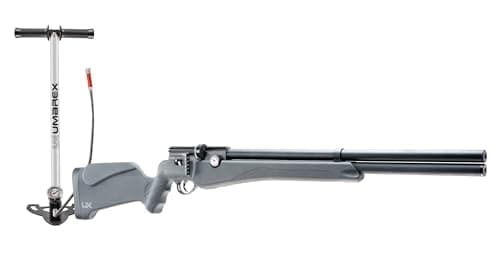
The most sensible first PCP on the market: it removes the fill-equipment problem by putting a 4,500 PSI pump in the box, and the Ever Pressure Tank makes that pump far less punishing than a hand pump has any right to be.
- Best for
- The shooter who wants a real PCP for small game and pest control without first buying a compressor, a tank, and an adapter they do not understand yet.
- Price context
- Mid-tier air rifle pricing, and the pump is included rather than sold alongside - which is the whole value argument, since a standalone hand pump is commonly a $70 to $100 purchase on its own. Check the live price below before buying; air rifle pricing moves.
Almost everyone who gives up on pre-charged pneumatics gives up for the same reason, and it is not the rifle. It is the air. A PCP needs a fill source, and the fill source is a second purchase — a hand pump, a scuba tank and an adapter, or a compressor — that most buyers do not price in until the rifle is already in the safe. The Umarex Origin is a direct answer to that problem: it ships with a 3-stage, 4,500 PSI hand pump and a fill probe in the box, and it is built around a tank system designed to make that pump tolerable.
It is already the top pick in our best .22 air rifles roundup and the reason Umarex earns its slot in our brand comparison. This review is the long version: what the specification actually says, where it contradicts itself, what independent testing found, and where the money shows.
What the Origin is
The Origin is a side-lever, magazine-fed, unregulated .22 PCP with a 23-inch barrel, a 43.1-inch overall length and a 3,625 PSI (250 bar) maximum fill. Umarex publishes 40 shots per fill in .22 and supplies two auto-indexing 10-shot rotary magazines rather than the customary one. The trigger is described as two-stage adjustable, the safety is manual, and the receiver carries a combination Picatinny and 11mm dovetail rail.
The piece that makes it different from every other value PCP is the tank. Umarex calls it the Ever Pressure Tankand describes it as a patented pre-pressurized reservoir that “is pressurized for a full-power shot with only 13 pumps.” In plain terms: the tank is not empty when the rifle is empty. There is a baseline charge behind the usable air, so the pump is compressing against a head start rather than filling a bare bottle from atmospheric pressure. The tank also carries an automatic overpressure air release, which is the right feature to have on a pump-filled rifle where enthusiasm is the main overpressure risk.
One spec-sheet oddity to note while we are here: Umarex's feature list calls the trigger two-stage adjustable and the rifle side-lever, while the spec table on the same page lists “Trigger Action: Single,” and at least one large retailer lists the action as bolt action. The rifle is a side-lever. We mention it because this is a product whose published data needs reading carefully, and the velocity section below is where that really bites.
The pump in the box, and the arithmetic that matters
Umarex publishes two pumping figures, and they describe two completely different jobs. About 100 pumps takes the Origin from empty to a full 3,625 PSI fill. Thirteen pumps develops one full-power shot from the pre-pressurized tank. Both are true, and reading only one of them gives you the wrong picture.
Here is the number nobody prints. If 100 pumps buys a fill and a fill is 40 shots, the real cost of shooting this rifle is 2.5 pumps per shot— computed, not published. That is the figure to plan a range session around, and it is remarkably low. The 13-pump figure is the cost of topping up for one shot, which is what you would do before a walk-around for squirrels, not what you would do for a forty-pellet session.
| Job | Pumps | What it buys |
|---|---|---|
| Empty to full fill | About 100 (Umarex published) | 40 shots in .22 (Umarex published) |
| Amortized cost per shot across a fill | 2.5 (computed from the two figures above) | One shot |
| Top up for one full-power shot | 13 (Umarex published, via the pre-pressurized tank) | One full-power shot from a shot-down tank |
Umarex markets the Ever Pressure Tank as needing up to 50 percent fewer pumps, and Outdoor Life's reviewer — after what he describes as numerous refills — called that claim fair. That is about as good as a marketing claim gets: an independent tester who did the work agreeing with the direction and the rough magnitude.
Three published velocities, and what was actually measured
This is the part of the Origin's documentation we cannot defend. On a single Umarex product page the .22 is listed at 1,100 FPS with an 11.9 grain pellet, at 1,000 FPS with .22 alloy pellets, and at 1075 FPS in the specification table. Those are three numbers for one rifle on one page. Retailers then pick whichever figure they like, which is how the same gun ends up advertised at three speeds across the internet.
Our reading: the 1,075 FPS spec-table figure is the one to plan against, the 1,100 figure is a best-case with a specific light pellet, and the 1,000 FPS alloy figure is a different pellet class entirely. Alloy pellets are lighter and faster and almost always worse for accuracy and penetration than good lead, so a velocity quoted with alloy is a marketing number rather than a hunting number.
What has actually been measured, and the caliber it was measured in, matters more:
| Source | Caliber | Measured velocity | Energy |
|---|---|---|---|
| Outdoor Life, 20-shot chronograph string | .25 | 829 fps max / 806 fps min / 818 fps average, 23 fps spread | About 38 ft-lb (reviewer's figure) |
| Baker Airguns, single used unit, velocity tested | .22 | 919 fps with 14.3 gr pellets | 26.8 ft-lb (computed) |
| Umarex published, spec table | .22 | 1075 fps | 30.5 ft-lb (computed, with the 11.9 gr pellet Umarex names) |
Two things are worth drawing out of that table. First, the arithmetic checks out: 818 fps with a 25.39 grain pellet computes to 37.7 ft-lb, which matches the roughly 38 ft-lb the reviewer reported, so the standard energy formula and the measured string agree. Second, the one .22 data point we could find — 919 fps with a 14.3 grain pellet, one used rifle, one pellet weight — lands well below the published 1,075 and still produces a computed 26.8 ft-lb.
That is the number that matters for hunting. The small-game energy bar we use across the site is 12 ft-lb at the target, and 26.8 ft-lb at the muzzle clears it with room for the energy a pellet loses on the way out to 35 or 40 yards. The Origin is a legitimate small-game rifle in .22 even at the pessimistic end of its published range — see our hunting air rifle guide for how that bar works by quarry, and .177 vs .22 for why .22 is the right caliber for this job.
Accuracy and the unregulated question
The Origin is unregulated. A regulator holds the pressure delivered to each shot constant until the reservoir falls below the regulator's set point, which is what produces the flat velocity strings PCP shooters talk about. Without one, pressure falls shot by shot and velocity traces a curve — rising as the valve opens more efficiently, peaking, then falling away.
What Outdoor Life found on the .25 is that the curve is unusually forgiving: a 23 fps spread across a 20-shot string, described as a fairly large sweet spot. Twenty-three feet per second over twenty shots is tight enough that it will not visibly move a group at normal air rifle distances. Accuracy backed that up — ragged one-hole groups at 30 yards and 0.6-inch groups at 50 yards with JSB 25.39 Exact Kings. Those are excellent results for this price class, with the caveat that they are .25 caliber results from one rifle with one pellet.
The practical consequence of being unregulated is that you find yourrifle's sweet spot and work inside it. Fill to 3,625, shoot a string over a chronograph if you have one or over a target if you do not, and note where the group opens up at the bottom end. Then refill there rather than shooting the tank dry. Pellet choice matters more on an unregulated gun than a regulated one — our pellet guide covers the weights worth trying first.
If flat velocity matters more to you than the included pump, Umarex sells a regulated alternative for less money: the Notos Gen 2, independently measured at a 1.88 fps standard deviation across nine pellets. It does not include a fill source, which is the trade.
Handling, trigger and the parts Umarex left off
At 43.1 inches overall and roughly 6.8 pounds bare — a figure that comes from the spec sheet Outdoor Life cites rather than from anything Umarex publishes on its own product page — the Origin is a full-size rifle, not a carbine. Add a scope and mount and you are carrying something in the seven-and-a-half pound region. That is fine from a bench or a blind and noticeable on a long walk-around.
The trigger is the pleasant surprise. Umarex calls it two-stage adjustable; Outdoor Life measured it breaking at about 2.8 pounds out of the box, which is a genuinely good factory trigger at this price and better than most break-barrels will ever be without work.
Two omissions are worth knowing before you order. The side lever is reported as rougher than higher-end PCPs— it cycles easily, it just does not feel expensive. And the rifle ships without swivel studs, so if you want a sling you are adding studs or using a clamp-on solution. Neither is a reason not to buy it; both are the kind of detail that a spec sheet will not tell you and a buyer notices on day one.
On sound: the shrouded barrel takes the edge off but does not make this a backyard-stealth rifle. Outdoor Life describes “a bit of a bark” that the shroud dampens enough for suburban use. If quiet is the priority above all else, our quietest air rifles guide is the better starting point.
Scoping it: the rail is the good news
The Origin ships with no scope and a combination Picatinny and 11mm dovetail rail, which is the most useful thing a budget airgun can do for an optics buyer. You are not locked into one ring standard, so whatever rings you already own probably fit, and you do not need the dovetail-to-Picatinny adapter that catches so many airgun buyers out.
The one fitment warning is height. Outdoor Life notes that low-profile mounts may not clear on this rifle and recommends medium profile. That is the shroud taking up the space a slim barrel would leave, and it is a clearance problem no amount of tightening fixes. Plan on a medium-profile mount as the default and a high profile if your scope carries a 50mm objective.
Our air rifle scope mount roundup has the published center heights and objective clearances for every mount worth considering, and the scope roundup covers the parallax and recoil-rating questions. One advantage the Origin has over any springer: it is recoilless in the way that matters to glass, so you do not need a scope rated for two-way piston recoil and you do not strictly need a stop pin.
Who it is for, and who should buy something else
Buy the Origin if you want your first PCP, you want it to work the day it arrives, and you do not want the second purchase to be the one that decides whether you shoot. It is also the right rifle for someone who already knows they want a compressor eventually: the pump covers you until then, and nothing about the rifle has to change when the compressor shows up.
Buy something else if one of these is you:
| You want flat velocity strings | Buy a regulated PCP. The Origin's sweet spot is wide for an unregulated gun but a regulator is a different kind of consistency, and nothing about the Origin's design substitutes for one. |
|---|---|
| You already own fill equipment | The pump is the Origin's main value argument. If you have a compressor or a tank, compare it on rifle merits alone against the rest of our PCP picks - the included pump is money you do not need to spend twice. |
| You want zero equipment chain | A multi-pump or a break barrel needs nothing but pellets. The Crosman 362 is the honest alternative at a fraction of the price, and our review of it explains what you give up. |
| You hunt on long walks | 43.1 inches and about 6.8 pounds bare is a lot of rifle to carry. A shorter PCP carbine or a compact break barrel will handle better in brush. |
The verdict
The Origin earns its reputation. It solves the single biggest practical problem in PCP ownership by putting the air supply in the box, and the Ever Pressure Tank turns the usual hand-pump argument on its head: 2.5 pumps per shot across a fill is a cost almost anyone will accept. The trigger is better than the price suggests, the two included magazines are unusually generous, and the independent accuracy results on the .25 version are genuinely good.
What keeps it off a perfect score is documentation and detail rather than performance. A manufacturer publishing three velocities for one caliber on one page, and no weight at all, is a manufacturer making the buyer do work the buyer should not have to do. No swivel studs and a rough side lever are the price showing. And unregulated is unregulated — the sweet spot is wide, but you still have to find it.
We do not sell air rifles, so we have no reason to push you up the range or to pretend the pumping is nothing. If you want into PCP shooting this season without a second equipment purchase standing between you and the first pellet, this is the rifle we would buy.
What we liked
- The hand pump is included - the fill-equipment purchase that stalls most first PCPs is already solved
- The pre-pressurized Ever Pressure Tank makes a full-power shot a 13-pump job rather than a full fill
- Two 10-shot auto-indexing magazines in the box, which is unusual at any price
- Combination Picatinny and 11mm dovetail rail, so almost any scope mount fits without an adapter
- 40 published shots per .22 fill is genuinely useful range time between fills
- Independent 50-yard accuracy results on the .25 version were excellent for the money
What gave us pause
- Umarex publishes three different velocity figures for the .22 on the same product page
- Unregulated, so velocity drifts across a fill - the sweet spot is wide but it is still a sweet spot
- About 100 pumps for a full fill is real physical work, and a compressor eventually becomes the answer
- Ships without swivel studs, so a sling is an extra job
- The side lever is reported as rougher than higher-end PCPs
- Low-profile scope mounts may not clear the shroud - plan on medium profile
- Umarex does not publish a weight anywhere we could find
Frequently asked questions
How many pumps does the Umarex Origin need?
Umarex publishes about 100 pumps for a complete fill from empty and 13 pumps to develop one full-power shot through the pre-pressurized Ever Pressure Tank. Because a fill is published at 40 shots in .22, the amortized cost of shooting it is about 2.5 pumps per shot - a figure we compute from Umarex's own two numbers rather than one they publish. The 13-pump figure is the cost of topping up for a single shot, not the cost of a range session.
How fast is the Umarex Origin .22?
Umarex publishes three different figures on the same product page: 1,100 FPS with an 11.9 grain pellet, 1,000 FPS with .22 alloy pellets, and 1075 FPS in the specification table. We would plan against 1,075 with good lead pellets and treat the others as a best case and an alloy-pellet number respectively. The only independent .22 data point we found was a dealer's velocity test on a single used unit at 919 fps with 14.3 grain pellets, which computes to 26.8 ft-lb.
Is the Umarex Origin regulated?
No. It is an unregulated PCP, so velocity rises and then falls across a fill rather than staying flat. Outdoor Life's 20-shot chronograph string on the .25 version showed a 23 fps spread between 806 and 829 fps, which the reviewer described as a fairly large sweet spot - tight enough not to visibly move groups at air rifle distances. Fill to 3,625 PSI, find where your rifle's groups open up at the bottom of the string, and refill before that point.
Is the Umarex Origin powerful enough for hunting?
In .22, yes, for small game. The pessimistic measured figure we found - 919 fps with a 14.3 grain pellet - computes to 26.8 ft-lb at the muzzle, comfortably above the 12 ft-lb at the target that we use as the small-game bar across this site, with margin for the energy a pellet loses out to 35 or 40 yards. Match the quarry to the energy rather than to the caliber, and check your state's rules on air rifle hunting first.
Does the Umarex Origin come with a scope?
No. It ships with the rifle, a 3-stage 4,500 PSI hand pump, a fill probe and two 10-shot rotary magazines - no optic. The receiver carries a combination Picatinny and 11mm dovetail rail, so most rings fit without an adapter. Plan on a medium-profile mount rather than a low one: Outdoor Life notes low-profile mounts may not clear the shroud on this rifle.
What does the Umarex Origin weigh?
Umarex does not publish a weight on its own product page. The spec sheet cited by Outdoor Life gives 6.8 pounds, and that review's body text rounds it to a seven-pound rifle. With a scope and mount, expect something in the seven-and-a-half pound region. Overall length is published at 43.1 inches with a 23-inch barrel, so this is a full-size rifle rather than a carbine.
Sources
- Umarex USA - Origin .22 cal PCP air rifle with high pressure air hand pump, published specifications: 1,100 FPS with 11.9 grain pellet, 1,000 FPS with .22 alloy pellets, 1075 FPS spec-table velocity, 10-shot magazine (two auto-indexing rotary magazines included), 40 shots per fill, 100 pumps per fill, 3,625 max fill pressure, side-lever action, two-stage adjustable trigger, manual safety, 23 in barrel, 43.1 in overall length, combination Picatinny and 11mm dovetail rail, scope not included, 3-stage 4,500 PSI hand pump and fill probe included, Ever Pressure Tank pressurized for a full-power shot with 13 pumps, automatic overpressure air release
- Outdoor Life independent Umarex Origin review (.25 caliber tested): 20-shot chronograph string 829 fps max / 806 fps min / 818 fps average, 23 fps spread, about 38 ft-lb; ragged one-hole groups at 30 yards and 0.6 in groups at 50 yards with JSB 25.39 Exact Kings; two-stage trigger breaking at about 2.8 lb; 6.8 lb per the spec sheet; about a dozen pumps per full-power shot and about 100 per fill, with the 50-percent-fewer-pumps claim judged fair after numerous refills; side lever a little rough; a bit of a bark dampened by the shroud; ships without swivel studs; low-profile scope mounts may not clear, medium profile recommended
- Baker Airguns listing for a used Umarex Origin .22 - the single .22 velocity data point we could find, velocity tested at 919 fps with 14.3 gr pellets (one unit, one pellet weight, not a regulated test)
- Pyramyd AIR - Umarex Origin PCP air rifle with hand pump listing, corroborating 40 shots per fill and the 10-shot magazine capacity
- Energy figures labeled computed on this page use the standard formula ft-lb = (velocity in fps squared x pellet weight in grains) / 450,240. The formula returns 37.7 ft-lb for Outdoor Life's measured 818 fps with a 25.39 gr pellet, matching the reviewer's reported figure of about 38 ft-lb
- Product availability, title and stock status verified via the Amazon Creators API, 2026-10-28
- Prices, product images and stock status via the Amazon price layer, refreshed daily
Keep reading
Gearing up before your next hunt?
See how we evaluate gear, then dig into the reviews and buying guides — written without inventory to sell.