Buying Guide
Best Pellet Traps and Airgun Backstops
Almost every pellet trap sold carries an energy limit and a minimum distance, and almost nobody checks either before buying. A magnum springer or a hunting PCP can exceed that limit by 50 percent, which is how a trap ends up with a hole in the back of it and a pellet in the fence behind.
Every guide on this site that tells you to shoot an air rifle also tells you to use a safe backstop. None of them, until now, told you which one - and the specification that decides the answer is not printed anywhere you would think to look.
Pellet traps are rated. Air Venturi publishes the rule plainly for its 10-gauge steel trap backstop: it is for "guns up to 20 ft-lbs. muzzle energy," you should "place trap with inserted backstop at least 10 meters from muzzle," and you should "regularly inspect the steel backstop for signs of penetration and/or weakening." Their instruction is blunt about the ceiling: "NEVER shoot at your pellet trap with guns exceeding 20 ft-lbs."
Now hold that number against what people actually shoot. A .22 pellet of 14.3 grains at 900 feet per second produces about 25.7 foot-pounds. A magnum springer pushing an 8.4-grain .177 at 1,200 fps produces about 26.9. Both of those are ordinary, widely sold air rifles, and both are comfortably over the limit on a trap most buyers assume is universal.
That is the whole reason this page exists. Below: how to work out your own rifle's energy in one line of arithmetic, what the four backstop types are genuinely for, and seventeen currently available picks with the honest limitation on each.
The energy ceiling nobody mentions
A pellet trap is not a container. It is a piece of steel angled or shaped to convert a pellet's forward energy into deformation and heat, inside a box that keeps the fragments where you can sweep them up. Every part of that job has a limit.
Exceed the limit and one of three things happens, in rough order of likelihood:
- The steel dents, then dishes, then cracks. This is why Air Venturi tells you to inspect the backstop regularly for penetration and weakening rather than treating it as a permanent object. A trap is a wear item.
- Pellets stop deforming and start bouncing. Under-energy pellets splash and drop. Over-energy pellets can come back at you in pieces, which is the mechanism behind almost every airgun eye injury that happens at a backstop rather than downrange.
- A pellet goes through. Rare with a purpose-built steel trap, routine with the cardboard box of phone books people improvise instead.
The distance rule matters for the same reason. Air Venturi's 20 ft-lb rating is stated at 10 meters, because a pellet slows down over that distance. Move the same trap to five yards and you are hitting it substantially harder than the rating contemplates - with no change to the number on your rifle.
Work out your rifle's energy first
This takes ten seconds and it is the only pre-purchase step that matters. Muzzle energy in foot-pounds is:
| The formula | Energy (ft-lbs) = velocity in fps, squared, multiplied by pellet weight in grains, divided by 450,240. |
|---|---|
| What to use for velocity | The figure for the pellet you actually shoot, not the headline number on the box. Manufacturer velocity claims are usually generated with ultra-light alloy pellets nobody hunts with. |
| What to use for weight | The grain weight printed on your pellet tin. A .177 domed pellet is commonly 7.9 to 10.5 grains; a .22 is commonly 14.3 to 18.1. |
Run it for a few real combinations and the picture is immediate:
| Pellet | Velocity | Energy | Under a 20 ft-lb trap rating? |
|---|---|---|---|
| 7.9 gr .177 | 1,000 fps | about 17.5 ft-lbs | Yes |
| 10.5 gr .177 | 1,000 fps | about 23.3 ft-lbs | No |
| 8.4 gr .177 | 1,200 fps | about 26.9 ft-lbs | No |
| 14.3 gr .22 | 800 fps | about 20.3 ft-lbs | Right at the line |
| 14.3 gr .22 | 900 fps | about 25.7 ft-lbs | No |
Two conclusions fall out of that table. A .177 plinker at moderate velocity is inside the rating of essentially every trap here. And a .22 hunting rifle - which is what our hunting air rifle guide and .22 guide spend their time recommending - is usually over it.
If you are over the line, your options are a trap explicitly rated for rimfire rather than airgun-only, a dedicated heavy steel backstop, or more distance. Shooting a 26 ft-lb rifle into a light airgun trap at ten yards is the one combination to avoid outright.
The four kinds of backstop
| Type | How it works | Best for | The catch |
|---|---|---|---|
| Sealed trap box | Angled steel plate inside a closed box; paper target clips to the front | Accuracy work, zeroing, indoor and backyard use | Heaviest and loudest; steel is a wear item |
| Resetting / spinner target | Steel paddles that flip and reset when hit | Plinking, kids, offhand practice, instant feedback | Open backed - it is a target, not a backstop, and needs something behind it |
| Steel plate backstop | A single heavy plate, usually behind a trap or a target frame | High-energy PCPs that exceed trap ratings | Loud, and needs plywood behind it to catch splash |
| Sacrificial / putty medium | Duct seal, ballistic putty or dense rubber that absorbs and holds pellets | Quiet indoor shooting; near-zero ricochet | Needs periodic re-facing, and is heavy for its size |
The distinction that catches people is the second row. A resetting spinner target is not a backstop. Every pellet that misses the paddle - and at 25 yards offhand, plenty will - continues into whatever is behind it. Buy the reactive target for fun and put something rated behind it.
Where ricochet actually comes from
Airgun ricochet is not random. It comes from three specific setups, and all three are avoidable:
- Flat steel struck square.A plate perpendicular to the pellet's path sends fragments straight back down the firing line. Every well-designed trap angles its plate so the pellet is deflected downward into a collection area instead.
- Too close. Distance is what bleeds off the energy that would otherwise become a bounce-back. This is why the trap rating and the distance figure are published together and should be read together.
- Hard pellets and BBs. Steel BBs do not deform. They bounce, reliably, off anything hard. If you are shooting BBs rather than lead pellets, use a trap that explicitly says BB - several here do - and treat eye protection as mandatory rather than advisable.
Safety glasses are not optional at a backstop for anyone in the vicinity, including the people watching. That is the single cheapest item in this entire hobby.
Your trap is probably the loudest part of your setup
This is the point our quietest air rifles guide makes and it is worth repeating here, because it changes which trap you should buy: on a well-moderated rifle, the sound of the pellet hitting the backstop is often the loudest thing happening.
A shrouded PCP can be quieter at the muzzle than a stapler. Put a 14-grain pellet into an unlined steel plate at 850 fps and the ring off that plate is what your neighbor hears - and it is what turns a backyard-legal setup into a complaint.
- Quietest: putty or duct-seal media, and rubber-backed traps. The pellet simply stops.
- Middle: a sealed trap box with a wooden or composite outer shell, which damps the steel inside it.
- Loudest: bare steel spinners and open plate backstops. The reactive targets that are the most fun are also the ones you cannot shoot at 7am.
If neighbors are the constraint, this factor outranks everything else on this page.
The lead problem nobody puts on the box
A trap that has done its job is a box of lead fragments and lead dust. Airguns do not have the primer and propellant that dominate lead exposure at firearm ranges, so the scale is different - but the handling advice from range guidance transfers directly, and it is worth two minutes of your attention.
Public health guidance for indoor firing ranges is consistent on the basics: avoid dry sweeping, which puts lead dust into the air, and use a HEPA-filtered vacuum or wet cleaning methods instead; wash hands thoroughly before eating, drinking or smoking; and do not eat, drink or smoke where lead exposure is possible. The same guidance flags take-home contamination - lead carried indoors on clothing becomes a secondary exposure risk for the rest of the household.
Translated to a backyard pellet trap, that is four habits:
- Empty the trap outdoors, into a sealed container, rather than tipping it out on a bench.
- Do not dry-sweep the area under a trap. Wipe it or vacuum it.
- Wash your hands before you eat, every session. Handling lead pellets is the main contact.
- Keep the trap and its contents away from where children play.
None of this makes airgun shooting hazardous. It makes it tidy, which is a lower bar than most people are currently clearing.
The picks at a glance
| Pick | Type | Stated rating | Best for |
|---|---|---|---|
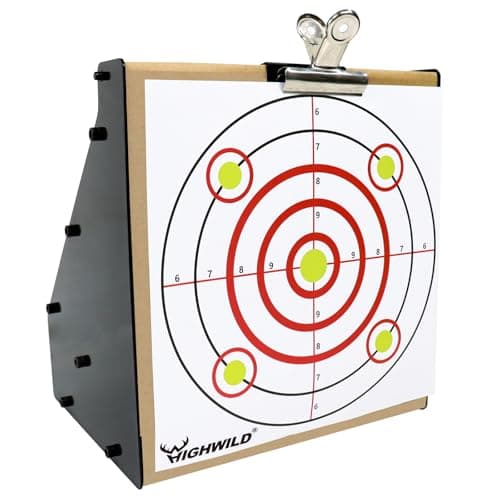
| Highwild Bullet Trap Box | Sealed trap | .22/.17 rimfire | The most headroom here; hunting-power airguns |
| KNINE OUTDOORS trap | Sealed trap | Airgun | Value - arrives with 100 targets |
| AIMAX resetting trap box | Sealed trap + reset | .22/.177 rimfire | Reactive feedback with a real backstop behind it |
| Highwild wall-mounted trap | Sealed trap | Airgun | Smallest footprint, under $20 |
| Highwild resetting target | Spinner | .22 | Plinking - needs a backstop behind it |
| NRA AR 5/10 targets | Paper | n/a | Official 10-meter scoring practice |
Best overall: Highwild Bullet Trap Box
This is the pick because of one line in its own description: it is rated for .22/.17 caliber rimfire, not airgun-only. Rimfire cartridges operate at energies far above any conventional air rifle, which means the steel inside has meaningful headroom over a 25-plus foot-pound PCP - the exact case where a light airgun trap is the wrong tool.
It takes standard paper targets on the front, closes on the sides so fragments stay inside, and is the trap our quietest air rifles guide already points readers to.
Honest cons: it is heavy, which is the price of the rating, and it is steel in a steel-framed box, so it is not the quiet option. If your constraint is neighbors rather than energy, a putty-medium trap will serve you better. And a rimfire rating is a statement about the steel, not a licence to shoot it at five yards - keep the distance.
Best value bundle: KNINE OUTDOORS pellet trap
A sealed pellet trap that ships with 100 eleven-inch bullseye paper targets, which is roughly a season of casual shooting included in the purchase price. For a first trap, buying the consumable and the hardware together is the sensible move - paper is the thing people run out of and then improvise badly.
Honest cons: this is an airgun-rated trap, not a rimfire-rated one, so it belongs with .177 plinkers and moderate .22s rather than a 30 foot-pound PCP. The included targets are large-format bullseyes - fine for practice, not the official 10-meter scoring face if you are training for anything formal.
AIMAX resetting trap box
The interesting one structurally: a trap box carrying a stated .22/.177 rimfire rating, with auto-resetting metal targets inside it and a dozen paper targets in the box. That combination solves the spinner problem - you get the instant feedback of a reactive target with an actual rated backstop behind it rather than your fence.
Honest cons: it is the most expensive item on this page, and the moving paddles are the part that will wear first. Reactive targets are also, unavoidably, the loud option - the mechanism is metal striking metal.
Crosman 0853 collapsible trap
The long-running name-brand option, and the one to buy if the trap has to travel or store flat. Collapsible construction means it goes in a truck or a closet rather than living permanently on a bench.
Honest cons: collapsible means lighter, and lighter means less material standing between a pellet and whatever is behind it - this is a plinking trap, not a magnum trap. Stock on this one was thin when we checked, so it may or may not be there when you look.
Gamo Rocker pellet trap
A trap with a reactive center-shot element built into the face, from a manufacturer whose rifles we cover in our Gamo Swarm Magnum review. The appeal is that you get an audible, visible hit indication without adding a separate spinner in front of the backstop.
Honest cons:the reactive element is the noise source, so this is not a quiet-yard trap. And as with every Gamo-branded airgun accessory, check the rating against the rifle - Gamo's own magnum break barrels can exceed what a light trap is comfortable with, which is an odd position to be in with matched-brand gear.
Best under $20: Highwild wall-mounted pellet trap
The smallest sensible trap here: a wall-mountable box that takes 5.5-inch paper targets and arrives with 100 of them. For a garage or basement lane where floor space does not exist, mounting the trap on the wall at a fixed height is genuinely the right answer.
Honest cons: small face, light construction, and firmly a .177-and-airsoft proposition. Mounting it on a wall also means whatever is behind that wall is now part of your safety plan - an interior stud bay is not a backstop.
Lightest duty: Atflbox BB gun trap
Sold with 50 paper targets and aimed squarely at BB guns, airsoft and low-power .177. It is on this page for one reason: if you are buying for a kid with a BB gun, this is the correct product and the heavier steel traps are not necessary.
Honest cons: it is the lightest-duty item here by a wide margin. Do not put a magnum springer into it. Because steel BBs do not deform, bounce-back is a real consideration with this category regardless of trap - eye protection for everyone present.
Trap-plus-reset combos
Two more that pair a catching box with resetting targets, at a lower price than the AIMAX box: the Atflbox center-shot trap, and the Highwild pellet collector with three spinners and paper targets included.
Honest cons on both: these are airgun-rated rather than rimfire-rated, the moving parts are the wear items, and the pellet collection on lighter combo units is less complete than on a sealed box - expect to sweep around them.
Best reactive target: Highwild resetting target
A standalone auto-reset steel target with a stated .22 caliber rating and a neon orange face, which is the detail that matters at 25 yards in poor light. Reactive targets are the reason people keep shooting - you get feedback without walking downrange, which triples the number of shots in a session.
Honest cons: it is a target, not a backstop. Everything you miss with goes past it. It is also bare steel, so it is loud, and the .22 rating is a ceiling rather than a suggestion - a high-energy PCP will bend paddles.
Other resetting targets
Three more worth knowing, each with a different argument:
- KNINE OUTDOORS resetting target - the cheapest way into reactive shooting, rated .22/.177.
- Birchwood Casey Gallery resetting airgun target - the established name in this niche, and the one most likely to have replacement parts available in five years.
- Atflbox animal silhouette spinner - the honest-limits example on this page: it is rated for .177 and .20 only. If you shoot .22, this is not your target, and the listing says so plainly.
Paper, and the target stand nobody buys
If you are working on accuracy rather than plinking, the target face matters more than the trap. Official NRA AR 5/10 targets are the 10-meter air rifle standard, with a twelve bullseye layout that lets you shoot a full session on one sheet without shooting out your aiming point.
Daisy's official 10-meter pellet gun targets on NRA heavy paper are the everyday alternative and were the better-stocked option when we checked. Buy heavy paper rather than copier paper: thin stock tears at the pellet hole and makes group measurement guesswork.
The accessory almost nobody buys and everybody improvises is a target stand. An adjustable holder puts the paper at a repeatable height, which removes one variable from every group you shoot - and stops you taping targets to a cardboard box that is not a backstop.
Pellet choice affects group size more than most shooters expect - see our air rifle pellet guide before you blame the rifle.
The DIY options, assessed honestly
Two homemade approaches are genuinely good and one is genuinely dangerous, so it is worth being specific.
- Duct seal putty in a shallow box - good. A block of electrical duct seal is the classic quiet backstop: the pellet buries itself with almost no noise and no bounce-back, and you re-face the surface with a putty knife when it gets cratered. It is heavy for its size and needs periodic maintenance, which is the whole trade.
- A rated steel plate behind a paper frame - good. This is the standard answer for PCPs that exceed conventional trap ratings, and the reason plate backstops are sold separately from traps at all. Put plywood behind the plate to catch splash.
- Cardboard, phone books, plywood alone or a pile of magazines - not good. These work until they do not, and the failure is invisible: repeated hits in the same spot tunnel through a soft medium long before the outside looks damaged. If you use a sacrificial medium, inspect the back of it, not the front.
What to avoid
- Any trap whose listing states no caliber or energy rating at all. The rating is the specification you are buying. Its absence is information.
- Shooting an unrated flat steel plate. Square-on flat steel is the ricochet geometry. Traps angle their plates for a reason.
- Closing the distance because the group looks better. Ratings are stated at a distance. Halving the distance does not halve the impact energy - it raises it.
- Treating a spinner as a backstop. Repeat offender, worth repeating.
- Skipping eye protection because it is "only an air rifle." Bounce-back from a backstop is the most common way airgun shooters get hurt, and it happens at your end of the range.
The bottom line
Work out your muzzle energy first. It is one line of arithmetic and it determines everything else on this page.
Under about 20 foot-pounds - most .177 plinkers and mild .22s - any sealed airgun trap here works. Buy the KNINE bundle for the included paper, or the Highwild wall-mount if space is tight.
Over 20 foot-pounds - most .22 hunting PCPs and magnum springers - buy the rimfire-rated Highwild box or the AIMAX box, and respect the distance.
If neighbors are the constraint, skip the steel spinners entirely and run a putty medium. Your rifle is probably already quieter than your backstop.
Related reading: quietest air rifles, best air rifles for target shooting, and best air rifle scopes.
Frequently asked questions
What energy rating do I need in a pellet trap?
Match it to your rifle's muzzle energy, which you can calculate as velocity in fps squared, times pellet weight in grains, divided by 450,240. Many conventional airgun traps are built around a 20 foot-pound ceiling - Air Venturi states plainly that its 10-gauge steel trap backstop is for guns up to 20 ft-lbs at 10 meters and warns never to shoot it with guns exceeding that. A 14.3-grain .22 pellet at 900 fps produces about 25.7 foot-pounds, so a lot of hunting airguns are over the line and need a rimfire-rated trap or a dedicated steel backstop.
How far away should a pellet trap be?
At the distance the manufacturer specifies, which is usually stated alongside the energy rating rather than separately. Air Venturi's instruction is to place the trap at least 10 meters from the muzzle, because a pellet sheds velocity over that distance and the rating assumes it. Shooting the same trap at five yards means striking it harder than the rating contemplates, which increases both wear and the chance of fragments coming back at you.
Can you shoot a magnum springer into a normal pellet trap?
Often not. A magnum break barrel pushing an 8.4-grain .177 pellet at 1,200 fps produces roughly 26.9 foot-pounds, comfortably above the 20 foot-pound ceiling common to conventional airgun traps. Options are a trap rated for rimfire rather than airgun-only, a dedicated heavy steel plate backstop with plywood behind it, or simply more distance. Shooting a magnum rifle into a light trap at close range is the combination to avoid.
Are resetting spinner targets safe to use without a backstop?
No - a spinner is a target, not a backstop. Every shot that misses the paddle carries on into whatever is behind it, and at realistic offhand distances plenty of shots miss. Bare steel spinners are also the loudest option available, which matters more than most buyers expect, because on a well-moderated rifle the impact noise is frequently louder than the shot itself. Use a reactive target for feedback and put a rated backstop behind it.
How do you safely clean out a pellet trap?
Treat the contents as lead. Public health guidance for indoor ranges is to avoid dry sweeping, which puts lead dust into the air, and to use a HEPA-filtered vacuum or wet cleaning instead; to wash hands thoroughly before eating, drinking or smoking; and not to eat or drink where lead exposure is possible. It also flags take-home contamination on clothing as a risk to the rest of the household. In practice: empty the trap outdoors into a sealed container, wipe or vacuum rather than sweep, keep the trap away from where children play, and wash up before you eat.
What is the quietest pellet trap?
A putty medium such as duct seal, or a rubber-backed trap - the pellet buries itself rather than ringing off steel. The loudest are bare steel spinners and open plate backstops; a sealed trap box with a wood or composite outer shell sits in the middle because the shell damps the steel inside. This matters more than most people assume: on a shrouded PCP the backstop is routinely the loudest part of the setup, and it is what turns a legal backyard session into a neighbor complaint.
Sources
- Air Venturi - Trap Backstop product specification and instructions (10-gauge steel; rated for safe use with airguns up to 20 ft-lbs muzzle energy; place trap with inserted backstop at least 10 meters from the muzzle; NEVER shoot at your pellet trap with guns exceeding 20 ft-lbs; regularly inspect the steel backstop for signs of penetration and/or weakening, and inspect the trap for wood splinters and weakening of the rear panel)
- Airgun Depot - Air Venturi Quiet Pellet Trap with steel backstop, published specifications and warnings (same 10-gauge steel, 20 ft-lbs muzzle energy limit, 10-meter minimum distance and inspection instructions)
- Florida Department of Health - lead hazards at indoor firing ranges fact sheet (avoid dry sweeping and use HEPA-filtered vacuums or wet cleaning methods; wash hands thoroughly before eating, drinking or smoking; do not eat, drink or smoke in areas where lead exposure is possible; change contaminated clothing before leaving to avoid take-home exposure for family members)
- Amazon product catalog - live availability, current pricing, published caliber and energy ratings, and product images verified for every trap and target listed on this page (checked 2026-09-09)
Keep reading
Gearing up before your next hunt?
See how we evaluate gear, then dig into the reviews and buying guides — written without inventory to sell.