Buying Guide
Best Shooting Sticks and Tripods for Hunting: Buy the Height, Not the Legs
Almost every shooting-stick buying guide starts with how many legs it has. That is the second question. The first is what height you will actually be shooting from - because a stick that tops out below your field position is a stick you will leave in the truck.
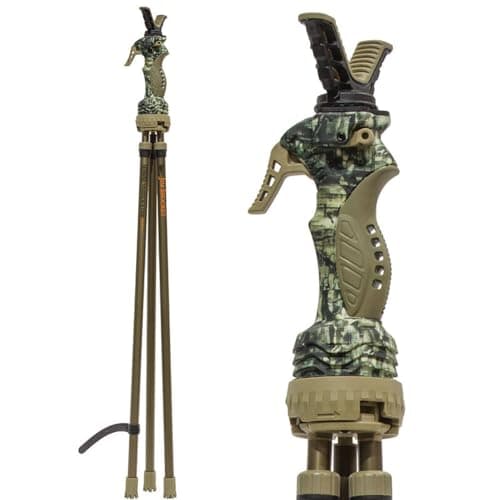
The best shooting stick for most hunters is the Primos Trigger Stick Gen 3 Tripod in the 24-62 inch length, and the reason is the number, not the brand. That range covers you sitting on the ground, kneeling and standing, and the trigger changes height with one hand while your other hand stays on the rifle. A rest you can adjust without breaking position is a rest you will use. A rest that needs two hands and a twist-lock is a rest you set once at the truck and never touch again.
If you want the rifle to stay put while you range, glass or dig out a call, the BOG DeathGripclamps it — and weighs 8.5 pounds for the privilege, which is the trade nobody mentions. If you need the widest spread of shooting positions in one unit, the BOG Adrenaline goes from 18 inches to 68. Below, all eight, with what each one costs you.
Why height is the first spec
A shooting rest only does one thing: it removes your body’s wobble from the rifle. That only works if the rest reaches the height your shooting position actually puts the rifle at — and your shooting position is decided by the terrain and the animal, not by you. Here is the problem in one table.
| Sitting on the ground | Roughly 18-26 in to the rifle. The most stable field position there is, and the one most tall sticks cannot collapse far enough to serve. |
|---|---|
| Sitting in a chair or blind seat | Roughly 30-40 in. This is where most ground-blind and tower-stand shots happen, and where a short bipod shines. |
| Kneeling | Roughly 36-48 in. The compromise position when grass or brush blocks a seated shot. |
| Standing | Roughly 52-68 in depending on your height. Least stable, most often necessary, and the position a rest helps most. |
Those are working approximations from the positions themselves, not manufacturer figures — measure yours. The point is the span: no single setting covers it, and the gap between the positions you planned for and the one the animal gives you is why height range, and the speed of changing it, outranks every other spec on a shooting stick.
The most common buying mistake follows directly. Hunters buy the short model because it is lighter and cheaper, discover the grass is higher than they expected, and end up shooting offhand anyway. If you only buy one, buy the one that reaches standing.
Monopod, bipod, tripod or clamp
With height settled, the leg count is a decision about how much stability you are willing to carry and how fast you need to swing.
| Type | What it does | Best at | The cost |
|---|---|---|---|
| Monopod | Removes vertical wobble only - you still control left-right and front-back | Stalking and still-hunting, where it doubles as a walking stick and deploys in a second | Least stable of the four; useless for a long hold |
| Bipod | Steadies side-to-side and gives a stable fore-end rest | Seated and kneeling shots, and the best stability-per-ounce on this page | Needs your body as the third leg, so it does not stand alone |
| Tripod (yoke) | Free-standing support under the fore-end | Standing shots and long waits; the all-rounder | Heavier and slower to deploy than a bipod |
| Clamping tripod | Grips the rifle so it stays aimed with no hands on it | Blinds, towers and vehicle hunting; ranging and glassing without losing your aim point | Heaviest by a wide margin, and a clamped rifle cannot swing quickly |
The eight picks compared
| Rest | Type | Height range | Adjustment | Best for |
|---|---|---|---|---|
| Primos Trigger Stick Gen 3 Tripod | Tripod, Quick Detach yoke | 24-62 in | One-hand trigger | Overall - seated to standing |
| BOG DeathGrip Aluminum | Clamping tripod | 7-59 in | Lever leg locks | Hands-free in a blind or tower |
| BOG Adrenaline Tripod | Tripod, Switcheroo head | 18-68 in | Lever leg locks | Widest range of positions |
| Primos Trigger Stick Gen 3 Bipod | Bipod, Quick Detach yoke | 18-38 in | One-hand trigger | Seated and kneeling |
| Primos Trigger Stick Gen 3 Monopod | Monopod | 35-65 in | One-hand trigger | Stalking - lightest to carry |
| Primos Pole Cat Tall Bipod | Bipod, aluminum | 25-62 in | Twist lock | Spending as little as possible |
| BOG DeathGrip Infinite Carbon Fiber | Clamping tripod, 360-degree ball head | Not published on the listing | Lever leg locks | Carrying a clamp instead of driving it |
| Caldwell DeadShot Bag Combo | Front and rear bags, filled | Bench height | None | Sighting in, not hunting |
Height ranges are as published by the manufacturer or stated on the retail listing. Where a figure is not published we say so rather than estimate it. Prices move constantly; every number comes from the live price checks below, stamped with the date each was captured.
What to check before you buy
| Collapsed height, not just extended | The bottom of the range is what strands people. The DeathGrip drops to 7 in and the Adrenaline to 18 in; a 24-62 in tripod will not serve a flat-ground seated shot. |
|---|---|
| One-handed adjustment | A trigger or lever you can work with your support hand while the rifle stays shouldered. Twist locks need two hands and a moment you may not have. |
| Weight against how far you walk | A 3.5 lb aluminum tripod is a carry. An 8.5 lb clamping tripod is a vehicle or blind item. Be honest about which you are. |
| Does the head come off | Primos's Quick Detach yoke and BOG's Switcheroo both let the same legs carry binoculars, a spotting scope or a camera head. That turns one purchase into two pieces of gear. |
| Leg angle locks and foot spikes | Locking leg angles are what make a tripod stable on a slope; retractable steel spikes are what keep it from sliding on frozen or hard ground. |
| Noise | Metal-on-metal legs and hard plastic locks are loud at dawn. Deploy and adjust it at home until the motion is quiet and familiar before you take it hunting. |
| Yoke width for your fore-end | A wide forearm, a bipod already mounted on the rifle, or a crossbow fore-end can all fit a yoke badly. Check it with the gun you own. |
Best overall: Primos Trigger Stick Gen 3 Tripod (24-62 in)
This is the one to buy if you buy one. 24 to 62 inches covers seated through standing for most adults, the legs lock at multiple angles for stability on uneven ground, and the Quick Detach yoke with an integrated lock swaps between a rifle yoke and an optics head in seconds. Construction is aluminum and polymer at roughly 3.5 pounds.
The trigger is the actual product. Squeeze it and the center column rises or drops to where you need it, one-handed, without you coming off the gun. Every other height-adjustment system on this page requires you to look at the stick and use two hands. In a treestand at last light with a buck walking, that difference is the whole reason this is the top pick.
Honest cons.It is a tripod, so it is slower to deploy than a bipod and bulkier strapped to a pack. The trigger mechanism and center column are more to go wrong than a plain twist-lock pole, and they are not silent — practice the motion before you need it. At around 3.5 pounds it is noticeably heavier than the monopod. And the yoke is a yoke: it supports the rifle, it does not hold it, so you still have to keep hands on the gun.
Best hands-free: BOG DeathGrip Aluminum Tripod
The DeathGrip is the one tripod here that changes what you can do rather than how steady you are. Its dual-adjustment clamping head with non-marring jaw insertsgrips the rifle’s fore-end, so the gun stays aimed down the lane with nothing holding it. You range, you glass, you work a call, you adjust your layers — and your aim point has not moved.
The rest of the specification is built for that job: 7 to 59 inches of height, 25 degrees of cant adjustment, 360-degree pan with tension adjustment, an integral bubble level, retractable steel foot spikes and lever leg locks. The 7-inch bottom end is the quiet standout — it will serve a prone or flat-ground seated shot that no other tripod here reaches.
Honest cons. 8.5 pounds.That is heavier than many of the rifles it will hold, and it rules the DeathGrip out of any hunt that involves real walking — this is a blind, tower, truck-bed and field-edge tripod. A clamped rifle also cannot be swung quickly, so it is the wrong tool for driven game or anything moving. Setting the clamp takes longer than dropping a fore-end into a yoke. And on a rifle with an unusual fore-end or an attached bipod, you should check clamp fit before buying.
Widest height range: BOG Adrenaline Tripod
If the height argument at the top of this page landed, the Adrenaline is the most direct answer to it: each leg carries a rapid-adjustment lever lock and the tripod runs from 18 inches, for shooting seated on the ground, up to 68 inches for kneeling or standing. That is the broadest published span on this page, and it is the single most useful number on a shooting stick.
It also carries BOG’s Switcheroosystem, which means the same legs accept interchangeable heads for binoculars, a spotting scope or a camera. For a hunter who glasses as much as they shoot, that turns one purchase into a glassing platform too — see our hunting binoculars guide and binocular harnesses for the rest of that system. Retractable metal foot spikes handle hard and frozen ground.
Honest cons.Lever leg locks are fast but need two hands and a glance, so changing height mid-hunt is a bigger movement than squeezing a Primos trigger. BOG does not publish a weight for the Adrenaline that we could find, which on a tripod chosen partly for carry is a real gap — we are not going to guess at it. And the Switcheroo heads are a separate purchase; the versatility is a capability you buy into, not one that ships in the box.
Best for seated and kneeling: Trigger Stick Gen 3 Bipod (18-38 in)
The same one-handed trigger and the same Quick Detach yoke as the tall tripod, on two legs and in a 18 to 38 inch range. That span is exactly the seated-and-kneeling window, which is where the majority of ground-blind, tower-stand and field-edge shots are actually taken. Two legs deploy faster than three and pack smaller, and a bipod braced against your knees is more stable than people expect.
Honest cons. It does not reach standing, and that is not a detail — if the grass is high or the shot comes from your feet, this stick cannot help you. A bipod needs your body as the third point of contact, so it will not hold a rifle on its own while you range. If you are only buying one rest, buy the tripod; buy this as the light one you carry when you know you will be sitting.
Lightest to carry: Trigger Stick Gen 3 Monopod (35-65 in)
One leg, 35 to 65 inches, the same trigger. The monopod is the rest for hunting that moves: still-hunting, spot-and-stalk, and anywhere a rest has to be in your hand already when the shot appears. It doubles as a walking stick on the way in, which means it is actually with you rather than strapped to the pack.
Honest cons. A monopod only removes vertical wobble. You are still controlling left-right and front-back with your body, so it is the least stable option here and it is unsuited to a long hold or a precise shot at distance. The 35-inch bottom end also means it does not serve a ground-seated shot at all. Treat it as a meaningful improvement on offhand, not as a substitute for a tripod.
Spend less: Primos Pole Cat Tall Bipod (25-62 in)
The Pole Cat is the older, simpler Primos design: an aluminum bipod with twist locks, in a 25 to 62 inch range that reaches standing. It costs a fraction of a Trigger Stick and gets you most of the stability, because the stability comes from the legs, not the adjustment mechanism.
Honest cons.Twist locks are the compromise. Changing height needs two hands, takes several seconds, and makes noise — so in practice you will set it once and live with it. Being a bipod, it also needs your body for the third point of contact. Stock was down to single digits when we checked, which is worth knowing on a long-running product. Buy it if the budget is the constraint; if you can stretch, the trigger is what you are actually paying for on the Gen 3.
A clamp you can pack: BOG DeathGrip Infinite Carbon Fiber
The DeathGrip’s problem is 8.5 pounds. The carbon-fiber Infinite is the answer to it: the same clamping concept in a carbon-fiber build with a 360-degree ball head and a quick-release plate, for hunters who want hands-free aim on a hunt that involves carrying the tripod to the spot rather than driving to it.
Honest cons. It is by far the most expensive item on this page, at better than twice the aluminum DeathGrip. The retail listing we checked does not publish a height range or a weight, so you are buying on the concept rather than the numbers — ask before you order if those matter to you, and we are not going to supply figures the listing does not. Carbon fiber is also less forgiving than aluminum of being dropped on rock. And a ball head is a different feel from the dual-adjustment head on the aluminum version; if you have used one, do not assume the other.
For the bench: Caldwell DeadShot bags
Included deliberately, because the rest you sight in on should not be the rest you hunt with. A filled front and rear bag combo gives you a near-rigid platform that takes your body almost entirely out of the rifle, which is what you want when you are trying to separate a scope-adjustment problem from a you problem. Our sight-in walkthroughs and scope mounting guide both assume you have something like this on the bench.
Honest cons.It is not a field rest — bags need a bench or a tailgate and will not work from a treestand or a kneeling position. Filled bags are heavy to transport. And a bag rest will flatter your rifle: groups shot off bags are tighter than groups shot off sticks, so do not use bench groups to predict your field accuracy. Shoot some groups off whatever stick you buy, at hunting distances, before you trust it.
Crossbows and air rifles
Both work on a stick, with caveats. A crossbowhas a wide, flat fore-end and a lot of stored energy, so a yoke needs to be wide enough to take it without the limbs or the rail touching, and you must be certain nothing is in front of the rail — a tripod leg in the path of a broadhead is a ruined bolt at best. Crossbows benefit more than rifles from a rest, because they are heavy and front-biased; our effective range guide makes the case that a steady rest extends useful range further than more speed does.
A big bore air rifleis the other obvious candidate — eight to nine pounds bare, ten-plus scoped, and usually a one-shot proposition, which makes a stable first shot everything. See big bore air rifles for that category, and how to sight in an air rifle for the hold-sensitivity problem that makes a consistent rest matter more on an airgun than on a centerfire.
The bottom line
Buy the Primos Trigger Stick Gen 3 Tripod (24-62 in) if you are buying one rest. It reaches standing, it collapses to seated, and the trigger means you will actually adjust it mid-hunt instead of living with whatever height you set at the truck.
Buy the BOG DeathGripif you hunt from a blind, a tower or a vehicle and want the rifle to hold its aim point with no hands on it — and accept 8.5 pounds. Buy the BOG Adrenaline if the 18-to-68-inch span is the thing you need most. Buy the Gen 3 Bipod as the light one for sitting, the Monopod for stalking, and the Pole Cat if the budget is the constraint.
Check the Primos Trigger Stick Gen 3 Tripod price on Amazon. Then do the one thing most buyers skip: shoot groups off it, at the height you actually hunt from, before the season opens. Our rifle season gear checklist covers what else belongs in that same pre-season session.
Frequently asked questions
What is the best shooting stick for hunting?
For most hunters, the Primos Trigger Stick Gen 3 Tripod in the 24-62 inch length. That range covers seated through standing, and its trigger lets you change height with one hand while the other stays on the rifle - which is the only way height adjustment gets used when an animal is already in the open. If you hunt from a blind or tower and want hands-free aim, the BOG DeathGrip clamping tripod is the better tool.
Monopod, bipod or tripod for hunting?
Monopod for hunting that moves - it removes vertical wobble, deploys instantly and doubles as a walking stick, but it is the least stable. Bipod for seated and kneeling shots, where it gives the best stability per ounce but still needs your body as the third contact point. Tripod if you take standing shots or hold a position for a long time. A clamping tripod is a fourth category: it holds the rifle rather than supporting it.
How tall should a shooting stick be?
Tall enough for the highest position you will realistically shoot from, and short enough for the lowest. Standing puts the rifle roughly 52-68 inches up depending on your height, kneeling roughly 36-48, a blind seat roughly 30-40, and sitting on the ground roughly 18-26. Measure your own positions. The usual mistake is buying the short model to save weight and then shooting offhand because the grass was higher than expected.
Is the BOG DeathGrip worth the weight?
It depends entirely on how you get to your spot. At 8.5 pounds it is heavier than many rifles, so it is a blind, tower, truck and field-edge tripod rather than a backpacking one. What you get for the weight is real: a clamping head that holds the rifle aimed while you range, glass or call, 7 to 59 inches of height, 25 degrees of cant and a 360-degree pan. If you walk a long way in, buy a yoke tripod instead.
Can you use a shooting stick with a crossbow?
Yes, and crossbows benefit more than rifles because they are heavy and front-heavy. Two cautions: check that the yoke is wide enough for the fore-end without the limbs or rail touching it, and be certain no part of the tripod is in the arrow's path - a leg in front of the rail will ruin a bolt and could do worse. A steady rest extends a crossbow's usable range further than extra speed does.
Do I need shooting bags if I own a tripod?
For sighting in, yes - they do different jobs. Filled front and rear bags take your body almost out of the rifle, which is what you want when separating a scope problem from a technique problem at the bench. But bags flatter a rifle: bench groups are tighter than field groups, so after you zero, shoot some groups off whatever stick you plan to hunt with, from the height you will actually be shooting from.
Are shooting sticks quiet enough for hunting?
Not inherently. Aluminum legs, hard plastic locks and a trigger mechanism all make noise, and twist locks are the worst of the group because they need a deliberate two-handed motion. The fix is practice rather than product: deploy and adjust the stick at home until the motion is quiet and automatic, and set your height before you expect the shot rather than during it.
Sources
- Primos Trigger Stick Gen 3 published specifications and features - one-hand trigger height adjustment, locking leg angles, Quick Detach yoke with integrated lock, aluminum and polymer construction, ~3.5 lb, 24-62 in tall tripod
- Guns & Ammo, 'Primos Gen3 Trigger Sticks Tri-Pod (And How to Use It)' - construction, height and angle adjustment in the field
- BOG DeathGrip published specifications - 7-59 in height, 8.5 lb, dual-adjustment clamping head with non-marring jaw inserts, 25 degrees of cant, 360-degree pan with tension adjustment, integral bubble level, retractable steel foot spikes, lever leg locks
- BOG Adrenaline Tripod published specifications - lever leg locks, 18-68 in height, retractable metal foot spikes, Switcheroo interchangeable head system
- Height ranges for the Trigger Stick Gen 3 bipod (18-38 in), monopod (35-65 in) and Pole Cat tall bipod (25-62 in) as stated on the retail listings checked 2026-10-07
- Prices, product images and stock status via the Amazon Creators API price layer, refreshed daily
Keep reading
Gearing up before your next hunt?
See how we evaluate gear, then dig into the reviews and buying guides — written without inventory to sell.