Buying Guide
Best Camo for Elk Hunting: Buy Pants, Not Patterns
Elk hunting is 10 miles of steep country a day in weather that swings 40 degrees. The camo that fails you is the camo that soaks, binds or blows out - not the one whose pattern is slightly wrong.
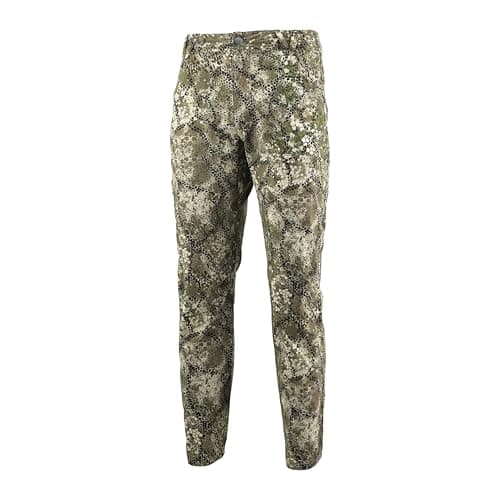
Whitetail camo is a concealment problem. Elk camo is an endurance problem. You will cover steep miles before daylight, sweat through the climb, sit soaked at 10,000 feet while the wind comes up, get rained on, crawl through deadfall, and do it again tomorrow. What defeats western hunters is almost never the pattern — it is a pant that soaks and will not dry, a seat that blows out on granite, or a cut that binds when you are crawling the last 60 yards.
So this guide is mostly about pants, which is where western hunters concentrate their spending for exactly this reason. The pattern discussion is real and we cover it — but it is the fourth most important thing on the garment, not the first.
Elk camo is a different problem
| Eastern whitetail | Western elk | |
|---|---|---|
| Activity level | Sit still for hours | Hike hard, then sit, then hike |
| Primary failure | Noise and movement give you away | You get wet from the inside and then cold |
| Distance to game | 20-40 yards, dense cover | Often spotted at 500+ yards across an open basin |
| What the pattern must do | Break a vertical outline against trunks | Break an outline against sage, rock, grass and skyline at distance |
| What kills the garment | Wear and washing | Granite, deadfall, brush and pack straps |
| Priority spend | A quiet outer layer | Pants, then a breathable layering system |
Elk have the same dichromatic vision family as deer — two color receptors, strong blue and UV sensitivity, excellent motion detection — so the underlying science from our camo patterns guide applies. What changes is the geometry: a whitetail sees you at 25 yards in cover, an elk sees you at 600 yards on an open hillside. At that range, fine pattern detail is meaningless and only your overall tone and silhouette exist.
What pattern actually needs to do out west
- Muted, mid-tone, and desaturated. Sage, granite, dead grass and lodgepole are gray-green-tan. The classic mistake is a dark eastern hardwood pattern that reads as a black blob against a light hillside.
- Macro breakup over mimicry.Photo-realistic leaf prints are built for a background that does not exist above treeline. Digital and abstract breakup designs — the family Sitka developed with W.L. Gore, and the equivalents from KUIU and others — were engineered specifically for disrupting outline at distance.
- Consider what is behind you, not around you. A glassing hunter skylined on a ridge is a black silhouette regardless of pattern. Getting below the ridgeline does more for you than any garment.
- Movement still dominates. Elk that have been hunted a week are looking for motion in open country. The slow, deliberate move beats every pattern on this page.
The specs that decide a September hunt
| Breathability first | You generate enormous heat climbing. A pant that will not vent leaves you soaked at the top, and wet at 10,000 feet at dawn is genuinely dangerous. Thigh vents are not a luxury item out west |
|---|---|
| Stretch and articulation | Diagonal 4-way stretch and articulated knees. You will high-step deadfall, crawl, and sit cross-legged glassing. A pant that binds at the knee costs you both energy and stealth |
| Reinforced seat and knees | Granite scree and glassing on rock destroy ordinary fabric. This is the single most common failure point on a western pant |
| Wind resistance | More useful than insulation. Basins funnel wind, and a wind-blocking softshell over a base layer beats a heavier insulated pant across a wider range of conditions |
| Dry time | Quick-drying synthetics only. Anything that stays wet overnight in a spike camp is a liability |
| Weight | You carry every ounce up every foot of elevation. Under a pound for a warm-weather pant is achievable; a heavy pant is a real tax across ten miles |
| Noise (lower priority than east) | Softshells are moderately quiet and that is generally enough. Do not trade away breathability for silence on an elk hunt - the trade goes the other way from whitetail |
The picks at a glance
| Pant | Type | Best season | Standout | Approx. price |
|---|---|---|---|---|
| Badlands Scree | Stretch hunting pant | Early to mid | Value plus an unconditional lifetime warranty | ~$140 |
| KUIU Switchback | Light stretch pant | Warm / early archery | Water and stain resistant, low weight | ~$129 |
| Sitka Ascent | Softshell | Early to mid | The western benchmark for articulation | ~$140-175 |
| KUIU Guide Pro | Wind-resistant technical pant | Mid to late | Durability in hard country | ~$199 |
| Sitka Traverse | Lightweight technical pant | Cool / late | Layering-friendly cut | ~$169 |
Prices are approximate mid-2026 brackets and vary by size and pattern; verify before buying.
Best value: Badlands Scree Pant
The Scree is the pant we would point a first-time elk hunter to. It is a stretch hunting pant in the roughly $140range (verify current pricing) that hits the important marks — four-way stretch, quick-drying synthetic fabric, articulation built for climbing — without the $200 entry fee of the premium western brands.
The part that changes the math is Badlands’ unconditional lifetime warranty. On a garment class whose defining failure mode is a blown-out seat on granite, a company that replaces it without argument is worth a genuine premium. Amortized over ten seasons, the Scree is the cheapest pant on this page.
Honest cons: fabric weight and finish sit a step below Sitka and KUIU, the fit runs less precisely articulated than the Ascent, and Badlands’ pattern range is narrower. Sizing skews long — check the inseam options.
Who it’s for: the DIY elk hunter kitting up for a first western trip who wants gear that will survive to a second one.
Best early-season and warm weather: KUIU Switchback Pant
September archery elk is often hot — 70s in the afternoon, hard climbing, sun exposure at altitude — and most hunting pants are built for November. The Switchback is KUIU’s answer: a light, water- and stain-resistant two-way stretch pant at roughly $129 (verify current pricing) that is genuinely comfortable to hike hard in.
For the archery opener this is the correct tool. Low weight, fast drying, and enough weather resistance to shrug off morning dew and an afternoon shower without becoming a rain pant you sweat inside.
Honest cons: light fabric means less abrasion resistance — this is not the pant for crawling scree fields — and it offers little wind resistance, so a cold front means adding layers. Two-way stretch is a step down from four-way for deep articulation.
Who it’s for: September archery hunters and anyone whose problem is heat rather than cold.
Best all-around: Sitka Gear Ascent Pant
The Ascent is the pant the western category gets measured against. It is an articulated softshell— a stretch woven face with light wind resistance and real breathability — and its reputation rests on movement: a gusseted, articulated cut that disappears when you are climbing, crawling or drawing a bow from a kneel. Street pricing runs roughly $140-175 depending on pattern and size (verify current pricing).
Softshell is the right fabric class for elk. It blocks enough wind to matter on a windy glassing knob, breathes far better than a hard shell, sheds light moisture, and dries quickly. Across the widest range of September and October conditions, this is the single most useful pant type to own.
Honest cons: the price is real and buys refinement rather than a step-change in capability, the fabric is not the most abrasion-resistant option for hard rock, and Sitka’s sizing runs athletic — layering underneath is tight if you order your street size.
Who it’s for: the hunter who has done a western hunt, knows the pant is where the money goes, and wants the benchmark.
Best for hard country: KUIU Guide Pro Pant
The Guide Pro is built for the hunt that punishes gear: wind-resistant, articulated, and reinforced where western pants die, at around $199(verify current pricing). KUIU’s entire design brief is backcountry-first, and this is the pant in their line aimed at people who will be out for ten days rather than a long weekend.
Wind resistance is the feature that earns its keep. Glassing a basin at first light in a 20-mph wind is a different experience in a wind-blocking pant than in a breathable one, and it is the difference between staying put and going back to camp.
Honest cons: it is the most expensive pant here, wind resistance costs breathability so it is warm for early September, and KUIU’s athletic fit is the least forgiving in this group. It is a specialist, not the default.
Who it’s for: backcountry and late-season hunters, and anyone who has already destroyed a pant in elk country.
Best late-season layering pant: Sitka Traverse
The Traverse is Sitka’s lightweight technical pant, roughly $169 (verify current pricing), and its role in the system is layering. Cut to go over a merino bottom or under a shell without bunching, it covers cold mornings and October rifle seasons where the Ascent alone is not enough.
Honest cons: on its own it is not warm, and it is not a substitute for a softshell in wind. As a second pant in a system it is excellent; as your only pant it is the wrong pick.
Who it’s for: hunters building a two-pant system for a season that spans September archery and October rifle.
The Kings XKG value system
Kings Camo’s XKG line was built specifically as the value answer to the premium western brands — a complete technical layering system, including pants in western-appropriate patterns, at prices that undercut Sitka and KUIU substantially. For a hunter kitting out an entire western setup at once, that gap is the difference between one hunt and two.
We are direct about where the premium brands still earn their money in our Kings Camo vs Sitka comparison, and the XKG review covers the line piece by piece.
Building the rest of the system
A western setup is a layering system, not a jacket. In rough order of what to buy after pants:
- A merino base layer— the multi-day odor resistance genuinely matters on a spike camp. See hunting base layers.
- Boots that fit, broken in months early. More elk hunts end from feet than from anything on this page. See best hunting boots.
- A packable rain shell you will actually carry — see hunting rain gear.
- A pack that carries meat, not just gear. See best hunting backpacks.
- Glass. Western hunting is spotting before it is stalking — see best hunting binoculars.
Frequently asked questions
What camo pattern is best for elk hunting?
Any muted gray-green-tan pattern with real light-and-dark contrast. Western backgrounds are sage, rock, dead grass and lodgepole, so dark eastern hardwood patterns read as a black blob on an open hillside. Because elk often see you at hundreds of yards, fine printed detail is irrelevant - overall tone and outline are what exist at that distance.
Why do elk hunters spend so much on pants?
Because pants are where a western hunt fails. You climb hard enough to soak anything that will not breathe, you crawl and glass on granite that destroys ordinary fabric, and you high-step deadfall all day, which punishes a cut that does not articulate. A jacket comes off when you climb; the pants stay on for every mile.
Are softshell pants good for elk hunting?
They are the most useful single class for September and October. Softshell blocks enough wind to make a windy glassing session tolerable, breathes far better than a hard shell, sheds light moisture, and dries fast. That combination covers more western days than either a light stretch pant or a heavy insulated one.
Do I need premium camo like Sitka or KUIU for elk?
No. A well-fitting, breathable, durable pant in a sensible muted tone does the job, and Badlands or Kings Camo deliver that for meaningfully less. The premium brands buy refinement - articulation, fabric quality, fit precision - which is worth real money to someone hunting ten days a year and not much to someone hunting three.
How many pairs of pants should I bring on an elk hunt?
Two, if you are packing in: one you hike and hunt in, and one lighter or warmer pair that covers the other end of the temperature range and gives you something dry if the first pair gets soaked. Quick-drying synthetics make one-pair trips survivable, but a spike camp with no dry option is a genuinely bad place to be.
Does scent control matter as much for elk as for whitetail?
Elk have excellent noses and hunting the wind matters enormously, but the western game is different - you are usually covering ground and playing thermals rather than sitting a fixed stand. Practical wind discipline and terrain choice do far more for you than scent-control apparel does on a mountain.
Sources
- SITKA Gear - types of camo: camouflage patterns 101 (macro/micro, Optifade development)
- Outdoor Empire - guide to hunting camo patterns by type, location and species
- Field & Stream - the science of camouflage
- Grit Outdoors - evaluating camo patterns: a guide for hunters
- Product specs, availability and pricing verified via the Amazon Creators API, 2026-08-13
- Kings Camo - XKG series
Keep reading
Gearing up before your next hunt?
See how we evaluate gear, then dig into the reviews and buying guides — written without inventory to sell.