Head to Head
.177 vs .22 Air Rifle: One Equation Settles It
Both calibers are sold out of the same rifles at the same power. That means the choice is not about power at all - it is about how a fixed amount of energy gets divided between speed and mass, and which half of that trade your shooting actually needs.
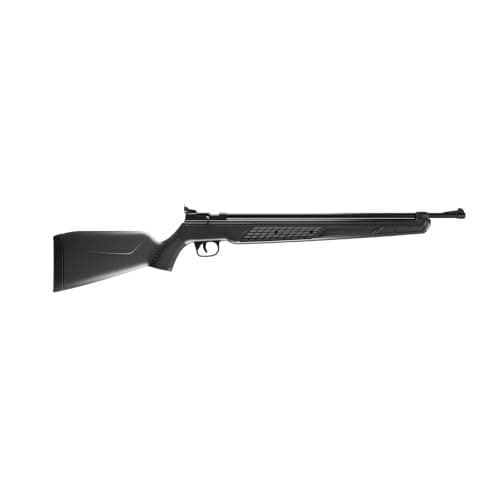
Buy .22 if the pellet is going to hit an animal. Buy .177 if it is going to hit paper. That is the whole verdict, and the reason is arithmetic rather than opinion: at the same muzzle energy a .22 pellet arrives with roughly 37 percent more momentum, and a .177 pellet arrives about three inches flatter at 35 yards. Our pick in .22 is the Crosman C362, because it is a recoilless multi-pump rated at 13 ft-lb that a new shooter can actually hold still. Our pick in .177 is the Diana Two-Forty Classic, a deliberately mild springer built for accuracy rather than a velocity claim.
Almost every version of this argument you will read online is a list of adjectives — flatter, harder-hitting, more accurate, better for hunting. None of those are measurements. The useful version is shorter: a given rifle makes a given amount of energy, and the caliber decides whether that energy is spent on speed or on mass. Below is that trade, in numbers you can check.
The short answer
| What you are shooting | Caliber | Why |
|---|---|---|
| Paper, targets, plinking cans | .177 | Flatter flight means less holdover guesswork, pellets cost less per tin, and the match-grade pellet selection is deepest here |
| Squirrels, rabbits, pigeons at sensible range | .22 | More momentum and better energy transfer at the ranges small game is actually shot at |
| Rats and pests around buildings | Either, leaning .22 | Shots are short so trajectory does not matter, and a heavier pellet is less likely to carry on through a thin wall |
| Field target competition | .177 | The discipline is built around it - flatter arc and a smaller, more predictable kill zone |
| Raccoons, possums, groundhogs | .22 minimum | Bigger animals need energy delivered rather than velocity, and this is where .177 runs out of argument |
| Deer and other big game | Neither | That is a .35-caliber-and-up legal question, not a .177-vs-.22 one - see our big bore guide |
The equation that decides it
Kinetic energy is mass times velocity squared, which for pellets works out as energy in foot pounds equals grain weight times velocity squared, divided by 450,240. Run it backwards and you get the number that settles this argument: for a fixed energy, velocity falls with the square root of pellet weight.
So take one honest energy figure — 12 ft-lb, which is the common field standard for humane small-game shooting and roughly what a decent break barrel or multi-pump actually makes with lead — and one pellet family, so the comparison is fair. The JSB Match Diabolo Exact is published at 8.44 grains in .177 and 15.9 grains in .22: same design, same brand, nearly double the mass.
| .177, 8.44 gr, at 12 ft-lb | About 800 fps at the muzzle |
|---|---|
| .22, 15.9 gr, at 12 ft-lb | About 583 fps at the muzzle |
| What the .22 gives up | About 27 percent of the velocity |
| What the .22 gains | About 88 percent more pellet mass, and about 37 percent more momentum (mass times velocity) at the muzzle |
Those four lines are the entire caliber debate. The .177 buys you flight. The .22 buys you mass. Energy is identical by construction, because it is the same rifle.
How much flatter is .177, in inches
“Flatter” is the most repeated claim in this argument and almost nobody puts a number on it. Here is the number, using the muzzle velocities above and simple free-fall over the time of flight — which ignores air resistance, so the real drops are somewhat larger and the gap between calibers a little wider.
| Distance | .177 at 800 fps | .22 at 583 fps | Difference |
|---|---|---|---|
| 20 yards | About 1.1 in of drop | About 2.0 in | About 1 in |
| 35 yards | About 3.3 in of drop | About 6.3 in | About 3 in |
Read that honestly in both directions. Three inches at 35 yards is a real difference and it is the entire case for .177 as a target caliber — less holdover to remember, fewer ways to be wrong. But one inch at 20 yards is not a difference that loses you a squirrel, and 20 to 25 yards is where most small game is actually shot with an air rifle. The .177 advantage grows with distance, and air rifle hunting should be shrinking distance, not stretching it.
These figures are drag-free arithmetic from published pellet weights at a stated energy level. They are not measurements, and they are not a substitute for mapping your own holdover card at 10, 15, 20, 30 and 40 yards — which is the exercise our air rifle sighting-in guide walks through, because a pellet flies a rainbow rather than a line in either caliber.
What happens at the other end
The muzzle is the easy half. What matters on an animal is whether the pellet stops inside it, because a pellet that exits took its remaining energy with it.
| .177 - higher sectional density for its weight class | A narrow, fast pellet concentrates force on a smaller frontal area, so it penetrates readily. On small, thin-skinned quarry that can mean passing straight through and leaving much of its energy on the far side. |
|---|---|
| .22 - more frontal area and more mass | A wider, heavier pellet gives up velocity but transfers more of what it carries into the animal. This is the single best argument for .22 as the hunting caliber. |
| Wind | A heavier pellet spends longer in flight but is harder to push sideways. In practice .22 is the better behaved of the two in a breeze, despite the longer flight time. |
| Over-penetration near buildings | Around barns, outbuildings and fences the relevant question is what the pellet does after it misses. The slower, heavier pellet is generally the more conservative choice. |
The practical differences nobody mentions
| Pellet cost and selection | Both calibers are well supported, but .177 tins are typically cheaper per pellet and the match-grade and wadcutter selection is deeper, because competition shooting lives there. |
|---|---|
| Rifle availability | More models are offered in .177 than .22, and when a rifle comes in only one caliber it is usually .177. If you want a specific rifle, check which bore it is actually sold in. |
| Velocity claims on the box | A headline fps figure is almost always measured with ultra-light alloy pellets, and the inflation is worse in .177 because the lighter bore makes the bigger number. Judge a rifle on its energy with lead, not on the box. |
| Spring piston pellet fit | Springers shoot mid-weight pellets best - roughly 8 to 10 grains in .177 and 14 to 16 in .22 - and dislike very light ones. A PCP is far more forgiving and often does its best work with heavy .22 pellets. |
| Noise | Nothing inherent to the caliber, but the .177 version of a rifle often runs closer to the sound barrier, and a transonic pellet is both louder and less accurate. That is a quiet point in .22's favor in a neighborhood. |
That last point connects to a question people ask after they buy: how loud is this going to be in a suburban backyard. Our quietest air rifles guide ranks the category on report, and PCP vs break barrel covers the powerplant decision that actually sets your energy budget before caliber divides it.
Which caliber by what you shoot
If you are buying one air rifle and you expect to shoot living things with it, buy .22. The three-inch trajectory penalty at 35 yards is a problem you solve with a holdover card and by getting closer; insufficient energy transfer on a raccoon is not a problem you can solve at all.
If you are buying one air rifle and it will mostly punch paper, shoot cans and teach a kid to aim, buy .177. The flatter arc makes it easier to learn on, the pellets cost less by the tin, and plinking is a volume activity.
If you are buying your second air rifle, buy the other one. That is not a joke — the two calibers genuinely do different jobs, and the cheapest way to cover both is two inexpensive rifles rather than one expensive one.
Best .22: Crosman C362
The C362 is our .22 pick and the top pick of this page. It is a multi-pump pneumatic at 35.6 inches and 4.5 pounds, and Crosman publishes 13 ft-lb of muzzle energy at maximum pumps. Independent testing has it averaging 611 fps with heavy 18.13-grain lead pellets, which works out to roughly 12 to 14 ft-lb— right at the common field standard for humane small-game shooting, and a useful demonstration that a rifle rated at 875 fps on alloy does not produce 875 fps with the lead you should hunt with.
Being a multi-pump matters as much as the caliber. There is no spring slamming forward, so there is no two-way recoil to fight and the rifle is materially easier to shoot accurately than a magnum break barrel at the same money. Honest cons: you pump it for every shot, which is slow and not quiet, and the energy depends on you doing the full pump count every time.
Best .177: Diana Two-Forty Classic
The Two-Forty is the .177 we would hand someone who wants to actually shoot well rather than chase a number on a box. Diana rates it at about 575 fps and 5.5 ft-lb with lead, and Hard Air Magazine measured roughly 555 fps with about a 7 fps standard deviation— which is the spec that matters and the one nobody advertises. Low power, low recoil, consistent, and a classic beech-stocked break barrel with the cocking effort of a rifle built in the last century rather than a magnum.
Honest cons: 5.5 ft-lb is a paper and tin-can energy level, not a hunting one. That is the point of the pick, but it is a real limit — do not take this rifle after squirrels.
Best .177 break barrel for close pests: Gamo Wildcat Whisper
If you want .177 with more energy than the Two-Forty for backyard pest work at short range, the Wildcat Whisper is the one in the registry we would choose. It is a conventional gas-piston break barrel with Gamo’s Whisper noise-dampening shroud, which is the feature worth paying for in a neighborhood where report, not power, is what gets you a conversation with a neighbor.
Honest cons: it is a springer, so it is hold-sensitive in a way the C362 is not — the artillery hold is mandatory rather than optional. And like every break barrel in this class, the advertised velocity is an alloy-pellet figure.
The .22 upgrade path: Umarex Notos Carbine
The honest limitation of a cheap .22 is that you are pumping or cocking for every shot. A compact PCP removes that entirely: fill the reservoir once, then shoot a magazine with no cocking effort, no recoil and far better shot-to-shot consistency. The Notos Carbine is the short, handy version of that idea — genuinely useful in a barn, a blind or anywhere there is no room to swing a full-length rifle.
Honest cons: it costs several times what the Prymex-class break barrels do, and a PCP needs a fill source — a hand pump, a tank or a compressor, which is a separate purchase and the real cost of entry. Our PCP compressor guide covers that side, and best PCP air rifles covers the tier above this one.
The pellet matters more than the caliber
Here is the uncomfortable part of the caliber debate: the difference between a good pellet and a bad one in the same caliber is usually larger than the difference between calibers. A rifle has a pellet it likes, and finding it is worth more accuracy than any bore choice.
| Pellet | Type | .177 weight | .22 weight | Use |
|---|---|---|---|---|
| JSB Match Diabolo Exact | Domed | 8.44 gr | 15.9 gr (Exact Jumbo) | The accuracy benchmark in both bores - and the fair basis for comparing them |
| H&N Field Target Trophy | Domed | 8.64 gr | 14.66 gr | A true mid-weight that suits spring piston rifles in either caliber |
| Crosman Premier | Domed | 7.9 or 10.5 gr | 14.3 gr | Widely available, good value, a sensible first tin |
| H&N Baracuda Match | Heavy domed | 10.65 gr | 21.14 gr | For regulated PCPs with the air to push it - too heavy for most springers |
Note what the weight columns tell you about the whole argument: the heaviest .177 in that table (10.65 gr) is still lighter than the lightest .22 (14.3 gr). The calibers do not overlap, which is why you cannot split the difference with pellet choice — you have to pick a bore. Our air rifle pellet guide goes through head shapes and what each one is for.
Above .22: the rest of the caliber ladder
The same arithmetic keeps working as the bore grows, and it changes what the rifle is for rather than just how it shoots.
| .25 | A PCP caliber in practice. Heavier pellets again, more momentum again, and an air supply requirement to feed it. Sensible step up for larger pests at moderate range. |
|---|---|
| .30 | Where airguns start crossing into genuine hunting tools for coyote-sized animals - and where state regulations start naming calibers explicitly. |
| .35 and up | Big bore territory, and a legal question rather than a ballistic one. Several states set a minimum bore for deer, and .357 passes in some and fails in others. |
If that is the direction you are heading, read our big bore air rifle guidefirst, because the first spec on a deer airgun is legal rather than ballistic — West Virginia, for example, requires .45 and a 200-grain bullet, while Virginia allows .35 and up for deer but prohibits pneumatics outright for bear and elk. Nothing on this page applies to that decision.
The bottom line
The same rifle, the same energy, two ways to spend it. The .177 spends it on velocity and buys you about three inches less drop at 35 yards. The .22 spends it on mass and buys you about 37 percent more momentum into the animal. Paper rewards the first trade; quarry rewards the second.
If you are buying one rifle for small game, buy .22 — the Crosman C362 is the one we would start with. If you are buying one rifle for targets, buy .177 and take the Diana Two-Forty. Then spend your next twenty dollars on three different tins of pellets rather than on a different caliber, because that is where the accuracy actually is.
Frequently asked questions
Is .177 or .22 better for an air rifle?
Neither is better in general - they divide the same energy differently. Out of the same rifle at 12 ft-lb, a .177 JSB Exact at 8.44 grains leaves at roughly 800 fps and a .22 Exact Jumbo at 15.9 grains at roughly 583 fps. The .177 gives up nothing in energy and gains about three inches less drop at 35 yards; the .22 gives up about 27 percent of the velocity and gains about 37 percent more momentum. Target shooting wants the first; hunting wants the second.
Is .22 more powerful than .177?
No. The powerplant makes the power and the caliber only divides it, so the same rifle makes the same muzzle energy in either bore. What the .22 genuinely has is more momentum for that energy - mass times velocity - which is the better predictor of penetration and energy transfer into an animal. It is a real advantage, but calling it more power is wrong.
Which caliber is better for hunting squirrels and rabbits?
.22. Small game is usually shot inside 25 yards, where the .177 trajectory advantage is only about an inch of drop difference at 20 yards, while the .22 pellet's extra mass and frontal area transfer noticeably more of what they carry into the animal. A fast .177 can pass straight through a small, thin-skinned animal and leave much of its energy on the far side.
How much flatter does a .177 shoot than a .22?
About an inch less drop at 20 yards and about three inches less at 35, comparing the same pellet family at the same 12 ft-lb muzzle energy. Those are drag-free figures from published pellet weights, so real-world drop is somewhat larger in both calibers and the gap widens slightly with distance. The practical lesson is that the .177 advantage grows with range - and air rifle hunting should be reducing range, not extending it.
Can you hunt with a .177 air rifle?
At close range, on small quarry, with enough energy, yes - roughly 12 ft-lb is the common field standard for humane small-game shooting, and plenty of .177 rifles make that. But many inexpensive .177 rifles make far less: the Diana Two-Forty Classic, for example, is rated at about 5.5 ft-lb, which is a paper and tin-can energy level. Check the rifle's energy with lead pellets rather than its advertised velocity, which is measured with light alloy.
Are .177 pellets cheaper than .22?
Generally yes, per pellet, and the selection is deeper - particularly for match-grade wadcutters, because competition shooting lives in .177. More rifle models are offered in .177 too, and when a rifle is sold in only one caliber it is usually .177. If you plan to shoot high volume at paper, that cost difference adds up in a way it never will for a hunter.
What about .25 caliber or bigger?
The same arithmetic continues: more mass, more momentum, less velocity, and a growing need for a PCP and an air supply to feed it. .25 is a sensible step up for larger pests at moderate range, .30 is where airguns become genuine hunting tools for coyote-sized animals, and .35 and up is big bore territory where the first question is legal rather than ballistic - several states set explicit minimum calibers for deer, and .357 passes in some and fails in others.
Sources
- Published pellet weights used for the arithmetic: JSB Match Diabolo Exact .177 8.44 gr and .22 Exact Jumbo 15.9 gr; H&N Field Target Trophy .177 8.64 gr and .22 14.66 gr; Crosman Premier .177 7.9/10.5 gr and .22 14.3 gr; H&N Baracuda Match .177 10.65 gr and .22 21.14 gr
- Energy and velocity figures derived from the standard pellet energy relationship (foot pounds = grains x velocity squared / 450,240) at a stated 12 ft-lb; trajectory figures are drag-free free-fall over the time of flight and therefore understate real drop
- Crosman C362 published specifications (35.6 in, 4.5 lb, 13 ft-lb at maximum pumps, rated 875 fps) and the independently measured 611 fps with 18.13-grain lead pellets, as cited in our Crosman 362 review
- Diana Two-Forty Classic published ratings (about 575 fps, 5.5 ft-lb with lead) and Hard Air Magazine's measured approximately 555 fps with about a 7 fps standard deviation
- Air Arms - '.177 or .22: what is the best calibre for air rifle hunting?' on the trade between flatter trajectory and knockdown power, and quarry suited to each
- Prices, product images and stock status via the Amazon price layer, refreshed daily
Keep reading
Gearing up before your next hunt?
See how we evaluate gear, then dig into the reviews and buying guides — written without inventory to sell.