Buying Guide
Best PCP Hand Pumps for Air Rifles
Every pump in this category claims 4,500 psi, so pressure is not the thing to shop on. The two specs that decide whether you keep using a hand pump are moisture management and the fitting on the end of the hose - and one of those is the single most common reason a new pump will not connect to your rifle at all.
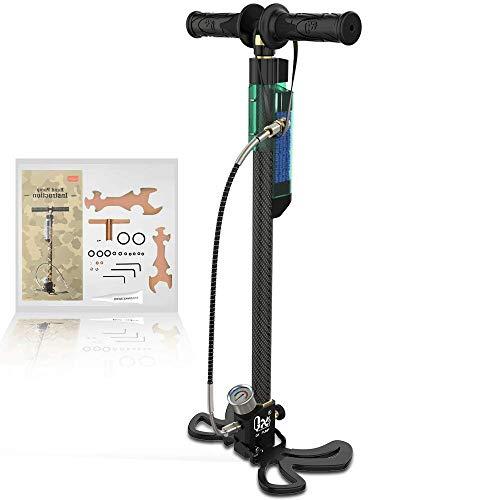
The verdict: the best PCP hand pump for most air rifle owners is the GX PUMP H-4 — 3.5 stages so the hardest part of the fill is divided across more compression steps, a published oil-moisture filter, and a stainless body, at roughly a third of what the premium pump costs. It is the right pump for the hunter or plinker filling a .22 PCP in the garage. The budget pick is the VEVOR 3-Stage, which is the cheapest pump here that still includes the two things we will not go without — an oil-moisture filter and a pressure gauge. And if you want to buy once, the Air Venturi MK5 by Hill is the only pump in this guide with a published consumable service part, which tells you more about how it is meant to be owned than any spec sheet does.
Here is the framing, because the whole category markets itself on the wrong number. Every pump on this page claims 4,500 psi.So claimed pressure cannot separate them, and it is not what fails. What fails is water: compressing atmospheric air to 3,000 psi condenses the moisture that was in it, and that water goes somewhere. Either the pump filters it out, or it ends up inside your rifle’s air reservoir. That is the spec to shop on, and it is why every pick on this page has a filter.
The best PCP hand pumps at a glance
| Pump | Price & buy | Stages | Max pressure | Moisture filter | Best for |
|---|---|---|---|---|---|
| GX PUMP H-4 | $129.99Buy | 3.5 | 30 MPa / 4,500 psi | Yes - oil-moisture filter | Best overall |
| VEVOR 3-Stage | $49.90Buy | 3 | 30 MPa / 4,500 psi | Yes - oil-moisture filter | Budget pick |
| Air Venturi MK5 by Hill | $329.27Buy | Not published | 4,500 psi | Yes - Dry-Pac desiccant system | Buy-once |
| Benjamin High Pressure Hand Pump | $169.98Buy | 3 | Not published on the listing | Not published | Benjamin / Crosman owners |
| FOUR UNCLES 4500 PSI | $62.99Buy | 3 | 4,500 psi | Not published | Published 8mm quick connect |
Prices shown are from Amazon as of November 8, 2026 and change often — the button always goes to the current listing. Some links may earn us a commission at no extra cost to you.
Note the two columns that are not“max pressure”. Every one of these either states 4,500 psi or is sold as a 4,500 psi pump, so that column separates nothing. The columns that do separate them are stages and filtration — and, as the next two sections explain, the fitting on the hose, which none of these listings puts in a specification table at all except one.
Moisture, not pressure, is what you are buying
This is the mechanism, and it is worth understanding because it explains every design decision in the category. Air contains water vapour. When you compress air, you reduce the volume it occupies without removing the water, so the air becomes saturated and the excess condenses into liquid. Compression also makes the pump hot, and the inside of a hot pump cooling down is exactly where that water collects.
A hand pump has two possible destinations for that water: a filter in the pump, or your rifle’s air reservoir. Water in an air cylinder is a corrosion problem in a part you cannot inspect and cannot easily replace, on a pressure vessel. That is the whole reason the oil-moisture filterappears in the product titles of the cheapest pumps in this category — it is not an upsell, it is the feature.
The fitting spec that stops a pump working
This is the practical failure that sends more PCP pumps back than any performance issue, and it has nothing to do with pumping. A pump’s hose ends in a quick-connect fitting, and your rifle has a fill probe or port of a particular size and type. If they do not match, the pump is an expensive paperweight until you buy an adapter.
The dominant fitting in the airgun world is an 8 mm quick connect (also sold as a 1/8 in BSPP foster-type coupling), but it is not universal, and it is not always stated. Of the five pumps here, FOUR UNCLES is the only one that publishes its fitting size on the listing — an 8 mm quick connect. That is a genuinely useful piece of information and the reason that pump is on this page.
| Check your rifle first | Find out whether your PCP fills through a male foster/quick-connect port, a female port, or a proprietary probe. This is in your rifle's manual and it decides which adapter, if any, you need. |
|---|---|
| Published fitting sizes in this guide | FOUR UNCLES: 8 mm quick connect. The GX H-4, VEVOR, MK5 and Benjamin listings do not state a fitting size - treat it as unverified until you have the pump. |
| The brand-matched shortcut | If you own a Benjamin or Crosman PCP, the Benjamin pump is specified as filling PCP airguns of that family, which removes the compatibility question rather than answering it. |
| Budget for an adapter | A foster-fitting adapter set is a small fraction of any pump's price. If your rifle and pump turn out to disagree, that is the fix - not a return. |
What 3-stage, 4-stage and 3.5-stage actually mean
A hand pump compresses air in steps, each one handing a smaller, denser volume to the next. More stages means each individual stage does less of the work, which matters most at the top of a fill where the pressure difference is largest. In practice:
- 3-stage— the standard. The VEVOR, Benjamin and FOUR UNCLES pumps are all 3-stage. Entirely adequate, and the handle gets noticeably heavier as you approach the top of the fill.
- 3.5-stage— what GX calls the H-4’s arrangement. An extra partial compression step intended to smooth out exactly that last, hardest part of the stroke.
- 4-stage— the most divided arrangement available in hand pumps, the smoothest stroke at high pressure, and usually the most complex pump to service.
Be careful not to over-read it, though. Nobody publishes a strokes-per-fill figure, so stage count cannot be converted into “how much easier is it.” Treat stage count as a reasonable tie-breaker between two otherwise similar pumps, not as a performance rating. The things you can actually verify — a filter, a gauge, a published fitting — matter more.
What nobody in this category publishes
We went looking for the three numbers a buyer would most want, on every pump here, and this is the honest result:
| Strokes per fill | Not published by any maker in this guide. It depends on your rifle's reservoir volume and your starting pressure anyway, so no single figure could be correct - but no maker publishes a reference figure either. |
|---|---|
| Service interval / rebuild kit availability | Published by Hill only, and indirectly: the Dry-Pac desiccant refill is sold as its own part, which is a maker telling you the filter is a consumable with a replacement path. No equivalent part is listed for the GX, VEVOR, Benjamin or FOUR UNCLES pumps. |
| Pump weight | Not published on any of these listings. |
| Duty cycle / rest interval | Not published by any maker here. The guidance in this guide to pump slowly and rest the pump is based on how condensation works, not on a published figure. |
We have not bench-tested these pumps and have not assigned them scores, ratings or awards. Everything above is published manufacturer specification, labelled as such, plus the physical reasoning about why those specs matter. Where a maker publishes nothing, this page says so rather than filling the gap.
Best overall: GX PUMP H-4
Best for:the air rifle owner who wants the best-balanced pump without paying premium money — a .177 or .22 PCP filled at home.
The H-4 is our pick because it is the only pump in this guide that puts all three of the things that matter in one product at a mid-range price: 3.5 stages (more compression steps than the standard three, aimed squarely at the hardest part of the fill), a published oil-moisture filter, and a stainless steel body. It is specified to 30 MPa / 4,500 psi and is sold as a stirrup pump for air rifles and paintball.
Put differently: the budget pumps give you a filter and three stages; the premium pump gives you a serviceable filtration system and a reputation. The H-4 is where the stage count and the filter meet at a price most people will actually pay, which is what a top pick should be.
The honest cuts: GX publishes no strokes-per-fill, no weight, no service interval, and no fitting size— so check your rifle’s fill port and be ready to buy an adapter. And “3.5 stage” is GX’s own description of its arrangement, not a standardised industry term, so treat it as a design claim rather than a measured advantage over a good 3-stage pump.
Budget pick: VEVOR PCP Hand Pump 3-Stage
Best for: the owner of a first PCP who needs a way to fill it today and is not yet sure how much pumping they are willing to do.
This is the cheapest pump here, and it is our budget pick rather than a compromise because it still has the two features we refuse to go without. It is specified as 3-stage to 30 MPa / 4,500 psi, in a stainless steel body, with an oil-moisture filter and a pressure gauge. A gauge is not optional on a hand pump — it is how you know when to stop, and filling a PCP by feel is not a thing you should do.
VEVOR sells it as a stirrup pump for airguns, scuba tanks, paintball and tyres, which is a fair description of what a 4,500 psi hand pump is: a general-purpose high-pressure pump that an airgun happens to be a good customer for.
The honest cuts: three stages means the top of the fill is the hardest work of any pump on this page, VEVOR publishes no fitting size, no weight and no service parts, and there is no published replacement path for the filter element — so when the filter is spent you are on your own in a way MK5 owners are not. At this price, with a filter and a gauge included, that is a reasonable trade for a first pump.
Buy-once pick: Air Venturi MK5 Pump by Hill
Best for: the shooter who intends to fill by hand for years and wants a pump with a maintenance path rather than a replacement date.
The MK5 is the premium option, and the honest case for it is not a performance number — Air Venturi publishes a 4,500 psi rating and little else. The case is the Dry-Pac. Hill sells a Dry-Pac desiccant refill as its own separate part, and that single fact tells you more about owning this pump than any spec sheet: the maker treats moisture management as a consumable to be serviced on a schedule, and has built a supply chain for it. Every other pump in this guide gives you a filter with no published replacement path.
That is the difference between a pump you maintain and a pump you eventually replace, and over several years of hand-filling it is the difference that decides total cost. Hill pumps have been the reference point in this category for a long time for exactly this reason.
The honest cuts: it costs several times the GX H-4 and roughly six times the VEVOR, Air Venturi publishes no stage count, no weight and no fitting size for it, and the Dry-Pac refill is a recurring cost the cheaper pumps do not formally have (because they do not offer the service at all). Buy it if you are certain hand-filling is your long-term plan. If you suspect you will own a compressor within two years, the money is better spent there.
Best brand-matched: Benjamin High Pressure Hand Pump
Best for: owners of a Benjamin or Crosman PCP who want the compatibility question to simply not arise.
The Benjamin pump is specified as a three-stage high pressure pumpthat fills PCP-powered airguns, in Benjamin’s own pump design. Its value is not a spec advantage — it is that buying the pump from the company that made your rifle removes the fitting problem described above, which is the single most common thing that goes wrong in this category. If you shoot a Benjamin Marauder or a Crosman 362, this is the path of least resistance.
The honest cuts, and they are notable: the listing does not publish a maximum pressure figure, does not publish a moisture filter, and does not publish a fitting size — it is the least-specified pump on this page. It also sits in the middle of the price range while giving you three stages, which is what the cheapest pump here gives you. You are paying for brand-matched compatibility, and that is a legitimate thing to pay for; just be clear that it is what you are buying.
Best published fitting: FOUR UNCLES PCP Hand Pump 4500 PSI
Best for: the buyer who wants to confirm the pump will physically connect to their rifle before ordering.
FOUR UNCLES earns its place here on one published specification nobody else prints: an 8 mm quick connect. Combined with 4,500 psi max pressure, 3-stage compression, a built-in gauge and a foldable stable base, that makes it the one pump in this guide where you can check compatibility against your rifle’s fill port in advance rather than finding out on the kitchen floor.
The foldable base is a better feature than it sounds, too. A hand pump needs you to stand on it, and a base that folds is a pump that stores in a cupboard instead of a corner.
The honest cut, and it is the reason this is not our budget pick despite being near the bottom of the price range: FOUR UNCLES does not publish a moisture filter for it. Given everything above about where the water goes, we would rather have the VEVOR’s published oil-moisture filter at a lower price than a published fitting without one. Buy the FOUR UNCLES if the 8 mm spec is the question you need answered; otherwise the filter is the more important box to tick.
When a hand pump is the wrong tool
We would rather you bought the right thing than the thing on this page, so here is the honest boundary. A hand pump is work, and the amount of work scales with your rifle’s reservoir volume and its fill pressure. There are three situations where a pump stops being the sensible answer:
- A large-reservoir or big-bore rifle. The bigger the air cylinder, the more strokes per fill, and on a big bore the arithmetic turns unpleasant fast. These rifles are compressor or tank customers.
- High shot volume. If you shoot competitively, or you plink a few hundred pellets in an afternoon, the pump becomes the limiting factor on your range time. See our PCP air compressor guide for what replaces it.
- You are not sure PCP is for you. If the appeal was simply a quiet, accurate rifle, a break barrel needs no filling equipment at all. Our PCP vs break barrel comparison is the honest version of that decision, and best break barrel air rifles covers the alternative.
Where a hand pump genuinely wins: it needs no power, it fits in a truck, it costs a fraction of a compressor, and it cannot fail in a way that leaves you unable to shoot. Plenty of serious PCP owners keep one as a backup even after buying a compressor, and that is a sensible thing to do.
The bottom line
Buy the GX PUMP H-4: 3.5 stages, a published oil-moisture filter and a stainless body is the best combination of the things that matter at a price that is not premium. Buy the VEVOR 3-Stage if you want to spend the least and still get a filter and a gauge. Buy the Air Venturi MK5 by Hill if hand-filling is your long-term plan and you want the one pump here whose maker sells you the consumable to keep it dry. Buy the Benjamin if you own a Benjamin or Crosman PCP and want the compatibility question closed, and the FOUR UNCLES if you specifically need to confirm an 8 mm quick connect before ordering.
Then do the three free things: pump slowly, rest the pump, and bleed it when you are done. Every pump on this page lasts longer that way, and none of them lasts long without it.
Frequently asked questions
What is the best PCP hand pump?
For most air rifle owners, the GX PUMP H-4. It is the only pump we found that combines 3.5 compression stages, a published oil-moisture filter and a stainless body at a mid-range price, which covers the three things that actually matter. The VEVOR 3-Stage is the budget choice and the cheapest pump that still includes both a moisture filter and a pressure gauge. The Air Venturi MK5 by Hill is the buy-once option, because Hill sells the Dry-Pac desiccant refill as its own part - it is the only pump here with a published service path for its filtration.
Why does moisture matter more than pressure on a PCP hand pump?
Because every pump in the category claims 4,500 psi, so pressure separates nothing - and water is what actually causes damage. Compressing atmospheric air to 3,000 psi reduces its volume without removing the water vapour in it, so the excess condenses into liquid, and the heat of compression plus the pump cooling afterwards is exactly where it collects. That water has two possible destinations: a filter in the pump, or your rifle's air reservoir, where it becomes a corrosion problem inside a pressure vessel you cannot inspect. That is why an oil-moisture filter appears in the product titles of even the cheapest pumps here.
Will a PCP hand pump fit my air rifle?
Check before you order, because a mismatch is the most common problem in this category. The pump's hose ends in a quick-connect fitting and your rifle fills through a port or probe of a particular size and type; if they disagree the pump will not connect until you buy an adapter. The common airgun standard is an 8 mm quick connect, and of the pumps in this guide only FOUR UNCLES publishes its fitting size on the listing. The GX H-4, VEVOR, MK5 and Benjamin listings do not state one, so treat it as unverified. Find your rifle's fill port type in its manual, and budget for an adapter set - it costs a small fraction of any pump.
How many pumps does it take to fill a PCP air rifle?
No maker in this guide publishes a strokes-per-fill figure, so there is no honest number to quote. It also genuinely depends on your rifle's reservoir volume and how far down you let the pressure fall before refilling, so no single figure could apply to every rifle. What you can shop on is stage count: more stages divides the work of the hardest part of the fill across more compression steps. Treat it as a tie-breaker between similar pumps, not as a performance rating.
Is a 4-stage pump better than a 3-stage pump?
More stages means each individual compression step does less of the work, which is most noticeable at the top of a fill where the pressure difference is largest. So a 4-stage or a 3.5-stage pump generally gives a smoother stroke at high pressure than a 3-stage. But nobody publishes strokes-per-fill or effort figures, so the advantage cannot be quantified from the spec sheet, and more stages usually means a more complex pump to service. The verifiable features - a moisture filter, a pressure gauge, a published fitting size, an available service part - matter more than the stage count.
When should I buy a compressor instead of a hand pump?
Three situations. If you shoot a large-reservoir or big-bore rifle, the strokes per fill climb quickly and a pump stops being practical. If you shoot high volume - competition, or a few hundred pellets in an afternoon - the pump becomes the limit on your range time rather than the rifle. And if you already suspect you will own a compressor within a couple of years, the money is better spent there now than on a premium pump first. A hand pump still earns a place as a backup afterwards: no power needed, fits in a truck, and it cannot fail in a way that stops you shooting.
Sources
- GX PUMP H-4 - published listing specification (3.5 stage, oil-moisture filter, 30 MPa / 4500 psi, stainless)
- VEVOR PCP Hand Pump 3 Stage - published listing specification (30 MPa / 4500 psi, oil-moisture filter, gauge, stainless)
- Air Venturi MK5 Pump by Hill - published listing specification (4,500 psi)
- Air Venturi / Hill Hand Pump Dry-Pac Refill - published consumable service part
- Benjamin High Pressure Hand Pump - published listing specification (three-stage)
- FOUR UNCLES PCP Hand Pump - published listing specification (4500 psi, 3-stage, 8mm quick connect, gauge, foldable base)
Keep reading
Gearing up before your next hunt?
See how we evaluate gear, then dig into the reviews and buying guides — written without inventory to sell.