Air Rifle Review
Umarex Notos Gen 2 Review: A Regulated PCP for Less Than $300
The Gen 2 Notos is the cheapest genuinely regulated PCP we know of, and independent testing backs the claim with a 1.88 fps standard deviation across nine pellets. What it costs you is shot count, a gritty trigger and a cocking lever you have to mean.
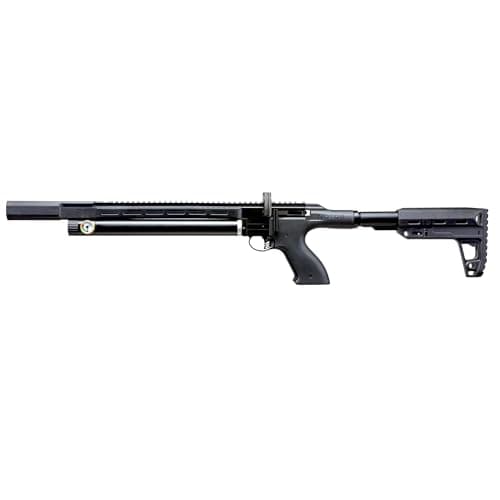
The cheapest way to buy regulated consistency in a PCP, and the regulation is real rather than marketing - independently measured at a 1.88 fps standard deviation across nine pellets. You pay for it in shot count, trigger quality and cocking effort.
- Best for
- The shooter who already owns a fill source, wants regulated shot-to-shot consistency rather than a bell curve, and is hunting small game or punching paper inside 40 yards.
- Price context
- Entry-tier PCP pricing and the least expensive regulated PCP we are aware of - but unlike the Origin it does NOT include a fill source, so budget a pump, tank or compressor on top. Check the live price below before buying.
A regulator used to be the thing that separated a cheap PCP from a serious one. It is a small pressure valve between the air reservoir and the firing valve, and its job is to hand every shot the same pressure until the tank falls below its set point — which is the difference between a velocity curve and a velocity line. Regulated rifles historically started around twice this price.
The Umarex Notos Gen 2 is a regulated .22 PCP carbine for under three hundred dollars, and the interesting part is that the regulation measures up. Hard Air Magazine's test found an average standard deviation of 1.88 fps across nine different pellets. That is not a marketing number; that is a flat line.
The site already names the Notos as the cheapest route into PCP in our air rifle brand comparison. This review is the long version of the Gen 2 — what changed, what the published specs get wrong, and what the regulator costs you everywhere else.
What the Notos Gen 2 is
The Notos Gen 2 is a short, light, regulated, side-lever .22 PCP carbine: a 13.5-inch barrel, a 118cc onboard tank filled to 3,625 PSI through a Foster quick-connect port, a 15-shot auto-indexing rotary magazine, an adjustable-length stock giving 32.75 to 35.5 inches overall, a built-in SilencAir moderator and a generous Picatinny rail. One magazine and one single-shot tray come in the box. Umarex offers a separate pistol-grip set that converts it to a pistol and a fiber-optic open sight set, both sold separately.
Umarex lists four changes from the original Notos: a redesigned cocking lever, a redesigned 15-shot magazine (the Gen 1 held seven), a longer barrel, a redesigned SilencAir device and a larger, higher-pressure onboard tank. Umarex does not publish the Gen 1 figures alongside them, so the size of the barrel and tank changes cannot be read off the page — only that they went up.
The magazine change is the one that matters most day to day. Seven shots is a magazine you are always reloading; fifteen is a magazine that lasts a squirrel hunt. Hard Air Magazine also notes that the Gen 2 magazine fits the original Notos, which is a decent thing for Umarex to have done for existing owners.
The regulator, and why it is the whole point
An unregulated PCP delivers a velocity curve. Pressure falls shot by shot, the firing valve behaves differently at each pressure, and velocity rises, peaks and then drops away. You learn where your rifle's usable window is and you refill before you leave it. That is how the Umarex Origin works, and it is how most PCPs at this price work.
A regulated PCP puts a pressure valve in the way. Every shot gets the regulator's set pressure, not the tank's current pressure, so velocity holds flat until the tank falls to the set point — at which point it falls off a cliff rather than tapering. The practical difference is that you stop thinking about where you are in the fill.
Two measured findings say the Notos Gen 2's regulator is doing its job:
| Measured by Hard Air Magazine | Figure | What it means |
|---|---|---|
| Average standard deviation across nine test pellets | 1.88 fps | Essentially a flat line. Shot-to-shot variation that small will not move a group at any distance an air rifle shoots. |
| Shootdown test - shot at which the regulator set point was reached | About shot 28 | Corroborates Umarex's published 30 regulated shots per fill, which HAM described as very close to its own result. Thirty shots is exactly two magazines. |
The published numbers that do not add up
Umarex prints three performance figures for this rifle, and they cannot all be correct. This is the second Umarex product in a row where we have had to write this paragraph — the same thing happens on the Origin, where three different .22 velocities appear on one page.
| Umarex publishes | Where | Problem |
|---|---|---|
| 820 FPS with a 15.89 gr pellet | Feature list | HAM measured 794 to 805 fps with 14.3 to 14.66 gr pellets and 705 fps with a 21.14 gr pellet. A heavier 15.89 gr pellet going faster than the lighter ones it measured is not how a PCP behaves. |
| Well over 800 FPS with an 11.9 grain pellet | Product description | This one checks out - HAM measured 831 fps with 11.9 gr RWS Hobby pellets. But it is a different pellet weight from the feature list, so the two velocity claims are not comparable. |
| 22 Joules with a 15.89 gr pellet | Feature list, beside the 820 FPS figure | Arithmetically inconsistent with the figure next to it. A 15.89 gr pellet at 820 fps is about 23.7 ft-lb, which is roughly 32 joules - not 22. Twenty-two joules with that pellet would be about 678 fps. |
Our reading: the 11.9 grain figure is the trustworthy one, because an independent chronograph confirmed it almost exactly. Treat the 15.89 gr velocity and the joule figure as unreliable. If you want a single number to plan against, use HAM's measured energy band rather than any published velocity.
That band is useful and honest: 17.2 to 26.3 ft-lbdepending on pellet, with most of the accurate pellets landing between 18 and 23 ft-lb. Against the 12 ft-lb at-the-target small-game bar we use across the site, that clears comfortably for squirrels, rabbits and raccoon-class pests inside sensible range — see our hunting air rifle guide for how that bar works by quarry. It is not a deer rifle, and nothing about it pretends to be.
Accuracy, pellet by measured pellet
This is where the Notos Gen 2 earns its score. Hard Air Magazine chronographed and accuracy-rated nine pellets, and seven of the nine came back Excellent. That is an unusually forgiving rifle — most air rifles at any price are fussy about one or two pellets and mediocre with the rest.
| Pellet | Weight | Measured velocity | Measured energy | HAM accuracy rating |
|---|---|---|---|---|
| H&N Field Target Trophy Green | 10.03 gr | 900 fps | 17.21 ft-lb | Excellent |
| Predator GTO | 11.75 gr | 851 fps | 18.90 ft-lb | Excellent |
| RWS Hobby | 11.9 gr | 831 fps | 18.25 ft-lb | Poor |
| Crosman Premier HP | 14.3 gr | 797 fps | 20.16 ft-lb | Excellent |
| JSB Jumbo Exact | 14.35 gr | 805 fps | 20.64 ft-lb | Excellent |
| H&N Field Target Trophy | 14.66 gr | 794 fps | 20.52 ft-lb | Excellent |
| NSA Hollowpoint Slugs | 20.2 gr | 692 fps | 26.25 ft-lb | Very Poor |
| H&N Baracuda Match | 21.14 gr | 705 fps | 23.31 ft-lb | Excellent |
| JSB Jumbo Monster | 25.39 gr | 640 fps | 23.11 ft-lb | Excellent - best tested |
Two things worth pulling out of that table. The best-tested pellet is the heaviest— the 25.39 grain JSB Jumbo Monster, at the lowest velocity on the page. HAM reported that seven of ten shots went through one hole at 25 yards with it, with the other three slightly off, and called it possibly the best 25-yard target the reviewer had shot. A rifle that shoots its best with a heavy pellet at 640 fps is telling you it is a precision instrument rather than a velocity contest.
And slugs are a dead end here.The NSA hollowpoints rated Very Poor, and the reviewer's conclusion was that this is probably not a slug gun. That is worth knowing before you spend money on slugs for it. Start with heavy domed lead — our pellet guide covers the weights and nose shapes worth trying.
Trigger, cocking lever and the rest of the honest list
The Notos Gen 2's weak points are all ergonomic, and there are more of them than the marketing suggests.
The triggermeasured 4 pounds 5.5 ounces as received, varying by about three ounces, and is described as rather gritty and needing conscious effort to pull through. It is adjustable, and it is explicitly not match grade. For context, the Origin's trigger measured about 2.8 pounds out of the box in Outdoor Life's test — so the cheaper, regulated rifle has the worse trigger by a wide margin.
The cocking lever is the bigger complaint. It is heavy, because the design gives it limited mechanical advantage; it is mounted on the left side and cannot be moved; it sits very close to the protruding magazine; and it has to be pushed fully home so the catch engages, or it can swing out when the rifle fires. That last one is a handling detail you want to internalize on day one rather than discover in the field.
The rest of the list, in descending order of how much it would bother us:
| Manual safety is hard to read | The safety setting is difficult to see from a distance or from the shooting position. On any air rifle the answer is the same - treat the muzzle direction as the safety and confirm the setting by feel every time. |
|---|---|
| Collapsible stock rattles | Described as somewhat rattly. It does not affect accuracy, and it does affect how expensive the rifle feels in your hands. |
| Fill-port cover is awkward | The quick-disconnect cover is tough to remove, especially in cold weather, and does not actually cover the fitting's aperture - so it is a cover that is both hard to use and not doing much. |
| Moderator is not interchangeable | The SilencAir is built in. You cannot swap it for something quieter or shorter. At this power level it is quiet enough that this is a limitation rather than a problem. |
| Hammer spring adjustment means stock removal | Tuners will find this annoying. Most owners will never touch it. |
On the positive side of handling: 6 pounds 7 ounces all-upwith scope, rings, riser and a loaded magazine is genuinely light for a scoped PCP, and the adjustable-length stock means it fits a smaller shooter and an adult. Umarex publishes pressure-gauge accuracy as plus or minus 10 percent, and HAM reported the test gun's gauge reading with commendable accuracy — a side-mounted gauge you can actually trust is a small thing that matters on a rifle you fill often.
Notos Gen 2 vs Umarex Origin
These are the two Umarex PCPs a first-time buyer is choosing between, and they are opposites. The honest framing is that one solves the air problem and the other solves the consistency problem, and you cannot have both for this money.
| Notos Gen 2 | Umarex Origin | |
|---|---|---|
| Regulated | Yes - measured 1.88 fps SD | No - velocity curve with a wide usable window |
| Fill source included | No | Yes - a 3-stage 4,500 PSI hand pump in the box |
| Shots per fill (published) | 30 regulated | 40 |
| Magazine | 15-shot, one included | 10-shot, two included |
| Trigger (measured) | 4 lb 5.5 oz, gritty | About 2.8 lb |
| Barrel / overall length | 13.5 in / 32.75-35.5 in adjustable | 23 in / 43.1 in fixed |
| Optics rail | Picatinny | Combination Picatinny and 11mm dovetail |
| Fill fitting | Foster quick-connect | Fill probe |
Buy the Notos Gen 2 if you already have air. If a pump, tank or compressor is already in the garage, the Notos gives you regulated consistency, a better fill fitting and a carbine that is eleven inches shorter, for less money. Our PCP fill guide covers what that equipment costs if you do not have it yet.
Buy the Origin if you do not.The pump in the box is worth more than the regulator to someone whose alternative is not shooting, and the Origin's longer barrel and 40-shot fill suit a bench or a blind better than a 13.5-inch carbine does.
Scoping it
The Notos Gen 2 ships with no optic and a Picatinny rail, described by Umarex as generous in length. That is the easier of the two airgun rail standards to buy for: Picatinny rings lock lugs into transverse slots rather than clamping onto a dovetail slope, so there is nothing to creep and no stop pin to worry about. Being a recoilless PCP, it also does not need glass rated for spring-piston recoil.
Two fitment notes. HAM's test rifle wore a riserin addition to rings, which is a hint that the built-in moderator and the magazine standing proud of the receiver both want some height above the rail. And if you are mounting a scope you already own on an 11mm dovetail mount, it will not fit this rifle without an adapter — the rail is Picatinny only, unlike the Origin's combination rail.
Our air rifle scope mount roundup tables the published center heights and objective clearances, and the scope roundup covers the close-focus parallax requirement that is specific to airgun optics. Then our sight-in guide walks the zeroing sequence.
Who it is for, and who should buy something else
Buy the Notos Gen 2 if you want regulated consistency on an entry budget, you already own a fill source, and your shooting is small game or paper inside about 40 yards. It is also a strong choice for a smaller shooter: 6 pounds 7 ounces scoped and an adjustable stock down to 32.75 inches is a rifle a young shooter can actually hold up.
Buy something else if one of these is you:
| You have no fill equipment | The Umarex Origin includes a 4,500 PSI hand pump, which is the single biggest practical barrier to PCP ownership. Solve the air problem first; a regulator is a refinement. |
|---|---|
| You want a high shot count | Thirty regulated shots from a 118cc tank is two magazines. A larger-reservoir PCP will triple that. If a fill session is a chore for you, the shot count matters more than the regulator. |
| You want to shoot slugs | Measured slug accuracy was Very Poor and the reviewer's verdict was that this is probably not a slug gun. Buy a rifle with a barrel twist designed for them. |
| You want a good trigger out of the box | 4 lb 5.5 oz and gritty is the weakest part of this rifle. It is adjustable, but if trigger feel is high on your list, spend elsewhere. |
| You need zero equipment chain | A multi-pump or break barrel needs nothing but pellets. Our break-barrel roundup and the Crosman 362 review cover that route. |
The verdict
The Notos Gen 2 is a genuinely interesting rifle because it moves a feature down a price class rather than adding a feature to a price class. A measured 1.88 fps standard deviation across nine pellets, a regulator set point reached at shot 28 that matches the published claim, seven of nine pellets rated Excellent, and a 25-yard target the tester called one of the best he had shot — all under three hundred dollars, in a six-and-a-half-pound scoped carbine.
What keeps it off a higher score is everything you touch. The trigger is gritty and heavy, the cocking lever is heavy and demands to be pushed fully home, the safety is hard to read, the stock rattles and the fill-port cover is a nuisance in the cold. And Umarex is again publishing figures that contradict each other on its own product page — the joule number and the velocity number beside it cannot both be right, and on this rifle the arithmetic is easy enough to check that there is no excuse for it.
We do not sell air rifles, so we have no reason to talk you up the range or to skip past the ergonomic list. If you already have air and you want flat velocity for entry money, this is the rifle. If you do not have air, buy the Origin and its pump first.
What we liked
- Genuinely regulated, and independently measured at a 1.88 fps standard deviation across nine pellets
- Accurate with almost everything - HAM rated 7 of 9 test pellets Excellent and called its 25-yard JSB Jumbo Monster target possibly the best it had shot
- A Foster quick-connect fill port instead of a fill probe, which is the right fitting and one fewer thing to lose
- 15-shot magazine, more than doubling the Gen 1's 7
- Quiet - the built-in SilencAir keeps it suburban-friendly at this power level
- Picatinny rail, adjustable-length stock, and a pistol conversion offered as a separate part
What gave us pause
- Umarex publishes three figures for this rifle that cannot all be true - see the velocity section, where the joule figure contradicts the FPS figure
- 30 regulated shots per fill is two magazines; a bigger-tank PCP goes much further
- The measured trigger is 4 lb 5.5 oz and described as gritty - adjustable, but not match grade out of the box
- The cocking lever is heavy, left-side only, and must be pushed fully home or it can swing out when fired
- No fill source included, unlike the Umarex Origin - budget a pump, tank or compressor
- Poor with slugs - the reviewer's verdict was that it is probably not a slug gun
- The collapsible stock is rattly and the fill-port cover is awkward in cold weather
- The built-in moderator cannot be swapped
Frequently asked questions
Is the Umarex Notos Gen 2 regulated?
Yes, and the regulation measures up. Umarex publishes 30 regulated shots per fill but no regulated pressure figure. Hard Air Magazine's shootdown test found the regulator set point reached at about shot 28, corroborating the claim, and measured an average standard deviation of 1.88 fps across nine test pellets - effectively a flat velocity line. That makes it the least expensive genuinely regulated PCP we are aware of.
How fast is the Umarex Notos Gen 2 in .22?
Depends entirely on pellet weight, and Umarex's own page is unreliable here. Hard Air Magazine measured 900 fps with a 10.03 gr pellet, 831 fps with 11.9 gr, 794 to 805 fps with 14.3 to 14.66 gr, and 640 fps with a 25.39 gr pellet - an energy band of 17.2 to 26.3 ft-lb. Umarex's description claims well over 800 fps with an 11.9 gr pellet, which the measured 831 fps confirms. Its feature list also claims 820 FPS with a 15.89 gr pellet and 22 joules with the same pellet, and those two figures contradict each other: 820 fps with 15.89 gr is about 23.7 ft-lb, or roughly 32 joules.
How many shots does the Notos Gen 2 get per fill?
Thirty regulated shots from the 118cc tank filled to 3,625 PSI, which is exactly two 15-shot magazines. Hard Air Magazine's shootdown test corroborated roughly that figure, reaching the regulator set point at about shot 28. Once a regulated gun drops below its set point velocity falls off rather than tapering, so plan on refilling at two magazines rather than trying to stretch it.
Does the Umarex Notos Gen 2 come with a pump?
No. Unlike the Umarex Origin, which includes a 3-stage 4,500 PSI hand pump and a fill probe, the Notos Gen 2 ships with the rifle, one 15-shot magazine and one single-shot tray. You will need a hand pump, a carbon fiber tank or a compressor. It does use a Foster quick-connect fill port rather than a fill probe, which is the better fitting and what most fill equipment terminates in.
What changed between the Notos and the Notos Gen 2?
Umarex lists five changes: a redesigned cocking lever, a redesigned 15-shot magazine (the Gen 1 held 7), a longer barrel, a redesigned SilencAir moderator, and a larger, higher-pressure onboard tank. Umarex does not publish the Gen 1 figures beside the new ones, so you can see that the barrel and tank went up but not by how much. The Gen 2 magazine is reported to fit the original Notos.
Can the Notos Gen 2 shoot slugs?
Not well. Hard Air Magazine rated NSA Hollowpoint Slugs Very Poor for accuracy at 20.2 grains and 692 fps, and the reviewer's conclusion was that the rifle is probably not a slug gun. The best-tested projectile was the opposite end of the lead spectrum - a 25.39 grain JSB Jumbo Monster domed pellet at 640 fps, which produced what the tester called possibly his best 25-yard target.
Is the Notos Gen 2 powerful enough for hunting?
For small game, yes. Hard Air Magazine's measured energy band of 17.2 to 26.3 ft-lb depending on pellet clears the 12 ft-lb at-the-target small-game bar we use across this site with margin, which covers squirrels, rabbits and raccoon-class pests at sensible range. It is not a deer or hog rifle - that is a big bore question. Check your state's rules on air rifle hunting before you go.
Sources
- Umarex USA - Notos Gen 2 PCP air rifle (2254852) published specifications: PCP, .22 caliber, 820 FPS with 15.89 gr pellet, 22 Joules with 15.89 gr pellet, description separately claiming well over 800 FPS with an 11.9 grain pellet, 15-shot standard magazine capacity, 30 regulated shots per fill (no regulated pressure published), 118cc tank with 3,625 PSI max fill, 13.5 inch / 343mm barrel, Foster quick-connect fill port, adjustable length stock, Picatinny scope rail, SilencAir noise device attached, one magazine and one single-shot tray included, convertible to a pistol with part 2254850, compatible with fiber-optic open sights part 2254851. Gen 2 changes listed as a redesigned cocking lever, redesigned 15-shot magazine, longer barrel, redesigned SilencAir and a larger, higher-pressure onboard tank
- Hard Air Magazine instrumented test review, Umarex Notos G2 .22 - measured velocities and energies for nine pellets (H&N FTT Green 10.03 gr / 900 fps / 17.21 ft-lb; Predator GTO 11.75 gr / 851 fps / 18.90; RWS Hobby 11.9 gr / 831 fps / 18.25; Crosman Premier HP 14.3 gr / 797 fps / 20.16; JSB Jumbo Exact 14.35 gr / 805 fps / 20.64; H&N FTT 14.66 gr / 794 fps / 20.52; NSA Hollowpoint Slugs 20.2 gr / 692 fps / 26.25; H&N Baracuda Match 21.14 gr / 705 fps / 23.31; JSB Jumbo Monster 25.39 gr / 640 fps / 23.11), average standard deviation 1.88 fps, regulator set point reached at about shot 28 in the shootdown test, measured trigger pull 4 lb 5.5 oz plus or minus about 3 oz as received and described as gritty, all-up weight 6 lb 7 oz with scope, rings, riser and loaded magazine, 32.75 to 35.5 in overall depending on stock setting, 12-month Umarex USA warranty, pressure gauge accuracy plus or minus 10 percent per Umarex. Criticisms: heavy left-side-only cocking lever that must be pushed fully home or it can swing out when fired and that sits close to the protruding magazine, hard-to-see manual safety, rattly collapsible stock, awkward quick-disconnect cover, non-interchangeable built-in silencer, poor slug performance, hammer spring adjustment requiring stock removal
- Sportsman's Guide and Evike listings corroborating the 118cc tank, 3,625 PSI max fill, 13.5 inch barrel, side-lever cocking, 15-shot auto-indexing rotary magazine, about 30 regulated shots per fill, 820 FPS with a 15.89 grain pellet and roughly 22 joules, and noting the Gen 2 magazine also fits the original Notos
- Energy figures labeled computed on this page use ft-lb = (velocity in fps squared x pellet weight in grains) / 450,240, and joules = ft-lb x 1.3558. The formula returns 18.25 ft-lb for Hard Air Magazine's measured 831 fps with an 11.9 gr pellet, matching HAM's published figure exactly, and 23.7 ft-lb (about 32 joules) for Umarex's published 820 fps with a 15.89 gr pellet - against the 22 joules Umarex prints beside it
- Product availability, title and stock status verified via the Amazon Creators API, 2026-11-04
- Prices, product images and stock status via the Amazon price layer, refreshed daily
Keep reading
Gearing up before your next hunt?
See how we evaluate gear, then dig into the reviews and buying guides — written without inventory to sell.