Head to Head
Backpacking Tent vs Camping Tent: You Are Buying Headroom, Not Floor Space
Run the published numbers on six tents and something odd falls out: a 2-person ultralight and an 8-person family dome give you almost exactly the same floor area per person. The thing that separates the two categories is vertical - and vertical is what weighs.
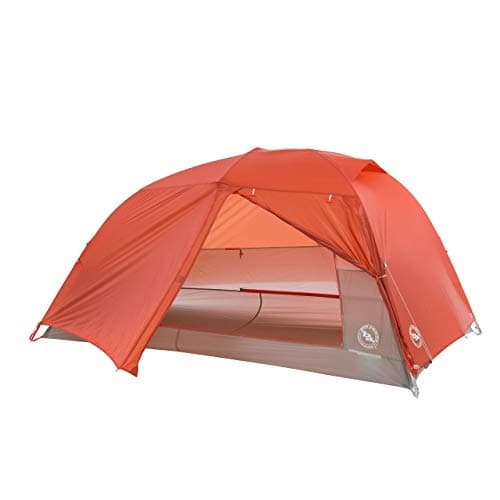
If you are only going to own one tent, buy the backpacking tent — the Big Agnes Copper Spur HV UL2 is the one we would pick. A 2 pound 11 ounce tent works perfectly well in a campground. A 6-person family dome will never, under any circumstances, work on a trail. The decision is asymmetric, and most people buy it backwards. If you know you will never carry a tent anywhere, the Coleman Skydome 6gives you 85 square feet and a 72-inch peak for a fraction of the ultralight’s price, and that is a genuinely good trade.
What almost nobody tells you is whatthe extra money and weight buys. We ran the published specs on six tents across both categories and the answer is not floor space per person — those are nearly identical. It is thirty-odd inches of height.
The number that surprised us
Divide each tent’s published floor area by its rated capacity and the two categories converge almost exactly:
| Tent | Category | Published floor area | Rated for | Floor area per person |
|---|---|---|---|---|
| Big Agnes Copper Spur HV UL2 | Backpacking | 29 sq ft | 2 | 14.5 sq ft |
| MSR Hubba Hubba LT 2 | Backpacking | About 29 sq ft | 2 | About 14.5 sq ft |
| Marmot Tungsten 2P | Backpacking | About 30 sq ft | 2 | About 15 sq ft |
| Coleman Skydome 6 | Camping | About 85 sq ft | 6 | About 14.2 sq ft |
| Marmot Limestone 6P | Camping | 83 sq ft | 6 | 13.8 sq ft |
| Coleman Skydome XL 8 | Camping | 114.5 sq ft | 8 | About 14.3 sq ft |
Every tent on that list, ultralight or family dome, allocates roughly 14 square feet per rated sleeper. That is not a coincidence — it is the footprint of an adult on a sleeping pad with a few inches to spare, and it is the same body in both categories. So when someone says a family tent is “so much roomier,” what they mean is that it is bigger, not that it gives each person more room to lie down.
What you are actually buying: 30 inches
The specs diverge in one column, and they diverge dramatically.
| Backpacking tent peak height | Roughly 40-42 inches. Copper Spur HV UL2 at 40 in, Hubba Hubba LT 2 at about 40 in, Tungsten 2P at 42 in. That is sitting-up height, and only at the single highest point. |
|---|---|
| Camping tent peak height | Roughly 72-76 inches. Coleman Skydome 6 at 72 in, Marmot Limestone 6P and Skydome XL 8 at 76 in. That is standing height for most adults. |
| What the 30-inch difference costs | Taller walls, longer poles, more fabric and far steeper geometry - which is most of the weight difference between a tent you carry in ounces and one you lift in pounds. |
That is the honest framing of this whole comparison. A backpacking tent is a place to lie down that you can carry. A camping tent is a room you can stand up and get dressed in, and you pay for the room in weight you will never carry anywhere.
Rated capacity is the same lie in both categories
Fourteen square feet per person is the industry’s arithmetic, and it assumes adults lying shoulder to shoulder in mummy bags with every bag, boot and pack stored elsewhere. It is a dimensional statement, not a comfort one. The practical correction is the same in both categories: subtract one person.
| Rated capacity | Realistic for | Why |
|---|---|---|
| 2-person backpacking | Two adults who are comfortable with each other, or one adult with gear inside | 29 sq ft is two pads touching. Vestibules exist because packs do not fit |
| 4-person camping | Two adults plus gear, or two adults and a small child | Air mattresses are wider than sleeping pads and eat the margin immediately |
| 6-person camping | Four people with room for duffels and a dog | The usable version of a family tent - this is the size most families should buy |
| 8-person camping | Six people, or four with cots | Cots are the real capacity killer: they have a footprint and you cannot overlap them |
If your sleep system is an air mattress or a cot rather than a sleeping pad, the correction is bigger than one person. A queen air mattress is wider than two sleeping pads and taller than the slope of most tent walls, which means it has to sit in the middle of the floor and it wastes the edges.
Six tents, side by side
| Tent | Category | Weight | Floor | Peak | Best for |
|---|---|---|---|---|---|
| Big Agnes Copper Spur HV UL2 | Backpacking | About 2 lb 11 oz packed | 29 sq ft | 40 in | Carrying it - the reference ultralight freestanding tent |
| MSR Hubba Hubba LT 2 | Backpacking | About 3 lb 6 oz | About 29 sq ft | About 40 in | Carrying it for years - same livability, tougher |
| Marmot Tungsten 2P | Backpacking | About 5 lb with footprint | About 30 sq ft | 42 in | Spending less and still being able to carry it |
| Coleman Skydome 6 | Camping | Not sold on weight | About 85 sq ft | 72 in | Best value in a stand-up family tent |
| Marmot Limestone 6P | Camping | Not sold on weight | 83 sq ft | 76 in | Campgrounds that get real weather |
| Coleman Skydome XL 8 | Camping | Not sold on weight | 114.5 sq ft | 76 in | Big families, groups and cots |
All figures are the manufacturers’ published specifications, not our measurements. Weights for backpacking tents are packed weights as published and generally include stakes and guylines; trail weight, which omits the stuff sack and some extras, is always lower and is the number the marketing prefers.
The other real differences
| Fabric denier and durability | Ultralight floors and flies use very thin fabric to save weight, so they need a footprint and care about where you pitch. A family tent uses heavier fabric that shrugs off a gravel campground pad. |
|---|---|
| Setup time and complexity | Both categories have gotten fast, but family tents with hub systems are the quickest of all - some go up in a couple of minutes by one person. Ultralight tents are fast once learned and fussier in wind. |
| Wind performance | Backpacking tents win, and it is not close. Low, steep, taut geometry handles wind far better than a tall, flat-walled room. A 76-inch peak is a sail. |
| Vestibules vs. floor space | Backpacking tents put gear storage outside under the fly because interior space is rationed. Family tents just have extra floor, which is simpler and much heavier. |
| Price per square foot | Camping tents are dramatically cheaper by area. The premium on an ultralight is paid almost entirely for the weight it does not have, not the space it does. |
| Cost of being wrong | A carried tent that is too heavy ruins a trip in progress. A campground tent that is too small is an annoyance you drive home from. |
Which one should you buy
| If this is you | Buy | The reasoning |
|---|---|---|
| You will walk more than a few hundred yards from the car, ever | Backpacking tent | Weight is the only tent spec that cannot be worked around once you are on the trail |
| You car camp with a family and nothing else | Camping tent, 6-person | Standing height and 85 square feet for a fraction of the money, and weight costs you nothing |
| You are buying one tent and are not sure | Backpacking tent | It does both jobs adequately. The reverse is not true at any price |
| You hunt from a spike camp or a truck camp | Either, sized up one | Wet gear, boots and a pack need floor area that the rated capacity does not allow for |
| You already own one and want the other | Buy the camping tent second | The upgrade from adequate to comfortable is cheapest on the car-camping side |
Best backpacking: Big Agnes Copper Spur HV UL2
The Copper Spur HV UL2 has been the reference ultralight freestanding tent for years, and the specs explain why: a published 2 pounds 11 ounces packed with 29 square feet of floor and a 40-inch peak. The high-volume pole architecture is what makes 40 inches feel like sitting-up room rather than a single point of clearance, and it is fully freestanding, which matters when the ground is rock or sand.
Honest cons: the price is near the top of the category, and ultralight fabrics want a footprint and some attention to where you pitch them. Two adults in 29 square feet is close quarters, and the vestibules exist because the packs are not coming inside.
Backpacking workhorse: MSR Hubba Hubba LT 2
At about 3 pounds 6 ounces with roughly the same 29 square feet and 40-inch peak, the Hubba Hubba LT 2 trades about eleven ounces to the Copper Spur for a build that takes more seasons of abuse. If you backpack a lot rather than occasionally, that is frequently the better purchase — eleven ounces is a water bottle; replacing a tent is not.
Honest cons: it is heavier than the ultralight benchmark and not meaningfully cheaper. If you count grams, this is not your tent.
The honest middle: Marmot Tungsten 2P
The Tungsten 2P is the tent for someone who wants a carryable tent without ultralight pricing: roughly 30 square feet, a 42-inch peak— the tallest backpacking peak on this page — and about 5 pounds with the included footprint. Five pounds is a real penalty on a long trip and a complete non-issue on a weekend, which is most people’s actual usage.
Honest cons: nearly twice the Copper Spur’s weight, and the included footprint is part of why. This is the compromise pick, and it is honest about being one.
Best camping value: Coleman Skydome 6
About 85 square feet and a 72-inch peak for a small fraction of what an ultralight two-person tent costs. If you genuinely never carry a tent, this is where the money goes furthest in the entire tent market: a family can stand up, change clothes and wait out an afternoon of rain in it, and a Skydome goes up fast enough that arriving at a campground after dark is not a crisis.
Honest cons: 72 inches of flat wall is a sail in wind, the fabric and poles are built to a price, and “6-person” means four people plus the gear four people bring. Our camping tent guide covers the storm-worthy tier above this one.
Best camping in weather: Marmot Limestone 6P
83 square feet, a 76-inch peak, and the build quality that separates a tent you keep from a tent you replace. The case for spending up on a family tent is not extra space — the Limestone has slightly lessfloor than the Skydome — it is poles, fabric and seams that hold up when the campground gets a real storm instead of a shower.
Honest cons: considerably more expensive than the Skydome for about the same floor area, and the 76-inch height is just as much of a sail. For fair-weather camping the value case is weak.
If the group is larger, the Coleman Skydome XL 8 at 114.5 square feet and the same 76-inch peak is the volume option, and it is the one to look at if anyone is sleeping on a cot.
The bottom line
Both categories give you about fourteen square feet per rated person, so stop comparing them on room. You are choosing between 40 inches of peak height you can carry and 76 inches you cannot. If there is any chance you will walk somewhere with it, the choice is made for you — the Copper Spur HV UL2 is the one to own. If the tent lives in a trunk and comes out in a campground, the Skydome 6 is more tent than an ultralight will ever be, for less money.
Then spend the next decision on what you sleep on rather than what you sleep under: a tent cannot fix a cold night, and pad R-value and bag temperature rating are what actually decide whether you sleep. Our synthetic vs down comparison and sleeping pad guide cover that half, and the camping checklist covers everything else.
Frequently asked questions
What is the difference between a backpacking tent and a camping tent?
Height and weight, not floor space per person. Run the published numbers and both categories give you about 14 square feet per rated sleeper - 14.5 for the Big Agnes Copper Spur HV UL2, about 14.2 for a Coleman Skydome 6. What differs is peak height: roughly 40 to 42 inches for backpacking tents against 72 to 76 inches for family tents. The taller walls, longer poles and extra fabric are most of the weight difference.
Can you use a camping tent for backpacking?
No, in any practical sense. A 6-person family dome is measured in pounds you lift rather than ounces you carry, and a 76-inch peak is a sail in the wind you actually meet away from a campground. The reverse works fine: a 2 pound 11 ounce backpacking tent is a perfectly good campground tent, just a smaller and more expensive one per square foot.
If I can only buy one tent, which should it be?
The backpacking tent. The decision is asymmetric - a light tent does the car-camping job adequately, while a family tent cannot do the trail job at all. The only reason to buy the camping tent first is certainty that you will never carry a tent anywhere, in which case the extra floor area and standing height are an excellent use of the money.
How many people does a tent really sleep?
Subtract one from the rating, and more than one if anyone is on a cot or an air mattress. The rated capacity is a dimensional statement - adults lying shoulder to shoulder in mummy bags with all gear stored elsewhere - rather than a comfort one. A 6-person camping tent is a good four-person tent with room for duffels; a 2-person backpacking tent is roomy for one person with gear inside.
Why are backpacking tents so expensive for how small they are?
Because you are paying for the weight the tent does not have, not the space it does. Camping tents are far cheaper per square foot and always will be. Thin high-denier-ratio fabrics, precision pole architecture that makes a 40-inch peak feel usable, and the engineering to hold shape in wind at under three pounds are what the premium buys.
Which handles wind better, a backpacking tent or a camping tent?
The backpacking tent, by a wide margin. Low, steep, taut geometry sheds wind; a 72 to 76 inch tall tent with relatively flat walls catches it. That is one of the few performance areas where the expensive small tent is outright better rather than just lighter, and it is worth remembering when a campground forecast turns.
What size tent do I need for a family of four?
A 6-person camping tent, if you are car camping. At about 85 square feet it gives four people their 14 square feet each plus genuine room for duffel bags, boots and a dog, and a 72-inch peak means adults can stand up to get dressed. A 4-person tent rates out at four people but in practice holds two adults plus gear, or two adults and a small child.
Sources
- Big Agnes Copper Spur HV UL2 published specifications - about 2 lb 11 oz packed, 29 sq ft floor, 40 in peak height, freestanding high-volume pole architecture
- MSR Hubba Hubba LT 2 published specifications - about 3 lb 6 oz, about 29 sq ft floor, about 40 in peak height
- Marmot Tungsten 2P published specifications - about 30 sq ft floor, 42 in peak height, about 5 lb including footprint; Marmot Limestone 6P - 83 sq ft floor, 76 in peak height
- Coleman Skydome 6 published specifications - about 85 sq ft floor, 72 in peak height; Skydome XL 8 - 114.5 sq ft floor, 76 in peak height
- Floor area per person figures are our arithmetic from the published floor areas and rated capacities above, not manufacturer claims
- Prices, product images and stock status via the Amazon price layer, refreshed daily
Keep reading
Gearing up before your next hunt?
See how we evaluate gear, then dig into the reviews and buying guides — written without inventory to sell.