Buying Guide
Best Hunting Boots Under $200
Under $200 is a real hunting boot band, but it is a narrower one than it looks: it is almost entirely insulated leather and rubber built for sitting still in the cold. Here is what that buys, what it cannot cover, and which boot to pick for the hunt you actually do.
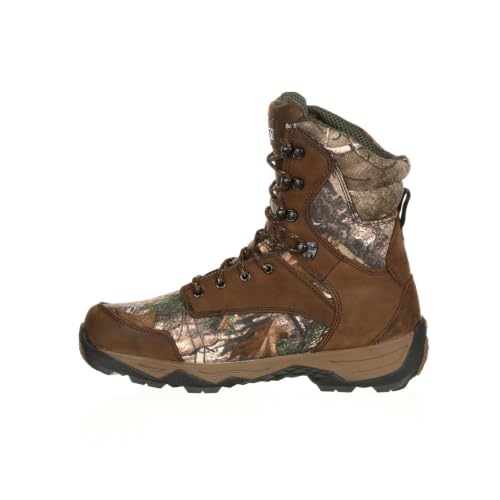
The verdict: the best hunting boot under $200 is the Rocky Retraction 800G — a waterproof leather lace-up with 800g of insulation, which is exactly what the band is built around and exactly what most people buying at this price are doing: sitting still in the cold. The budget pick is the Rocky Core 800G, the same insulation weight and waterproof construction for less. If your ground is wet, buy a rubber boot instead — the Muck Woody Max— and if you hunt early season in the South, the Rocky Lynx snake boot is the only pick here that addresses the actual hazard.
And here is the framing that makes this band worth its own page rather than a cheaper slice of our full hunting boot guide: under $200 is not a general-purpose hunting boot band — it is a cold-sit band. Four of the five boots here carry 800g of insulation. That is not a coincidence or our selection bias; it is what the price point is built to sell, and it has a specific consequence for early-season and mountain hunters that we lay out below before any pick.
The best hunting boots under $200 at a glance
| Boot | Price & buy | Type | Insulation | Waterproof | Best for |
|---|---|---|---|---|---|
| Rocky Retraction 800G | $109.99Buy | Leather lace-up | 800g | Yes - published waterproof | Best overall |
| Rocky Core 800G | $90.37Buy | Leather lace-up | 800g | Yes - published waterproof | Budget pick |
| Muck Woody Max | $138.75Buy | Rubber pull-on | Fleece lining + thermal foam (see below) | Yes - rubber | Wet ground, mud, scent control |
| Rocky Lynx Snake Boot | $164.95Buy | Snake boot | Not published - uninsulated class | Yes - published waterproof | Snake country, early season |
| Northside Renegade 800 | $110.00Buy | Leather lace-up | 800g Thinsulate | Yes - published waterproof | Alternative fit |
Prices shown are from Amazon as of November 11, 2026 and change often — the button always goes to the current listing. Some links may earn us a commission at no extra cost to you.
Everything on this page had a live, buyable price under $200 when we built it, in a real men’s size. That matters more in boots than in any other category we cover, because boot listings are per size and per color — the same model can sit on both sides of a price line depending on which size is in stock, so check the live price on the button for your size rather than trusting any number typed into an article.
What $200 buys - and what it does not
The good news is substantial. Under $200 you can buy a genuinely waterproof boot with real insulation, a lugged rubber outsole and a camo or brown leather upper, from a maker that has been building hunting boots for decades. For whitetail hunting from a stand or a blind, for a wet morning in a duck marsh, or for walking a property line in November, that boot will do the job and keep doing it for several seasons.
Here is the honest list of what the band does not buy:
- A mountain boot.The stiff-shanked, supportive boots built for carrying weight across steep ground start far above this band — the Kenetrek and Schnees models in our mountain hunting boot guide are priced in the $500 range, not the $200 range. If you are hunting elk in the high country, nothing on this page is the right boot and we are not going to pretend otherwise.
- A lightweight uninsulated boot for early season.This is the band’s sharpest limitation. The uninsulated and lightly-insulated hunting boots built for walking in warm weather — Danner’s Sharptail line, Irish Setter’s VaprTrek line, Danner’s Pronghorn — sit above $200 in the sizes and colors we can find in stock. Below the line you are buying insulation whether you want it or not.
- A rebuildable boot. Nothing here is sold with a resoleable welted construction. These are cemented-sole boots: when the outsole goes, the boot goes. Plan on replacing them, not rebuilding them.
- A named membrane with its own warranty.Every boot here is published as waterproof, and none of them names a licensed third-party membrane on its listing. Each maker uses its own construction. That is not necessarily worse — but it means the waterproof claim is the brand’s, with no second company standing behind it.
The 800g trap: the band's defining limit
Look at the table again. The Retraction, the Core and the Renegade are all 800g. That is the number this price band sells, and it is worth understanding what 800 grams actually means before you buy, because it is the most commonly over-bought spec in hunting footwear.
Insulation weight is grams of insulation per square meter of material — a measure of how much is in the boot, not a temperature rating. There is no standardized temperature scale for boot insulation, so one maker’s 800g and another’s are not directly comparable, and neither is a promise. What is reliable is the relationship between insulation and activity:
| Sitting still, cold weather | 800g is the right call. Blood flow drops when you stop moving, and a boot that was comfortable on the walk in will be cold by the second hour on stand. This is the hunt the sub-$200 band is built for. |
|---|---|
| Walking, cool weather | 800g is too much. A foot that sweats inside an insulated boot gets cold faster than a dry foot in a thinner one, because wet insulation does not insulate. This is the scenario where the band's uniformity hurts you. |
| Early season, warm weather | No insulation at all is the answer, and this band largely does not offer it. The one pick here that is not an insulated leather boot is the Rocky Lynx snake boot, which is why it earns a place. |
| Deep cold, long sits | Above 800g - 1,000g and up - is a different band again, and so is a pac boot with a removable liner. Our hunting boot insulation guide walks the whole scale. |
How to choose: leather, rubber or snake boot
| Leather lace-up | The default, and the right default. Lacing lets you adjust fit and ankle support, leather breaks in to your foot, and the insulated versions are what this band does best. Buy this unless you have a specific reason not to. Downside: leather absorbs scent and takes a long time to dry if it floods over the top. |
|---|---|
| Rubber pull-on | Buy this if your ground is wet, muddy or flooded, or if scent control is a priority - rubber holds and sheds far less scent than leather and hoses clean in seconds. Downside: a pull-on cannot be adjusted for fit, so it either fits or it does not, and rubber offers less ankle support on uneven ground. |
| Snake boot | A specialty answer to a specific hazard: a tall, bite-resistant upper for the South and the Southwest in warm weather. Downside: the protective upper is heavy and hot relative to its insulation, and you are paying for protection you do not need outside snake country. |
A fourth category exists and this band does not reach it: the knee-high insulated rubber boot with a neoprene core, which is the standard for a flooded timber or marsh hunt. The models we have verified in that class sit above $200 today, and we cover them in our waders guide and the full boot guide rather than stretching this page over its own price line.
Best overall: Rocky Retraction 800G
Best for:stand and blind hunting in genuine cold — the hunt most people in this band are buying for.
This is the boot to buy. Rocky publishes it as a waterproof, 800g insulated outdoor boot in Realtree Xtra, and it does the core job of a sub-$200 hunting boot without asking you to compromise on either of the two specs that matter at this price: it is actually waterproof and it has enough insulation for a long sit.
The quieter argument for it is the catalog behind it. Rocky runs the deepest line in this price band — the Core sits below it and the Lynxbeside it — so if the Retraction’s last does not suit your foot, the next thing to try is a sibling model built around a related fit rather than a completely different brand’s shape. In a category where fit is everything and you are buying online, that is worth real money.
Honest cons:800g is too warm for walking hunts in mild weather, which is the band-wide limitation and not specific to this boot. Rocky does not name a third-party membrane, publish a boot weight, or publish a shaft height on this listing, so you are buying on the brand’s word for waterproofing and cannot compare weight against anything. It is a cemented sole, so it is not rebuildable. And camo listings are sold per size and color — the price in your size may not match the price in ours.
Budget pick: Rocky Core 800G
Best for: the cheapest honest way into a waterproof insulated hunting boot.
The Core is the least expensive boot on this page and it gives up less than the price gap suggests. Rocky publishes it as a waterproof 800g insulated outdoor bootin brown and Mossy Oak Break-Up Infinity — the same two headline specs as the Retraction above it, at a lower price.
This is the boot we would recommend to someone buying their first pair of dedicated hunting boots, or to someone who needs a second pair to keep in the truck. Spending the minimum on a boot that is genuinely waterproof and genuinely insulated is a better outcome than spending more on features you cannot evaluate from a listing.
Honest cons:it is the plainest boot here — Rocky publishes no outsole name, no shaft height, no weight and no membrane name, which is less disclosure than the Northside gives at a similar price. It carries the same 800g limitation as the rest of the band. And being the cheapest boot in a band is a reason to be careful with sizing, because a boot that does not fit is not a bargain at any price.
Best rubber boot: Muck Woody Max
Best for: wet ground, mud, and anyone who takes scent control seriously.
If your hunt involves standing water, a muddy walk-in or a creek crossing, a rubber pull-on beats a leather lace-up and it is not close. The Woody Max is Muck’s hunting boot and the one we would buy in this band, here in Realtree Edge.
Muck’s listing for the same Woody Max boot in Mossy Oak Break-Up Country publishes the line’s construction: a warm fleece lining, a comfort topline, 2 mm thermal foam and an EVA midsole. We are citing the sibling listing because the Realtree Edge listing we link publishes no specification at all beyond the model and the pattern — worth knowing before you order, and worth saying rather than quietly borrowing the specs.
The scent argument is the one most people underrate. Rubber absorbs and releases far less odor than leather and can be hosed off at the truck, which is why rubber boots are standard among whitetail hunters who walk to a stand through the area they intend to hunt. Our scent control guide covers where footwear fits in the wider system.
Honest cons: a pull-on cannot be adjusted, so fit is pass or fail and heel slip is the common complaint across the whole rubber-boot category. Thermal foam plus a fleece lining is a mid-weight warmth package, not an 800g-equivalent one, so for a long sit in real cold the leather picks have more insulation. Rubber gives less ankle support on sidehills than a laced boot. And it costs more than either Rocky.
Best for snake country: Rocky Lynx Snake Boot
Best for: early-season hunting in the South and Southwest, where the hazard underfoot is not the weather.
The Lynx is the one pick on this page that is not built around insulation, and it earns its place for that reason as much as for the snake protection. Rocky publishes it as a waterproof snake hunting bootin Mossy Oak — a tall, bite-resistant upper over a waterproof boot.
If you hunt September whitetails in Georgia, turkeys in Texas, or hogs anywhere warm, this is the boot on this page that fits the conditions. It is also, incidentally, the only pick here you would want to wear on a warm-weather walking hunt, because it is the only one not carrying 800 grams of insulation.
Honest cons:Rocky publishes no insulation figure, no shaft height and no boot weight on this listing, which is thin disclosure for the most specialized boot on the page — and shaft height is the spec that matters most on a snake boot. The protective upper makes it heavy and warm relative to its insulation, so it is not a cold-weather boot despite the bulk. It is the second most expensive pick here. And outside snake country you are paying for protection you will not use — buy the Retraction instead.
The alternative lace-up: Northside Renegade 800
Best for: the same job as the Rockys, when the Rockys do not fit your foot.
The Renegade is the most specific listing on this page, which is worth something. Northside publishes waterproof leather, 800g Thinsulate — a named insulation rather than a generic gram figure — a rubber traction outsole, a quick lace-up system and Daybreak camo. That is more disclosure than either Rocky gives at a comparable price.
We rank it below the Rockys anyway, for one reason: Rocky has been building hunting boots far longer and runs a deeper line in this band, which matters when a boot does not fit and you need a sibling model rather than a refund. But if you have tried Rocky’s last and it is wrong for your foot, this is where to go next, and the named Thinsulate fill is a genuine point in its favor.
Honest cons:Northside is a smaller name with a shorter hunting-boot track record than Rocky or Muck, and in boots that reputation gap is a real consideration rather than snobbery — it determines whether the model is still made in two seasons. No boot weight or shaft height is published. It carries the same 800g limitation as the rest of the leather picks. And a quick-lace system is faster but gives up some of the fine-grained tension control that makes a conventional lace-up fit an awkward foot.
Fit is the spec, and it is the one nobody publishes
Every boot on this page is published as waterproof and most are published at 800g. Not one of them publishes a last width, a volume, a shaft height or a weight. That is the real state of disclosure in this band, and it means the decision you cannot make from a listing is the one that determines whether you are happy. Four things that help:
- Size with your hunting sock on.A heavy wool sock takes up measurable volume. Sizing a boot in a dress sock and then adding a hunting sock is the most common way a correctly-sized boot ends up too tight — and a tight boot is a cold boot, because it restricts circulation. Our hunting sock guide covers the pairing.
- If you have wide feet, start from the width, not the model. Width options are thinner at this price than above it. Our guide to hunting boots for wide feet is built around that specific problem.
- Do not fix fit with an insole without reading up first. An aftermarket insole makes a boot smaller, and in an insulated boot the lost volume can make your feet colder rather than warmer. Our boot insole guide covers when it helps and when it backfires.
- Break them in before the season, not during it. Leather boots at this price need miles before they stop being hostile. Our guide to breaking in hunting boots has the schedule.
The bottom line
Buy the Rocky Retraction 800G if you sit still in the cold, which is what this price band is built for. Buy the Rocky Core 800G if you want the same two specs that matter for less. Buy the Muck Woody Max if the ground is wet or scent is your priority, the Rocky Lynx if you hunt snake country, and the Northside Renegade 800if Rocky’s last is wrong for your foot.
Be honest with yourself about the band’s ceiling, though. If you are hunting steep country with weight on your back, or walking all day in September heat, this page does not have your boot and we would rather say so than sell you one. The mountain boots in our mountain hunting boot guide and the lighter uninsulated models in the full boot guide are above this price for reasons you will feel on the second mile.
Frequently asked questions
What is the best hunting boot under $200?
The Rocky Retraction 800G. Rocky publishes it as a waterproof, 800g insulated leather boot, which is exactly what this price band is built to do well and exactly what most people buying at this price need: a boot for sitting still in the cold in a stand or a blind. Rocky also runs the deepest line in the band, so if the fit is wrong there is a sibling model to try rather than a different brand's shape entirely. The Rocky Core 800G is the budget pick with the same two headline specs for less.
Is 800g insulation too much for a hunting boot?
It depends entirely on whether you are moving. For sitting still in cold weather - stand hunting, a blind, a long watch - 800g is right, because blood flow drops when you stop and a boot that felt fine on the walk in gets cold by the second hour. For walking hunts in cool weather it is too much: a foot that sweats inside an insulated boot ends up colder than a dry foot in a thinner one, because wet insulation does not insulate. Insulation weight is grams per square meter, not a temperature rating, and there is no standard scale, so treat it as a measure of how much is in the boot rather than a promise about degrees.
Can you get a good uninsulated hunting boot under $200?
Mostly no, and that is the sharpest limit of this price band. The lightweight uninsulated hunting boots built for warm-weather walking - Danner's Sharptail and Pronghorn lines, Irish Setter's VaprTrek line - sit above $200 in the sizes and colors we can verify in stock. The one exception on this page is the Rocky Lynx snake boot, which is not built around insulation, though it is heavy for its warmth because of the protective upper. If you only hunt early season, either spend above this band or wear a non-hunting hiker you already trust.
Rubber or leather hunting boots?
Leather lace-ups are the better default: lacing lets you tune the fit and ankle support, leather breaks in to your foot, and the insulated versions are what this band does best. Buy rubber instead when your ground is wet, muddy or flooded, or when scent control matters - rubber holds and sheds far less odor than leather and hoses clean at the truck, which is why it is standard among whitetail hunters walking to a stand through the ground they intend to hunt. The trade is that a pull-on cannot be adjusted for fit and gives less ankle support on uneven ground.
Are $200 hunting boots good enough for elk hunting?
No, and we would rather say so. Mountain hunting asks for a stiff shank and the support to carry weight across steep, broken ground, and the boots built for that - the Kenetrek and Schnees models in our mountain hunting boot guide - are priced around $500 rather than $200. A sub-$200 boot on a steep pack-out is where people roll ankles and lose toenails. If your hunt is flat-to-rolling whitetail country, this page is the right page; if it is the high country, it is not.
Why do hunting boot prices change between sizes?
Because hunting boots are listed per size and per color rather than as a single product. Stock on a given size and camo pattern moves independently, so the same model can show one price in a size 10 and another in a size 12, and can sit on either side of a $200 line depending on the day. That is why every price on this page is a live figure pulled from the retailer rather than a number typed into the article - always check the price in your own size on the buy button before you decide.
Sources
- Rocky Retraction Waterproof 800G Insulated Outdoor Boot - published listing specification
- Rocky Core Waterproof 800G Insulated Outdoor Boot - published listing specification
- MUCK Men's Woody Max, Realtree Edge - published listing
- MUCK Men's Woody Max, Mossy Oak Break-Up Country - published listing specification for the same model (fleece lining, comfort topline, 2 mm thermal foam, EVA midsole)
- Rocky Men's Lynx Waterproof Snake Hunting Boot - published listing
- Northside Men's Renegade Hunting Boots - published listing specification (waterproof leather, 800g Thinsulate, rubber traction outsole, quick lace-up)
- Danner Pronghorn - published listing, cited as the price tier above this band
Keep reading
Gearing up before your next hunt?
See how we evaluate gear, then dig into the reviews and buying guides — written without inventory to sell.